Showing posts with label OSHA. Show all posts

Wednesday, March 25, 2026

Witnessing Piles of Dead Women on a New York Street


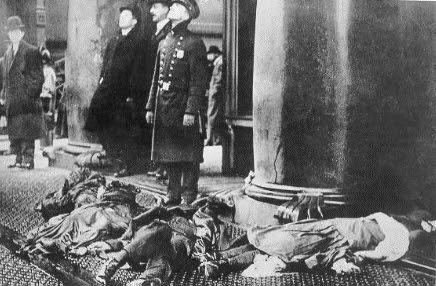
Police and bystanders watch helplessly as more victims jump to their deaths to escape the flames of the Triangle Shirtwaist Factory on the upper floors of the Asch Building.

It was a sunny but raw day in New York City, a late Saturday afternoon and the streets near Washington Square in the immigrant Greenwich Village neighborhood were teaming with traffic. Around 4:45, as the many garment industry sweatshops were preparing for their “early” Saturday closing, pedestrians began to notice smoke billowing from the upper floors of the Asch Building, at 29 Washington Place. Crowds gathered to watch as horse drawn fire engines and ladder trucks pounded to the scene. Soon witnesses watched in horror as one after another young women leapt from the burning building to sure death on the pavement below—the Fire Departments ladders were too short to reach the windows from which they jumped. It was March 25, 1911. The top three floors of the building, housing the Triangle Shirtwaist Factory had turned into a roaring inferno. 

The Fire Department responded quickly but did not have ladders tall enough to reach the top three floors which were on fire and fire fighters could not get up stairways choked with the bodies of those trying to escape.  They could only use their most powerful pumpers to spay water from the outside.

About 500 workers were getting ready to leave when the fire started smoldering in the scrap bin under a cutting table, probably ignited by a carelessly discarded cigarette or cigar. When it was over 146 of them, mostly young Italian and Jewish women, perished. Many were piled against locked exit doors and died of asphyxiation. Sixty-two victims leaped to their death on the sidewalk or were killed when the sole fire escape collapsed. Others jumped down elevator shafts after the elevators, which managed to rescue several, stopped working when the fire’s heat twisted the rails on which they ran. At least 71 others were reported injured, although many more were probably tended at home, unable to afford medical care. 

It was not the first fire in such a factory. In fact, authorities had reported an epidemic of fires at shirtwaist factories. This was one, however, was made worse because of overcrowding on the shop floors, failure to clear flammable material—scrap bins had not been emptied in two months—and because stairways and exits were either blocked by bales of material or padlocked to prevent employee pilferage. 

The factory occupied floors 8, 9, and 10 of the building, all beyond the reach of ladders which could only reach the sixth floor at full extension. There was no alarm system and on the most crowded production floor, the 9th, the first warning was literally when flames erupted. By that time most office personnel, including the owners and their visiting children had already been able to evacuate from the higher floor to the safety of the roof. 

There had, of course, been awful industrial accidents and fires before. Mine collapses were commonplace. Many were killed in boiler explosions on steamships and riverboats, others died in railroad accidents. Fires had devastated lint-filled textile plants. But never had such a calamity played out so publicly on the streets of the nation’s premier city with the press—including photographers—on hand to record the horror. The fact that most of the victims were young women, girls in their teens mostly, added to the impact. Grimy men were expected to be expendable, girls were not. 

 The sewing floor of a typical shirtwaist factory and the young women who worked there.

Lurid headlines and gruesome photos spread across the country. Both the city and state governments launched investigations, which would lead eventually to the establishment of the nation’s strongest industrial workplace safety and labor laws in New York state. It spurred the growth of the International Ladies Garment Workers’ Union (ILGWU) and other needle trade unions which made safety a key issue.   Many years later the Federal government added its weight to worker safety with the establishment of the Occupational Health and Safety Administration (OSHA) under the Department of Labor

The labor movement commemorates the anniversary, but the hard-fought gains paid for by those dead shop girls are under attack from coast-to-coast. Under the guise of cost cutting, deregulation, and as a frank assault on the working class on behalf of an oligarchy, Trump and Musks DOGE dudes  attempted to slash jobs at the agency and across the Department of Labor and OSHA itself is on the chopping block while blocking in every possible way the rights of workers to defend themselves through unions or by suing for damages in the courts. The old battles have to be refought. Hopefully it will not take another tragedy of epic proportion to re-prick the public conscience. 

Protests like this large parade featuring a contingent of Jewish women workers from the United Hebrew Trades demanded enactment of factory safety laws and organized shops into powerful unions.

In 2012, after years of painstaking research, the last 10 victims of the fire were finally identified. Today the Asch Building, now known as the Brown Building, still stands. It is a designated landmark, as much, we are told, for its architectural significance as the site of a tragedy.

Thursday, March 27, 2025

Weeping for the Piles of Dead Women on a New York Street

Police and bystanders watch helplessly as more victims jump to their deaths to escape the flames of the Triangle Shirtwaist Factory on the upper floors of the Asch Building.

It was a sunny but raw day in New York City, a late Saturday afternoon and the streets near Washington Square in the immigrant Greenwich Village neighborhood were teaming with traffic. Around 4:45, as the many garment industry sweatshops were preparing for their “early” Saturday closing, pedestrians began to notice smoke billowing from the upper floors of the Asch Building, at 29 Washington Place. Crowds gathered to watch as horse drawn fire engines and ladder trucks pounded to the scene. Soon witnesses watched in horror as one after another young women leapt from the burning building to sure death on the pavement below—the Fire Departments ladders were too short to reach the windows from which they jumped. It was March 25, 1911. The top three floors of the building, housing the Triangle Shirtwaist Factory had turned into a roaring inferno. 

The Fire Department responded quickly but did not have ladders tall enough to reach the top three floors which were on fire and fire fighters could not get up stairways choked with the bodies of those trying to escape.  They could only use their most powerful pumpers to spay water from the outside.

About 500 workers were getting ready to leave when the fire started smoldering in the scrap bin under a cutting table, probably ignited by a carelessly discarded cigarette or cigar. Before it was over 146 of them, mostly young Italian and Jewish women, would perish. Many would be piled against locked exit doors to die of asphyxiation. Sixty-two victims leaped to their death on the sidewalk or were killed when the sole fire escape collapsed. Others jumped down elevator shafts after the elevators, which managed to rescue several, stopped working when the fire’s heat twisted the rails on which they ran. At least 71 others were reported injured, although many more were probably tended at home, unable to afford medical care. 

It was not the first fire in such a factory. In fact, authorities had reported an epidemic of fires at shirtwaist factories. This was one, however, was made worse because of overcrowding on the shop floors, failure to clear flammable material—scrap bins had not been emptied in two months—and because stairways and exits were either blocked by bales of material or padlocked to prevent employee pilferage. 

The factory occupied floors 8, 9, and 10  of the building, all beyond the reach of ladders which could only reach the sixth floor at full extension. There was no alarm system and on the most crowded production floor, the 9th, the first warning was literally when flames erupted. By that time most office personnel, including the owners and their visiting children had already been able to evacuate from the higher floor to the safety of the roof. 

There had, of course, been awful industrial accidents and fires before. Mine collapses were commonplace. Many were killed in boiler explosions on steamships and riverboats, others died in railroad accidents. Fires had devastated lint-filled textile plants. But never had such a calamity played out so publicly on the streets of the nation’s premier city with the press—including photographers—on hand to record the horror. The fact that most of the victims were young women, girls in their teens mostly, added to the impact. Grimy men were expected to be expendable, girls were not. 


 The sewing floor of a typical shirtwaist factory and the young women who worked there.

Lurid headlines and gruesome photos spread across the country. Both the city and state governments launched investigations, which would lead eventually to the establishment of the nation’s strongest industrial workplace safety and labor laws in New York state. It spurred the growth of the International Ladies Garment Workers’ Union (ILGWU) and other needle trade unions which made safety a key issue.   Many years later the Federal government added its weight to worker safety with the establishment of the Occupational Health and Safety Administration (OSHA) under the Department of Labor

The labor movement commemorates the anniversary, but the hard fought gains paid for by those dead shop girls are under attack from coast-to-coast. Under the guise of cost cutting, deregulation, and as a frank assault on the working class on behalf of an oligarchy, Trump and Musks DOGE dudes have attempted to slash jobs at the agency and across the Department of Labor and OSHA itself is on the chopping block while blocking in every possible way the rights of workers to defend themselves through unions or by suing for damages in the courts. The old battles have to be refought. Hopefully it will not take another tragedy of epic proportion to re-prick the public conscience. 

Protests like this large parade featuring a contingent of Jewish women workers from the United Hebrew Trades demanded enactment of factory safety laws and organized shops into powerful unions.

In 2012, after years of painstaking research, the last 10 victims of the fire were finally identified. Today the Asch Building, now known as the Brown Building, still stands. It is a designated landmark, as much, we are told, for its architectural significance as the site of a tragedy.

Saturday, March 25, 2023

There Were Piles of Dead Women on a New York Street

Police and bystanders watch helplessly as more victims jump to their deaths to escape the flames of the Triangle Shirtwaist Factory on the upper floors of the Asch Building.

It was a sunny but raw day in New York City, a late Saturday afternoon and the streets near Washington Square in the immigrant Greenwich Village neighborhood were teaming with traffic.  Around 4:45, as the many garment industry sweatshops were preparing for their “early” Saturday closing, pedestrians began to notice smoke billowing from the upper floors of the Asch Building, at 29 Washington Place.

Crowds gathered to watch as horse drawn fire engines and ladder trucks pounded to the scene.  Soon witnesses watched in horror as one after another young women leapt from the burning building to sure death on the pavement below—the Fire Departments ladders were too short to reach the windows from which they jumped.  It was March 25, 1911.  The top three floors of the building, housing the Triangle Shirtwaist Factory had turned into a roaring inferno

The Fire Department responded quickly but did not have ladders tall enough to reach the top three floors which were on fire and fire fighters could not get up stairways choked with the bodies of those trying to escape.  They could only use their most powerful pumpers to spay water from the outside.

About 500 workers were getting ready to leave when the fire started smoldering in the scrap bin under a cutting table, probably ignited by a carelessly discarded cigarette or cigar.  Before it was over 146 of them, mostly young Italian and Jewish women, would perish.  Many would be piled against locked exit doors to die of asphyxiation. Sixty-two victims leaped to their death on the sidewalk or were killed when the sole fire escape collapsed.  Others jumped down elevator shafts after the elevators, which managed to rescue several, stopped working when the fire’s heat twisted the rails on which they ran.  At least 71 others were reported injured, although many more were probably tended at home, unable to afford medical care.

It was not the first fire in such a factory.  In fact, authorities had reported an epidemic of fires at shirtwaist factories.  This was one, however, was made worse because of overcrowding on the shop floors, failure to clear flammable material—scrap bins had not been emptied in two months—and because stairways and exits were either blocked by bales of material or padlocked to prevent employee pilferage.

The factory occupied the 8, 9, and 10 floors of the building, all beyond the reach of ladders which could only reach the sixth floor at full extension.  There was no alarm system and on the most crowded production floor, the 9th, the first warning was literally when flames erupted.  By that time most office personnel, including the owners and their visiting children had already been able to evacuate from the higher floor to the safety of the roof.

There had, of course, been awful industrial accidents and fires before.  Mine collapses were commonplace.  Many were killed in boiler explosions on steamships and riverboats, others died in railroad accidents.  Fires had devastated lint-filled textile plants.  But never had such a calamity played out so publicly on the streets of the nation’s premier city with the press—including photographers—on hand to record the horror.  The fact that most of the victims were young women, girls in their teens mostly, added to the impact.  Grimy men were expected to be expendable, girls were not.

The sewing floor of a typical shirtwaist factory and the young women who worked there.

Lurid headlines and gruesome photos spread across the country.  Both the city and state governments launched investigations, which would lead eventually to the establishment of the nation’s strongest industrial workplace safety and labor laws in New York state.  It spurred the growth of the International Ladies Garment Workers’ Union (ILGWU) and other needle trade unions which made safety a key issue.  Many years later the Federal government added its weight to worker safety with the establishment of the Occupational Health and Safety Administration (OSHA) under the Department of Labor.

Today the labor movement commemorates the anniversary, but the hard fought gains paid for by those dead shop girls are under attack from coast-to-coast.  Whether under the guise of cost cutting, deregulation, or a frank assault on the working class, attempts are ongoing to defund, strip authority from, or abolish altogether OSHA and its state counterparts while blocking in every possible way the rights of workers to defend themselves through unions or by suing for damages in the courts. Under the former Trump mal-administration and with Federal Courts increasingly in the hands of right-wing judges that trend accelerated.

Protests like this large parade featuring a contingent of Jewish women workers from the United Hebrew Trades demanded enactment of factory safety laws and organized shops into powerful unions.

The old battles have to be refought.  Hopefully it will not take another tragedy of epic proportion to re-prick the public conscience. 

Today the Asch Building, now known as the Brown Building, still stands.  It is a designated landmark, as much, we are told, for its architectural significance as the site of a tragedy.  And in 2012, after years of painstaking research, the last 10 victims of the fire were finally identified
  

Friday, March 27, 2020

Piles of Dead Women on a New York Street

Police and bystanders watch helplessly as more victims jump to their deaths to escape the flames of the Triangle Shirtwaist Factory on the upper floors of the Asch Building.
It was a sunny but raw day in New York City, a late Saturday afternoon and the streets near Washington Square in the immigrant Greenwich Village neighborhood were teaming with traffic.  Around 4:45, as the many garment industry sweatshops were preparing for their “early” Saturday closing, pedestrians began to notice smoke billowing from the upper floors of the Asch Building, at 29 Washington Place.
Crowds gathered to watch as horse drawn fire engines and ladder trucks pounded to the scene.  Soon witnesses watched in horror as one after another young women leapt from the burning building to sure death on the pavement below—the Fire Department’s ladders were too short to reach the windows from which they jumped.  It was March 25, 1911.  The top three floors of the building, housing the Triangle Shirtwaist Factory had turned into a roaring inferno.  

The Fire Department responded quickly but did not have ladders tall enough to reach the top three floors which were on fire and fire fighters could not get up stairways choked with the bodies of those trying to escape.  They could only use their most powerful pumpers to spay water from the outside.
About 500 workers were getting ready to leave when the fire started as smoldering in the scrap bin under a cutting table, probably ignited by a carelessly discarded cigarette or cigar.  Before it was over 146 of them, mostly young Italian and Jewish women, would perish.  Many would be piled against locked exit doors to die of asphyxiation. Sixty-two victims leaped to their death on the sidewalk or were killed when the sole fire escape collapsed.  Others jumped down elevator shafts after the elevators, which managed to rescue several, stopped working when the fire’s heat twisted the rails on which they ran.  At least 71 others were reported injured, although many more were probably tended at home, unable to afford medical care.
It was not the first fire in such a factory.  In fact, authorities had reported an epidemic of fires at shirtwaist factories.  This was one, however, was made worse because of overcrowding on the shop floors, failure to clear flammable material—scrap bins had not been emptied in two months—and because  stairways and exits were either blocked by bales of material or padlocked to prevent employee pilferage
The factory occupied the 8, 9, and 10 floors of the building, all beyond the reach of ladders which could only reach a sixth floor at full extension.  There was no alarm system and on the most crowded production floor, the 9th, the first warning was literally when flames erupted.  By that time most office personnel, including the owners and their visiting children had already been able to evacuate from the higher floor to the safety of the roof.
There had, of course, been awful industrial accidents and fires before.  Mine collapses were common place.  Many were killed in boiler explosions on steamships and riverboats, others died in railroad accidents.  Fires had devastated lint-filled textile plants.  But never had such a calamity played out so publicly on the streets of the nation’s premier city with the press—including photographers—on hand to record the horror.  The fact that most of the victims were young women, girls in their teens mostly, added to the impact.  Grimy men were expected to be expendable, girls were not.

The sewing floor of a typical shirtwaist factory and the young women who worked there.
Lurid headlines and gruesome photos spread across the country.  Both the city and state governments launched investigations, which would lead eventually to the establishment of the nation’s strongest industrial workplace safety and labor laws in New York state.  It spurred the growth of the International Ladies Garment Workers’ Union (ILGWU) and other needle trade unions which made safety a key issue.  Many years later the Federal government added its weight to worker safety with the establishment of the Occupational Health and Safety Administration (OSHA) under the Department of Labor.
Today the labor movement commemorates the anniversary, but the hard fought gains paid for by those dead shop girls, are under attack from coast-to-coast.  Whether under the guise of cost cutting, deregulation, or a frank assault on the working class, attempts are ongoing to defund, strip authority from, or abolish altogether OSHA and its state counterparts while blocking in every possible way the rights of workers to defend themselves through unions or by suing for damages in the courts. Under the Trump mal-administration and with Federal Courts increasingly in the hands of right-wing judges that trend has accelerated.


Protests like this large parade featuring a contingent of Jewish women workers from the United Hebrew Trades demanded enactment of  factory safety laws and organized shops into powerful unions.

The old battles have to be refought.  Hopefully it will not take another tragedy of epic proportion to re-prick the public conscience.  
Today the Asch Building, now known as the Brown Building still stands.  It is a designated landmark, as much, we are told, for its architectural significance as the site of a tragedy.  And in 2012, after years of painstaking research, the last 10 victims of the fire were finally identified. 


Saturday, April 28, 2018

We Have Reckoned Our Dead—Poems for Workers’ Memorial Day


Today is Worker’s Memorial Day although unless you are a card carrying union member, you would hardly have noticed.  Only the labor movement seems to make much of a big deal about it.  In 1970, the AFL-CIO first declared April 28 Workers’ Memorial Day in honor the hundreds of thousands of working people killed and injured on the job every year. Following the passage of the Occupational Safety and Health Act by Congress that year, the Occupational Safety and Health Administration (OSHA) was formed and officially came into existence on this date in 1971.
The commemoration is annually made official in the United States by Presidential proclamation.  I didn’t check to see if the current Resident bothered to uphold the tradition or if he was too busy with compulsive tweeting, gutting the hard-won protections of OSHA, and plotting union busting with his billionaire pals.  If he did, his heart certainly wasn’t in it, or some staffer quietly slipped into his sign today pile while he was distracted by a squirrel or bad news on the investigation front.
The Day has gone international, first in Canada where it is now called Workers’ Day of Mourning and then across the world.  In Britain and much of Europe and Asia it is called International Commemoration Day (ICD) for Dead and Injured.  Since 2001 the International Labor Organization (ILO) and the United Nations have concurrently recognized April 28 as World Day for Safety and Health at Work.
Despite the improvements and reforms in industrialized countries brought about by militant labor actions and often reluctant government regulations, tens of thousands are still maimed, sickened, and killed on or by their jobs.   The current blank check being written to employers rescinding those regulations and the wink and nod that enforcement or punishment for violations of rules that remain on the books will not be vigorous, means that after decade of decline those grim figures will be on the rise again.
Meanwhile, in the Third World factories that churn out the West’s consumer goods, few if any protections are in place as witnessed by several horrible textile plant fires in India, Bangladesh, and South East Asia; factory collapses; and a continuing wave of suicides by the stressed out and overworked employees of Chinese industry.

We Have Fed You All for a Thousand Years by working class artist and muralist Mike Alewitz.
If Worker’s Memorial Day has an official poem, it is We Have Fed You All For a Thousand Years, which first appeared in the Industrial Workers of the World (IWW) Industrial Union Bulletin in 1908 under the title The Cry of Toil and attributed to an Unknown Proletarian.   It was subsequently set to a stirring march by Rudolf von Liebich, identified as “of the General Recruiting Union, Chicago, and Composer of Music for the Working Class, and later included in Songs for the Workers, the IWW famous Little Red Songbook.  It was so popular that it was also issued as sheet music.  The song has been recorded many times and there is at least one alternative melody in use.  Wobbly bard Utah Philips reintroduced the song to new generations.
We Have Fed You All for a Thousand Years
We have fed you all, for a thousand years
And you hail us still unfed,
Though there’s never a dollar of all your wealth
But marks the worker’s dead.
We have yielded our best to give you rest
And you lie on crimson wool.
Then if blood be the price of all your wealth,
Good God! We have paid it in full.

There is never a mine blown skyward now
But we're buried alive for you.
There's never a wreck drifts shoreward now
But we are its ghastly crew.
Go reckon our dead by the forges red
And the factories where we spin.
If blood be the price of your cursed wealth
Good God! we have paid it in.

We have fed you all for a thousand years—
For that was our doom you know,
From the days when you chained us in your fields
To the strike of a week ago
You have taken our lives, and our babies and wives
And we're told it's your legal share;
But if blood be the price of your lawful wealth
Good God! we have bought it fair!

—an Unknown Proletarian 


In the U.S. the event that sparked public outrage and led to the first tentative worker safety reforms in New York state was the 1911 Triangle Shirtwaist Factory Fire in New York City’s Greenwich Village that killed more than 146 workers, mostly young immigrant Italian and Jewish women.  Witnessed by hundreds and documented in gruesome photographs the images of the young women dropping to their deaths on the side walk from the upper stories of the factory or screaming from windows compelled a response.  Within four days of the tragedy the Jewish Daily Forward printed a poem by Morris Rosenfeld, known as the poet laureate of the slum and the sweatshop, down the full length of its front page.
Requiem: The Triangle Fire Victims in Verse
Neither battle nor fiendish pogrom
Fills this great city with sorrow;
No clouds darken, no cannon’s roar shatters the air.
Only hell’s fire engulfs these slave stalls
Nor does the earth shudder or lightning rend the heavens,
And Mammon devours our sons and daughters.
Wrapt in scarlet flames, they drop to death from his maw
And death receives them all.
Sisters mine, oh my sisters; brethren
Hear my sorrow:
See where the dead are hidden in dark corners,
Where life is choked from those who labor.
Oh, woe is me, and woe is to the world
On this Sabbath
When an avalanche of red blood and fire
Pours forth from the god of gold on high
As now my tears stream forth unceasingly.
Damned be the rich!
Damned be the system!
Damned be the world!
Over whom shall we weep first?
Over the burned ones?
Over those beyond recognition?
Over those who have been crippled?
Or driven senseless?
Or smashed?
I weep for them all.
Now let us light the holy candles
And mark the sorrow
Of Jewish masses in darkness and poverty.
This is our funeral,
These our graves,
Our children,
The beautiful, beautiful flowers destroyed,
Our lovely ones burned,
Their ashes buried under a mountain of caskets.
There will come a time
When your time will end, you golden princes. Meanwhile,
Let this haunt your consciences:
Let the burning building, our daughters in flame Be the nightmare that destroys your sleep,
The poison that embitters your lives,
The horror that kills your joy.
And in the midst of celebrations for your children,
May you be struck blind with fear over the Memory of this red avalanche
Until time erases you.

—Morris Rosenfeld, Translated from Yiddish by Leon Stein


There have been books filled with poems commemorating mine disasters, train and ship wrecks and other wide spread disasters.  But most worker victims die by ones and twos in unspectacular accidents that barely merit an inch of newsprint or a twenty-second voice over of a video clip on the evening news.  More sicken and waste away out of sight from Black Lung, silicosis, exposure to agricultural pesticides and industrial poisons.  No one even measures those whose hearts give out from the stress of tyrannical bosses and speed-ups or those driven to suicide in despair.  Sue Walz created this poem for oral presentation at commemorations to remember them.

The Plan
A poem for two voices - female & male, dedicated to all workers
who have gone before us, and who we remember on Worker Memorial Day.

I am your....
Mother. . . . . . . . . . Father
Sister . . . . . . . . . . . Brother
Child . . . . . . . . . . . Partner
Lover . . . . . . . . . . . Friend

Today, I planned to....
Take a walk . . . . . . See a friend
Tell a joke . . . . . . . . Give a smile
Pay a bill . . . . . . . . . Play a game
Take a ride . . . . . . . . Kiss a cheek
Hug a child . . . . . . . . . . . . . . . . . .

I didn’t plan to . . . Die today
. . . but I did

I planned to....
Go to work . . . . . . . . . Build a bridge
Pave a road . . . . . . . . . Fix a pipe
Teach a class . . . . . . . . Save a life
Paint a room . . . . . . . . Write  reports
Enter data . . . . . . . . . . .Work the line
Wire buildings . . . . . . . Walk the iron
Erect the steel . . . . . . . . . . . . . . . . . . . .

I didn’t plan to . . . Die today
 . . . but I did

Please think of me...
Just once today . . . . . . . . . . . . . . . . . When you
Fulfill your plans

I am your....
Mother . . . . . . . . . . . . . Father
Sister . . . . . . . . . . . . . . . Brother
Child . . . . . . . . . . . . . . . Partner
Lover . . . . . . . . . . . . . . . Friend

I didn’t plan to . . . Die today
BUT I  DID ...

—Sue Waltz