Showing posts with label labor movement. Show all posts

Wednesday, March 25, 2026

Witnessing Piles of Dead Women on a New York Street


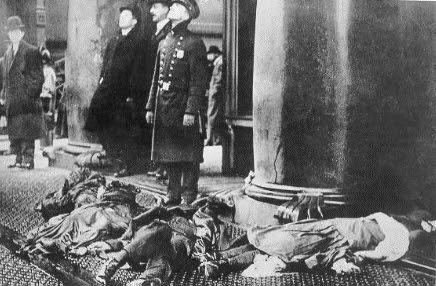
Police and bystanders watch helplessly as more victims jump to their deaths to escape the flames of the Triangle Shirtwaist Factory on the upper floors of the Asch Building.

It was a sunny but raw day in New York City, a late Saturday afternoon and the streets near Washington Square in the immigrant Greenwich Village neighborhood were teaming with traffic. Around 4:45, as the many garment industry sweatshops were preparing for their “early” Saturday closing, pedestrians began to notice smoke billowing from the upper floors of the Asch Building, at 29 Washington Place. Crowds gathered to watch as horse drawn fire engines and ladder trucks pounded to the scene. Soon witnesses watched in horror as one after another young women leapt from the burning building to sure death on the pavement below—the Fire Departments ladders were too short to reach the windows from which they jumped. It was March 25, 1911. The top three floors of the building, housing the Triangle Shirtwaist Factory had turned into a roaring inferno. 

The Fire Department responded quickly but did not have ladders tall enough to reach the top three floors which were on fire and fire fighters could not get up stairways choked with the bodies of those trying to escape.  They could only use their most powerful pumpers to spay water from the outside.

About 500 workers were getting ready to leave when the fire started smoldering in the scrap bin under a cutting table, probably ignited by a carelessly discarded cigarette or cigar. When it was over 146 of them, mostly young Italian and Jewish women, perished. Many were piled against locked exit doors and died of asphyxiation. Sixty-two victims leaped to their death on the sidewalk or were killed when the sole fire escape collapsed. Others jumped down elevator shafts after the elevators, which managed to rescue several, stopped working when the fire’s heat twisted the rails on which they ran. At least 71 others were reported injured, although many more were probably tended at home, unable to afford medical care. 

It was not the first fire in such a factory. In fact, authorities had reported an epidemic of fires at shirtwaist factories. This was one, however, was made worse because of overcrowding on the shop floors, failure to clear flammable material—scrap bins had not been emptied in two months—and because stairways and exits were either blocked by bales of material or padlocked to prevent employee pilferage. 

The factory occupied floors 8, 9, and 10 of the building, all beyond the reach of ladders which could only reach the sixth floor at full extension. There was no alarm system and on the most crowded production floor, the 9th, the first warning was literally when flames erupted. By that time most office personnel, including the owners and their visiting children had already been able to evacuate from the higher floor to the safety of the roof. 

There had, of course, been awful industrial accidents and fires before. Mine collapses were commonplace. Many were killed in boiler explosions on steamships and riverboats, others died in railroad accidents. Fires had devastated lint-filled textile plants. But never had such a calamity played out so publicly on the streets of the nation’s premier city with the press—including photographers—on hand to record the horror. The fact that most of the victims were young women, girls in their teens mostly, added to the impact. Grimy men were expected to be expendable, girls were not. 

 The sewing floor of a typical shirtwaist factory and the young women who worked there.

Lurid headlines and gruesome photos spread across the country. Both the city and state governments launched investigations, which would lead eventually to the establishment of the nation’s strongest industrial workplace safety and labor laws in New York state. It spurred the growth of the International Ladies Garment Workers’ Union (ILGWU) and other needle trade unions which made safety a key issue.   Many years later the Federal government added its weight to worker safety with the establishment of the Occupational Health and Safety Administration (OSHA) under the Department of Labor

The labor movement commemorates the anniversary, but the hard-fought gains paid for by those dead shop girls are under attack from coast-to-coast. Under the guise of cost cutting, deregulation, and as a frank assault on the working class on behalf of an oligarchy, Trump and Musks DOGE dudes  attempted to slash jobs at the agency and across the Department of Labor and OSHA itself is on the chopping block while blocking in every possible way the rights of workers to defend themselves through unions or by suing for damages in the courts. The old battles have to be refought. Hopefully it will not take another tragedy of epic proportion to re-prick the public conscience. 

Protests like this large parade featuring a contingent of Jewish women workers from the United Hebrew Trades demanded enactment of factory safety laws and organized shops into powerful unions.

In 2012, after years of painstaking research, the last 10 victims of the fire were finally identified. Today the Asch Building, now known as the Brown Building, still stands. It is a designated landmark, as much, we are told, for its architectural significance as the site of a tragedy.

Wednesday, March 18, 2026

The Tolpuddle Martyrs Sparked British and Australian Trade Unionism

Farm laborers from Dorset may have met under a tree to swear a secret oath to create a combination to raise wages and protect tenants.

The fate of six farm laborers in Dorset and the huge protest and movement that their brutal transportation to Australia stirred are touchstones to the British labor movement.  The Tolpuddle Martyrs are widely celebrated in England as well as in the former penal colony where they were sent and in far off Canada.  Most Americans have never heard of them.  We aim to rectify that.

In 1833 George Loveless, a Methodist lay preacher, and a respected leader among the farm laborers around the village of Tolpuddle in southern England, called a few of his mates together. Legend has it that six of them met under a sycamore tree.  Others say that they squeezed into the tiny hovel of Thomas Standfield.  They had serious business to attend to.

Landlords in the area were putting the arm on their laborers and tenants.  Unlike areas closer to London or the grimy cities of the rapidly industrializing north, farmers in Dorset did not have to keep up wages to compete with the lure of the cities and factory jobs.  In addition, modest changes to age old farming practices were reducing the number of laborers needed on the farms and estates.  Conditions were ripe for wage cutting. 

Local wages had been steady at 10 schillings a week—hardly a fortune, but enough to barely feed and clothe a family.  Landowners had already cut that to 7 and had announced a second cut to 6 was imminent.   No reductions in the rent demanded for their cottages were proposed.

Earlier, in 1830, farm workers had responded to such cuts and the new farm equipment that made them possible with the Swing Rebellion—a Luddite like uprising in which laborers rioted, attacking and burning equipment like threshing machines and menacing landlords.  Frightened farmers suspended their cuts, or sometimes even gave wage boosts, but waited for authorities to act. 

And act they did.  Militia and Army units swept the county rounding up hundreds of suspects.  At trial several were sentenced to hang, although in the end only a handful were swung in public as an object lesson, the rest were torn from their families and transported to Australia.  Conditions returned to what they were before the protests—or worse.

Loveless and his friends knew that violence and disorganized riot was not the answer.  They had to find new ways of organizing a protest.  They had some reasons for hope.  The Combination Acts, passed in 1799 at the height of panic about the possible spread of revolution from France to the English working and agrarian classes and which had outlawed combinations to obtain better wages and working conditions, had been repealed in 1824 and’25.  A modest trade union movement was developing, not without severe opposition, in among skilled tradesmen in cities and in the mines.

Moreover, the Reform Act, passed earlier in 1832, had finally extended the franchise to some without yet granting universal male suffrage.  It was not enough by half, but the Dorset men felt that it might foretell a more liberal age.

Despite these reasons for optimism, the fate of the Swing Rebellion left them no illusions about the dangers of their undertaking.  So that when they agreed to form the Friendly Society of Agricultural Labourers they did so swearing an oath of secrecy.

Local landlords began to hear certain rumors.  As planting season neared men were refusing to work for less than the old 10 schillings standard.

One landlord, James Frampton, petitioned to Lord Melbourne, the Whig Home Minister for relief.  It was fast in coming.  On February 24, 1834 Loveless and the other men were arrested as they left their homes.  Their families would not see them for a long time.

 Five of the six accused conspirators.

In no time at all they were hauled before an unsympathetic Judge Baron John Williams.  Loveless, Stanfield, James BrineJames Hammett, and James Loveless, George’s brother were charged under an obscure law also dating to the late 18th Century which made the swearing of secret oaths to each other illegal.  On March 18, subsequently celebrated as Tolpuddle Martyrs Day, they were found guilty and sentenced to 7 years transportation to Australia—a sentence few men ever returned from.

Despite rising protests from working people across England, all of the men were quickly bundled off to the ships that carried them away.

From his cell before being shipped out George Loveless had scribbled a note on a scrap of paper that was soon printed all over England:

God is our guide! from field, from wave,

From plough, from anvil, and from loom;

We come, our country’s rights to save,

And speak a tyrant faction’s doom:

We raise the watch-word liberty;

We will, we will, we will be free!


Tens of thousands rallied on Copenhagen Fields near King's Cross, London organized by the Central Committee of the Metropolitan Trade Unions and marched through London to Kennington Common with a wagon carrying a petition with over 200,000 signatures for the remission of the  Tolpuddle Martyrs's sentences.

Inspired by those words an unprecedented protest arose across the country.  More than 80,000 signed petitions to Lord Melbourne himself in April.  And in London more than 25 thousand assembled for the largest public demonstration of its kind ever held in protest to a government action.  In addition to the labor movement, the reform press took up the protest as did the liberal wing of Melbourne’s own Whig party.

In 1836 by then Prime Minister Melbourne’s new Home Secretary Lord John Russell commuted the sentences of all but Hammett who had a previous minor conviction.  Four of the men arrived back in England at Plymouth.  A plaque next to the Mayflower Steps commemorates their return.

Hammett was released a year later and returned to Tolpuddle, where he lived a long life in poverty and want.  He died in the Dorchester workhouse in 1891. 


Tolpuddle Martyrs Monument and cottages in London, Ontario.

The other men realized they could not support their families back home where no landlord would hire them.  They moved together for a time to Essex and then with the help of funds subscribed for their relief, immigrated together to London, OntarioCanada.  They were greeted in their new home as heroes and are still commemorated there today with a monument and an affordable housing co-op / trade union complex named after them.

Back home, the Tolpuddle Martyrs Museum preserves their story and their deep connection to the trade union movement.  A monument was erected to them in 1934 on the centennial of their sentence and a new statue installed before the museum in 2001.

There are also modest monuments in Australia.

The Tolpuddle Martyrs Festival is held annually in Tolpuddle, usually in the third week of July, organized by the National Union of Agricultural Workers (recently amalgamated with the Transport and General Workers Union) and the Trades Union Congress (TUC) featuring a parade of banners from many trade unions, a memorial service, speeches and music. Festivals have featured speakers such as Tony Benn and musicians such as Billy Bragg.   

Forgetting for a moment that as a Methodist, Loveless was likely a teetotaler, I propose all good working men and women raise a toast today to the lads from Tolpuddle.


Thursday, March 27, 2025

Weeping for the Piles of Dead Women on a New York Street

Police and bystanders watch helplessly as more victims jump to their deaths to escape the flames of the Triangle Shirtwaist Factory on the upper floors of the Asch Building.

It was a sunny but raw day in New York City, a late Saturday afternoon and the streets near Washington Square in the immigrant Greenwich Village neighborhood were teaming with traffic. Around 4:45, as the many garment industry sweatshops were preparing for their “early” Saturday closing, pedestrians began to notice smoke billowing from the upper floors of the Asch Building, at 29 Washington Place. Crowds gathered to watch as horse drawn fire engines and ladder trucks pounded to the scene. Soon witnesses watched in horror as one after another young women leapt from the burning building to sure death on the pavement below—the Fire Departments ladders were too short to reach the windows from which they jumped. It was March 25, 1911. The top three floors of the building, housing the Triangle Shirtwaist Factory had turned into a roaring inferno. 

The Fire Department responded quickly but did not have ladders tall enough to reach the top three floors which were on fire and fire fighters could not get up stairways choked with the bodies of those trying to escape.  They could only use their most powerful pumpers to spay water from the outside.

About 500 workers were getting ready to leave when the fire started smoldering in the scrap bin under a cutting table, probably ignited by a carelessly discarded cigarette or cigar. Before it was over 146 of them, mostly young Italian and Jewish women, would perish. Many would be piled against locked exit doors to die of asphyxiation. Sixty-two victims leaped to their death on the sidewalk or were killed when the sole fire escape collapsed. Others jumped down elevator shafts after the elevators, which managed to rescue several, stopped working when the fire’s heat twisted the rails on which they ran. At least 71 others were reported injured, although many more were probably tended at home, unable to afford medical care. 

It was not the first fire in such a factory. In fact, authorities had reported an epidemic of fires at shirtwaist factories. This was one, however, was made worse because of overcrowding on the shop floors, failure to clear flammable material—scrap bins had not been emptied in two months—and because stairways and exits were either blocked by bales of material or padlocked to prevent employee pilferage. 

The factory occupied floors 8, 9, and 10  of the building, all beyond the reach of ladders which could only reach the sixth floor at full extension. There was no alarm system and on the most crowded production floor, the 9th, the first warning was literally when flames erupted. By that time most office personnel, including the owners and their visiting children had already been able to evacuate from the higher floor to the safety of the roof. 

There had, of course, been awful industrial accidents and fires before. Mine collapses were commonplace. Many were killed in boiler explosions on steamships and riverboats, others died in railroad accidents. Fires had devastated lint-filled textile plants. But never had such a calamity played out so publicly on the streets of the nation’s premier city with the press—including photographers—on hand to record the horror. The fact that most of the victims were young women, girls in their teens mostly, added to the impact. Grimy men were expected to be expendable, girls were not. 


 The sewing floor of a typical shirtwaist factory and the young women who worked there.

Lurid headlines and gruesome photos spread across the country. Both the city and state governments launched investigations, which would lead eventually to the establishment of the nation’s strongest industrial workplace safety and labor laws in New York state. It spurred the growth of the International Ladies Garment Workers’ Union (ILGWU) and other needle trade unions which made safety a key issue.   Many years later the Federal government added its weight to worker safety with the establishment of the Occupational Health and Safety Administration (OSHA) under the Department of Labor

The labor movement commemorates the anniversary, but the hard fought gains paid for by those dead shop girls are under attack from coast-to-coast. Under the guise of cost cutting, deregulation, and as a frank assault on the working class on behalf of an oligarchy, Trump and Musks DOGE dudes have attempted to slash jobs at the agency and across the Department of Labor and OSHA itself is on the chopping block while blocking in every possible way the rights of workers to defend themselves through unions or by suing for damages in the courts. The old battles have to be refought. Hopefully it will not take another tragedy of epic proportion to re-prick the public conscience. 

Protests like this large parade featuring a contingent of Jewish women workers from the United Hebrew Trades demanded enactment of factory safety laws and organized shops into powerful unions.

In 2012, after years of painstaking research, the last 10 victims of the fire were finally identified. Today the Asch Building, now known as the Brown Building, still stands. It is a designated landmark, as much, we are told, for its architectural significance as the site of a tragedy.

Saturday, March 25, 2023

There Were Piles of Dead Women on a New York Street

Police and bystanders watch helplessly as more victims jump to their deaths to escape the flames of the Triangle Shirtwaist Factory on the upper floors of the Asch Building.

It was a sunny but raw day in New York City, a late Saturday afternoon and the streets near Washington Square in the immigrant Greenwich Village neighborhood were teaming with traffic.  Around 4:45, as the many garment industry sweatshops were preparing for their “early” Saturday closing, pedestrians began to notice smoke billowing from the upper floors of the Asch Building, at 29 Washington Place.

Crowds gathered to watch as horse drawn fire engines and ladder trucks pounded to the scene.  Soon witnesses watched in horror as one after another young women leapt from the burning building to sure death on the pavement below—the Fire Departments ladders were too short to reach the windows from which they jumped.  It was March 25, 1911.  The top three floors of the building, housing the Triangle Shirtwaist Factory had turned into a roaring inferno

The Fire Department responded quickly but did not have ladders tall enough to reach the top three floors which were on fire and fire fighters could not get up stairways choked with the bodies of those trying to escape.  They could only use their most powerful pumpers to spay water from the outside.

About 500 workers were getting ready to leave when the fire started smoldering in the scrap bin under a cutting table, probably ignited by a carelessly discarded cigarette or cigar.  Before it was over 146 of them, mostly young Italian and Jewish women, would perish.  Many would be piled against locked exit doors to die of asphyxiation. Sixty-two victims leaped to their death on the sidewalk or were killed when the sole fire escape collapsed.  Others jumped down elevator shafts after the elevators, which managed to rescue several, stopped working when the fire’s heat twisted the rails on which they ran.  At least 71 others were reported injured, although many more were probably tended at home, unable to afford medical care.

It was not the first fire in such a factory.  In fact, authorities had reported an epidemic of fires at shirtwaist factories.  This was one, however, was made worse because of overcrowding on the shop floors, failure to clear flammable material—scrap bins had not been emptied in two months—and because stairways and exits were either blocked by bales of material or padlocked to prevent employee pilferage.

The factory occupied the 8, 9, and 10 floors of the building, all beyond the reach of ladders which could only reach the sixth floor at full extension.  There was no alarm system and on the most crowded production floor, the 9th, the first warning was literally when flames erupted.  By that time most office personnel, including the owners and their visiting children had already been able to evacuate from the higher floor to the safety of the roof.

There had, of course, been awful industrial accidents and fires before.  Mine collapses were commonplace.  Many were killed in boiler explosions on steamships and riverboats, others died in railroad accidents.  Fires had devastated lint-filled textile plants.  But never had such a calamity played out so publicly on the streets of the nation’s premier city with the press—including photographers—on hand to record the horror.  The fact that most of the victims were young women, girls in their teens mostly, added to the impact.  Grimy men were expected to be expendable, girls were not.

The sewing floor of a typical shirtwaist factory and the young women who worked there.

Lurid headlines and gruesome photos spread across the country.  Both the city and state governments launched investigations, which would lead eventually to the establishment of the nation’s strongest industrial workplace safety and labor laws in New York state.  It spurred the growth of the International Ladies Garment Workers’ Union (ILGWU) and other needle trade unions which made safety a key issue.  Many years later the Federal government added its weight to worker safety with the establishment of the Occupational Health and Safety Administration (OSHA) under the Department of Labor.

Today the labor movement commemorates the anniversary, but the hard fought gains paid for by those dead shop girls are under attack from coast-to-coast.  Whether under the guise of cost cutting, deregulation, or a frank assault on the working class, attempts are ongoing to defund, strip authority from, or abolish altogether OSHA and its state counterparts while blocking in every possible way the rights of workers to defend themselves through unions or by suing for damages in the courts. Under the former Trump mal-administration and with Federal Courts increasingly in the hands of right-wing judges that trend accelerated.

Protests like this large parade featuring a contingent of Jewish women workers from the United Hebrew Trades demanded enactment of factory safety laws and organized shops into powerful unions.

The old battles have to be refought.  Hopefully it will not take another tragedy of epic proportion to re-prick the public conscience. 

Today the Asch Building, now known as the Brown Building, still stands.  It is a designated landmark, as much, we are told, for its architectural significance as the site of a tragedy.  And in 2012, after years of painstaking research, the last 10 victims of the fire were finally identified


Saturday, March 18, 2023

The Tolpuddle Martyrs Inspired British and Australian Labor

Farm laborers from Dorset may have met under a tree to swear a secret oath to create a combination to raise wages and protect tenants.

The fate of six farm laborers in Dorset and the huge protest and movement that their brutal transportation to Australia stirred are touchstones to the British labor movement.  The Tolpuddle Martyrs are widely celebrated in England as well as in the former penal colony where they were sent and in far off Canada.  Most Americans have never heard of them.  We aim to rectify that.

In 1833 George Loveless, a Methodist lay preacher, and a respected leader among the farm laborers around the village of Tolpuddle in southern England, called a few of his mates together. Legend has it that six of them met under a sycamore tree.  Others say that they squeezed into the tiny hovel of Thomas Standfield.  They had serious business to attend to.

Landlords in the area were putting the arm on their laborers and tenants.  Unlike areas closer to London or the grimy cities of the rapidly industrializing north, farmers in Dorset did not have to keep up wages to compete with the lure of the cities and factory jobs.  In addition, modest changes to age old farming practices were reducing the number of laborers needed on the farms and estates.  Conditions were ripe for wage cutting

Local wages had been steady at 10 schillings a week—hardly a fortune, but enough to barely feed and cloth a family.  Landowners had already cut that to 7 and had announced a second cut to 6 was imminent.   No reductions in the rent demanded for their cottages were proposed.

Earlier, in 1830, farm workers had responded to such cuts and the new farm equipment that made them possible with the Swing Rebellion—a Luddite like uprising in which laborers rioted, attacking and burning equipment like threshing machines and menacing landlords.  Frightened farmers suspended their cuts, or sometimes even gave wage boosts, but waited for authorities to act. 

And act they did.  Militia and Army units swept the county rounding up hundreds of suspects.  At trial several were sentenced to hang, although in the end only a handful were swung in public as an object lesson, the rest were torn from their families and transported to Australia.  Conditions returned to what they were before the protests—or worse.

Loveless and his friends knew that violence and disorganized riot was not the answer.  They had to find new ways of organizing a protest.  They had some reasons for hope.  The Combination Acts, passed in 1799 at the height of panic about the possible spread of revolution from France to the English working and agrarian classes and which had outlawed combinations to obtain better wages and working conditions, had been repealed in 1824 and’25.  A modest trade union movement was developing, not without severe opposition, in among skilled tradesmen in cities and in the mines.

Moreover, the Reform Act, passed earlier in 1832, had finally extended the franchise to some without yet granting universal male suffrage.  It was not enough by half, but the Dorset men felt that it might foretell a more liberal age.

Despite these reasons for optimism, the fate of the Swing Rebellion left them no illusions about the dangers of their undertaking.  So that when they agreed to form the Friendly Society of Agricultural Labourers they did so swearing an oath of secrecy.

Local landlords began to hear certain rumors.  As planting season neared men were refusing to work for less than the old 10 schillings standard.

One landlord, James Frampton, petitioned to Lord Melbourne, the Whig Home Minister for relief.  It was fast in coming.  On February 24, 1834 Loveless and the other men were arrested as they left their homes.  Their families would not see them for a long time.

 Five of the six accused conspirators.

In no time at all they were hauled before an unsympathetic Judge Baron John Williams.  Loveless, Stanfield, James Brine, James Hammett, and James Loveless, George’s brother were charged under an obscure law also dating to the late 18th Century which made the swearing of secret oaths to each other illegal.  On March 18, subsequently celebrated as Tolpuddle Martyrs Day, they were found guilty and sentenced to 7 years transportation to Australia—a sentence few men ever returned from.

Despite rising protests from working people across England, all of the men were quickly bundled off to the ships that carried them away.

From his cell before being shipped out George Loveless had scribbled a note on a scrap of paper that was soon printed all over England:

God is our guide! from field, from wave,

From plough, from anvil, and from loom;

We come, our country’s rights to save,

And speak a tyrant faction’s doom:

We raise the watch-word liberty;

We will, we will, we will be free!

Tens of thousands rallied on Copenhagen Fields near King's Cross, London organized by the Central Committee of the Metropolitan Trade Unions and marched through London to Kennington Common with a wagon carrying a petition with over 200,000 signatures for the remission of the  Tolpuddle Martyrs's sentences.

Inspired by those words an unprecedented protest arose across the country.  More than 80,000 signed petitions to Lord Melbourne himself in April.  And in London more than 25 thousand assembled for the largest public demonstration of its kind ever held in protest to a government action.  In addition to the labor movement, the reform press took up the protest as did the liberal wing of Melbourne’s own Whig party.

In 1836 by then Prime Minister Melbourne’s new Home Secretary Lord John Russell commuted the sentences of all but Hammett who had a previous minor conviction.  Four of the men arrived back in England at Plymouth.  A plaque next to the Mayflower Steps commemorates their return.

Hammett was released a year later and returned to Tolpuddle, where he lived a long life in poverty and want.  He died in the Dorchester workhouse in 1891. 

Tolpuddle Martyrs Monument and cottages in London, Ontario.

The other men realized they could not support their families back home where no landlord would hire them.  They moved together for a time to Essex and then with the help of funds subscribed for their relief, immigrated together to London, Ontario, Canada.  They were greeted in their new home as heroes and are still commemorated there today with a monument and an affordable housing co-op / trade union complex named after them.

Back home the Tolpuddle Martyrs Museum preserves their story and their deep connection to the trade union movement.  A monument was erected to them in 1934 on the centennial of their sentence and a new statue installed before the museum in 2001.

There are also modest monuments in Australia.

The Tolpuddle Martyrs Festival is held annually in Tolpuddle, usually in the third week of July, organized by the National Union of Agricultural Workers (recently amalgamated with the Transport and General Workers Union) and the Trades Union Congress (TUC) featuring a parade of banners from many trade unions, a memorial service, speeches and music. Recent festivals have featured speakers such as Tony Benn and musicians such as Billy Bragg.   

Forgetting for a moment that as a Methodist, Loveless was likely a teetotaler, I propose all good working men and women raise a toast today to the lads from Tolpuddle.


Monday, July 20, 2020

Labor Movement Unites for Black Lives Matter and Job Justice


The Labor movement and Black Lives Matter will come together today in a nationwide Strike for Black Lives organized by the Service Employees International Union (SEIU), which represents nearly 2 million service workers and other unions, Civil Rights organizations, and labor allies.
According to SEIU President Mary Kay Henry the strike is intended to highlight the economic plight of service workers, many of whom are People of Color.  During the first two months of the coronavirus pandemic, her union was concerned about how essential workers were being treated on the front lines. Some lacked access to personal protective equipment (PPE) that would help them avoid contracting COVID-19. 

SEIU President Mary Kay Henry at a health care workers' action.
The death of Black Minneapolis resident George Floyd while in police custody “escalated the case we were trying to make” about the mistreatment of Black people, Henry said.    “We hope to gain that corporations and governments will understand the need to dismantle racist policies and make sure every family has a living wage and is able to be healthy and safe.”
The strike is intended to put more attention on low-wage workers who risk their lives but struggle to pay their bills. Although major companies pledge support for the Black Lives Matter movement, they pay their workers low wages, fail to provide paid time off while sick, and, in some cases, fail to provide the necessary equipment to keep them healthy on the job, Henry said. “Most workers are infuriated by it because it’s so hypocritical,”
The demands being put forth during the strike include:
  • Justice for Black communities.
  • Elected officials and candidates at every level use their authority to rewrite and reimagine the rules so that Black communities can thrive.
  • Corporations take immediate action to dismantle racism, white supremacy and economic exploitation wherever it exists, including in our workplaces.
  • Every worker has the opportunity to form a union, no matter where they work.
Unions and civil rights groups planning to take part in the strike include the International Brotherhood of Teamsters, the American Federation of Teachers, Fight for $15 and a Union, United Food and Commercial Workers, Greenpeace, MoveOn, and the American Civil Liberties Union.  Ride-sharing drivers for companies like Uber and Lyft are also expected to join in.
Police unions, which have been hyper-critical of the Black Lives Matter movement, defended police violence, and encouraged even more aggressive action to suppress protests will not be participating although Henry says that some unions representing correctional and probation officers “actually understand that there is systemic inequality that has to be addressed.”

This call for the San Francisco  action shows participating organization.
The strike will take place at different times depending on the city and location. Some of the 25 cities expected to have actions include Los Angeles, Chicago, Miami, Seattle, and Houston. In Los Angeles workers will gather in cars as part of a caravan beginning at a local McDonald’s—a long time target of  demands for a $15 an hour base wage  and union recognition—and then drive through the city, stopping by places like the University of Southern California, where organizers said they’ll “demand the nation's second-largest school district and the university drop their use of the Los Angeles Police Department (LAPD) on campuses.

Critical medical workers demanded a safe working environment, sick leave, and a living wage at a Chicago area hospital.
Chicago will have at least two actions.  The Chicago March/Caravan for Black Lives will start from the Illinois State Government Thompson Center, 100 West Randolph and visit job site across the city where the SEIU represents impacted workers including hospital and nursing home staff, home health care workers, custodians and housekeeping staff, hospitality and fast food workers, and state and local public employees.  Teamsters represent warehouse and distribution workers and the Food and Commercial Workers have grocery store and other retail workers.
At  3 pm a Chicago Teamsters Walk Out for Black Lives sponsored by  Teamsters Joint Council 25 will begin at a job site at 4600 South Kolin Avenue.
In New York City, essential workers will gather outside of the Trump International Hotel to demand that the Senate and President Donald Trump pass and sign the HEROES Act, House-passed legislation for providing PPE,  essential pay, and extended unemployment benefits to workers who have not had the option of working from home during the coronavirus pandemic.  Organizers said New York Senator Chuck Schumer is expected to rally with workers.

McDonald's has long been a target of the Fight for $15 and a Union campaign of the SEIU and of other unions including the Industrial Workers of the World (IWW.)
Strikers in Minneapolis, where Floyd was killed, will include nursing home and airport workers demanding a $15-per-hour minimum wage.  In Missouri, participants will rally at McDonald’s locations in St. Louis and Ferguson, a key BLM landmark sparked by the death of Michael Brown who was killed by police in 2014. The Ferguson strikers will also march to a memorial site where Brown was shot and killed.
For workers who are unable to strike, the organizers urge them to walk off their jobs at noon for eight minutes and 46 seconds, the amount of time initially that a police officer held George Floyd under a knee on his.
Today’s action are an important and historic link between a revived and energized labor movement and one of the most important and game changing social movements of our time.