Showing posts with label Palestine. Show all posts

Monday, March 16, 2026

Remembering the Blood Sacrifice of Rachel Corrie


                                Rachel Corrie as a student at Evergreen State College in her hometown of Olympia, Washington.

It was 23 years ago today on March 16, 2003 that Rachel Corrie, a 23-year-old American volunteer with the International Solidarity Movement (ISM) was killed by an Israel Defense Forces (IDF) armored bulldozer as it attempted to destroy the home of a Palestinian doctor in the Rafah refugee camp in Gaza.  The Palestinians she died protecting are in even greater peril today as an Israeli invasion has turned much of the area into charred rubble, turned most of the populations into internal refugees who continue to suffer under managed starvation. 

Eyewitness members of her ISM team say that Corrie, wearing a bright orange jacket, was clearly visible to the driver of the bulldozer before she fell off the mound of earth it was pushing up and was crushed underneath the debris and the tractor, which they said ran over her twice. 


Corrie defying an Israeli bulldozer in Gaza moments before she was run over.

The IDF and Israeli government disputed that and claimed that her death was an accident in which the driver never saw her and the tractor never touched her.  Despite promises, the official autopsy report and the results of an official investigation were never released. 

While Corrie’s death stirred up international outrage, she was painted by Israeli media as, at best, a naïve dupe of terrorists and more likely an active accomplice who deserved her fate. 

Corrie was born to middle class, politically liberal parents in Olympia Washington.  She attended her hometown school, Evergreen State College, long known as hot bed of activism.  She wanted to be an artist and writer.  She studied and was deeply moved by the writings on non-violence by Gandhi and Martin Luther King.  In her senior year she devised an independent study program that included service with the ISM in Gaza.  She had already organized a pen pal program between children in Rafah and Olympia youngsters. 

She arrived in Israel on January 22 and received two days of training in nonviolent tactics at ISM headquarter on the West Bank before being posted to Rafah.  It was an intense period of the Second Intifada with regular clashes between Israeli troops and Palestinians.

Corrie spent much of February at the Canada Well, a water facility built by the Canadians that was been damaged by the Israelis.  She protected Palestinian workers trying to do repair work.  She and they came under fire. 


Corie burned a hand drawn paper American flag protesting U.S, support of Israeli displacement of Palestinians from their homes.

On February 15 she was present at a demonstration and was photographed holding a burning paper replica of the U.S. flag.  American right-wing commentators would use that photo later to claim she was a traitor to her country. 

The IDF was in the midst of a massive campaign to clear hundreds of homes and farms from a new buffer zone by the Egyptian border.  ISM observers routinely interceded by placing themselves in front of bulldozers to prevent demolitions.  Although there had been violent incidents and camps where Corrie and others stayed were subject to harassing arms fire at night, tractor drivers had always stopped before harming the volunteers.  Until the day Corrie died. 
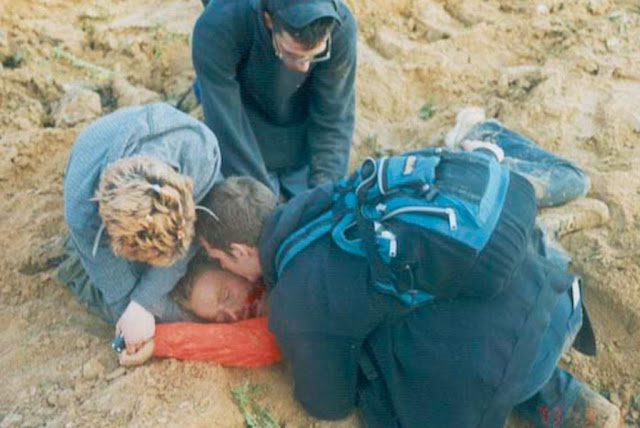
Witnesses and International Solidarity Movement (ISM) comrades surrounded Corrie's crushed body.

In April two other ISM volunteers were severally injured by the IDF.  American Brian Avery was shot in the face while protracting Palestinian medical workers and Briton Thomas Hurndall was shot in the head.  He was declared brain dead and finally died in 2004.  About the same time an experienced British news cameraman was killed by IDF fire despite wearing clearly marked press identification. 

There was speculation, never proven, that Israeli authorities may have decided to target Western witnesses to their activity in Gaza. 

Protesters carried portraits of Corrie in her Palestinian keffiyeh.

After Corie died her family released letters and e-mails she sent from the Gaza.  Articulate and moving they were published posthumously as Let Me Stand Alone in 2008.  The material was also used to create the play My Name is Rachel Corrie which opened in London in 2005 to good reviews and large audiences.  An attempt to mount an American production initially fell through with the British producers alleging interference by pro-Israel forces.  It eventually opened off-Broadway.  The play has been produced successfully around the world, including, finally, in Israel. 

Corrie’s life and death have also been celebrated in a cantata and songs by over 30 artists. 

A playbill for the original London production My Name is Rachel Corrie.  Famed British actor Alan Rickman co-edited the text taken from Corrie's own letters and journals.

Meanwhile a counter industry of anti-Corrie books and magazine articles has sprang up.  As her death is commemorated today by those who knew and loved her and by those who admired her, she will be reviled, in often lurid terms on-line by commentators in the U.S. and in Israel.

All of that—the good and the hateful—will be dredged up again today.

I, for one, just try to remember a lively young woman who dared put her life on the line for others.


Tuesday, April 16, 2024

Was Masada Heroic Martyrdom or Fanatic Waste—National Poetry Month 2024


An aerial view of the ruins of the Fortress of Masada today.  The siege ramp built by the Romans over a period of months and from which the walls were finally breached is clearly visible on the left.

Today marks the date traditionally ascribed to the Fall of Masada to the Roman Legions—April 16, 63 CE.  It is an event of enormous symbolic importance in Jewish history, elevated by the experience of the Holocaust, the establishment of the State of Israel, and modern archeological excavations that have confirmed much of the story as related the Judeo-Roman historian Josephus.  Details of the end of the long siege laid by the Romans are stomach turning—the suicide of the warriors of the rebellious sect of the Zealots known as the Sicarii  and the slaughter of their wives, children, and elders to prevent them from becoming Roman slaves.  As many as 960 were said to have died that awful day, though the true number will never be known, and some archeologists suspect the numbers were far lower.


Romans laboriously constructed a siege ramp to the upper walls of the Masada mountain top fortress for their tower and siege engines.

The question that haunts us is was this the ultimate heroic sacrifice of a freedom loving people—the Alamo of American mythmaking writ large—or was it a senseless act of fanaticism—akin to the People’s Temple mass suicide or the Branch Davidian holdout in Waco, Texas?  Much depends on the modern political lessons one is pre-disposed to draw from the story.

Of course, such an epic tale and its emotional wallop have made Masada a ripe inspiration for poetry.

                            Yitzhak Lamdan in  Israel, 1949.

The most famous of the poets represented here is Yitzhak Lamdan—often called Isaac in the West—who was born in the Ukraine in the Russian Empire in 1899.  He came to British ruled Mandatory Palestine in 1920, a part of the Third Aliyah (Third Wave) of Zionist immigration after World War I and the upheavals associated with the Russian Revolution and Civil War.  In 1927 he published Masada: A Historical Epic in Hebrew from which the lines below were excerpted.  The poem celebrated the stand at Masada as a heroic example for the persecuted and endangered Jewish diaspora.  By inference it held up a Jewish homeland in Palestine as a fortress/refuge.  As such it was embraced Zionist movement as a national epic. 

Later stanzas of the poem warned that Zion, like Masada, could become a trap which ensnares the best of Jews and leads to their annihilation.  The Zionists ignored that part and later, when the poem was included in Hebrew text books, those stanzas were often omitted entirely.

The poem was translated into most major European languages and widely circulated by the Zionist Movement press.  Some historians credit it with inspiring the Warsaw Ghetto Uprising in January of 1943.  It was also a rallying call during the 1948 Arab-Israeli War or Israeli War of Independence.

Lamdan died in the State of Israel in 1955 as a revered cultural hero.

Masada

Who are you that come, stepping heavy in silence?

—The remnant.
Alone I remained on the day of great slaughter.
Alone, of father and mother, sisters and brothers.
Saved in an empty cask hid in a courtyard corner.
Huddled, a child in the womb of an anxious mother.
I survived.
Days upon days in fate’s embrace I cried and begged
for mercy:
Thy deed it is, O God, that I remain.
Then answer: Why?
If to bear the shame of man and the world.
To blazon it forever—
Release me! The world unshamed will flaunt this shame
As honor and spotless virtue!
And if to find atonement I survive
Then Answer: Where?
So importuning a silent voice replied:
“In Masada!”
And I obeyed that voice and so I came.
Silent my steps will raise me to the wall,
Silent as all the steps filled with the dread
Of what will come.
Tall, tall is the wall of Masada.
Deep, deep is the pit at its feet.
And if the silent voice deceived me,
From the high wall to the deep pit
I will fling me.
And let there be no sign remaining,
And let no remnant survive.


—Yitzhak Lamdan

Martin Rasmussen is a 34 year old writer who has published several poems on line.  

The last stand of the Maccabees in an Israeli mural glorifying the sacrifice glorifying their sacrifice.  But their already slaughter wives and children are nowhere to be seen.

Today I Met a Jew


Today I met a Jew
And I looked into her eyes
I say ten plagues being bought
For ten wonders, just to be the chosen people.

Today I met a Jew
And the smell of her hair
Made me think of the red sea
And all that’s lost beneath it.

Today I met a Jew
And was reminded of an exile
That lasted for a thousand years,
And how it ended.

Today I met a Jew

But found God

In the pages of a people’s history.


Never another Masada!


—Martin Rasmussen

On Masada was submitted and posted to a poetry site anonymously.

On Masada

Did drip

—the zealot's blood—
when engines did array,
on Masada hill that day.

Rebellion, tho’ long overdue,
beneath the Roman yoke
 . . . in isolation broke.
Last bastion of oppressed folk.

What unified demeanour gave them up
to be a Roman slave?
How can resistance

—in their eyes—
reduce them thus
 . . . the world despise?

Can bring to me the longest day
when women ...
children ...
did he slay?
Not yet awhile
 ... we think it’s done
 ... on that stark hill that stands alone.

Four Heavens lighted up
and yet.
In consequence ...
In suffering ...
Did one so fearless then as fret.
Smote fearlessly the one before

—the one last held the winning straw?
As ramparts built upon the shore
of this poor isle...
Masada—


Author unidentified

From Poets From a Tender Age


Sunday, March 10, 2024

Poetry for Ramadan 2024

The faithful gather to eat and share food after a day-long Ramadan fast.

In most of the Islamic world Ramadan, the ninth month of the Muslim Calendar, and will begin today at sundown         The date is calculated by the first sighting of the crescent after the New Moon.  Since this can vary in different parts of the world, so can the marked beginning of the month.  In the United States the western calendar that is today.

Ramadan was the month in which the first verses of the Qur’an were revealed to the Prophet Mohammad.

The month of cleansing as the faithful rededicate themselves to Allah by emphasizing patience, humility, and spirituality by an absolute fast observed by all Muslims over the age of puberty each day between dawn and dusk.  The observant also are called to be more reverent and fervent in prayer.  During Ramadan the entire Qur’an is often read in mosques in 30 installments.

Customs connected to the Ramadan observance vary somewhat culturally and between Sunni and Shi’a traditions.  In more secular Islamic countries evenings after the fast are often filled with feasting and entertainment, while attendance at evening services following a modest breaking of the fast is customary in more traditional societies.  Acts of charity to the poor are encouraged. 

The holiday of Eid-al-Fitr marks the end of the fasting period of Ramadan and the first day of the following month, after another new moon has been sighted, 29 or 30 days after the onset of Ramadan.  This is the most festive of Islamic holidays and is marked by the donning of new clothes, feasting, and family gatherings.

There is a rich tradition of poetry in both Arabic speaking societies and in Iran, formerly Persia which is the spiritual center of Shi’a Islam.  Poets have been considered to have a special duty to speak to social and moral conditions and to hold rulers to the high standards of Allah.  While they are often revered by the masses they are often harassed, imprisoned, or even killed by unamused religious and state authorities.

Fathima Zahro reading at a British poetry event.

Fathima Zahra is an Indian poet based in Essex. She is a Roundhouse Poetry Collective alum and BBC 1Xtra Words First participant. Her poems have been published in Khidr Zine, Tentacular Magazine, and SLAM! You’re Gonna Wanna Hear This, her debut short collection was issued by ignitionpress in 2021. In 2019 she was the first-prize winner of the British Moon Poetry Challenge on Young Poets Network third-prize winner in the Golden Shovel Challenge.

Nii Parkes, a judge of the British Moon Poetry Challenge had this to say about her prize-winning poem:

Ramadan, 2019 is a remarkably deceptive poem, simple but complex powered by an imagination that subverts hierarchy while being playful e.g. the idea of scholars pasting – an activity that infants indulge in at nursery, the Adhan going off on phones. It also brings to mind similarly titled poems that refer to war e.g. W.B. Yeats’ Easter 1916 and the famous Christmas 1914 truce, but here a gunshot pulls “smiles out of the closet strutting in their Eid clothes.”

Ramadan, 2019

We stalk the moon all month round, lick

our lips, till the Adhan goes off on our phones,

dig our teeth into the soft flesh of dates, wash

it down with Roohafza, rinse and repeat. The

scholars paste their eyes to the sky, the crowds

trade their eyeballs for telescopes, watch the

moon turn bashful, wait for henna stains

to appear, a gunshot signal to pull our smiles

out of the closet strutting in their Eid clothes.


—Fathima Zahra


Poet, voice of the Palestinian Diaspora, and activist.

Palestinian Mahmoud Darwish was born on March 13, 1941 in al-Birwa in Galilee, a village that was occupied and later razed by the Israeli army. Because they had missed the official Israeli census, Darwish and his family were considered “internal refugees” or “present-absent aliens.” Darwish lived for many years in exile in Beirut and Paris. He was the author of over 30 books of poetry, eight books of prose, and earned the Lannan Cultural Freedom Prize from the Lannan Foundation, the Lenin Peace Prize, and the Knight of Arts and Belles Lettres Medal from France.

In the 1960s Darwish was imprisoned for reciting poetry and traveling between villages without a permit. Considered a resistance poet, he was placed under house arrest when his poem Identity Card was turned into a protest song. After spending a year at a university in Moscow in 1970, Darwish worked at the newspaper Al-Ahram in Cairo. He subsequently lived in Beirut, where he edited the journal Palestinian Affairs from 1973 to 1982. In 1981 he founded and edited the journal Al-Karmel. Darwish served from 1987 to 1993 on the executive committee of the Palestinian Liberation Organization (PLO). In 1996 he was permitted to return from exile to visit friends and family in Israel and Palestine.

Mahmoud Darwish’s early work of the 1960s and 1970s reflected his unhappiness with the occupation of his native land. Carolyn Forché and Runir Akash noted in their introduction to Unfortunately It Was Paradise in 2003 that “as much as [Darwish] is the voice of the Palestinian Diaspora, he is the voice of the fragmented soul.”  They noted for his 20th volume of verse, Mural:

Assimilating centuries of Arabic poetic forms and applying the chisel of modern sensibility to the richly veined ore of its literary past, Darwish subjected his art to the impress of exile and to his own demand that the work remain true to itself, independent of its critical or public reception.”

Mahmoud Darwish died in 2008 in Houston, Texas.

In Jerusalem


In Jerusalem, and I mean within the ancient walls,

I walk from one epoch to another without a memory

to guide me. The prophets over there are sharing

the history of the holy ... ascending to heaven

and returning less discouraged and melancholy, because love

and peace are holy and are coming to town.

I was walking down a slope and thinking to myself: How

do the narrators disagree over what light said about a stone?

Is it from a dimly lit stone that wars flare up?

I walk in my sleep. I stare in my sleep. I see

no one behind me. I see no one ahead of me.

All this light is for me. I walk. I become lighter. I fly

then I become another. Transfigured. Words

sprout like grass from Isaiah’s messenger

mouth: “If you don’t believe you won’t be safe.”

I walk as if I were another. And my wound a white

biblical rose. And my hands like two doves

on the cross hovering and carrying the earth.

I don’t walk, I fly, I become another,

transfigured. No place and no time. So who am I?

I am no I in ascension’s presence. But I

think to myself: Alone, the prophet Muhammad

spoke classical Arabic. “And then what?”

Then what? A woman soldier shouted:

Is that you again? Didn’t I kill you?

I said: You killed me ... and I forgot, like you, to die.


—Mahmoud Darwish

Translated by Fady Joudah

Kazim Ali.

Kazim Ali is a British born Muslim of Indian descent.  Educated in the United States with a B.A. from University of Albany-SUNY, and an MFA from New York University.  Ali’s poetry collections include The Far Mosque (2005), The Fortieth Day (2008), Sky Ward (2013), and Inquisition (2018).  Today’s selection, Ramadan, comes from The Fortieth Day.

Ramadan

You wanted to be so hungry, you would break into branches,

and have to choose between the starving month’s


nineteenth, twenty-first, and twenty-third evenings.

The liturgy begins to echo itself and why does it matter?


If the ground-water is too scarce one can stretch nets

into the air and harvest the fog.


Hunger opens you to illiteracy,

thirst makes clear the starving pattern,


the thick night is so quiet, the spinning spider pauses,

the angel stops whispering for a moment—


The secret night could already be over,

you will have to listen very carefully—


You are never going to know which night’s mouth is sacredly reciting

and which night’s recitation is secretly mere wind—


—Kazim Ali