Showing posts with label Roman Legions. Show all posts

Tuesday, April 16, 2024

Was Masada Heroic Martyrdom or Fanatic Waste—National Poetry Month 2024


An aerial view of the ruins of the Fortress of Masada today.  The siege ramp built by the Romans over a period of months and from which the walls were finally breached is clearly visible on the left.

Today marks the date traditionally ascribed to the Fall of Masada to the Roman Legions—April 16, 63 CE.  It is an event of enormous symbolic importance in Jewish history, elevated by the experience of the Holocaust, the establishment of the State of Israel, and modern archeological excavations that have confirmed much of the story as related the Judeo-Roman historian Josephus.  Details of the end of the long siege laid by the Romans are stomach turning—the suicide of the warriors of the rebellious sect of the Zealots known as the Sicarii  and the slaughter of their wives, children, and elders to prevent them from becoming Roman slaves.  As many as 960 were said to have died that awful day, though the true number will never be known, and some archeologists suspect the numbers were far lower.


Romans laboriously constructed a siege ramp to the upper walls of the Masada mountain top fortress for their tower and siege engines.

The question that haunts us is was this the ultimate heroic sacrifice of a freedom loving people—the Alamo of American mythmaking writ large—or was it a senseless act of fanaticism—akin to the Peoples Temple mass suicide or the Branch Davidian holdout in Waco, Texas?  Much depends on the modern political lessons one is pre-disposed to draw from the story.

Of course, such an epic tale and its emotional wallop have made Masada a ripe inspiration for poetry.

                            Yitzhak Lamdan in  Israel, 1949.

The most famous of the poets represented here is Yitzhak Lamdan—often called Isaac in the West—who was born in the Ukraine in the Russian Empire in 1899.  He came to British ruled Mandatory Palestine in 1920, a part of the Third Aliyah (Third Wave) of Zionist immigration after World War I and the upheavals associated with the Russian Revolution and Civil War.  In 1927 he published Masada: A Historical Epic in Hebrew from which the lines below were excerpted.  The poem celebrated the stand at Masada as a heroic example for the persecuted and endangered Jewish diaspora.  By inference it held up a Jewish homeland in Palestine as a fortress/refuge.  As such it was embraced Zionist movement as a national epic. 

Later stanzas of the poem warned that Zion, like Masada, could become a trap which ensnares the best of Jews and leads to their annihilation.  The Zionists ignored that part and later, when the poem was included in Hebrew text books, those stanzas were often omitted entirely.

The poem was translated into most major European languages and widely circulated by the Zionist Movement press.  Some historians credit it with inspiring the Warsaw Ghetto Uprising in January of 1943.  It was also a rallying call during the 1948 Arab-Israeli War or Israeli War of Independence.

Lamdan died in the State of Israel in 1955 as a revered cultural hero.

Masada

Who are you that come, stepping heavy in silence?

—The remnant.
Alone I remained on the day of great slaughter.
Alone, of father and mother, sisters and brothers.
Saved in an empty cask hid in a courtyard corner.
Huddled, a child in the womb of an anxious mother.
I survived.
Days upon days in fate’s embrace I cried and begged
for mercy:
Thy deed it is, O God, that I remain.
Then answer: Why?
If to bear the shame of man and the world.
To blazon it forever—
Release me! The world unshamed will flaunt this shame
As honor and spotless virtue!
And if to find atonement I survive
Then Answer: Where?
So importuning a silent voice replied:
“In Masada!”
And I obeyed that voice and so I came.
Silent my steps will raise me to the wall,
Silent as all the steps filled with the dread
Of what will come.
Tall, tall is the wall of Masada.
Deep, deep is the pit at its feet.
And if the silent voice deceived me,
From the high wall to the deep pit
I will fling me.
And let there be no sign remaining,
And let no remnant survive.


—Yitzhak Lamdan

Martin Rasmussen is a 34 year old writer who has published several poems on line.  

The last stand of the Maccabees in an Israeli mural glorifying the sacrifice glorifying their sacrifice.  But their already slaughter wives and children are nowhere to be seen.

Today I Met a Jew


Today I met a Jew
And I looked into her eyes
I say ten plagues being bought
For ten wonders, just to be the chosen people.

Today I met a Jew
And the smell of her hair
Made me think of the red sea
And all that’s lost beneath it.

Today I met a Jew
And was reminded of an exile
That lasted for a thousand years,
And how it ended.

Today I met a Jew

But found God

In the pages of a people’s history.


Never another Masada!


—Martin Rasmussen

On Masada was submitted and posted to a poetry site anonymously.

On Masada

Did drip

—the zealot's blood—
when engines did array,
on Masada hill that day.

Rebellion, tho’ long overdue,
beneath the Roman yoke
 . . . in isolation broke.
Last bastion of oppressed folk.

What unified demeanour gave them up
to be a Roman slave?
How can resistance

—in their eyes—
reduce them thus
 . . . the world despise?

Can bring to me the longest day
when women ...
children ...
did he slay?
Not yet awhile
 ... we think it’s done
 ... on that stark hill that stands alone.

Four Heavens lighted up
and yet.
In consequence ...
In suffering ...
Did one so fearless then as fret.
Smote fearlessly the one before

—the one last held the winning straw?
As ramparts built upon the shore
of this poor isle...
Masada—


Author unidentified

From Poets From a Tender Age


Friday, September 13, 2019

Trump’s Hadrian Envy

Hadrian's Wall is now a picturesque British tourist attraction.
Donald Trump probably slept through world history classes at expensive New York Military Academy and the two years he spent at Fordham before transferring to Wharton to study the art of the real estate swindle.  He probably promised to pay some dweeb to do his homework and then stiffed him.  But even The Donald may have heard of Hadrian and his wall and been envious and inspired.  After all, he wants to be Caesar and has a taste for bloated projects.  
According to sources I consult when choosing topics for the blog, on this date in 122 A.D. or C.E. in current academic parlance work began on the construction of Hadrian’s Wall, defensive fortifications that stretched across the northern boundary of the Roman province of Britannia.  How that can be determined with such precision is unclear to me, but never let a fuzzy date interfere with a good story.

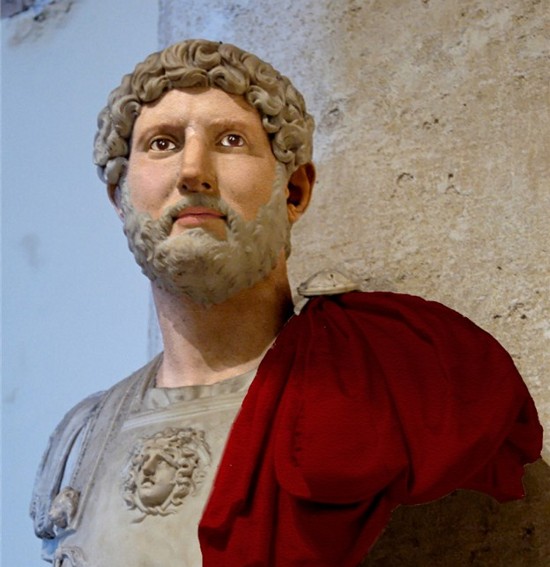
A statue of the Emperor Hadrian photo shopped to re-create its original vivid paint job makes for a stunningly life-like image. 
The wall was built at the direction of the Emperor Hadrian, the third of the so-called Five Good Emperors, who ruled the Empire from 117 to 138.  He came from a noble Roman family of Iberian origins and was also a noted Stoic philosopher.  Hadrian ruled over a period of stability and initiated a policy of peace through strength by fortifying and garrisoning the borders of the Empire most threatened—in Germania and Britannia.  The German fortifications were elaborate wooden palisades, but the largely treeless moors of northern Britannia caused those fortifications to be built of abundant local stone.
Hadrian’s Legions had crushed a major rebellion in Britannia a year earlier and sent the remnants of the defeated armies scurrying north into the Cornish and Scottish highlands where both Celts and Picts had long resisted Roman rule. The Emperor personally ordered the construction to “separate the Romans from the Barbarians,” while on a personal inspection tour of the remote province.  
The Wall eventually extended west from Segedunum at Wallsend on the River Tyne to the shore of the Solway Firth.  For most of its distance the wall was continuous but interspersed at intervals with gates to allow trade and collect tariffs and garrison forts.  In the rugged terrain near its western terminus, the curtain wall was replaced by a system of Milecastles and Turrets, each within sight of one another.

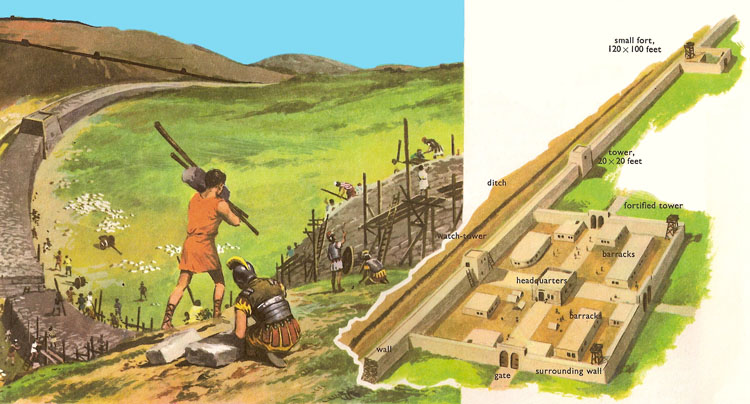
Construction of a section of the wall with a diagram of fortifications.
Construction on the wall took six years to complete.  Sections were assigned to each of the three Legions posted to Britannia, and construction details differed depending on which Legion did the work.  Originally Milecastles and gates were to be manned by small garrisons of a few dozen each.  Within a few years, it was determined to strengthen the line with the construction of 14 to 17 major forts at intervals, each capable of holding 100 to 1000 troops.  Infantry was posted along most of the distance and two large cavalry posts for 1000 riders anchored each end.
Eventually the entire defensive line included small forts set north of the wall as an early warning system; a glacis, an artificial slope of earth and ditch; a berm with rows of pits concealing entanglements; the curtain wall and gate fortresses; and an interior military road.  It was a formidable barrier.

Remains of a small gate garrison fortification.  The gate below was cut by modern farmers to access grazing for their sheep.
After the Legions completed construction, the Wall was garrisoned by Auxiliary troops—non-Roman citizen mercenaries hired by the Empire.  They probably included troops raised in Germania, Gaul, and Iberia, but eventually were mostly locally recruited Britons.  The garrisons were permanent and the soldiers farmed nearby lands on both sides of the wall for sustenance, married, and raised families.  By the end of its useful existence, which actually outlived the Roman presence in Britain, the troops were so well integrated that they were essentially a local militia.  In its early years as many as 10,000 soldiers maintained the garrisons.
After Hadrian’s death his successor Antoninus Pius sought to aggressively push the frontier north.  He ordered the Antoine Wall built to the north at the narrowest width of lower Scotia.  Hadrian’s Wall was stripped of most of its garrisons and made a secondary defensive line.  But the barbarians of the north were too much and after Marcus Aurelius came to power he ordered the Antoine Wall abandoned in 164 and the return to and reconditioning of Hadrian’s original line.  

"Barbarians" attacking the Wall.
In the years around 190 the wall came under concerted attack from the barbarians.  Fierce fighting damaged some sections, but on the whole the Wall prevented Britannia from being overwhelmed.  Major renovations and repairs were made.
By 410 the Legions and most Roman administrators had left the island.  While still technically part of the Empire, local troops and Romanized Britons were left to their own devises.  Parts of the wall remained occupied and garrisoned well into the 5th Century before the last remnants of Romanized Briton collapsed under pressure—the myth shrouded era that gave original birth to the Arthurian Legend.
For generations local farmers stripped portions of the wall of stone for their own construction and local authorities used them for road building.  By the early 19th Century it was in danger of disappearing as a landmark.  

Early Victorian John Clayton began buying up land crossed by the wall, sponsored archeological excavations, and  began reconstruction efforts.
In 1830 Newcastle upon Tyne Town Clerk John Clayton, an avid antiquarian, undertook to save the Wall from continued demolition and to restore as much of it as possible.  In 1834 he personally began to buy land on which the wall sat and to do excavations and eventual restoration.  Over time he had control of land from Brunton to Cawfields.  By the introduction of modern agricultural techniques and selective livestock breading, the lands became profitable enough to sustain Clayton’s continued work on the wall.  He also publicized and popularized his work throughout England.
Although Clayton’s heirs squandered his fortune at the gambling tables, much of the work was done.  
In 1987 Hadrian’s Wall was declared a UNESCO World Heritage Site.  Its maintenance and preservation is the responsibility of English Heritage, a government organization in charge of historic sites in England.  Hiking trails parallel much of the Wall and in most places visitors can walk right up to it, and even climb it to have their pictures taken.  It is the most popular tourist attraction in northern England.

Although often photographed, this stretch of Trump's Wall is part of less than 47 miles he has actually built.
Despite looting Federal agencies including FEMA and the Department of Defense of billions for construction of his southern border wall and running roughshod over public lands including nature reserves as well as over local land owners and municipalities, Donny Boy’s project is not going well.  46.7 miles actual wall have been built two-and-a-half years into Trump's presidency.  Existing fencing and barriers, some of it merely barbed and razor wire already cover 648 of the more than 1000 miles of his proposed wall from the Pacific Ocean to the Gulf of Mexico.  Despite ordering his minions to defy Federal Law and court orders with a promise to pardon them if they are indicted, he is unlikely ever to come close to completing the monument to his own ego.  As Caesars go he is much more likely to be remembered as a Nero fiddling while Rome—American democracy—burns, than as the “Good Emperor” Hadrian.

Tuesday, September 13, 2016

Hadrian Built a Wall

Ruins and remnants of Hadrian's Wall.


Donald Trump probably slept through world history classes at expensive New York Military Academy and the two years he spent at Fordham before transferring to Wharton to study the art of the real estate swindle.  He probably promised to pay some dweeb to do his homework and then stiffed him.  So chances are that The Donald never heard of Hadrian and his wall.  If he had, I am sure he would have been inspired.  After all, he wants to be Caesar  and has a taste for bloated projects.  According to sources I consult when choosing topics for the blog, on this date in 122 A.D. work began on the construction of Hadrian’s Wall, defensive fortifications that stretched across the northern boundary of the Roman province of Britannia.  How that can be determined with such precision is unclear to me, but never let a fuzzy date interfere with a good story.
The wall was built at the direction of the Emperor Hadrian, the third of the so-called Five Good Emperors, who ruled the Empire from 117 to 138.  He came from a noble Roman family of Iberian origins and was also a noted Stoic philosopher.  Hadrian ruled over a period of stability and initiated a policy of peace through strength by fortifying and garrisoning the borders of the Empire most threatened—in Germania and Britannia.  The German fortifications were elaborate wooden palisades, but the largely treeless moors of northern Britannia caused those fortifications to be built of abundant local stone.

A statue of the Emperor Hadrian photo shopped to re-create its original vivid paint job makes for a stunningly life-like image. 

Hadrian’s Legions had crushed a major rebellion in Britannia a year earlier and sent the remnants of the defeated armies scurrying north into the Cornish and Scottish highlands where both Celts and Picts had long resisted Roman rule. The Emperor personally ordered the construction to “separate the Romans from the Barbarians,” while on a personal inspection tour of the remote province. 
The Wall eventually extended west from Segedunum at Wallsend on the River Tyne to the shore of the Solway Firth.  For most of its distance the wall was continuous but interspersed at intervals with gates to allow trade and collect tariffs and garrison forts.  In the rugged terrain near its western terminus, the curtain wall was replaced by a system of Milecastles and Turrets, each within sight of one another.
Construction on the wall took six years to complete.  Sections were assigned to each of the three Legions posted to Britannia, and construction details differed depending on which Legion did the work.  Originally Milecastles and gates were to be manned by small garrisons of a few dozen each.  Within a few years, it was determined to strengthen the line with the construction of 14 to 17 major forts at intervals, each capable of holding 100 to 1000 troops.  Infantry was posted along most of the distance and two large cavalry posts for 1000 riders anchored each end.

Construction of a section of the wall with a diagram of fortifications.

Eventually the entire defensive line included small forts set north of the wall as an early warning system; a glacis, an artificial slope of earth and ditch; a berm with rows of pits concealing entanglements; the curtain wall and gate fortresses; and an interior military road.  It was a formidable barrier.
After the Legions completed construction, the Wall was garrisoned by Auxiliary troops—non-Roman citizens mercenaries hired by the Empire.  They probably included troops raised in Germania, Gaul, and Iberia, but eventually were mostly locally recruited Britons.  The garrisons were permanent and the soldiers farmed nearby lands on both sides of the wall for sustenance, married, and raised families.  By the end of its useful existence, which actually outlived the Roman presence in Britain, the troops were so well integrated that they were essentially a local militia.  In its early years as many as 10,000 soldiers maintained the garrisons.
After Hadrian’s death his successor Antoninus Pius sought to aggressively push the frontier north.  He ordered the Antoine Wall built to the north at the narrowest width of lower Scotia.  Hadrian’s Wall was stripped of most of its garrisons and made a secondary defensive line.  But the barbarians of the north were too much and after Marcus Aurelius came to power he ordered the Antoine Wall abandoned in 164 and the return to and reconditioning of Hadrian’s original line. 
In the years around 190 the wall came under concerted attack from the barbarians.  Fierce fighting damaged some sections, but on the whole the Wall prevented Britannia from being overwhelmed.  Major renovations and repairs were made.
By 410 the Legions and most Roman administrators had left the island.  While still technically part of the Empire, local troops and Romanized Britons were left to their own devises.  Parts of the wall remained occupied and garrisoned well into the 5th Century before the last remnants of Romanized Briton collapsed under pressure—the myth shrouded era that gave original birth to the Arthurian Legend.
For generations local farmers stripped portions of the wall of stone for their own construction and local authorities used it for road building.  By the early 19th Century it was in danger of disappearing as a landmark.  

John Clayton who saved, preserved, and restored much of the Wall.

In 1830 Newcastle upon Tyne Town Clerk John Clayton, an avid antiquarian, undertook to save the Wall from continued demolition and to restore as much of it as possible.  In 1834 he personally began to buy land on which the wall sat and to do excavations and eventual restoration.  Over time he had control of land from Brunton to Cawfields.  By the introduction of modern agricultural techniques and selective livestock breading, the lands became profitable enough to sustain Clayton’s continued work on the wall.  He also publicized and popularized his work throughout England.
Although Clayton’s heir squandered his fortune at the gambling tables, much of the work was done. 
In 1987 Hadrian’s Wall was declared a UNESCO World Heritage Site.  Its maintenance and preservation is the responsibility of English Heritage, a government organization in charge of historic sites in England.  Hiking trails parallel much of the Wall and in most places visitors can walk right up to it, and even climb it to have their pictures taken.  It is the most popular tourist attraction in northern England.