Showing posts with label Praying Indians. Show all posts

Wednesday, June 24, 2026

King Phillips War--When Tribes Almost Drove Out Settler Colonists


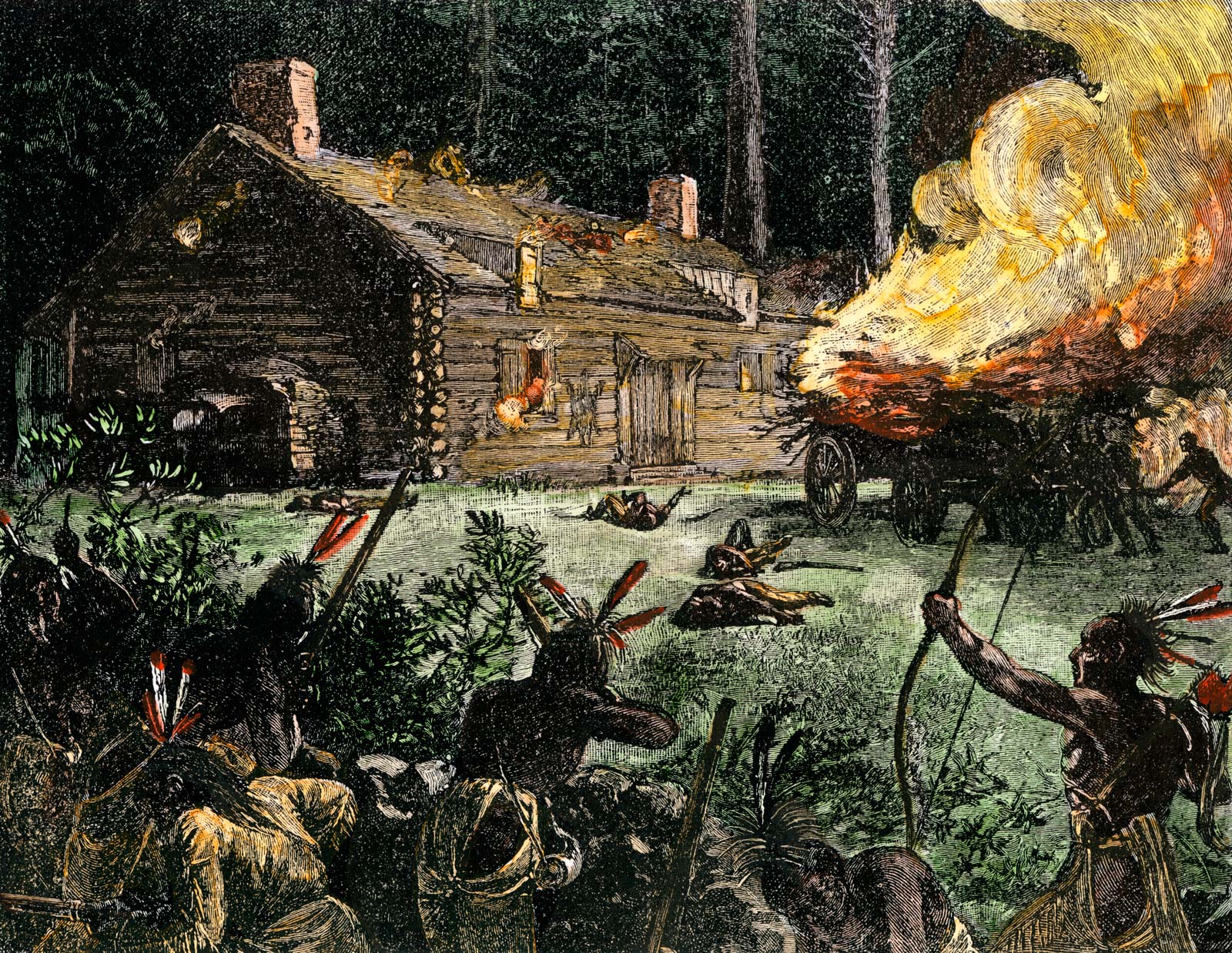
Attacking a homestead during King Philip's War.

On June 24, 1675 King Philip’s War erupted in New England with the sudden attack on isolated farmsteads in the Town of Swansea in Plymouth Colony by a band of Pokanoket.  The raiders lay siege to the town for five days before capturing and burning it with several settlers killed, including some from other towns who had attempted to raise the siege.

Alarm spread across the colonies.  Forces of Plymouth and Boston responded by raiding and burning a Wampanoag town at Mt. Hope (modern Bristol, Rhode Island).  The war quickly spread across the region with the Wampanoag, Pokanoket, Nipmunk, Podunk, Narragansett, and Nashaway peoples rising up against the colonists and their native allies the Mohegan and Pequoit.

It was the bloodiest conflict between settlers and natives in the early colonial period and per-capita on both sides the bloodiest war ever fought in North America.  Out of a total English population of about 56,000 more than 800 were killed, about 1.5% of the total.  Nearly half of all New England towns were attacked and more remote areas were swept of settlers.

Losses were even worse for native tribes.  Out of about 20,000 people in the various tribes, 3,000 or so were killed outright—about 15% of the population—and many more were injured.  Smaller tribes were nearly destroyed, and many fled their homes to an uncertain fate in the territory of hostile tribes further inland.

What stunned the settlers was that the war erupted after 50 years of general peace and was led by the Wampanoag, long-time allies and trading partners.  The original peace had been made by Massasoit, Sachem of the tribe and Plymouth leaders shortly after their 1620 landing.  It was Massasoit and his band that had helped the struggling colony survive the first brutal winter, taught them how to grow corn, and were the guests at the semi-mythical First Thanksgiving.  The Wampanoag prospered trading pelts, meat, and crafts with the colonists for knives, pots, and other desired iron goods.  And the alliance protected them from their enemies including the Iroquoian Mohegans.

But tensions had gradually been rising as Plymouth and the Massachusetts Bay colony centered at Boston spread inland, north and south along the coast, and up the Connecticut River stabbing deep into tribal hunting grounds.  The rapid population growth of Colonists put pressure on game populations.  And an economic crisis of sorts arose as the friendly tribes began running out of trade goods and turned to bartering for land—often land that they shared with other tribes.

Attempts to Christianize the tribes was also resented by most, although a few hundred did convert and moved to Praying Towns where they studied the Gospel and learned English crafts and trades.  These Praying Indians were resented by traditionalists, and, when push came to shove, distrusted by their White protectors.

After the elderly Massasoit, who crafted the alliance died in 1661, relations rapidly deteriorated.  His eldest son Wamsutta became Grand Sachem of the Wampanoag Confederacy.  Wamsutta himself died suddenly, and somewhat mysteriously, while visiting Plymouth Governor Josiah Winslows home for negotiations.  He was succeeded as Sachem by his younger brother Metacom, who would become known among the colonists as King Philip


                                                Paul Revere imagined this is what Metacom looked like in  this engraving for the book The Entertaining History of King Philip's War.

In council Metacom had long advocated resistance to the English.  Now he circulated among the tribes, both members of the Wampanoag Confederacy and ancient tribal enemies urging them to unite and rise up.  An advisor to Metacom, Praying Indian John Sassamon and the first native educated at Harvard, became alarmed and warned Plymouth officials of a possible uprising.  His mutilated body was soon found frozen in a pond, likely assassinated by Metacom’s supporters.

Plymouth authorities, acting on tips from other Praying Indians, arrested three warriors, tried them before a jury that included some natives, and hanged them on June 8.  Two weeks later war broke out. 


Early in the war the natives were triumphant. During the summer the towns of Middleborough, Dartmouth, Mendon, Brookfield, and Lancaster were attacked, and survivors fled. In early September they attacked Deerfield, Hadley, and Northfield


100 Militia and unarmed farmers sent to reap harvests abandoned by panicked settlers were ambushed and nearly massacred at Battle of Bloody Bank.

The New England Confederation consisting of the colonies of Plymouth, Massachusetts Bay, Connecticut, and New Haven, declared war on September 9 and began organizing a common defense.  Their first action was a disaster.  A column of about 100 militia and farmers was dispatched to the burned over areas to try to reap abandoned harvests and retrieve other supplies for the coming winter.  They were ambushed near Hadley and nearly massacred at the Battle of Bloody Bank.  More raids against the frontier towns of Springfield and Hatfield continued in the early Fall


Plymouth Governor Josiah Winslow was the main New England leader in King Philip's War.  The death of Wampanoag Grand Sachem Wamsutta at his home while visiting for negotiations may have been an assassination or an accident, but it set of the war.  He would order the attack on the neutral Narragansett Praying Indians was not only an atrocity, it spread the war.

Led by Plymouth Governor Winslow the Colonists elected not to strike west into the Wamponoag heartland, but south against the Narragansett, who tried to remain neutral in the war.  Winslow suspected them of harboring Wamponoag women and children and feared that they might join the general uprising.  With friendly Indians for guides the force moved into Rhode Island, not a member of the New England Confederacy and generally friendly to the tribe.  In December they found and destroyed several villages then located the Narragansett stronghold palisade fort near modern South Kingston.  Winslow attacked with about a thousand men across a frozen bog.  The Great Swamp Fight ended with the fort and most of the tribe’s winter provisions burned.  The Narragansett lost at least 300 and the remnants of the tribe were forced away from their homes where many died of exposure or starvation and the surviving warriors joined the general uprising.

The colonists also lost heavily in the fight with 70 killed, including many of their most experienced officers, and 150 wounded. 


The Great Swamp Fight.

Over the Winter the tribal offensive intensified.  Twenty-three towns and villages were attacked.  And in reprisal for the Narragansett raid the Jireh Bull Garrison House near the site of the Great Swamp Fight was attacked, burned to the ground, and its 15-man garrison massacred.  It was a rare instance of a well-fortified colonial post being taken by assault.

Things got even worse that Spring.  Plymouth Plantation itself, deep in the most settled and well defended area, was attacked on March 12.  Although the attack was repulsed it demoralized the colonists.  Three more towns were attacked within two weeks.  A sizable company of Massachusetts Militia under a Captain Pierce was ambushed between Pawtucket and Blackstones settlement.  Most were killed outright and those taken captive were tortured and killed.

The Rhode Island capitol of Providence had to be abandoned and was later burned.  Across the region colonists were forced back on their most populous towns which were fortified to withstand repeated attacks.  Rhode Islanders were forced into a small defensive perimeter around Newport.

But despite battlefield victories, the Indian offensive began to grind to a halt for lack of provisions.  The war had left their own crops neglected and a hunting season was lost to battle.  Hoped for aid from the English enemy the French in Canada did not materialize except for some arms and ammunition used in the northernmost battleground—Massachusetts’s colonies in what is now Maine.

The Wampanoag’s traditional enemies the Pequot and Mohegans joined the colonists in greater numbers and began raiding Wamponoag villages and burning crops.  They played a big role in defending Connecticut from the kind of destruction faced elsewhere.

Desperately Metacom traveled to the lands of his traditional enemies the Mohawks to secure an alliance but instead they launched attacks on his exposed villages and fields.  Hungry bands began leaving the area for safety in Maine, New Hampshire, New York, and even Canada.

In April 1676 the remnants of the Narragansett under Canonchet were defeated and the chief killed.  The next month Massachusetts Militia under Captain William Turner fell upon a large group of natives in a fishing camp at Peskeopscut on the Falls of the Connecticut River killing nearly 200 and forcing many survivors to jump into the river where they likely drown.  It was an expensive victory.  Turner and 40 of his men were also killed.

Battles near Hadley and Marlborough scattered native survivors.  Colonial authorities offered an amnesty to those who would come in to surrender and who could show that they had not been combatants.  Hungry bands began to straggle in.  By early July over 400 had surrendered.

Metacom went into hiding in the Assowamset Swamp near Providence and near where the war started.  He was hunted by mixed teams of settlers and native allies.  He was found and killed by Praying Indian John Alderman.  He was beheaded, drawn and quartered. 


                                            Victorious militia troops march into Plymouth with Metacom's head on a pike.

The severed head of “King Philip” was on display at Plymouth for the next twenty years.  Fighting in northern Maine dragged on another year, but the New England heartland was secure.

Many of the tribes were essentially eliminated as organized bands or pushed beyond the frontier.  Hundreds of native captives were tried and executed or sold as slaves in Bermuda, where many residents today trace their lineage to exiled Indians.

Although Plymouth and other colonies had gone deeply in debt and much capital was destroyed, the amazing population growth of the colonies recouped losses within a few years.  Western settlement was delayed by lingering fears of Indian attacks and by the growing threat of the French but that allowed the core settlements to grow into real cities and encouraged a move away from subsistence farming to trade and manufacture.  By the end of the century the per capita income and standard of living in New England exceeded that of Mother England.

Thursday, May 23, 2024

Why the Greatest Real Estate Deal of All Time Wasn’t and How it Cursed All it Touched

Almost everything is wrong with this 19th Century depiction of the sale of Manhattan Island to the Dutch under Peter Minuit including the squatting Canarsie tribe being depicted in Plains Indian attire and the trade goods offered by the Europeans.

On this day in 1626 the greatest real estate deal in history went down.  But the real winner in the deal is not the one you have been told about.

Due to a simplistic account in a 19th Century popular reader, almost any American will tell you that Manhattan Island was bought by the Dutch from local Indians for “$24 in beads and trinkets.”  Those with especially acute memories might recall the alleged sharpie who hoodwinked the natives with his paltry offering was Peter Minuit, Governor of the North American colony owned by the Dutch West Indies Company

There are several things wrong with this version.  First and foremost is that the trade goods Minuit offered were not the trade trifles mentioned, but a selection of metal tools and implements including axe heads, knives, awls, needles, cast iron kettles, as well as cloth.  They were valued by Minuit at 60 silver guilders, a significant sum.  Depending on who is doing the reckoning and how inflation over nearly four centuries is figured, that would be worth well more than $1000 in today’s cash. 

But as one historian points out, the value of the items to the natives was probably much more than the actual monetary value.  Most of these items had been virtually unobtainable, although a few had found their way ashore from other European ships or have been traded down from New England or far away New France.  A historian described it as a significant “high-end technology transfer, handing over equipment of enormous usefulness.”

                        Peter Minuit--a colonial governor for both Dutch and Swedish mercantile firms.

But it was the natives who Minuit dealt with that may have been the real sharpies.  He assumed he was doing business with the Lenape; a powerful and extensive tribe that held sway over what is now the Delaware Valley including much of modern New Jersey and over the area around the mouth of the Hudson River including Manhattan and much of Long Island.  They were a sedentary people engaged in extensive agriculture and both coastal and inland fishery, including the harvesting of oysters.  Relatively large villages relocated within the range every year or so, returning to previous sites when the land rejuvenated itself.

Evidently the local Lenape, however, were not using Manhattan at the time the Dutch arrived.  Instead, they made sort of a sub-lease agreement with the much smaller Canarsie tribe who shared some of Long Island with them and a dozen other small bands.  The Canarsie, who were harvesting oysters and gardening on the island, could hardly believe their good fortune.  They gladly sold the Dutch what didn’t belong to them and retreated to Long Island with what they must have considered a fortune.

A previous governor had established Fort Amsterdam on the southern tip of the island the year before.  Minuit now felt secure enough in his sale to begin settlement of a new colonial capital Nieuw-Amsterdam.  Eventually the Lanape, who became the chief partners of the new colony in the fur trade, complained about the Dutch squatting on their land and a second purchase had to be arranged.  The exact price paid in this second deal is lost to history, but the Lenape likely did pretty well in trade goods themselves.

The fates of all parties to the deal were unhappy.

In 1631 Minuit was fired by the Dutch West India company for failing to meet expectations for the fur trade and was accused of skimming accounts for his own benefit.  Enraged, he returned to Europe and offered himself to the Swedes, an ascending power eager to get into North American colonization.  In 1638 he returned as Governor General of New Sweden and established Fort Christiana new modern day Wilmington, Delaware.  He was killed later the same year on a return voyage to recruit more settlers.  He sailed via the Caribean to pick up a load of tobacco to make the journey profitable for the company and perished in a hurricane near the island of St. Christopher.  His colony lasted a dozen more years until a later Dutch governor, Peter Stuyvesant, conquered it in 1655.

The Canarsie, one of thirteen small tribes on Long Islandallied themselves with the much more powerful Mohawks from the mainland for protection.  They lived in relative harmony with the Dutch until a later governor, William Kieft, launched a war on local tribes.  A massacre of the village of Pavonia united all the tribes in a general uprising in 1643.  The ensuing war was devastating to both settlers and the tribes.  Peter Stuyvesant eventually negotiated a peace.  Many Canarsie converted to Christianity during the period of peace and continued to farm and fish in the area.

The Dutch persuaded the 13 tribes of Long Island not to pay tribute to their traditional protectors, the Mohawks.  In 1655 a large Mohawk war party invaded Long Island and massacred most of the local tribal residents.

Descendants of the Canarsie sill living in Brooklyn participated in this 1937 re-enactment of their real estate scam at a public school.

A remnant of the Canarsie later sold most of their remaining land to the British, after they seized New Amsterdam.  Small numbers continued to live and farm in rural Brooklyn into the 19th Century.  A unit of Canarsie volunteers served in the Civil War.  Eventually descendants of the tribe became absorbed by the white community and the tribe disappeared into the mist of history.

The much larger Lenape at least persist as a people.  Their culture was much disrupted by the arrival of the Dutch, Swedes, and the English.  In order to obtain much desired trade goods, they abandoned much of their traditional agricultural and fishery based economy to pursue the fur trade.  This took them deep into hostile territory dominated by the Mohawk and other Iroquoian people.  By the late 18th Century pressure from the Iroquois and expanding European settlement forced most major bands to re-settle west of the Allegany Mountains in what is now western Pennsylvania and along the Ohio RiverRemnant bands in the east were mostly absorbed by other tribes or by neighboring white settlements.  

A traditional eastern Lanape Village before their culture was disrupted and they were forced out of their original range.

After the signing of the Treaty of Easton in 1758, most of the remaining Lenape were forced to move west out of their lands in Delaware, New Jersey, eastern New York, and eastern Pennsylvania into what is today known as Ohio.  Some of Lenape were converted by the Moravians, a German pietistic sect that practiced pacifism.  These “Praying Indians” settled west of Ft. Pitt along the Ohio River with their missionaries

In the French and Indian Wars more warlike bands allied themselves with the French and were present at the Siege of Ft. Pitt.

During the American Revolution bands of the tribe, by then generally known as the Delaware, split allegiances between the British and the colonists.  Several large bands relocated to the Sandusky to be closer to the British stronghold of Ft. Detroit.  Others scouted for the Americans, or in the case of the Praying Indians tried to remain neutralCoshocton was the main town of the Delaware friendly to the colonists.  They hoped to form an all-Indian state within the infant republic.  But after their chief, White Eyes was killed, probably by American militiamen, many of the warriors from Coshocton joined their kinsmen with the British.

Massacre of the Praying Indians by the Pennsylvania Militia and their native scouts.

American Colonel Daniel Brodhead led an expedition out of Fort Pitt and in 1781 destroyed Coshocton. Surviving residents fled to the north to the British.  The next year the peaceful Moravian missionary village of Gnadenhutten was attacked by Pennsylvania militia.  At least 96 men, women and children were massacred.

Various Delaware bands were caught up in the continuing fierce warfare along the Ohio frontier after the Revolution.  Some took up arms again with the British in the War of 1812.  After the capture of Ft. Detroit in that war, northern Delaware bands, including some of the Moravians relocated to what is now western Ontario.

Most of the remaining American Delaware ceded their lands in Ohio in the Treaty of St. Marys in 1814.  Bands took up lands in Indiana and Missouri.  In 1829 yet another treaty, the Treaty of James Fork pushed the tribe yet further west.  In exchange for the Indiana and Missouri lands they received grants in Kansas.

The Delaware became active as guides and trappers in the trans-Mississippi West and frequently served as scouts for the Army.  They were prominent in the Seminole Wars and were among those with John Charles Frèmont when he entered California during the Mexican War.  Later they would be guides for emigrant trains to the West.

A Delaware couple in the late 19th Century, probably in Indian Territory (Oklahoma).  Their dress was reflective of cultural contact with other tribes and adaptations in their generations of being pushed ever west.

Despite loyal service the Delaware were again pushed from their lands.  Most relocated to Indian Territory by 1860.  They were forced to buy lands from the Cherokee.  In 1979 The Bureau of Indian Affairs ceased to recognize the Oklahoma Delaware as a separate tribe and began to count them as Cherokee.  That decision was overturned in 1996.  A challenge by the Cherokee to the re-instatement caused a see-sawing legal battle with the tribe stripped of recognition again and then having it restored.  As of 2009 they have had tribal status and the same year reorganized under the Oklahoma Indian Welfare Act with a tribal government of its own.

Other small bands of Lenape or Delaware are scattered from New Jersey to Wisconsin but have no formal recognition.  In Ontario, decedents of the Lenape of Ohio still live on four reservations.