Showing posts with label King Phillip's War. Show all posts

Wednesday, June 24, 2026

King Phillips War--When Tribes Almost Drove Out Settler Colonists


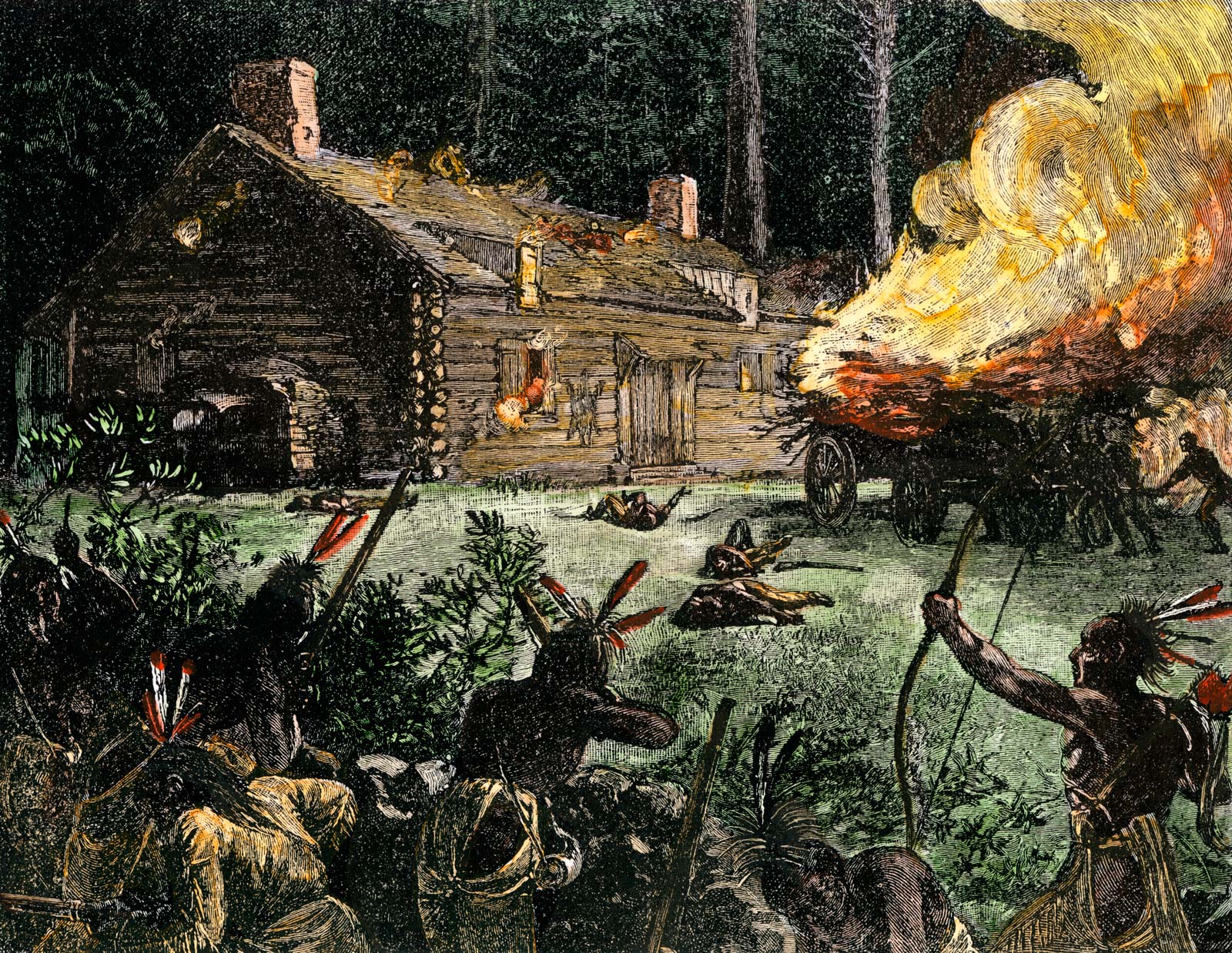
Attacking a homestead during King Philip's War.

On June 24, 1675 King Philip’s War erupted in New England with the sudden attack on isolated farmsteads in the Town of Swansea in Plymouth Colony by a band of Pokanoket.  The raiders lay siege to the town for five days before capturing and burning it with several settlers killed, including some from other towns who had attempted to raise the siege.

Alarm spread across the colonies.  Forces of Plymouth and Boston responded by raiding and burning a Wampanoag town at Mt. Hope (modern Bristol, Rhode Island).  The war quickly spread across the region with the Wampanoag, Pokanoket, Nipmunk, Podunk, Narragansett, and Nashaway peoples rising up against the colonists and their native allies the Mohegan and Pequoit.

It was the bloodiest conflict between settlers and natives in the early colonial period and per-capita on both sides the bloodiest war ever fought in North America.  Out of a total English population of about 56,000 more than 800 were killed, about 1.5% of the total.  Nearly half of all New England towns were attacked and more remote areas were swept of settlers.

Losses were even worse for native tribes.  Out of about 20,000 people in the various tribes, 3,000 or so were killed outright—about 15% of the population—and many more were injured.  Smaller tribes were nearly destroyed, and many fled their homes to an uncertain fate in the territory of hostile tribes further inland.

What stunned the settlers was that the war erupted after 50 years of general peace and was led by the Wampanoag, long-time allies and trading partners.  The original peace had been made by Massasoit, Sachem of the tribe and Plymouth leaders shortly after their 1620 landing.  It was Massasoit and his band that had helped the struggling colony survive the first brutal winter, taught them how to grow corn, and were the guests at the semi-mythical First Thanksgiving.  The Wampanoag prospered trading pelts, meat, and crafts with the colonists for knives, pots, and other desired iron goods.  And the alliance protected them from their enemies including the Iroquoian Mohegans.

But tensions had gradually been rising as Plymouth and the Massachusetts Bay colony centered at Boston spread inland, north and south along the coast, and up the Connecticut River stabbing deep into tribal hunting grounds.  The rapid population growth of Colonists put pressure on game populations.  And an economic crisis of sorts arose as the friendly tribes began running out of trade goods and turned to bartering for land—often land that they shared with other tribes.

Attempts to Christianize the tribes was also resented by most, although a few hundred did convert and moved to Praying Towns where they studied the Gospel and learned English crafts and trades.  These Praying Indians were resented by traditionalists, and, when push came to shove, distrusted by their White protectors.

After the elderly Massasoit, who crafted the alliance died in 1661, relations rapidly deteriorated.  His eldest son Wamsutta became Grand Sachem of the Wampanoag Confederacy.  Wamsutta himself died suddenly, and somewhat mysteriously, while visiting Plymouth Governor Josiah Winslows home for negotiations.  He was succeeded as Sachem by his younger brother Metacom, who would become known among the colonists as King Philip


                                                Paul Revere imagined this is what Metacom looked like in  this engraving for the book The Entertaining History of King Philip's War.

In council Metacom had long advocated resistance to the English.  Now he circulated among the tribes, both members of the Wampanoag Confederacy and ancient tribal enemies urging them to unite and rise up.  An advisor to Metacom, Praying Indian John Sassamon and the first native educated at Harvard, became alarmed and warned Plymouth officials of a possible uprising.  His mutilated body was soon found frozen in a pond, likely assassinated by Metacom’s supporters.

Plymouth authorities, acting on tips from other Praying Indians, arrested three warriors, tried them before a jury that included some natives, and hanged them on June 8.  Two weeks later war broke out. 


Early in the war the natives were triumphant. During the summer the towns of Middleborough, Dartmouth, Mendon, Brookfield, and Lancaster were attacked, and survivors fled. In early September they attacked Deerfield, Hadley, and Northfield


100 Militia and unarmed farmers sent to reap harvests abandoned by panicked settlers were ambushed and nearly massacred at Battle of Bloody Bank.

The New England Confederation consisting of the colonies of Plymouth, Massachusetts Bay, Connecticut, and New Haven, declared war on September 9 and began organizing a common defense.  Their first action was a disaster.  A column of about 100 militia and farmers was dispatched to the burned over areas to try to reap abandoned harvests and retrieve other supplies for the coming winter.  They were ambushed near Hadley and nearly massacred at the Battle of Bloody Bank.  More raids against the frontier towns of Springfield and Hatfield continued in the early Fall


Plymouth Governor Josiah Winslow was the main New England leader in King Philip's War.  The death of Wampanoag Grand Sachem Wamsutta at his home while visiting for negotiations may have been an assassination or an accident, but it set of the war.  He would order the attack on the neutral Narragansett Praying Indians was not only an atrocity, it spread the war.

Led by Plymouth Governor Winslow the Colonists elected not to strike west into the Wamponoag heartland, but south against the Narragansett, who tried to remain neutral in the war.  Winslow suspected them of harboring Wamponoag women and children and feared that they might join the general uprising.  With friendly Indians for guides the force moved into Rhode Island, not a member of the New England Confederacy and generally friendly to the tribe.  In December they found and destroyed several villages then located the Narragansett stronghold palisade fort near modern South Kingston.  Winslow attacked with about a thousand men across a frozen bog.  The Great Swamp Fight ended with the fort and most of the tribe’s winter provisions burned.  The Narragansett lost at least 300 and the remnants of the tribe were forced away from their homes where many died of exposure or starvation and the surviving warriors joined the general uprising.

The colonists also lost heavily in the fight with 70 killed, including many of their most experienced officers, and 150 wounded. 


The Great Swamp Fight.

Over the Winter the tribal offensive intensified.  Twenty-three towns and villages were attacked.  And in reprisal for the Narragansett raid the Jireh Bull Garrison House near the site of the Great Swamp Fight was attacked, burned to the ground, and its 15-man garrison massacred.  It was a rare instance of a well-fortified colonial post being taken by assault.

Things got even worse that Spring.  Plymouth Plantation itself, deep in the most settled and well defended area, was attacked on March 12.  Although the attack was repulsed it demoralized the colonists.  Three more towns were attacked within two weeks.  A sizable company of Massachusetts Militia under a Captain Pierce was ambushed between Pawtucket and Blackstones settlement.  Most were killed outright and those taken captive were tortured and killed.

The Rhode Island capitol of Providence had to be abandoned and was later burned.  Across the region colonists were forced back on their most populous towns which were fortified to withstand repeated attacks.  Rhode Islanders were forced into a small defensive perimeter around Newport.

But despite battlefield victories, the Indian offensive began to grind to a halt for lack of provisions.  The war had left their own crops neglected and a hunting season was lost to battle.  Hoped for aid from the English enemy the French in Canada did not materialize except for some arms and ammunition used in the northernmost battleground—Massachusetts’s colonies in what is now Maine.

The Wampanoag’s traditional enemies the Pequot and Mohegans joined the colonists in greater numbers and began raiding Wamponoag villages and burning crops.  They played a big role in defending Connecticut from the kind of destruction faced elsewhere.

Desperately Metacom traveled to the lands of his traditional enemies the Mohawks to secure an alliance but instead they launched attacks on his exposed villages and fields.  Hungry bands began leaving the area for safety in Maine, New Hampshire, New York, and even Canada.

In April 1676 the remnants of the Narragansett under Canonchet were defeated and the chief killed.  The next month Massachusetts Militia under Captain William Turner fell upon a large group of natives in a fishing camp at Peskeopscut on the Falls of the Connecticut River killing nearly 200 and forcing many survivors to jump into the river where they likely drown.  It was an expensive victory.  Turner and 40 of his men were also killed.

Battles near Hadley and Marlborough scattered native survivors.  Colonial authorities offered an amnesty to those who would come in to surrender and who could show that they had not been combatants.  Hungry bands began to straggle in.  By early July over 400 had surrendered.

Metacom went into hiding in the Assowamset Swamp near Providence and near where the war started.  He was hunted by mixed teams of settlers and native allies.  He was found and killed by Praying Indian John Alderman.  He was beheaded, drawn and quartered. 


                                            Victorious militia troops march into Plymouth with Metacom's head on a pike.

The severed head of “King Philip” was on display at Plymouth for the next twenty years.  Fighting in northern Maine dragged on another year, but the New England heartland was secure.

Many of the tribes were essentially eliminated as organized bands or pushed beyond the frontier.  Hundreds of native captives were tried and executed or sold as slaves in Bermuda, where many residents today trace their lineage to exiled Indians.

Although Plymouth and other colonies had gone deeply in debt and much capital was destroyed, the amazing population growth of the colonies recouped losses within a few years.  Western settlement was delayed by lingering fears of Indian attacks and by the growing threat of the French but that allowed the core settlements to grow into real cities and encouraged a move away from subsistence farming to trade and manufacture.  By the end of the century the per capita income and standard of living in New England exceeded that of Mother England.

Friday, June 24, 2022

The War When Tribes Almost Drove Out Settler Colonists

Attacking a homestead during King Philip's War.

On June 24, 1675 King Philip’s War erupted in New England with the sudden attack on isolated farmsteads in the Town of Swansea in Plymouth Colony by a band of Pokanoket.  The raiders lay siege to the town for five days before capturing and burning it with several settlers killed, including some from other towns who had attempted to raise the siege.

Alarm spread across the colonies.  Forces of Plymouth and Boston responded by raiding and burning a Wampanoag town at Mt. Hope (modern Bristol, Rhode Island).  The war quickly spread across the region with the Wampanoag, Pokanoket, Nipmunk, Podunk, Narragansett, and Nashaway peoples rising up against the colonists and their native allies the Mohegan and Pequoit.

It was the bloodiest conflict between settlers and natives in the early colonial period and per-capita on both sides the bloodiest war ever fought in North America.  Out of a total English population of about 56,000 more than 800 were killed, about 1.5% of the total.  Nearly half of all New England towns were attacked and more remote areas were swept of settlers.

Losses were even worse for native tribes.  Out of about 20,000 people in the various tribes, 3,000 or so were killed outright—about 15% of the population—and many more were injured.  Smaller tribes were nearly destroyed, and many fled their homes to an uncertain fate in the territory of hostile tribes further inland.

What stunned the settlers was that the war erupted after 50 years of general peace and was led by the Wampanoag, long-time allies and trading partners.  The original peace had been made by Massasoit, Sachem of the tribe and Plymouth leaders shortly after their 1620 landing.  It had been Massasoit and his band that had helped the struggling colony survive the first brutal winter, taught them how to grow corn, and were the guests at the legendary First Thanksgiving.  The Wampanoag had prospered trading pelts, meat, and crafts with the colonists for knives, pots, and other desired iron goods.  And the alliance had protected them from their enemies including the Iroquoian Mohegans.

But tensions had gradually been rising as Plymouth and the Massachusetts Bay colony centered at Boston had spread inland, north and south along the coast, and up the Connecticut River stabbing deep into tribal hunting grounds.  The rapid population growth of Colonists put pressure on game populations.  And an economic crisis of sorts arose as the friendly tribes began running out of trade goods and turned to bartering for land—often land that they shared with other tribes.

Attempts to Christianize the tribes was also resented by most, although a few hundred did convert and moved to Praying Towns where they studied the Gospel and learned English crafts and trades.  These Praying Indians were resented by traditionalists, and, when push came to shove, distrusted by their White protectors.

After the elderly Massasoit, who had crafted the alliance died in 1661, relations rapidly deteriorated.  His eldest son Wamsutta became Grand Sachem of the Wampanoag Confederacy.  Wamsutta himself died suddenly, and somewhat mysteriously, while visiting Plymouth Governor Josiah Winslows home for negotiations.  He was succeeded as Sachem by his younger brother Metacom, who would become known among the colonists as King Philip


Paul Revere imagined this is what Metacom looked like in  this engraving for the book The Entertaining History of King Philip's War.

In council Metacom had long advocated resistance to the English.  Now he circulated among the tribes, both members of the Wampanoag Confederacy and ancient tribal enemies urging them to unite and rise up.  An advisor to Metacom, Praying Indian John Sassamon and the first native educated at Harvard, became alarmed and warned Plymouth officials of a possible uprising.  His mutilated body was soon found frozen in a pond, likely assassinated by Metacom’s supporters.

Plymouth authorities, acting on tips from other Praying Indians, arrested three warriors, tried them before a jury that included some natives, and hanged them on June 8.  Two weeks later war broke out. 


Early in the war the natives were triumphant. During the summer the towns of Middleborough, Dartmouth, Mendon, Brookfield, and Lancaster were attacked, and survivors fled. In early September they attacked Deerfield, Hadley, and Northfield


100 Militia and unarmed farmers sent to reap harvests abandoned by panicked settlers were ambushed and nearly massacred at Battle of Bloody Bank.

The New England Confederation consisting of the colonies of Plymouth, Massachusetts Bay, Connecticut, and New Haven, declared war on September 9 and began organizing a common defense.  Their first action was a disaster.  A column of about 100 militia and farmers was dispatched to the burned over areas to try to reap abandoned harvests and retrieve other supplies for the coming winter.  They were ambushed near Hadley and nearly massacred at the Battle of Bloody Bank.  More raids against the frontier towns of Springfield and Hatfield continued in the early fall


Plymouth Governor Josiah Winslow was the main New England leader in King Philip's War.  The death of Wampanoag Grand Sachem Wamsutta at his home while visiting for negotiations may have been an assassination or an accident, but it set of the war.  He would order the attack on the neutral Narragansett Praying Indians was not only an atrocity, it spread the war.

Led by Plymouth Governor Winslow the Colonists elected not to strike west into the Wamponoag heartland, but south against the Narragansett, who had tried to remain neutral in the war.  Winslow suspected them of harboring Wamponoag women and children and feared that they might join the general uprising.  With friendly Indians for guides the force moved into Rhode Island, not a member of the New England Confederacy and generally friendly to the tribe.  In December they found and destroyed several villages then located the Narragansett stronghold palisade fort near modern South Kingston.  Winslow attacked with about a thousand men across a frozen bog.  The Great Swamp Fight ended with the fort and most of the tribe’s winter provisions burned.  The Narragansett lost at least 300 and the remnants of the tribe were forced away from their homes where many died of exposure or starvation and the surviving warriors joined the general uprising.

The colonists also lost heavily in the fight with 70 killed, including many of their most experienced officers, and 150 wounded. 


The Great Swamp Fight.

Over the winter the tribal offensive intensified.  Twenty-three towns and villages were attacked.  And in reprisal for the Narragansett raid the Jireh Bull Garrison House near the site of the Great Swamp Fight was attacked, burned to the ground, and its 15 man garrison massacred.  It was a rare instance of a well-fortified colonial post being taken by assault.

Things got even worse that spring.  Plymouth Plantation itself, deep in the most settled and well defended area, was attacked on March 12.  Although the attack was repulsed it demoralized the colonists.  Three more towns were attacked within two weeks.  A sizable company of Massachusetts Militia under a Captain Pierce was ambushed between Pawtucket and Blackstones settlement.  Most were killed outright and those taken captive were tortured and killed.

The Rhode Island capital of Providence had to be abandoned and was later burned.  Across the region colonists were forced back on their most populous towns which were fortified to withstand repeated attacks.  Rhode Islanders were forced into a small defensive perimeter around Newport.

But despite battlefield victories, the Indian offensive began to grind to a halt for lack of provisions.  The war had left their own crops neglected and a hunting season was lost to battle.  Hoped for aid from the English enemy the French in Canada did not materialize except for some arms and ammunition used in the northernmost battleground—Massachusetts’s colonies in what is now Maine.

The Wampanoag’s traditional enemies the Pequot and Mohegans joined the colonists in greater numbers and began raiding Wamponoag villages and burning crops.  They played a big role in defending Connecticut from the kind of destruction faced elsewhere.

Desperately Metacom traveled to the lands of his traditional enemies the Mohawks to secure an alliance but instead they launched attacks on his exposed villages and fields.  Hungry bands began leaving the area for safety in Maine, New Hampshire, New York, and even Canada.

In April 1676 the remnants of the Narragansett under Canonchet were defeated and the chief killed.  The next month Massachusetts Militia under Captain William Turner fell upon a large group of natives in a fishing camp at Peskeopscut on the Falls of the Connecticut River killing nearly 200 and forcing many survivors to jump into the river where they likely drown.  It was an expensive victory.  Turner and 40 of his men were also killed.

Battles near Hadley and Marlborough scattered native survivors.  Colonial authorities offered an amnesty to those who would come in to surrender and who could show that they had not been combatants.  Hungry bands began to straggle in.  By early July over 400 had surrendered.

Metacom went into hiding in the Assowamset Swamp near Providence and near where the war had started.  He was hunted my mixed teams of settlers and native allies.  He was found and killed by Praying Indian John Alderman.  He was beheaded, drawn and quartered


Victorious militia troops march into Plymouth with Metacom's head on a pike.

The severed head of “King Philip” was on display at Plymouth for the next twenty years.  Fighting in northern Maine dragged on another year, but the New England heartland was secure.

Many of the tribes were essentially eliminated as organized bands or pushed beyond the frontier.  Hundreds of native captives were tried and executed or sold as slaves in Bermuda, where many residents today trace their lineage to exiled Indians.

Although Plymouth and other colonies had gone deeply in debt and much capital was destroyed, the amazing population growth of the colonies recouped losses within a few years.  Western settlement was delayed by lingering fears of Indian attacks and by the growing threat of the French but that allowed the core settlements to grow into real cities and encouraged a move away from subsistence farming to trade and manufacture.  By the end of the century the per capita income and standard of living in New England exceeded that of Mother England.

Tuesday, March 16, 2021

Samoset Surprised the Pilgrims in More Ways Than One

Samoset appears at Plymouth.

It seemed like a warm day by comparison to the harsh winter that had killed 45 of the 102 of them. The settlers, by now a bedraggled bunch were out and about in their small compound on the sheltered side of a hook-shaped cape that jutted into the Atlantic Ocean.  They called the place, somewhat grandly, New Plymouth.  They were religious dissenters, and the sailors and tradesmen they employed.

We call them the Pilgrims.  They called themselves the Company.  That day they were paying particular attention to the professional soldier among them.  Native tribes were moving in the vicinity and at least some seemed hostile.  The soldier, Miles Standish, was trying to organize a militia force. 

Sometime that morning, March 16, 1621, a native man startled the settlers by casually strolling from the woods into the clearing of the village.  He wore only a loin cloth and was very lightly armed with a bow and arrow which he did not display threateningly.  The frightened, agitated settlers accosted him.  Then he spoke, astonishing them all.

He greeted them in broken, but clearly understandable English! “Welcome, Englishmen! My name is Samoset.”

He did not come from the local tribes, but was visiting among them.  He was a Sagamore—local chieftain of an Algonquian people from what is now Maine.  He had met and learned English from fishermen who plied waters of Monhegan Island twelve miles off the coast.  The fishermen traded with the natives on the island.  They took Samoset whether as a slave, hostage, or visitor, with them to England but allowed him to return to his people on the next voyage to the rich fishery.

Samoset was dwelling that season with the distantly related Wampanoag led by the Sachem—the local language variant of Sagamore—Massasoit.  His extended presence among these people was indicative of the web of social and trade relations that connected tribes and clans over great distances.

There is no known life portrait of William Bradford, Governor and historian of Plymouth, the drawing is a commonly used imaginary portrait based on scraps of physical descriptions in letters and journals.

In 1622, William Bradford described the meeting:

Friday the 16th a fair warm day towards; this morning we determined to conclude of the military orders, which we had begun to consider of before but were interrupted by the savages, as we mentioned formerly; and whilst we were busied hereabout, we were interrupted again, for there presented himself a savage, which caused an alarum. He very boldly came all alone and along the houses straight to the rendezvous, where we intercepted him, not suffering him to go in, as undoubtedly he would, out of his boldness. He saluted us in English, and bade us welcome, for he had learned some broken English among the Englishmen that came to fish at Monchiggon, and knew by name the most of the captains, nigers, and masters that usually came. He was a man free in speech, so far as he could express his mind, and of a seemly carriage. We questioned him of many things; he was the first savage we could meet withal. He said he was not of these parts, but of Morattiggon, and one of the sagamores or lords thereof, and had been eight months in these parts, it lying hence a day's sail with a great wind, and five days by land. He discoursed of the whole country, and of every province, and of their sagamores, and their number of men, and strength. The wind being to rise a little, we cast a horseman's coat about him, for he was stark naked, only a leather about his waist, with a fringe about a span long, or little more; he had a bow and two arrows, the one headed, and the other unheaded. He was a tall straight man, the hair of his head black, long behind, only short before, none on his face at all; he asked some beer, but we gave him strong water and biscuit, and butter, and cheese, and pudding, and a piece of mallard, all which he liked well, and had been acquainted with such amongst the English. He told us the place where we now live is called Patuxet, and that about four years ago all the inhabitants died of an extraordinary plague, and there is neither man, woman, nor child remaining, as indeed we have found none, so as there is none to hinder our possession, or to lay claim unto it. All the afternoon we spent in communication with him; we would gladly have been rid of him at night, but he was not willing to go this night. Then we thought to carry him on shipboard, wherewith he was well content, and went into the shallop, but the wind was high and the water scant, that it could not return back. We lodged him that night at Stephen Hopkins’ house, and watched him.

The next day he went away back to the Massasoits, from whence he said he came, who are our next bordering neighbors. They are sixty strong, as he saith. The Nausets are as near southeast of them, and are a hundred strong, and those were they of whom our people were encountered, as before related. They are much incensed and provoked against the English, and about eight months ago slew three Englishmen, and two more hardly escaped by flight to Monchiggon; they were Sir Ferdinando Gorges his men, as this savage told us, as he did likewise of the huggery, that is, fight, that our discoverers had with the Nausets, and of our tools that were taken out of the woods, which we willed him should be brought again, otherwise, we would right ourselves. These people are ill affected towards the English, by reason of one Hunt, a master of a ship, who deceived the people, and got them under color of trucking with them, twenty out of this very place where we inhabit, and seven men from Nauset, and carried them away, and sold them for slaves like a wretched man (for twenty pound a man) that cares not what mischief he doth for his profit.

Saturday, in the morning we dismissed the savage, and gave him a knife, a bracelet, and a ring; he promised within a night or two to come again, and to bring with him some of the Massasoits, our neighbors, with such beavers' skins as they had to truck with us.

Being immortalized on a cigar box was a marker of fame in 19th Century America.  Accuracy was not guaranteed.  

There you have it.  Although somewhat peevishly annoyed Samoset’s brief visit provided the settlers with a world of intelligence about the disposition, numbers, and mood of the tribes in their immediate area, information that they may only have gained at great cost of lives and peril, especially because it allowed them to differentiate between “friendly” and hostile natives.

Even better, true to his word, a few days later Samoset returned bringing with him a delegation including Squanto, who spoke even better English.  Squanto, a Pawtuxet had been kidnapped with others by a lieutenant of John Smith, and taken to Spain in 1614 to be sold as a slave in Spain.  Instead he was given refuge by Spanish Friars who instructed him in Christianity and allowed him to go to England in search of passage back to his home.  Squanto lived for some years in London and learned excellent English before securing passage back home in 1619.

Squanto discovered that his village, the very one occupying the site of New Plymouth, was virtually wiped out by a plague, possibly small pox.  He was now living with his kinsmen in Massasoit’s band.  Despite his bitter experience, he was not totally hostile to the English, although suspicious of them.  Perhaps, having seen London, he was keenly aware of how plentiful they were and how resistance to them might be futile.

At any rate Squanto and Samoset helped open up talks, mostly centered on trading for furs, with the settlers.  When he could ascertain that the talks were friendly, Massasoit himself finally entered the village.  The two sides concluded a treaty of peace and trade and pledged a military alliance against tribes hostile to one or both.

Samoset soon returned to his people in Maine.  In 1624 Captain Christopher Levett, a Yorkshire fisherman entertained Samoset and members of his band on his boat.  After that the man who made first contact with the strangers on the shore, faded into the mists of history.

Squanto helped save the colonists from starvation when he taught them native farming techniques like burying a small fish with a corn seed as fertilizer and growing corn and squash together.

Squanto, out of attachment to the place of his former village and at the behest of Massasoit, who did not fully trust the English, remained at the village and lived there, famously imparting his life saving advice on farming techniques suitable for the stony soil and sharing secret fishing spots and oyster shoals.  He also served as a guide and an envoy to surrounding tribes.

The next year he was taken captive by a Wampanoag band under the Sachem Corbitant and had to be rescued by an armed party led by Captain Standish.  In 1622 he fell ill of fever while on a mission from the settlers and died in a Nauset village near present-day Chatham.  In his dying words, he wished his English friends well, bequeathed them his few possessions, and expressed hope that their God would have mercy on them.  William Bradford reported, “His death was a great loss.”

In the early stages of King Philip's War, native warriors wiped out isolated farmsteads and burned villages sending the settlers reeling back on Plymouth and Boston.  But when the colonists regrouped and went on the offensive they wrought terrible destruction and punishment not distinguishing between hostile tribes, allies, and neutrals.  

The peace that the two English speaking natives helped secure lasted for 50 years until the bloody King Philip’s War in 1675 when Massasoit’s son rose up against the repeated land grabs of the burgeoning settler colonies of Plymouth and Massachusetts Bay.  Losses were heavy and atrocities were committed by all sides, but ultimately the friendly tribe that had saved the people we call the Pilgrims was virtually wiped out.

Monday, June 24, 2019

King Philip’s War—That Time the Indians Almost Won

Attacking a homestead during King Philip's War.
On June 24, 1675 King Philip’s War erupted in New England with the sudden attack on isolated farmsteads in the town of Swansea in Plymouth Colony by a band of Pokanoket.  The raiders lay siege to the town for five days before capturing and burning it with several settlers killed, including some from other towns who had attempted to raise the siege. 
Alarm spread across the colonies.  Forces of Plymouth and Boston responded by raiding and burning a Wampanoag town at Mt. Hope (modern Bristol, Rhode Island).  The war quickly spread across the region with the Wampanoag, Pokanoket, Nipmunk,  Podunk, Narragansett, and Nashaway peoples rising up against the colonists and their native allies the Mohegan and Pequoit.
It was the bloodiest conflict between settlers and natives in the early colonial period and per-capita on both sides the bloodiest war ever fought in North America.  Out of a total English population of about 56,000 more than 800 were killed, about 1.5% of the total.  Nearly half of all New England towns were attacked and more remote areas were swept of settlers. 
Losses were even worse for native tribes.  Out of about 20,000 people in the various tribes, 3,000 or so were killed outright—about 15% of the population—and many more were injured.  Smaller tribes were nearly destroyed and many fled their homes to an uncertain fate in the territory of hostile tribes further inland. 
What stunned the settlers was that the war erupted after 50 years of general peace and was led by the Wampanoag, long-time allies and trading partners.  The original peace had been made by Massasoit, Sachem of the tribe and Plymouth leaders shortly after their 1620 landing.  It had been Massasoit and his band that had helped the struggling colony survive the first brutal winter, taught them how to grow corn, and were the guests at the legendary First Thanksgiving.  The Wampanoag had prospered trading pelts, meat, and crafts with the colonists for knives, pots, and other desired iron goods.  And the alliance had protected them from their enemies including the Iroquoian Mohegans. 
But tensions had gradually been rising as Plymouth and the Massachusetts Bay colony centered at Boston had spread inland, north and south along the coast, and up the Connecticut River stabbing deep into tribal hunting grounds.  The rapid population growth of Colonists put pressure on game populations.  And an economic crisis of sorts arose as the friendly tribes began running out of trade goods and turned to bartering for land—often land that they shared with other tribes. 
Attempts to Christianize the tribes was also resented by most, although a few hundred did convert and moved to Praying Towns where they studied the Gospel and learned English crafts and trades.  These Praying Indians were resented by traditionalists, and, when push came to shove, distrusted by their White protectors. 
After the elderly Massasoit, who had crafted the alliance died in 1661, relations rapidly deteriorated.  His eldest son Wamsutta became Grand Sachem of the Wampanoag Confederacy.  Wamsutta himself died suddenly, and somewhat mysteriously, while visiting Plymouth Governor Josiah Winslow’s home for negotiations.  He was succeeded as Sachem by his younger brother Metacom, who would become known among the colonists as King Philip
Paul Revere imagined this is what Metacom looked like in  this engraving for the book The Entertaining History of King Philip's War.
In council Metacom had long advocated resistance to the English.  Now he circulated among the tribes, both members of the Wampanoag Confederacy and ancient tribal enemies urging them to unite and rise up.  An advisor to Metacom, Praying Indian John Sassamon and the first native educated at Harvard, became alarmed and warned Plymouth officials of a possible uprising.  His mutilated body was soon found frozen in a pond, likely assassinated by Metacom’s supporters. 
Plymouth authorities, acting on tips from other Praying Indians, arrested three warriors, tried them before a jury that included some natives, and hanged them on June 8.  Two weeks later war broke out. 
Early in the war the natives were triumphant. During the summer the towns of Middleborough, Dartmouth, Mendon, Brookfield, and Lancaster were attacked and survivors fled. In early September they attacked Deerfield, Hadley, and Northfield
100 Militia and unarmed farmers sent to reap harvests abandoned by panicked settlers were ambushed and nearly massacred at Battle of Bloody Bank.
The New England Confederation consisting of the colonies of Plymouth, Massachusetts Bay, Connecticut, and New Haven, declared war on September 9 and began organizing a common defense.  Their first action was a disaster.  A column of about 100 militia and farmers was dispatched to the burned over areas to try to reap abandoned harvests and retrieve other supplies for the coming winter.  They were ambushed near Hadley and nearly massacred at the Battle of Bloody Bank.  More raids against the frontier towns of Springfield and Hatfield continued in the early fall
Plymouth Governor Josiah Winslow was the main New England leader in King Philip's War.  The death of Wampanoag Grand Sachem Wamsutta at his home while visiting for negotiations may have been an assassination or an accident, but it set of the war.  He would order the attack on the neutral Narragansett Praying Indians was not only an atrocity, it spread the war.
Led by Plymouth Governor Winslow the Colonists elected not to strike west into the Wamponoag heartland, but south against the Narragansett, who had tried to remain neutral in the war.  Winslow suspected them of harboring Wamponoag women and children and feared that they might join the  Ggeneral uprising.  With friendly Indians for guides the force moved into Rhode Island, not a member of the New England Confederacy and generally friendly to the tribe.  In December they found and destroyed several villages then located the Narragansett stronghold palisade fort near modern South Kingston.  Winslow attacked with about a thousand men across a frozen bog.  The Great Swamp Fight ended with the fort and most of the tribe’s winter provisions  burned.  The Narragansett lost at least 300 and the remnants of the tribe were forced away from their homes where many died of exposure or starvation and the surviving warriors joined the general uprising. 
The colonists also lost heavily in the fight with 70 killed, including many of their most experienced officers, and 150 wounded. 
The Great Swamp Fight.
Over the winter the tribal offensive intensified.  Twenty-three towns and villages were attacked.  And in reprisal for the Narragansett raid the Jireh Bull Garrison House near the site of the Great Swamp Fight was attacked, burned to the ground, and its 15 man garrison massacred.  It was a rare instance of a well-fortified colonial post being taken by assault
Things got even worse that spring.  Plymouth Plantation itself, deep in the most settled and well defended area, was attacked on March 12.  Although the attack was repulsed it demoralized the colonists.  Three more towns were attacked within two weeks.  A sizable company of Massachusetts Militia under a Captain Pierce was ambushed between Pawtucket and Blackstone’s settlement.  Most were killed outright and those taken captive were tortured and killed. 
The Rhode Island capital of Providence had to be abandoned and was later burned.  Across the region colonists were forced back on their most populous towns which were fortified to withstand repeated attacks.  Rhode Islanders were forced into a small defensive perimeter around Newport
But despite battlefield victories, the Indian offensive began to grind to a halt for lack of provisions.  The war had left their own crops neglected and a hunting season was lost to battle.  Hoped for aid from the English enemy the French in Canada did not materialize except for some arms and ammunition used in the northernmost battleground—Massachusetts’s colonies in what is now Maine
The Wampanoag’s traditional enemies the Pequot and Mohegans joined the colonists in greater numbers and began raiding Wamponoag villages and burning crops.  They played a big role in defending Connecticut from the kind of destruction faced elsewhere. 
Desperately Metacom traveled to the lands of his traditional enemies the Mohawks to secure an alliance but instead they launched attacks on his exposed villages and fields.  Hungry bands began leaving the area for safety in Maine, New Hampshire, New York,  and even Canada. 
In April 1676 the remnants of the Narragansett under Canonchet were defeated and the chief killed.  The next month Massachusetts Militia under Captain William Turner fell upon a large group of natives in a fishing camp at Peskeopscut on the Falls of the Connecticut River killing nearly 200 and forcing many survivors to jump into the river where they likely drown.  It was an expensive victory.  Turner and 40 of his men were also killed. 
Battles near Hadley and Marlborough scattered native survivors.  Colonial authorities offered an amnesty to those who would come in to surrender and who could show that they had not been combatants.  Hungry bands began to straggle in.  By early July over 400 had surrendered. 
Metacom went into hiding in the Assowamset Swamp near Providence and near where the war had started.  He was hunted my mixed teams of settlers and native allies.  He was found and killed by Praying Indian John Alderman.  He was beheaded, drawn and quartered
Victorious militia troops march into Plymouth with Metacom's head on a pike.

The severed head of “King Philip” was on display at Plymouth for the next twenty years.  Fighting in northern Maine dragged on another year, but the New England heartland was secure. 
Many of the tribes were essentially eliminated as organized bands or pushed beyond the frontier.  Hundreds of native captives were tried and executed or sold as slaves in Bermuda, where many residents today trace their lineage to exiled Indians. 
Although Plymouth and other colonies had gone deeply in debt and much capital was destroyed, the amazing population growth of the colonies recouped losses within a few years.  Western settlement was delayed by lingering fears of Indian attacks and by the growing threat of the French but that allowed the core settlements to grow into real cities and encouraged a move away from subsistence farming to trade and manufacture.  By the end of the century the per capita income and standard of living in New England exceeded that of Mother England.