Showing posts with label Presidential Election. Show all posts

Saturday, March 2, 2013

The Ascension of His Fraudulency

An editorial cartoon shows Democrat Samuel Tilden crying when Republican Rutherford B. Hayes takes away is hobby horse--The Presidency.


Don’t you just love stories about f*cked up U.S. Presidential elections?   As we have seen in previous posts, there have been plenty of them.  None are more embarrassing than when the winner of the popular vote somehow doesn’t end up with his feet up on a desk in the White House.  It has happened more often than you probably suspect.  Four times in fact.  Five for those who believe Richard J. Daley stole more votes for John F. Kennedy in Chicago than Republican bosses stole downstate.
In 1824 John Quincy Adams lost the popular vote to Andrew Jackson by a slim 44,804 votes nationwide but won when the election was thrown into the House of Representatives and a third candidate, Henry Clay swung his votes to Adams.  Then Adams then appointed Clay Secretary of State.  This pissed off Jackson who raged against a corrupt bargain and went on to create the modern Democratic Party to whip the New Englander’s ass in the next election.
In 1888 Benjamin Harrison deprived Grover Cleveland of a second consecutive term despite losing by 95,713 votes.  Four years later the Democrat was back in office, the only man ever to serve two non-consecutive terms.
But until George W. Bush, those hanging chads, and a stupefying corrupt decision of the Supreme Court, the most famous minority president was Rutherford B. Hayes.
On March 2, 1876 Hayes became the first person selected for the Presidency by a Bi-Partisan Commission. 
Hayes won the Republican nomination only after the leading candidate James G. Blaine failed in six ballots to win the majority of delegates at the party convention.  A bland non-entity picked because “he offended no one,” Hayes went into the election an underdog to Democrat Samuel Tilden. 
And indeed Tilden carried the popular vote by a not insignificant 250,000 vote lead out of 8.5 million ballots cast.  Other presidents were elected by more slender margins.  But in the Electoral College, Tilden came up just one vote shy with the results from four states—Florida, Louisiana, South Carolina, and Oregon were contested. 
If the electoral votes of the three states from the old Confederacy were counted for the Democrats, Tilden would be an easy victor.  Fearing civil unrest if the election was determined by the Republican controlled House of Representatives, Congress decided to appoint a bi-partisan commission to decide the contested electoral votes. 
The commission was to be composed of 7 Republican, 7 Democrats and the Chief Justice of the Supreme Court, the supposedly independent David Davis in whom both parties had confidence.  But before the Commission could act, Davis resigned his seat on the Court and on the Convention to take a Senate seat from Illinois.  Another Justice, a Republican, replaced him on the Commission.  The Commission then voted along party lines 8-7 to award all of the disputed electoral votes to Hayes. 
Senator James Garfield and Southern Democrats, however, worked out an agreement to prevent trouble.  Hayes would withdraw the last Federal troops from the South, end Reconstruction, and appoint at least one Southerner to his Cabinet. By prematurely ending protection for black voters and office holders in the South, this bargain ushered in the era of Jim Crow, rigid segregation, and disenfranchisement of freed Blacks.
The deal embittered Democrats, especially northerners and the evolving big city, working class machine voters who understandably called the new president His Fraudulency.

Monday, February 4, 2013

The Dullest Presidential Election in American History


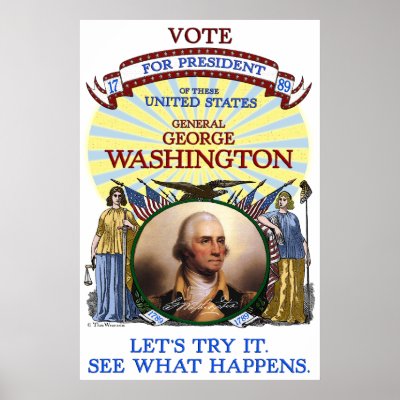
The least exciting Presidential Election in United States history was held on February 4, 1789.  On that day the votes of the first Electoral College under the shiny new Constitution were opened, read, and counted before the House of Representatives in the new temporary capital of New York City. Earlier, the Electors of each participating state had assembled in their state capitals to cast their votes.  Of the 69 Electors who voted, 68 were Federalists—not yet a party but avowed supporters of the new Constitution—and one, from Georgia, was an Anti-Federalist.
Electors were chosen in a variety of ways.  A minority were directly elected either state-wide or by Congressional or special electoral districts.  Most were elected by state legislatures, most frequently by a state’s upper chamber or Senate.  Because of that, property restrictions on voting, exclusion of Blacks slave or free, and of women, less than 1.3% of the adult population of the nation got to cast a popular vote for an elector, and thus indirectly for President.  The total popular vote was only 38,818.
Only 10 of the 13 states participated in the election.  North Carolina and Rhode Island could not because they had not yet ratified the Constitution.  In New York Anti-Federalists led by Governor George Clinton and Federalists controlled by Alexander Hamilton deadlocked in the state legislature and failed to select their allotted 8 Electors.  In addition, one Virginia district failed to report returns and was thus had no Elector.  One Virginia and two Maryland Electors did not vote.
A total of 12 candidates were nominated for the Presidency, led by Revolutionary War Commander in Chief George Washington.  But at first it was not certain that Washington would accept the post.  Other candidate’s either hoped that Washington would stay in Virginia, or hoped to be selected Vice President.  The candidates included the well-known— Minister to Great Britain John Adams, Governor John Hancock of Massachusetts, Secretary of Foreign Affairs under the Articles of Confederation John Jay, General Benjamin Lincoln, and governors of  Connecticut, South Carolina, and Georgia.  New York Governor Clinton was the best known Anti-Federalist.  And there were less well known candidates—Robert H. Harrison of Maryland, Georgia Secretary of State John Milton, and James Armstrong who was so obscure that historians are not entirely sure about who he was or if he was from Pennsylvania or from Georgia, where one Elector pledged to him was elected.
In fact all of the secondary candidates had at least one pledged Elector, with Adams leading the pack.
When Washington finally signaled his willingness to serve, all participating Electors cast their votes for him, making him the only man ever unanimously elected president with 69 votes.
But under the new Constitution, each Elector cast two votes for President.  The top total vote-getter—if he achieved a majority in the College—would be President and the second place finisher would be Vice President.  Although locked out of the procedure by New York’s stalemate, Alexander Hamilton, acting as a Federalist whip, made sure that votes were withheld from Adams to ensure a clear victory for Washington.  Other electors cast their second vote among the other candidates.  Adams won with 36 votes, only one more than the needed 35.
Adams felt slighted by Hamilton’s work to keep his support down among Federalists.  It was the beginning of a long, bitter rivalry for leadership of the Federalists as they morphed into a real political party.