Showing posts with label Puritanism. Show all posts

Thursday, July 9, 2020

The Early Outlier—A Forgotten Prophet of Pre-Revolutionary Boston

The Rev. Jonathan Mayhew--a religious and political radical and visionary of old Boston.

When the Rev. Jonathan Mayhew died in Boston on July 9, 1766 his moral, religious, and political legacy was far from accomplished.  Indeed years and decades would unfold before the depth of his influence became apparent in a new nation and in a new faith.  Mayhew, then only 46 years old, was the minister of Old West Church, and much beloved by his congregation and admired by the hot heads and radicals being rallied by Samuel Adams who would soon become the Sons of Liberty.  He was decidedly unpopular among the majority of his ministerial peers, conservative civic leaders, and with the Royal Governor of Massachusetts and his Council. 
Mayhew was born on Martha’s Vineyard on October 8, 1720, a fifth generation descendent of Thomas Mayhew, the Elder who first arrived in the New World with the Great Migration fleet of Puritan settlers in 1631.  Ten years later the original Mayhew secured a proprietary colony grant for Martha's Vineyard, Nantucket, the Elizabeth Islands, and other small islands.  Installing himself as governor he began populating his grant with new immigrants and also established his own farm and whaling operations.  Thomas, his son, and grandson also were missionaries among the local Wampanoag and established such fair and friendly relations with the natives.  They made clear that religion and governance were separate.  The tribe was welcome to embrace Christianity, but Mayhew was at pains to assure them that their governance and lands were secure on their own.  Relations were so good that despite vastly outnumbering the settlers the local Wampanoag did not join the general uprising known as King Philips War that almost wiped out the Massachusetts Bay Colony of 1675-76.
Although the small proprietary colony was absorbed by Massachusetts after 1688, the family, or much of it, remained on the island in relative isolation from the mainstream of Puritan society.  Devoutly religious, their local version of the Congregationalist New England Standing Order drifted from the harsh and rigid Calvinism of the mainland.
Young Jonathan, noted for his scholarly bent, left the island to pursue the Lord’s work as a student at the factory of divines, Harvard College.  Upon graduation Mayhew he found New England in a religious upheaval. 

Puritan firebrand Rev. Jonathan Edwards appalled Mayhew.

The Connecticut minister and Theologian Jonathan Edwards had helped inaugurate the first round of revival meetings in the 1730’s. In 1641 he scared the hell out of New England with his fiery sermon Sinners in the Hands of an Angry God which quickly became the first big best seller in the Colonies in pamphlet form.  Mayhew rejected Edwards view declaring that “total depravity [is] both dishonourable to the character of God and a libel on human nature.”  He likewise rejected the five points of Calvinism including the doctrine of irresistible grace and the doctrine of the Trinity as taught by the Athanasian and Nicene Creeds.
At the same time Mayhew also rejected the Great Awakening—the first of a series of huge revival movements that have periodically swept Americans up into religious frenzies.  Mayhew had seen the principle mover of the Awakening, the English preacher and revivalist George Whitefield, an Anglican preacher who became a founding figure in Methodism, at camp meetings in what is now Maine.  He was repulsed by the mindless emotionalism he witnessed which he suspected would burn brightly but soon extinguish itself.  He found Whitefield’s followers, ‘of the more illiterate sort,” and the preaching “confused, conceited and enthusiastic.”  He was repelled by the “extravagance and fanaticism, and violent gestures and shrieks” of people in the throes of religious ecstasy.
Mayhew made his views publicly know.  He proposed a third path based on religious rationalism and a view of a loving, but firm God as Father as revealed in his careful reading and analysis of The Bible. 

Boston's Old West Church called Mayhew to its pulpit..  Its working class members responded to Mayhews radicalism.  The steeple shown was torn down by the British during the Seige of Boston in the American Revolution in part to prevent it from being used to signal Colonial troops in Cambridge and in part as punishment for being Mayhew's pulpit of rebellion.
hese view made it difficult for the young minister to find a parish.  But in 1747 West Church in Boston, one of the city’s nine Congregational Churches—and the least prosperouscalled him to be their minister.  Only two of the other ministers in the city would even agree, as was customary, to be at the service of installation and ordination for the customary laying on of hands, symbolizing a welcome into the ministerial community.  One prominent minister is known to have scolded his barber when the man expressed interest in hearing Mayhew warning him not to go hear “that heretic.” 
Shortly after assuming the pulpit Mayhew crossed the ocean to pursue his doctorate of divinity at the University of Aberdeen in Scotland, an intellectual hot bed of the Scottish Enlightenment.  Although the liberal ideas of the Scottish Enlightenment were taking hold among a young and rising generation of Virginia Tidewater aristocrats, they were a novelty in New England where most ministers who pursued advanced degrees in the Mother Country did so at firmly Puritan institutions.
Despite the cold shoulder of his colleagues, Mayhew perused a ministry that presaged Unitarianism—a theological position that did not even yet have a name—by more than two decades.  His belief in a firm, fair, and loving God/king led him to believe that even the worst sinners, after a period of punishment and reflection, could be reconciled and dwell thereafter in Heaven with the saints and the angels.  This was a kind of universalism, making Mayhew probably the first North American preacher to combine the two ideas which became the two streams of modern Unitarian Universalism. 
But Mayhew, however far seeing and a religious pioneer, is best remembered for the political sermons that helped stir rebellion. 
His most famous and influential sermon was preached on the centennial of the execution of King Charles I, January 30, 1750.  Discourse Concerning Unlimited Submission and Non-Resistance to the Higher Powers refuted the growing opinion that the king was a martyr.  It was a long, scholarly history of the monarchy and the development of the English constitution and built a Biblical argument against the Devine Right of Kings and in favor of popular resistance to unjust government in answer to a higher law.  He concluded that the execution of Charles was justified when he when he “too greatly infringed upon British liberties.  It was also a lesson for any future monarch with inclinations to despotism. 
While the justification for regicide may have been in line with the Puritan inheritors of Oliver Cromwell, his reasoning was far more radical and seemed pointed as much at the existing monarchy as the headless Stuart.
The sermon was widely printed and circulated as a pamphlet, for a while supplanting Jonathan Edwards old screed in popularity.  It was also reprinted in London in 1752 and again in 1767 as relations between the Mother Country and the Colonies were reaching crisis.  Mayhew became an international celebrity, albeit a highly controversial one.  His radicalism was denounced from other pulpits, and, of course, condemned by authorities.
But Sam Adams and his boys and a rising generation of patriots did listen.  Years later Sam’s cousin John Adams would recall, that Mayhew’s sermon “was read by everybody.”  Some would call it the intellectual opening salvo in the run-up to the American Revolution. 
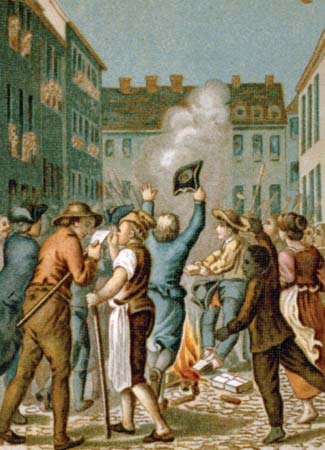
Mayhew's words inspired the Sons of Liberty, seen here burning copies of the Stamp Act.  They were "read by everybody" recalled John Adams.
Mayhew continued to preach influential, widely circulated sermons including two election day charges in 1750 and 1754 espousing colonial rights and the civic duty to resist tyranny.  He became particularly aroused with the imposition of the Stamp Act in 1765.  The essence of slavery, he argued in a new sermon, consists in subjection to others—“whether many, few, or but one, it matters not.” The day after his sermon, a Boston mob attacked and destroyed Lieutenant Governor Thomas Hutchinson’s house.  Mayhew and his sermon were held responsible by the “respectable citizens of Boston.”

Powerful Lt. Governor Thomas Hutchinson blamed Mayhew's sermon for the mob that burned down his house.
In 1763 Mayhew rebuked the Anglican Society for the Propagation of the Gospel for its plans to dispatch missionaries, priests, and teachers to the Colonies as well as the eminent appointment of an Anglican Bishop.  He regarded all of this as a camel’s nose under the tent meant to bring the colonies back into conformity with the Crown and its institutions.
In 1765 Mayhew was invited by Harvard to deliver the annual Dudlean Lecture on religion. This was a rare show of approval from the New England establishment and an acknowledgement of his popular leadership against the Crown.
The Snare Broken was a thanksgiving discourse preached by Mayhew on May 23, 1766 occasioned by Parliament’s repeal of the Stamp Act.  It was a warning to William Pitt and others in England who he knew would read it that taking self-government into private hands in some circumstances must surely proceed from “self-preservation, being a great and primary law of nature.”
Weeks after delivering this last famous salvo, Mayhew died.  Most of the Boston clergy still avoided his funeral as did virtually all officeholders.
In addition to his influence on the Sons of Liberty and the American Revolution, Mayhew’s religious ideas, except for his proto-universalism, were quietly adopted by a new generation of Harvard graduates and ministers.  In the years following the revolution all most all Boston churches affiliated with the Standing Order were quietly but unofficially unitarian.  An open break with the Congregationalists however would not come until William Ellery Channing’s Baltimore sermon in 1819.  Ironically Mayhew’s old congregation Old West would be one of only two Boston churches to remain with the orthodox Congregationalists.

Friday, February 7, 2020

The Bonfire of Vanities —Burning Art for Christ

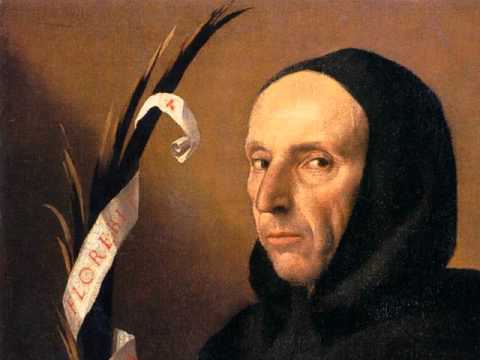
Dom Girolamo Savonarola of Florence.

The Bonfire of Vanities was not just a particularly snarky novel by Tom Wolfe or the one of the few movie duds starring Tom Hanks.  It was an event—or more precisely the most famous of a series of events—in Renaissance Italy propagated by elements of the Catholic Church in revulsion against perceived decadence and corruption of the flourishing new culture.

On February 7, 1497, the date of the traditional Mardi Gras festival, crowds whipped up by charismatic Dominican Friar Girolamo Savonarola seized and burned thousands of objects like cosmetics, art, and books in Florence, part of a pattern of defiance to the corruptions of the Church and to the Pope himself.

Savonarola can be seen as a forerunner of the Protestant Reformation.  Denouncing clerical hubris, abuse of the poor, and the despotic rule of the Medici, he gathered a fanatical following, especially among the educated young with his promises of new civic glory based on virtue and purity.  


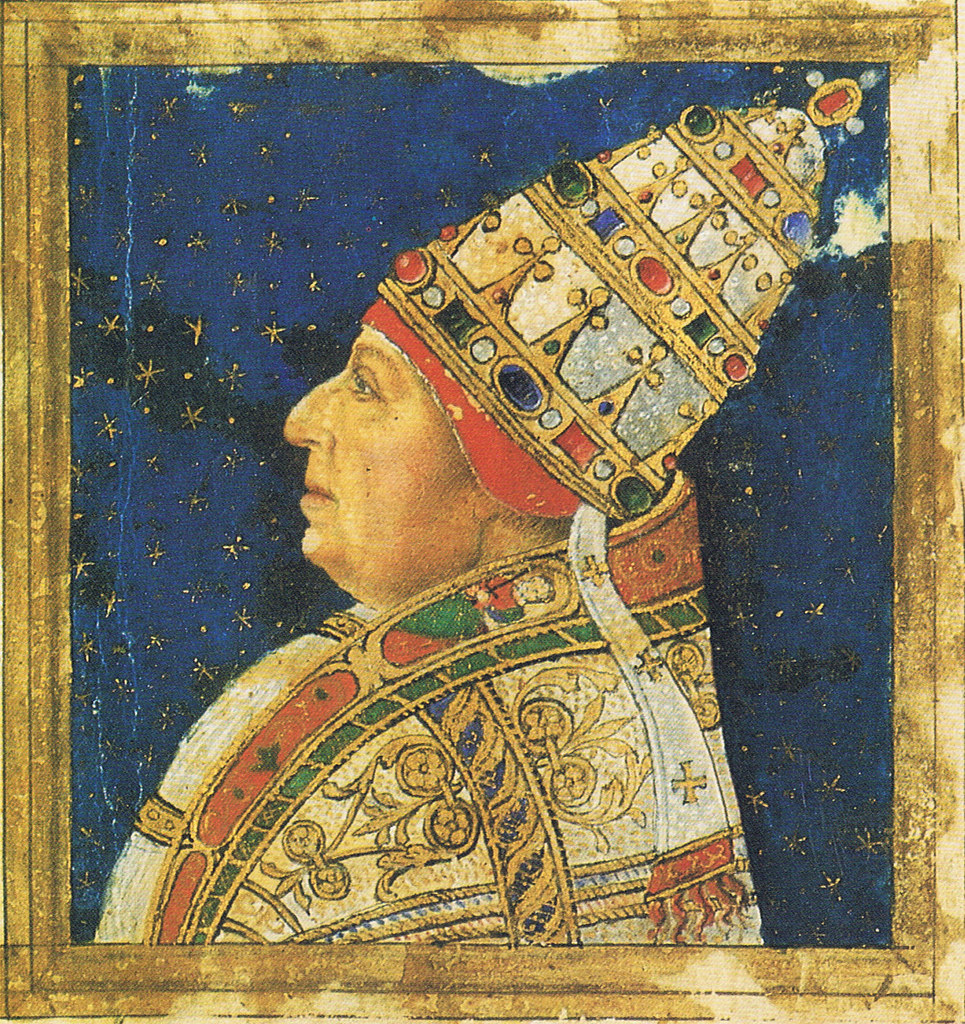
Pope Alexander XI was a Borgia and notorious libertine who lusted for temporal power in Italy was Savonarola's great enemy

It was a time of particular turmoil as Charles VIII of France in 1494 invaded Italy in opposition to Pope Alexander VI and his plans to extend Papal influence and control.  As the mighty French army neared the city Savonarola entered negotiations with the king while his supporters overthrew the Medici and expelled them from the city proclaiming a republic.  He welcomed the French as liberators, defying the direct order of the Pope to join his alliance.  The French, for their part, spared the city from sacking and promised to respect the new republic.

Savonarola was, naturally considered a hero by many.  But Medici and Papal loyalists remained.  To shore up support the Friar staged elaborate public processions and theatrical events both celebrating the new order and promoting purification to earn God’s approval for a New Jerusalem.  The celebrated Bon Fire was the highlight of his movement.  


                                    Florentines Renounce Vanities, a late 91th Century British illustration.

No one really knows how many great books, musical instruments, paintings, and statues were consigned to the flames along with ostentatious clothing, cosmetics, mirrors, and personal trifles like playing cards.  Some believe the loss to be a cultural catastrophe, while other historians downplay the amount of damage done claiming it was largely symbolic and most fine pieces were either hidden or smuggled out of Florence before the flames could consume them.

Among those caught up in the euphoria of the moment was one of Florence’s leading artists, Sandro Botticelli who had risen to fame painting allegories from classical mythology, most notably his  stunning The Birth of Venus with its famous nude on the half-shell.  Obviously such themes and sexuality would not be in keeping with Savonarola’s austere piety.  The artist had already moved on to more acceptable themes, particularly various renditions of the Virgin Mary.  The artists may—or may not—have pitched many of his own paintings on the fire.  We do know that for some years he retired from painting all together and was as a result reduced to poverty.  He would later, however, recant his allegiance to Savonarola and regain the patronage of the restored Medici.


Florentine painter  Sandro Botticelli had risen to fame painting allegories from classic mythology.  The Birth of Venus was his most famous work.  But he fell under the sway of Dom Savonarola.  Luckily Venus and many other paintings were hidden or spirited out ot the city.  But the artist may have thrown some of his more recent work on the Bonfire.

The French king’s army sliced through Italy with little resistance outside of a couple of stubborn cities which paid heavily for their defiance.  Just weeks after Savonarola’s party in Florence, Charles reached Naples where he claimed the crown of the state that controlled most of southern Italy.  Alarmed by the ease with which Charles had moved, the Pope was able to rally most of the Northern states into the League of Venice.  The idea was to cut off Charles’s return to France with his army and destroy it.  The Republic of Florence had little choice but to formally join the alliance, although under Savonarola’s influence, they never actually committed troops to the Papal force.

After a nasty battle in which he lost most of his loot, Charles got his army safely back to France.  But he had lost Naples already and once friendly northern cities like Florence were coming back into the Papal orbit.  

In May of 1497 the Pope formally excommunicated the Friar and threatened to put the city under interdiction unless they surrendered him.  Under pressure from local authorities he withdrew from public preaching and composed a manuscript of justification and a theological reflection, Triumph of the Cross.  Unfortunately for him in it he not only claimed to receive visions from God, but hinted that he had been given the power to perform miracles.  Big mistake.  It left him open to the charge of Heresy.

A rival friar and preacher called on Savonarola to prove his innocence by an ordeal by fire.  When another monk and friend volunteered to take the test for him, Savonarola felt he had no choice but to accept the challenge.  On April 7 1497 as he prepared to walk through the fire in the first such ordeal in Florence for 400 years, a rainstorm broke out extinguishing the flames.  As the burden of proof was on him, the crowd took it as a sign that he was guilty.  They attacked his convent.  Savonarola and two other friars were arrested. 


          Savonarola and two of his Friars were hung and roasted for heresy and schematism. 

On the morning of May 23, 1498, the three friars were led out into the main square where, before a tribunal of high clerics and government officials, they were condemned as heretics and schismatics, and sentenced to die.  They were immediately stripped of their Dominican robes down to thin white shirts.  Each ascended to separate gallows on which they were hung with fire burning below them to consume their bodies.  Their ashes were scattered in the Arno River to prevent them from becoming relics for stubborn followers. 

However his partisans remained active as both a religious and political force until the Medici were restored in Florence and the Republic squashed in 1517.

But Savonarola’s idea lived on.  Martin Luther read Triumph of the Cross as did John Calvin.  He was very influential in the briefly flourishing Italian Protestant Reform movement which included the scholars like Faustus Socinus and Giorgio Blandrata who were instrumental in introducing anti-trinitarianism and unitarianism into central and eastern Europe.

On the Catholic side, when it was safe to do so the Dominican Order reclaimed Savonarola and recast him as a benevolent and saintly prophet mostly stripped of his political importance and rougher edges.  Later Catholic reformers would call him the last hope to “prevent the catastrophe of the Reformation.”  And in the 19th Century he would be adopted as a symbol for Italian nationalists and their drive to create a modern nation state.


Savinarola was recast politically as a hero of Italian Republicanism and religiously as the last hope "to prevent the catastrophe" of the Reformation.

As for the Bonfire business, well, that has been more controversial.  Intellectuals, writers, and artists have looked on it with horror.  As such it has often been referenced directly or indirectly in books from George Eliot’s Romola to Margaret Atwood’s works which allude to the Bonfire, as in her dystopian novel, The Handmaid’s Tale.

On the other hand, some have found inspiration in Savonarola’s urge to purge.  In some ways what we have come to think of as 19th Century American Puritanism, especially the obsessive sexual prudery and zeal at suppression of corrupting influences, might be more rightly called Savonarolaism.  Certainly the notorious Anthony Comstock and his Society for the Suppression of Vice are the old Friar’s direct heirs.

And so were and are, whether they know it or not—and most assuredly they do not—all of the modern book burners of whatever stripe.

Sunday, February 7, 2016

Burning Art for Christ —The Bonfire of Vanities

Savonarola's bonfire.  Believe me, it got bigger than this.


The Bonfire of Vanities was not just a particularly snarky novel by Tom Wolfe or the one of the few movie duds starring Tom Hanks.  It was an event—or more precisely the most famous of a series of events—in Renaissance Italy propagated by elements of the Catholic Church in revulsion against perceived decadence and corruption of the flourishing new culture.
On February 7, 1497, the date of the traditional Mardi Gras festival, crowds whipped up by charismatic Dominican Friar Girolamo Savonarola seized and burned thousands of objects like cosmetics, art, and books in Florence, part of a pattern of defiance to the corruptions of the Church and to the Pope himself.
Savonarola can be seen as a forerunner of the Protestant Reformation.  Denouncing clerical, abuse of the poor, and the despotic rule of the Medici, he gathered a fanatical following, especially among the educated young with his promises of new civic glory based on virtue and purity. 
It was a time of particular turmoil as Charles VIII of France in 1494 invaded Italy in opposition to Pope Alexander VI and his plans to extend Papal influence and control.  As the mighty French army neared the city Savonarola entered negotiations with the king while his supporters overthrew the Medici and expelled them from the city proclaiming a republic.  He welcomed the French as liberators, defying the direct order of the Pope to join his alliance.  The French, for their part, spared the city from sacking and promised to respect the new republic.

Dom Girolamo Savonarola of Florence.

Savonarola was, naturally considered a hero by many.  But Medici and Papal loyalists remained.  To shore up support the Friar staged elaborate public processions and theatrical events both celebrating the new order and promoting purification to earn God’s approval for a New Jerusalem.  The celebrated Bon Fire was the highlight of his movement. 
No one really knows how many great books, musical instruments, paintings, and statues were consigned to the flames along with ostentatious clothing, cosmetics, mirrors, and personal trifles like playing cards.  Some believe the loss to be a cultural catastrophe, while other historians downplay the amount of damage done claiming it was largely symbolic and most fine pieces were either hidden or smuggled out of Florence before the flames could consume them.
Among those caught up in the euphoria of the moment was one of Florence’s leading artists, Sandro Botticelli who had risen to fame painting allegories from classical mythology, most notably his  stunning The Birth of Venus with its famous nude on the half-shell.  Obviously such themes and sexuality would not be in keeping with Savonarola’s austere piety.  The artist had already moved on to more acceptable themes, particularly various renditions of the Virgin Mary.  The artists may—or may not—have pitched many of his own paintings on the fire.  We do not that for some years he retired from painting all together and was as a result reduced to poverty.  He would later, however, recant his allegiance to Savonarola and regain the patronage of the restored Medici.
The French king’s army sliced through Italy with little resistance outside of a couple of stubborn cities which paid heavily for their defiance.  Just weeks after Savonarola’s party in Florence, Charles reached Naples where he claimed the crown of the state that controlled most of southern Italy.  Alarmed by the ease with which Charles had moved, the Pope was able to rally most of the Northern states into the League of Venice.  The idea was to cut off Charles’s return to France with his army and destroy it.  The Republic of Florence had little choice but to formally join the alliance, although under Savonarola’s influence, they never actually committed troops to the Papal force.
After a nasty battle in which he lost most of his loot, Charles got his army safely back to France.  But he had lost Naples already and once friendly northern cities like Florence were coming back into the Papal orbit.  

Pope Alexander XI was a Borgia and notorious libertine who lusted for temporal power in Italy was Savonarola's great enemy.
In May of 1497 the Pope formally excommunicated the Friar and threatened to put the city under interdiction unless they surrendered him.  Under pressure from local authorities he withdrew from public preaching and composed a manuscript of justification and a theological reflection, Triumph of the Cross.  Unfortunately for him in it he not only claimed to receive visions from God, but hinted that he had been given the power to perform miracles.  Big mistake.  It left him open to the charge of Heresy.
A rival friar and preacher called on Savonarola to prove his innocence by an ordeal by fire.  When another monk and friend volunteered to take the test for him, Savonarola felt he had no choice but to accept the challenge.  On April 7 1497 as he prepared to walk through the fire in the first such ordeal in Florence for 400 years, a rainstorm broke out extinguishing the flames.  As the burden of proof was on him, the crowd took it as a sign that he was guilty.  They attacked his convent.  Savonarola and two other friars were arrested.

Savonarola and two of his Friars were hung and roasted for heresy and schismatism. 

On the morning of May 23, 1498, the three friars were led out into the main square where, before a tribunal of high clerics and government officials, they were condemned as heretics and schismatics, and sentenced to die.  They were immediately stripped of their Dominican robes down to thin white shirts.  Each ascended to separate gallows on which they were hung with fire burning below them to consume their bodies.  Their ashes were scattered in the Arno River to prevent them from becoming relics for stubborn followers.
However his partisans remained active as both a religious and political force until the Medici were restored in Florence and the Republic squashed in 1517.
But Savonarola’s idea lived on.  Martin Luther read Triumph of the Cross as did John Calvin.  He was very influential in the briefly flourishing Italian Protestant Reform movement which included the scholars like Faustus Socinus and Giorgio Blandrata who were instrumental in introducing anti-trinitarianism and unitarianism into central and eastern Europe.
On the Catholic side, when it was safe to do so the Dominican Order reclaimed Savonarola and recast him as a benevolent and saintly prophet mostly stripped of his political importance and rougher edges.  Later Catholic reformers would call him the last hope to “prevent the catastrophe of the Reformation.”  And in the 19th Century he would be adopted as a symbol for Italian nationalists and their drive to create a modern nation state.

Politically Savinarola was recast as a hero of Italian Republicanism.
As for the Bonfire business, well, that has been more controversial.  Intellectuals, writers, and artists have looked on it with horror.  As such it has often been referenced directly or indirectly in books from George Eliot’s Romola to Margaret Atwood’s works which allude to the Bonfire, as in her dystopian novel, The Handmaid’s Tale.
On the other hand, some have found inspiration in Savonarola’s urge to purge.  In some ways what we have come to think of as 19th Century American Puritanism, especially the obsessive sexual prudery and zeal at suppression of corrupting influences, might be more rightly called Savonarolaism.  Certainly the notorious Anthony Comstock and his Society for the Suppression of Vice are the old Friar’s direct heirs.
And so were and are, whether they know it or not—and most assuredly they do not—all of the modern book burners of whatever stripe.