Showing posts with label Salem Massachusetts. Show all posts

Monday, March 16, 2020

Hawthorne’s Fallen Woman—The First Great American Novel

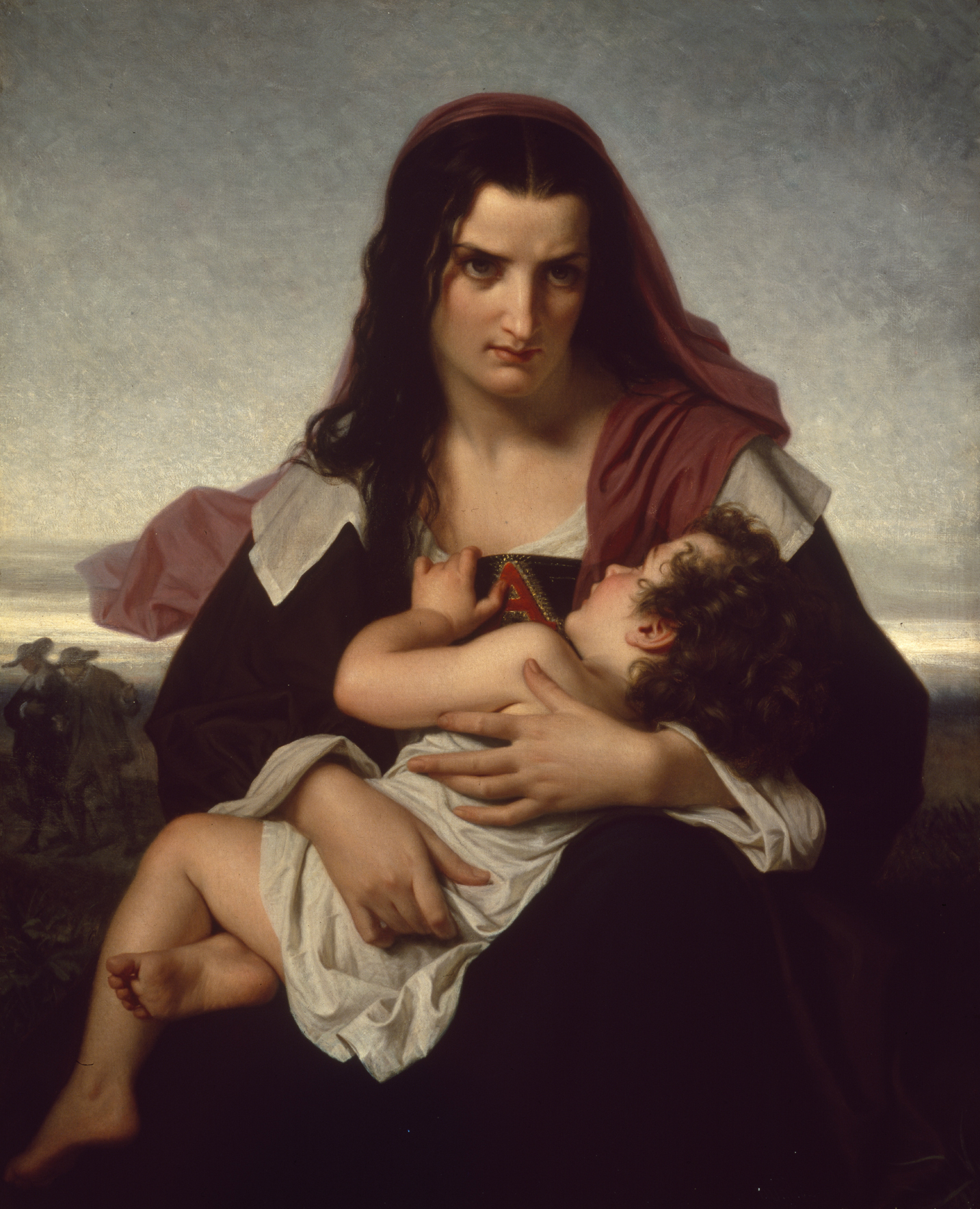
The Scarlet Letter by Hugues Merlem 1861. Hester Prynne and daughter Pearl are in the foreground and Arthur Dimmesdale and Roger Chillingworth can be seen dimly in the background at left. 
On March 16, 1850 Nathaniel Hawthorne’s The Scarlet Letter, widely regarded as the first great American novel was issued by Ticknor, Reed & Fields, the publisher of choice for the New England transcendentalist literary elite.  
Nathanial Hathorne was born in 1804 in Salem, Massachusetts, a member of an old family that, much to his chagrin and embracement, included one of the judges of the Salem Witch Trials.  He later added a w to the spelling of the family name in a vain attempt to disguise the connection.
After his sea captain father died when he was two, his family family sent him to be  fostered with wealthy local relatives who saw that the boy was educated Bowden College in Maine, which aspired to be the Harvard of the North and which was considerably cheaper than the Harvard of Massachusetts.  Among his classmates were lifelong friends Henry Wadsworth Longfellow and Franklin Pierce.  A shy and brooding young man, but strikingly handsome, he wished only to write.  
Despite a receding hair line, Nathaniel Hawthorne was still matinee idol handsome in this 1848 Daguerreotype taken two years before the publication of his masterpiece.
A Democrat in ultra Whig Massachusetts he was able to secure political appointments at the Boston Custom House to support himself as he wrote.  He published an undistinguished first novel anonymously and sold short stories to various literary magazines.   His first collection of short stories Twice-Told Tales drew local interest in Boston.  He began to move in the intellectual orbit of the emerging Transcendentalists.  
Hawthorne courted Elizabeth, the eldest of the brilliant Peabody Sisters, but to everyone’s surprise, especially the heart broken Elizabeth, proposed to her frail sister Sophia, an artist.  The Peabodys were always in a condition of dire genteel poverty.  Hawthorne decided to raise money for his marriage by investing a $1000 and joining the Brook Farm community.  He was put in charge of the manure pile.  It was not a happy experience and he soon departed.  He later satirized the community in his Blithedale Romance.  
The lovely but sickly Sophia Peabody married Hawthorne and her health improved. She ended up out living him by seven years.  Her charcoal self-portrait. 
Sofia and Hawthorne married in 1842 anyway and moved to the epicenter of Transcendentalist life, Concord where they lived for three years in The Old Manse, later the home of Longfellow. While there he completed a second story collection Mosses from an Old Manse The couple were madly in love and devoted to each other.  
In 1846 with the return to power of the Democrats in Washington, Hawthorne got the lucrative appointment as Inspector of Revenue at the Port of Salem.  The move back to his—and Sophia’s—home town was a mixed blessing.  On one hand his growing family was secure.  On the other hand the dreary duties of the custom house sapped his energy for writing.  But he did have time to explore the legacy of Puritan morality.  When the Whig’s return ousted him from his position, he turned those musings into The Scarlet Letter.  
The shocking tale of the noble but fallen Hester Prynne and the tormented Rev. Dimmsdale, as sexually predatory preacher who was the cause of Hester’s shame, was a literary sensation and one of the first American best sellers.  More than 2,500 copies flew off of bookstore shelves in the first ten days.  
Hawthorne moved his family to a farm house near Lenox in the Berkshire Mountains of western Massachusetts to dedicate himself to writing.  While there he met and became fast friends with Oliver Wendell Holmes, Sr., the physician, wit, and poet, and Herman Melville, to whom he became a mentor.  During these years he completed The House of the Seven Gables, The Blithedale Romance, and his collection of classic mythology for children, The Wonder-Book for Girls and Boys.  
The Wayside, formerly the Concord home of Bronson Alcott and his family including young Louisa May, was twice Hathorne's home.
Summers in the mountains were pleasant but winters brutal and lonely. The family moved once again, this time back to Concord into the old home of Bronson Alcott where Ralph Waldo Emerson and Henry David Thoreau were neighbors and close friends. He named the house The Wayside. He also found time to complete a campaign biography for old pal Franklin Pierce.  
When Pierce won the Presidency, Hawthorne was rewarded with appointment as United States Consul in Liverpool.  After his appointment lapsed when the Pierce administration ended, Hawthorne and Sophie made the grand tour of Europe before returning to Concord and the Wayside.  He completed and published the Marble Faun in 1860 and was working sporadically on several other romances.  
But Hawthorne’s health was failing.  In 1864 Pierce took him back to the Berkshires to restore his health.  Hawthorne died there with his old friend at his bedside at Plymouth, New Hampshire on May 18, 1864.  
At his funeral in Concord Longfellow, Emerson, Alcott, and Holmes were among his pallbearers.  Sophia died in London seven years later.  In 2006 her remains and those of their daughter Una were relocated to the Sleepy Hollow Cemetery in Concord and laid next to Hawthorn’s.
The Scarlet Letter became a staple of 20th Century high school English classes, although it has increasingly been protested by fundamentalist parents who think that Hester got just what was coming to her, the little slut, and sometimes banned by timid or rightwing dominated school boards.
Meanwhile being branded by a scarlet letter became a widely used cultural metaphor for public shaming and mob mentality bullying.
Perhaps the most memorable of all of the film versions of Hawthorne's masterpiece was the MGM silent starring the ever-suffering Lillian Gish.  Here she is condemned in a mob scene before a castle-like building unlike anything found in old Salem.
The semi-salacious nature of the plot made it a natural for several stage and film adaptations.  The first movie version was a 1911 one reel film King Baggot, Lucille Young, and William Robert Daly shifted the focus to Baggot, then a major star as the tortured Dimmsdale.  Hester fared better in the third version released in 1926 as a prestige MGM feature with their biggest melodrama star, Lillian Gish.  Colleen Moore, Hardie Albright, and Henry B. Walthall, the star of Birth of a Nation, were featured in the first sound version, a 1934 release shot on location at Salem’s Pioneer Village.  German director Wim Wenders made a European film starring Senta Berger in 1973 which has seldom been shown in the United States.
In 1995 Demi Moore, Gary Oldman, and Robert Duval headlined a star studded cast.  But the film took great liberties with the novel and was roundly mocked—the film review aggregator site Rotten Tomatoes gave the film a 14% approval rating, based on 35 reviews.  It won the Golden Raspberry Award for Worst Remake or Sequel and Moore was nominated for Worst Actress.
There was also a Public Broadcasting System miniseries made by WBGH in Boston in 1979 as an answer to the tony BBC costume/literary dramas that dominated the public airways.  The production featured Meg Foster, John Heard, and Kevin Conway.
And inevitably there were porn versions and take offs.  Yes, you can see up-close and personal just how Hester earned the A.

Monday, August 5, 2019

Martín Espada—Two Poems for a Lights for Liberty Rally

Poet Martín Espada.
My friend Everett Hoagland, proud and skilled Black poet who has lived and worked much of his life in mostly white environments was kind enough to share the work of another writer of importance and discernment.  Hoagland has been the poet laureate of New Bedford, Massachusetts and is a long-time member of the First Unitarian Church there.  When Everett recommends a poet I sit up and take notice
Martín Espada is a 62 year old poet, academic, and activist who was born in Brooklyn, New York to Puerto Rican parents.  His father was a leader in the Puerto Rican community and the civil rights movement.  Espada received a B.A. in history from the University of Wisconsin–Madison and a doctorate of law from Northeastern University in Boston.  For many years, he worked as a tenant lawyer and a supervisor of a legal services program
In 1982, Espada published his first book of political poems, The Immigrant Iceboy's Bolero, featuring photography by his father.  Since then he has written thirteen more highly praised volumes in English and in Spanish, most recently Vivas to Those Who Have Failed which was published in 2016 by W.W. Norton.

His work has gleaned honors including the National Endowment for the Arts Creative Writing Fellowship in 1986; the PEN/Revson Foundation Fellowship in Poetry, 1989; Paterson Poetry Prize, 1991; National Endowment for the Arts Creative Writing Fellowship, 1992; National Book Critics Circle Award Finalist, 1997; Before Columbus Foundation American Book Award, 1997; Pushcart Prize, 1999,  Independent Publisher Book Award, 1999; Poet Laureate of Northampton, Massachusetts, 2001; American Library Association Notable Book, 2004; John Simon Guggenheim Memorial Foundation Fellowship, 2006; Pulitzer Prize Finalist, 2007; Library Journal Best Poetry Books, 2007; National Hispanic Cultural Center Literary Award, 2008; Massachusetts Book Award, 2012; International Latino Book Award, 2012; Busboys and Poets Award, 2014; Academy of American Poets Fellowship, 2018; and the Ruth Lilly Poetry Prize, 2018 among others.
He is currently a professor at the University of Massachusetts Amherst, where he teaches poetry.
Espada spoke at a July 12 Lights for Liberty vigil to end detention camps at the Unitarian Universalist First Church in Salem, Massachusetts. The two poems he shared there and some explanatory notes are featured in the current issue of the venerable Progressive.
Espada's Lights for Liberty poems are in the current July/August issue of The Progressive.
Espada explained his first verse:
Trump announced his candidacy in June 2015, with the pronouncement that Mexicans crossing the border brought with them a range of criminal tendencies from drug smuggling to rape. That August, two brothers, Scott and Steve Leader, took him at his word, attacking a homeless Mexican immigrant as he slept outside the JFK subway stop on the Red Line.
This poem is about that hate crime. It’s also about Donald Trump’s idea of hell: empathy. There were many more healing hands than hurting hands placed on the victim’s body that night. Now, since this is a poem about a hate crime, there is some language and imagery you might find ugly. The poem is called:
Not for Him the Fiery Lake of the False Prophet
When Mexico sends its people, they’re not sending their best…They’re bringing drugs. They’re bringing crime. They’re rapists. —Donald Trump, June 16, 2015
They woke him up by pissing in his face. He opened his mouth 
to scream in Spanish, so his mouth became a urinal at the ballpark.

Scott and Steve: the Leader brothers, celebrating a night at Fenway, 
where the Sox beat the Indians and a rookie named Rodríguez spun 
the seams on his changeup to hypnotize the Tribe. Later that night, 
Steve urinated on the door of his cell, and Scott told the cops why 
they did it:  Donald Trump was right. All these illegals need to be deported.

He was a Mexican in a sleeping bag outside JFK station on a night 
in August, so they called him a wetback and emptied their bladders
in his hair. In court, the lawyers spoke his name: Guillermo Rodríguez
immigrant with papers, crop-picker in the fields, trader of bottles 
and cans collected in his cart. Two strangers squashed the cartilage
in his nose like a can drained of beer. In dreams, he would remember
the shoes digging into his ribcage, the pole raked repeatedly across
his cheekbones and upraised knuckles, the high-five over his body.

Donald Trump was right, said Scott. And Trump said: The people 
that are following me are very passionate. His hands fluttered 
as he spoke, a demagogue’s hands, no blood under the fingernails, 
no whiff of urine to scrub away.  He would orchestrate the chant 
of Build That Wall at rally after rally, bellowing till the blood rushed 
to his face, red as a demagogue in the grip of masturbatory dreams:
a tribute to the new conquistador, the Wall raised up by Mexican hands,  
Mexican hair and fingernails bristling in the brick, Mexican blood 
swirling in the cement like raspberry syrup on a vanilla sundae. 
On the Cinco de Mayo, he leered over a taco bowl at Trump Tower.

Not for him the fiery lake of the false prophet, reddening
his ruddy face. Not for him the devils of Puritan imagination,
shrieking in a foreign tongue and climbing in the window
like the immigrant demons he conjures for the crowd.

Not even for him ten thousand years of the Leader brothers.
streaming a fountain of piss in his face as he sputters forever.

For him, Hell is a country where the man in a hard hat
paving the road to JFK station sees Guillermo and dials 911;
Hell is a country where EMTs kneel to wrap a blanket around
the shivering shoulders of Guillermo and wipe his face clean;
Hell is a country where the nurse at the emergency room
hangs a morphine drip for Guillermo, so he can go back to sleep.
Two thousand miles away, someone leaves a trail of water bottles
in the desert for the border crossing of the next Guillermo.

We smuggle ourselves across the border of a demagogue’s dreams:
Confederate generals on horseback tumble one by one into 
the fiery lake of false prophets; into the fiery lake crumbles
the demolished Wall. Thousands stand, sledgehammers in hand, 
to await the bullhorns and handcuffs, await the trembling revolvers. 
In the full moon of the flashlight, every face interrogates the interrogator. 
In the full moon of the flashlight, every face is the face of Guillermo.

Martín Espada

Espada wrote the second poem especially for the Lights for Liberty rally.
The mass incarceration of migrant children—by the thousands—is also a hate crime. Let’s call it what it is. And that brings me to a place called Tornillo. The Trump Administration opened the Tornillo internment center in Texas in June 2018 and closed it in January 2019. My good friend Camilo Pérez-Bustillo, as Director of Research and Advocacy at Hope Border Institute in El Paso, was a major organizer in the campaign to shut down Tornillo—and shut it down they did.
Camilo told me: “the one place the kids detained there told us they felt free was on the soccer field . . . It was the only place they could be connected in some kind of physical flow with the world beyond the barbed wire, by kicking as many soccer balls as high and as far as they could, beyond the fencing around them. Large numbers of these balls piled up quickly outside and at the edges of the facility.”
Latino youth play soccer.
Ode to the Soccer Ball Sailing Over a Barbed Wire Fence
          Tornillo…has become the symbol of what may be the largest U.S. mass detention of children not charged with crimes since the World War II internment of Japanese-Americans. —Robert Moore, Texas Monthly

Praise Tornillo: word for screw in Spanish, word for jailer in English,  
word for three thousand adolescent migrants incarcerated in camp.

Praise the three thousand soccer balls gift-wrapped at Christmas,
as if raindrops in the desert inflated and bounced through the door.

Praise the soccer games rotating with a whistle every twenty minutes 
so three thousand adolescent migrants could take turns kicking a ball.

Praise the boys and girls who walked a thousand miles, blood caked  
in their toes, yelling in Spanish and a dozen Mayan tongues on the field.

Praise the first teenager, brain ablaze like chili pepper Christmas lights,
to kick a soccer ball high over the chain link and barbed wire fence.

Praise the first teenager to scrawl a name and number on the face
of the ball, then boot it all the way to the dirt road on the other side.

Praise the smirk of teenagers at the jailers scooping up fugitive 
soccer balls, jabbering about the ingratitude of teenagers at Christmas.

Praise the soccer ball sailing over the barbed wire fence, white
and black like the moon, yellow like the sun, blue like the world.

Praise the soccer ball flying to the moon, flying to the sun, flying to other 
worlds, flying to Antigua Guatemala, where Starbucks buys coffee beans.

Praise the soccer ball bounding off the lawn at the White House,
thudding off the president’s head as he waves to absolutely no one.

Praise the piñata of the president’s head, jellybeans pouring from his ears, 
enough to feed three thousand adolescents incarcerated at Tornillo.

Praise Tornillo: word in Spanish for adolescent migrant internment camp, 
abandoned by jailers in the desert, liberated by a blizzard of soccer balls.

Martín Espada
On a personal note, Espada second poem evoked one of the few specific stories that my father, W.M. Murfin, ever told me about his World War II experiences.
Italian POWs in Libya--glad to be out of the war.
He was the top sergeant of a U.S. Army Field Hospital attached to the British and ANZAC troops under Field Marshal Montgomery who chased Rommel and his Afrika Korps out of Egypt and across North Africa.   In the deserts of Libya the hospital pitched its tents next to a prisoner of war camp for captured Italian troops.  Most of the Italians had gladly surrendered and were happy to be out of the war.  The Tommies in their khaki shorts and tin hats for the most part treated the prisoners well.  They reserved their rage and vengeance for the Germans and Nazis.
Aside from some hastily erected gun towers, the camp had no walls or even barbed wire fence.  There was no need—there was nowhere to escape to in the vast and terrible desert.  Lines literally scratched in the ground were the only marks of the camp’s perimeter
The Brits gave their prisoners some of their footballs to kick around to pass the time.  The Italians quickly organized teams and were playing il calico—soccer—on the sands.  One idle afternoon under the baking sun patients and staff from the hospital joined inmates and guards to watch a match.
During the back and forth action the ball got kicked out of bounds and across the camp’s line in the sand.  Without thinking a player sprinted after it.  When he crossed the line without even a shouted warning, a guard shot him dead.
Of all of the horror my Dad saw in the war in North Africa and then in three Pacific island landings this one senseless execution haunted him the most.

Thursday, March 16, 2017

The First Great American Novel Still Speaks to Us

The Scarlet Letter by Hugues Merlem 1861. Hester Prynne and daughter Pearl are in the foreground and Arthur Dimmesdale and Roger Chillingworth can be seen dimmnly in the background at left. 


On March 16, 1850 Nathaniel Hawthorne’s The Scarlet Letter, widely regarded as the first great American novel was issued by Ticknor, Reed & Fields, the publisher of choice for the New England transcendentalist literary elite. 
Hawthorne was born in 1804 in Salem, Massachusetts, a member of an old family that, much to his chagrin and embracement, included one of the judges of the Salem Witch Trials.  He later added a w to the spelling of the family name in a vain attempt to disguise the connection.
After his sea captain father died when he was two, his family was fostered with wealthy local relatives who saw that the boy was educated Bowden College in Maine, which aspired to be the Harvard of the North and which was considerably cheaper than the Harvard of Massachusetts.  Among his classmates were lifelong friends Henry Wadsworth Longfellow and Franklin Pierce.  A shy and brooding young man, but strikingly handsome, he wished only to write. 
A Democrat in ultra Whig Massachusetts he was able to secure political appointments at the Boston Custom House to support himself as he wrote.  He published an undistinguished first novel anonymously and sold short stories to various literary magazines.   His first collection of short stories Twice-Told Tales drew local interest in Boston.  He began to move in the intellectual orbit of the emerging Transcendentalists. 
Despite a receding hair line, Nathaniel Hawthorne was still matinee idol handsome in this 1848 Daguerrotype taken two years before the publication of his masterpiece.
Hawthorne courted Elizabeth, the eldest of the brilliant Peabody Sisters, but to everyone’s surprise, especially the heart broken Elizabeth, proposed to her frail sister Sophia, an artist.  The Peabodys were always in a condition of dire genteel poverty.  Hawthorne decided to raise money for his marriage by investing a $1000 and joining the Brook Farm community.  He was put in charge of the manure pile.  It was not a happy experience and he soon departed, but satirized the community later in his Blithedale Romance. 
Sofia and Hawthorne married in 1842 anyway and moved to the epicenter of Transcendentalist life, Concord where they lived for three years in The Old Manse, latter the home of Longfellow. While there he completed a second story collection Mosses from an Old Manse The couple were madly in love and devoted to each other.  
The lovely but sickly Sophia Peabody married Hawthorne and her health improved. She ended up out living him by seven years.  Her charcoal self-portrait. 


In 1846 with the return of the Democrats to power in Washington, Hawthorne got the lucrative appointment as Inspector of Revenue at the Port of Salem.  The move back to his—and Sophia’s—home town was a mixed blessing.  On one hand his growing family was secure.  On the other hand the dreary duties of the custom house sapped his energy for writing.  But he did have time to explore the legacy of Puritan morality.  When the Whig’s return ousted him from his position, he turned those musings into The Scarlet Letter. 
The shocking tale of the noble but fallen Hester Prynne and the tormented Rev. Dimmsdale, as sexually predatory preacher who is the cause of Hester’s shame, was a literary sensation and one of the first American best sellers.  More than 2,500 copies flew off of bookstore shelves in the first ten days. 
Hawthorne moved his family to a farm house near Lenox in the Berkshire Mountains of western Massachusetts to dedicate himself to writing.  While there he met and became fast friends with Oliver Wendell Holmes, Sr., the physician, wit, and poet, and Herman Melville, to whom he became a mentor.  During these years he completed The House of the Seven Gables, The Blithedale Romance, and his collection of classic mythology for children, The Wonder-Book for Girls and Boys.  
The Wayside, formerly the Concord home of Bronson Alcott and his family including young Louisa May, was twice Hathorne's home.
Summers in the mountains were pleasant but winters brutal and lonely. The family moved once again, this time back to Concord into the old home of Bronson Alcott where Ralph Waldo Emerson and Henry David Thoreau were neighbors and close friends. He named the house The Wayside. He also found time to complete a campaign biography for old pal Franklin Pierce. 
When Pierce won the Presidency, Hawthorne was rewarded with appointment as United States Consul in Liverpool.  After his appointment lapsed when the Pierce administration ended, Hawthorne and Sophie made the grand tour of Europe before returning to Concord and the Wayside.  He completed and published the Marble Faun in 1860 and was working sporadically on several other romances.  But Hawthorne’s health was failing.  In 1864 Pierce took him back to the Berkshires to restore his health.  Hawthorne died there with his old friend at his bedside at Plymouth, New Hampshire on May 18, 1864.    
At his funeral in Concord Longfellow, Emerson, Alcott, and Holmes were among his pallbearers.  Sophia died in London seven years later.  In 2006 her remains and those of their daughter Una were relocated to the Sleepy Hollow Cemetery in Concord and laid next to Hawthorn’s.

The Scarlet Letter became a staple of 20th Century high school English classes, although it has increasingly been protested by fundamentalist parents who think that Hester got just what was coming to her, the little slut, and sometimes banned by timid or right wing dominated school boards.
Meanwhile being branded by a scarlet letter became a widely used cultural metaphor for public shaming and mob mentality bullying.
 
Perhaps the most memorable of all of the film versions of Hawthorne's masterpiece was the MGM silent starring the ever-cuffering Lillian Gish.
The semi-salacious nature of the plot made it a natural for several stage and film adaptations.  The first movie version was a 1911 one reel film King Baggot, Lucille Young, and William Robert Daly shifted the focus to Baggot, then a major star as the tortured Dimmsdale.  Hester fared better in the third version released in 1926 as a prestige MGM feature with their biggest melodrama star, Lillian Gish.  Colleen Moore, Hardie Albright, and Henry B. Walthall, the star of Birth of a Nation released in 1932 and shot on location at Salem’s Pioneer Village was the first sound version.  German director Wim Wenders made a European version starring Senta Berger in 1973 has seldom been shown in the United States.
In 1995 Demi Moore, Gary Oldman, and Robert Duval headlined a star studded cast.  But the film took great liberties with the novel and was roundly mocked—the film review aggregator site Rotten Tomatoes gave the film a 14% approval rating, based on 35 reviews.  It won the Golden Raspberry Award for Worst Remake or Sequel and Moore was nominated for Worst Actress.
There was also a Public Broadcasting System miniseries made by WBGH in Boston in 1979 as an answer to the tony BBC costume/literary dramas that dominated the public airways.  The production featured Meg Foster, John Heard, and Kevin Conway.
And inevitably there are numerous porn versions and take offs.  Yes, you can see up-close and personal just how Hester earned the A.