Showing posts with label Sammy Cahn. Show all posts

Friday, December 14, 2018

Murfin Winter Holidays Music Festival—The Christmas Waltz


Word has come that the lovely, silken voice of jazz and pop chanteuse Nancy Wilson was stilled yesterday when she died at age 81 after a long illness at her Pioneertown, California.  Although often identified as a jazz artist, she preferred to characterize herself as a song interpreter for the way she caressed lyrics, she said, “I do not do runs and—you know. I take a lyric and make it mine. I consider myself an interpreter of the lyric.

Wilson was born on February 20, 1939 in Chillicothe, Ohio to working class parents who filled their home with recording by Billy Eckstine, Nat King Cole, Jimmy Scott with Lionel Hampton’s Big Band, and especially Dinah Washington.  At an early age she was singing their songs around the house and was also featured in her church choir.  She said she knew she would be a singer by age.
The family moved to Columbus, Ohio where at the age of 15 and still in high school she won a talent contest.  The prize was an appearance on Skyline Melodies, a twice-a-week local TV WTVN. She so impressed the station that she was soon made the regular host of the program.  Until graduating from high school two years later she regularly performed in local clubs.
Her parents were leery of the chances for a successful career as a singer, so she enrolled in Central State College, a historically Black school to prepare to be a teacher.  That did not last long.  She dropped out to pursue her dreams.  Wilson won a spot with Rusty Bryant’s Carolyn Club Big Band in 1956 and toured with them throughout Canada and the Midwest for two years.  She made her first recordings with the band on Dot Records.
Her big break came when she met saxophonist and jazz superstar Cannonball Adderley who became her mentor and eventually collaborator.  He encouraged her to abandon touring with the band and to move to New York City where there was opportunity for a singer of her talent.  Within weeks she secured a regular four-night-a-week at the popular night club The Blue Morocco.  Adderley’s manager John Levy hooked her up with Capital Records which released her first solo single Guess Who I Saw Today which was so successful that Capital released five of her albums from 1960 to 62 beginning with Like in Love showcasing a Rhythm and Blues style.  The collaboration Nancy Wilson and Cannonball Adderley cemented her reputation as a jazz singer.  

Nancy Wilson at the height of here career.
By the mid-60’s Wilson was a superstar in her own right.  1964 she released what became her biggest hit on the Billboard Hot 100, (You Don't Know) How Glad I Am, which peaked at No. 11.  From 1963 to 1971 Wilson logged eleven songs on the Hot 100, including two Christmas singles.
Wilson was featured on all of the top variety shows including the Ed Sullivan Show, the Smothers Brothers Comedy Show, and Carol Burnett as well as on talk shows from the Tonight Show with both Jack Paar and Johnny Carson, to Mike Douglas, and Arsenio Hall.  She had her own series on NBC, The Nancy Wilson Show in the 1967–1968 season—a stunning breakthrough for a Black female artist—for which she won an Emmy.
Her good looks and statuesque figure led to acting.  At first appearing as herself or fictional singers on programs like I Spy and The FBI she was soon doing dramatic guest spots on several series including Room 222, Hawaii Five-O, and Police Story.  More recently she had recurring roles on Moesha, and The Parkers.
Despite a booming career in the ‘60’s and ‘70’s and warning that it would kill her career with white audiences, Wilson found time to be an active supporter of and participant in the Civil Rights Movement including participation in the Selma to Montgomery March for voting rights.  In recognition of that work she was won the Urban Leagues Whitney Young Award, and NAACP Image Award, was honored by the Martin Luther King Jr. Center for Nonviolent Social Change, and was inducted into the International Civil Rights Walk of Fame at the Martin Luther King Jr. National Historic Site of which she said, “This award means more to me than anything else I have ever received.”

Nancy Wilson acknowledging a Grammy Award for Best Jazz album.
Although her days of hit singles were over by the mid-70’s Wilson continued to record critically praised albums for decades.  She won two of her three Grammy Awards—the first was in 1965 for Best R&B Recording for How Glad I Am—for jazz albums late in her career, R.S.V.P. (Rare Songs, Very Personal) in 2005 and Turned to Blue in 2007, both on the MCG Jazz label.
Wilson reaped many more honors and continued to record, tour, and act until ill health forced her to retire from touring 2008.  She made a final public appearance on September 10, 2011, at Ohio University in Athens, Ohio where she noted I’m not going to be doing it anymore, and what better place to end it than where I started—in Ohio.”
In 2001 Wilson released A Nancy Wilson Christmas with all proceeds benefiting the Manchester Craftsmen’s Guild, a Pittsburg non-profit that promotes music and the arts to poor and minority children.  That fine LP, did not, however, include her wonderful 1969 cover of The Christmas Waltz originally written by Sammy Cahn and Jule Styne for Frank Sinatra in 1954.  No one has ever done that lovely song better.

Tuesday, June 18, 2013

High Hopes Spurred Sammy Cahn’s Cheerful Career

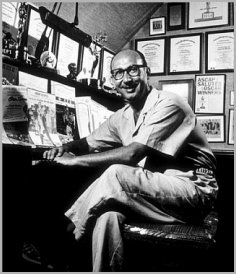
Sammy Cahn at the piano surrounded by honors.


He may not be quite in the same class as Cole Porter, Ira Gershwin or Johnny Mercer, the artful poets of the American popular song, but Sammy Cahn’s cheerful, upbeat songs entertained generations. 
Samuel Cohen was born in Manhattan’s Lower East Side on June 18, 1913 to a family of immigrant Jews from Galicia in the Austro-Hungarian Empire.  The family was successful enough to provide music lessons for the children—piano for his four sisters, and the violin for him.  At sixteen he left school and joined a Dixieland band playing in the Catskill resort hotels.
Back in the city after the season ended he supported himself by odd jobs and spent most of his money attending vaudeville performances.  He studied the style and form of the musical numbers and concluded he could do as well writing the material he saw on the stage as anyone.
He soon teamed up with the first of many partners he would have over his long career, Saul Chaplin.  Using the joint credit of Cohen and Chaplin, the pair started churning out an astonishing volume of specialty numbers for vaudevillians.  Seldom published these songs sometimes were written for special events or appearances, often reworked over and over for subsequent uses, or as novelty numbers in longer acts.  They were clever and soon in demand if not well paid.  Clients included rising stars Milton Berle, Danny Kaye, Phil Silvers, and Bob Hope.
With the addition of sound to motion pictures they also picked up work doing songs for Warner Bros. Vidaphone shorts at the company’s Brooklyn studios, their first work in movies.
The duo finally broke into the big time when a childhood chum, music publisher Lou Levy got their tune Rhythm is Our Business into the hands of Black bandleader Jimmie Lunceford who made it his signature song.  Not only was it their first ASCAP credit, but opened the door to work with other big band leaders Glen Gray and Tommy Dorsey. 
The pair relocated to Hollywood where they were under contract to Warner Bros.  Their hits included Until the Real Thing Comes Along and Please be Kind.  Cahn also wrote the English words to the Andrews Sister’s break out hit, Beir Mir Bist Du Schöen.
Cahn and Chaplain broke up when their Warner contract expired in the early ‘40s, but Sammy wasted no time in finding a new partner who would help bring his career to greater heights—Jule Styne.  The soon busy new duo were soon churning out songs for big bands and radio crooners, as freelancers in the movies, and even co-wrote a Broadway hit, High Button Shoes.
Through Dorsey Cahn met Frank Sinatra and was soon the singer’s favorite lyricist.  Sinatra recorded Saturday Night (Is the Loneliest Night of the Week), The Things We Did Last Summer, and Five Minutes More. Other hits from this fertile period included I’ve Heard that Song Before for Harry James; Doris Day’s I’ll Walk Alone; It’s Been a Long, Long Time, a hit for both Bing Crosby and Harry James; and Let it Snow, Let it Snow, Let it Snow. 
The pair also wrote scores for almost a dozen films.  But the success of High Button Shoes temporarily broke up the songwriting team.  Styne wanted to stay in New York and dedicate himself full time to musical theater.  Always practical, Cahn figured there was more work in Hollywood and as a freelancer.
He hooked up with partner number 3, Nicholas Brodszky, a refugee from the Nazis and war torn Europe.  Brodszky’s European sensibility and affinity for operetta, got the new team work for Mario Lanza films including Lanza’s signature song Be My Love.  They also penned numbers for Doris Day including I’ll Never Stop Loving You.
Despite their success, Cahn reteamed with Styne for just one fruitful year in 1959.  They won Cahn’s first Academy Award for Best Song after 9 previous nominations stretching back to 1942—Frank Sinatra’s Three Coins in the Fountain.  They also did the score to The Seven Year Itch.
Styne went back to New York, but the unstoppable Cahn teamed up once again, this time with Jimmy Van Heusen.  Soon they were known as Sinatra’s favorite writers and established the signature sound and the infectious, up-beat lyrics for which Cahn is now best known.  The resultant string of hits and included Love and Marriage, The Tender Trap, All the Way, The Second Time Around, Ain’t That a Kick in the Head, Pocketful of Miracles, High Hopes, Come Fly With Me, My Kind of Town, and September of My Years. Those included two more Oscar winners and almost innumerable nominations.  This work alone would cement a reputation.
But there was more.  Call Me Irresponsible, introduced by Jackie Gleason in Papa’s Delicate Condition won Cahn his fifth Oscar.  Cahn and Van Heusen teamed up to write the films Robin and the Seven Hoods, Thoroughly Modern Millie, and Star!
Cahn also occasionally collaborated with others over his career including Sammy Fain for You Can Fly, You Can Fly, You Can Fly from Disney’s animated Peter Pan, Written on the Wind with Victor Young, and The Best of Everything with Alfred Newman.
In the late ‘70’s and ‘80’s when his contemporaries like Hoagie Carmichael and Johnny Mercer were discouraged by the lack of opportunities.  Cahn kept plugging away, still providing songs for Sinatra with Van Heusen but also doing work with new partner George Barrie for a couple more Oscar nominees, All That Love Went to Waste and Now That We're in Love. 
But Cahn really carved out a new career when he launched his one man show Words and Music in 1974 on Broadway.  The critically acclaimed show featured Sammy and a piano performing a parade of his hits interspersed with charming recollections of his long career.  The stories, some perhaps embellished for effect, were mostly true although some of his former collaborators found nits to pick. The show won Cahn the Outer Circle Critics award for, ironically, Best New Talent on Broadway. The same year his autobiography, I Should Care: The Sammy Cahn Story was published.
Cahn took his show to London and toured the States with it.  He became a popular guest on TV talk shows.  The show was remounted to more success on Broadway in the 1980’s.
Cahn was inducted into the Songwriters Hall of Fame in 1972 and later took over as President when his friendly rival Johnny Mercer became ill. Over the course of his career, he was nominated for 23 Academy Awards, five Golden Globes, Emmy, and received a Grammy nomination with Van Heusen for Best Original Score.  In 1988 a new award for movie songs and scores was named The Sammy in his honor recognizing that he had received more Oscar nominations and awards than any other songwriter.
When he died on January 15, 1993 at the age of 79, Sammy Cahn was memorialized as one of the most successful—and prolific—lyricists in history.
So, happy 100th birthday, Sammy!