Showing posts with label Sir Walter Raleigh. Show all posts

Sunday, August 5, 2018

The First English Colony in North America…Nope Not the One You Think

Fishermen from Holland, Portugal, Normandy, and England put ashore at St. Johns in seasonal camps to dry, salt, and store the cod bounty from the Grand Banks for decades before a colony was officially established.

Ok, it’s quiz time, campers!  For 100 points and a gold star on your forehead, what was the first English colony in North America?  Bzzzzz.  If you said, I bet almost all of you did, Virginia (Jamestown) or Plymouth Plantation, you would be dead wrong.  By decades.

On August 5, 1583 Sir Humphrey Gilbert established that first English colony at what is now St. John’s, Newfoundland and Labrador in Canada.
Venetian navigator John Cabot sailing for England's King Henry VII discovered the deep natural harbor in what is now Newfoundland in 1497 and name it for St. John the Baptist
John Cabot became the first European to sail into the deep a commodious harbor way back on June 24, 1497, the feast day of Saint John the Baptist and bestowed the Saint’s name on the place, although his exact landfall is unknown.  Cabot made his charts and reported back to his English employers including the information that the harbor had easy access to the seemingly endless cod fisheries off shore.

By the early 16th Century Portuguese from the Azores, Basques from Spain, and the French were annually visiting the fisheries and sometimes making temporary camp ashore and trading with the natives.  On August 3 1527 English sailor John Rut on a mission from King Henry VIII to find the Northwest Passage that Cabot had been seeking thirty years earlier sailed into the harbor where he found eleven Norman, one Brittany, and two Portuguese fishing vessels moored.  He described the event in a letter to the King, the first ever written from North America.

By the 1640’s St. Johns, by now a well-established seasonal fishing camp, appeared in various Portuguese and French atlases.  Around that time Water Street running along harbor shore was in use, making it the oldest street or road in North America.

Reports on the rich fisheries and fine harbor began to attract English fishermen from the west country as well.  Within the next thirty years or so they dominated the annual summer runs.
Sir Humphrey Gilbert, a soldier/explorer/adventurer like his half-brother Sir Walter Raleigh, managed to set sail for the New World under a nearly expired six-year royal patent for exploration in 1683 with a small six or seven ship fleet crewed by the dregs of English ports.  One ship sailed under the command of Raleigh, but he was forced to turn back when his ship was damaged in a storm.  

After trials and tribulations Gilbert and his little fleet arrived off St. Johns but found themselves blocked from landing by the united opposition of multinational fishing fleet which was commanded by an Englishman appointed by the seamen as Admiral.  One of Gilbert’s ship masters had committed piracy against the Portuguese some years earlier and was recognized.
Sir Humphrey Gilbert claims St. John's as a colony of England and Queen Elizabeth I be fore astonished fishermen from half a dozen countries.
Eventually Gilbert satisfied the fishermen and was allowed to land on August 5.  They were astonished when Gilbert, waving his patent papers, claimed St. Johns and a vast surrounding area for the English Crown.  The claim was solemnized in a brief ceremony ashore.   After a few days Gilbert and his fleet sailed away, supposedly back to England.

But Gilbert decided to do a little freelance exploring first and managed to ground his largest vessel loosing most of his food, water, and supplies.  On board his personal favorite, a leaking tub called the Squirrel instead of the far more sea worthy Golden Hind, the ship that had circumnavigated the globe under Sir Francis Drake a few years earlier, he foundered and was lost on September 9.

But his claim made it safely back into the hands of Queen Elizabeth, officially making it the first colony in North America.  Plans for permanent settlement, however, were put aside for some years.  But the seasonal fishing village flourished and the Queen and her successors made a pretty penny taxing the fleet.

Sometime before 1620 a permanent settlement was finally established, about the same time as Jamestown in 1619 and Plymouth a year later.  Shortly after it became the first incorporated English city on the continent.
An early view of the St. John's waterfront.
St. John’s because of its magnificent harbor and command of the rich Grand Bank fisheries became a strategic point in the control of the entire continent. The Dutch under Admiral Michiel de Ruyter temporarily seized the port in June 1665.  After that the English began to erect fortifications, which were re-enforced after each new threat.

French Admiral Pierre Le Moyne d’Iberville captured and destroyed the town in 1696 and leveled the original earth work fortification.  The English returned the next year to find the town all but deserted after which stronger stone and masonry fortifications were built. The French attacked St. John’s again in 1705 and captured it in 1708 in the Battle of St. John’s. Both times the civilian town was leveled by fire.
The French attack St. Johns in 1762 in the Seven Years War.
The French captured the town for the last time in 1762 during the Seven Years War known as the French and Indian War in the lower English colonies.  The English took it back after the Battle of Signal Hill, the final major action of the war.

The port city was a major English naval base and staging area for operations in both the American Revolution and the War of 1812.
British aviators John Alcock and Arthur Brown  made the first non-stop transatlantic flight in June 1919 taking off in a modified World War I Vickers Vimy bomber from St. John's.
Because it is the eastern most port in North America, St. Johns figured prominently in several communications and transportation firsts.  Guglielmo Marconi received the first transatlantic radio signal there from his wireless station in Poldhu, Cornwall in December 1901.  Alcock and Brown made the first transatlantic flight in a modified Vickers Vimy IV bomber, in June 1919 leaving from Lester’s Field in St. John’s and ending in a bog near Clifden, Connemara, Ireland.

St. John’s is the capital city of Newfoundland and Labrador which after a long history as an independent colony became the 10th Province of Canada in 1949.

In the 1990’s the cod fisheries of the Grand Banks, the economic engine of the city for hundreds of years, collapsed plunging the city and province into a depression and causing a hemorrhage of population to the rest of Canada.

In recent years the development of the Hibernia, Terra Nova and White Rose oil fields has spurred population growth and commercial development.


Thursday, August 18, 2016

The Lasting Mystery of Virginia Dare

This popular and widely circulated 19th Century print purports to depict the christening of Virgina Dare.  Wrong on several counts.  She may have been christened, but there was no clergyman or deacon among the colonists.  And no structure in the struggling colony was was grand and spacious as this timbered Tudor home.  Colonists were living in huts and hovels.


On August 18, 1587 Virginia Dare was born on Roanoke Island, one of the Outer Bank Islands off the coast of what is now North Carolina in a fledgling colony underwritten by adventurer Sir Walter Raleigh. 
Her mother Eleanor was one of 17 women who had made the hazardous Atlantic crossing and was the daughter of the man assigned by Raleigh to establish the colony, John White.  And that is all we really know about her. 
When her grandfather made his long delayed return to the settlement exactly three years later on August 18, 1590, he discovered the settlement abandoned with no sign of a struggle.  In fact the palisade and buildings had been carefully dismantled, indicating a planned move. A Maltese cross that was supposed to be carved on a designated tree as a distress signal in case the colonists had to flee hostile natives was not in evidence.
The only other clue to the fate of the inhabitants was the word Croatoan carved into a post of the fort and “Cro” carved into a nearby tree.  Croatoan was the name of a local tribe of southern Algonquin speakers with whom friendly relations had been established in earlier attempts to found the colony.  Their main village known to the English was on another barrier island, but the crew of the privateer on which White had hitched a ride refused to continue the search for them.  
White had to return to England with no knowledge of the fate of his colony, daughter and granddaughter.  Subsequent attempts to locate the survivors—if there were any—or to find any evidence of their fate turned up only rumor and speculation.  
The fate of the Lost Colony of Roanoke and of young Virginia Dare became one of the great mysteries of American history and the basis of countless myths, tall tales, and what we today would call conspiracy theories.  
The dashing privateer and favorite of Queen Elizabeth was granted a charter for a colony on the understanding that she would be cut in for a share of his pirate loot.

The short lived colony had its origins in a favor granted by Queen Elizabeth I to a court favorite, the dashing and handsome Raleigh, just the type to catch the Virgin Queen’s eye.  She granted him a Charter to establish a colony in the lands north of Spanish Florida which had been designated as Virginia.  The Charter required that Raleigh establish a permanent colony within ten years or lose his rights. 
Raleigh intended his proposed colony to trade with the natives and hopefully find gold or silver, but primarily to establish a base from which privateers could prey upon rich Spanish shipping.  In other words it was to become a base for gentlemen pirates willing to cut the Queen in on their loot. 
Although he did not go personally to Virginia, Raleigh wasted no time in establishing his claim. In 1584 he dispatched Phillip Amadas and Arthur Barlowe to explore the east coast for likely locations.  They returned with a recommendation for the Outer Banks islands, whose sheltered waters would be ideal for launching adventures against the Spanish.  They had also established relations with the Croatoan who they described as friendly. 
The following year Raleigh sent Sir Richard Grenville with a party of all male colonizers made up mainly of soldiers who had recently campaigned in Ireland.  The martial make-up of this group betrayed its intentions.  Unfortunately, most of the colony’s provisions were ruined when the main ship ran into a reef and sprang a leak.  Worse, while exploring the mainland shore they encountered non-Croatoan natives who they accused of stealing a sliver goblet.  In retaliation the men sacked and burned the village and executed the local chief by burning him.  This earned the natural enmity of many natives. 
Despite these problems Grenville decided to leave a skeleton colony of 75 men under Ralph Lane on the north end of Roanoke Island to enforce Raleigh’s claim.  He set sail with bulk of his men for England with a promise to return with reinforcements and provisions.  The promise relief date of April 1586 came and went without a sign of Grenville. 
When Sir Francis Drake, on his way back to England after successfully plundering the Caribbean happened upon them in June, they eagerly accepted his offer a ride back to England.  Grenville’s re-supply expedition arrived soon after to find the little colony abandoned.  Frustrated Grenville left a handful of men and returned to report the failure.  
A map of Roanoke Island with a circle palisade protecting a ring of huts taken from John White's accounts.

Next time Raleigh sent 117 settlers, including women and children under the command of his good friend White, an artist who had been on both of the earlier voyages and knew the area.  White got his colony off to a good start.  He re-established relations with the friendly Croatoan, but was rebuffed by the mainland tribes still angry over Lane’s depredations. They killed one settler as he was crabbing alone in Albemarle Sound.  Fearing for their safety should the mainland tribes attack, the colonists persuaded White to return with the ship that brought them to beg for reinforcements and protection. 
The series of unforeseen circumstances that would so long delay White’s return began with the late season crossing which was beset by gales.  The ship’s pilot declared that it had barely survived to reach port.  After White hastily gathered supplies and men, the Captain refused to make an even more dangerous winter crossing back.  Come spring the threat of the Spanish Armada caused every sea-worthy ship in England to be impressed into service.  White found two small coastal ships considered unfit for naval use.  But their captains decided to try their hand a privateering along the way and got captured by the Spanish, who confiscated their supplies but allowed them to return empty to England.  The war with Spain kept White from mounting another expedition. 
In desperation in the spring of 1590 he signed on a privateer planning to raid in the Caribbean whose captain promised to stop by Roanoke on the trip back to England.  White would come nearly empty handed, but he would come.  And be bitterly disappointed
John White finally returned three years to the day of Virginia's  birth and found the settlement abandoned and the clue "Croatoan" carved into a tree.  The print errs in showing the palisade standing--it and all of the buildings had been carefully disassembled  and removed indicating a voluntary and planned relocation.

Theories about the fate of the vanished colonists have led to wild speculation over the years.  At one point it was suggested that the Mandan, a tribe on the upper Missouri with whom Lewis and Clark over-wintered in 1803, were the decedents of the Roanoke people based on their pale complexions in comparison to other natives and the presence of some people among them with blue eyes.  Other lost “white” tribes were reported, or rumored across the east from as far north as Maine to the swamps of Florida. 
And there were occasional possible sightings of survivors or descendants.  In 1609 settlers from Jamestown relayed reports at that “four men and a maid” were living among the Iroquoian speaking Tuscarora, likely the hostile mainland tribe that Lane encountered.  But Chief Wahunsunacock, known to history as Powhatan allegedly told Jamestown’s Captain John Smith that he had wiped out the survivors shortly before near modern day Hampton Roads because they were living with a people who refused to join his growing confederacy.  He allegedly showed Smith English made iron trinkets to prove his story.
Yet another story tells of early settlers in Person County, North Carolina years later encountering fair skinned natives who spoke some English and had knowledge of “our Lord, Jesus Christ.”  Most scholars, however believe this group was an offshoot of the Saponi people who may have encountered—and slept with—English privateers or other visiting seamen
Other theories, not widely credenced, are that the settlers used wood from their dismantled village to build boats for an ill-advised and doomed attempt to reach England on their own or that they were found and massacred by the Spanish.  Most scholars today believe that they were either absorbed by the friendly Croatoan or captured and enslaved by the Tuscarora.  
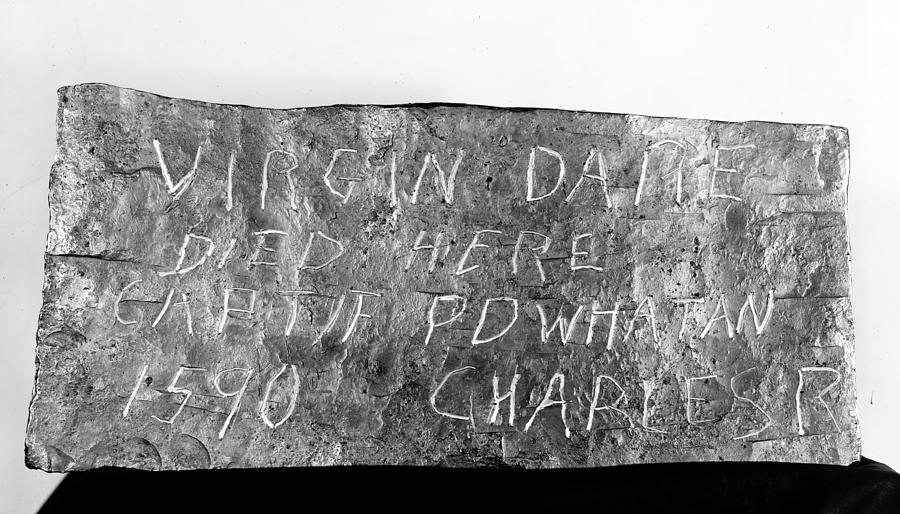
The fraudulent grave marker of Virginia Dare, one of 48 stone allegedly carved by her mother and scattered over two states.
Between 1937 and 1941, 48 stones were found around the Carolinas and Northern Georgia supposedly carved by Virginia Dare’s mother, Eleanor, as documentation of the colonists movements and subsequent deaths. These stones purportedly told the story of how the colonists, including Virginia and her father Ananias, were killed by “savages”, and plead for whoever found them to exact revenge on their perpetrators. For a time, the stones were thought by many to be authentic, but have been discredited by modern science and now only get attention from those notoriously sensational and unreliable History Channel “documentaries.” 
In 1998 some confirmation of the theory that they lived among the Croatoan was uncovered by archeologists from East Carolina University who found a gold 16th century English signet ring, gun flints, and two 16th century copper farthings at the site of the ancient Croatoan capital, 50 miles from the colony.  The ring has been identified with Master Kendall who is recorded as having lived in the Ralph Lane colony on Roanoke Island from 1585 to 1586.  But they don’t provide a link to the later colony and could have been acquired by trade.  
Some believe that the ongoing Lost Colony DNA Project founded by a group led by Roberta Estes in 2005, will solve the mystery by doing DNA testing of long residents of the area who claim Native American ancestry and whose families have long lived near Croatoan or other known sites.  They also plan to trace family names in the area, some of which correspond to names found among the Roanoke settlers.  They are attempting to re-construct possible family lines.  A web site seeking volunteer from people connected to a long list of family names to be genetically tested went up in 2007 but I have found no reports of progress or results.  But if the research has not sputtered out,  maybe, just maybe they will find a descendant of Virginia Dare.