Showing posts with label Theodore Parker. Show all posts

Friday, May 30, 2025

The American Unitarian Association—Tap Root of the Unitarian Universalist Association Has its Bicentennial

A graphic with dark blue background at the top with a circular, blue, yellow, and white "AUA 200 Years" logo at the top left and the words in white script, "Happy Anniversary, Beloveds" on the right.

Below this, on in black text on a white background is the follow quote:

"We must remember that we are a sanctuary people—not only in collaborating around the work of justice, but also in providing nourishment and shelter for our own spirits so that we do not give up in the face of all that is. 

Happy anniversary, beloveds. May this milestone year be one that galvanizes us in all the ways we are called to live into this moment and organize around our shared values in community. Rev. Dr. Sofía Betancourt"

In a line drawing style at the bottom, there is an image of a person with long hair lighting a candle in the lower left corner, then the UUA.org URL centered, then a line style drawing of a candle, then a black UUA chalice logo in the bottom right corner. 

NoteThis post required extensive research to refresh my once solid knowledge of this history.  Time erodes things. 

Last Sunday, May 25, was the 200th anniversary of the founding of the American Unitarian Association in Boston by ministers serving mostly in and around the Hub of the Universe in 1825.  The ministers all served self-governing congregations that were affiliated with the New England Standing Order, the former state church of Massachusetts, Maine, Connecticut, and New Hampshire. 

The Rev. Sofía Betancourt, President of the Unitarian Universalist Association (UUA) wrote:

…we celebrate 200 years of the American Unitarian Association at a time when Unitarian Universalism is badly needed in our nation and in the world. We should be proud of the accomplishments and impact of liberal thought and the theology that grows from that thought. Yet too there is trouble born of comfort in thinking that we know best when it comes to restoring justice and building a world and an Earth community that allows all to fully thrive.

So how do we proceed as authoritarianism is on the rise both domestically and around the world? We must remember that we are a sanctuary people—not only in collaborating around the work of justice, but also in providing nourishment and shelter for our own spirits so that we do not give up in the face of all that is.

Happy anniversary, beloveds. May this milestone year be one that galvanizes us in all the ways we are called to live into this moment and organize around our shared values in community.

Liberal preachers had been drifting away from the rigid orthodoxy of hell-fire-and-damnation Calvinism that arose from Puritanism since before the American Revolution.  Inspired by the Enlightenment these ministers were increasingly skeptical of the Doctrine of Predestination, the literal as opposed to symbolic or poetic absolute truth of every Bible story, proof by miracles, and finally even the divinity of the man named Jesus and the Doctrine of the Trinity

Rev. William Ellery Channing defined Unitarianism in his Baltimore ordination sermon in 1819 and was a prime mover in establishing the American Unitarian Association.

These differences became more profound after The Rev. William Ellery Channing preached an ordination sermon for Rev. Jarred Sparks at the First Independent Church of Baltimore on May 5, 1819.  The speech published in pamphlet form as Unitarian Christianity outlined a broad platform of belief and gave the movement an identity and a name—unitarianism.  Unitarianism was once an epithet used against non-Christian monotheists  including despised Jews and Muslims and a handful of heretic anti-Trinitarians.  Channing threw it in the face of the descendants of Cotton Mather—Sinners in the Hands of an Angry Godwho dominated the Standing Order.  Asserting unitarianism was not even the main focus of the address.  The right to read and interpret scripture using individual consciousness and reason was.

An open breach of the old Standing Order became inevitable.  The traditionalists became the Congregational Church and dominated outside the environs of Boston and port cities.  The fiercely independent liberals resisted any form of ecclesiastical, Presbytery, or other denominational structure.  They adhered to the Cambridge Platform of totally independent and self-governing congregations.  Aside from voluntary reciprocal cooperation of neighboring congregations and informal cooperation among ministers the newly define Unitarians lacked any cohesion.
File:Portrait of Andrew Norton Buell, 1855.jpg - Wikimedia Commons

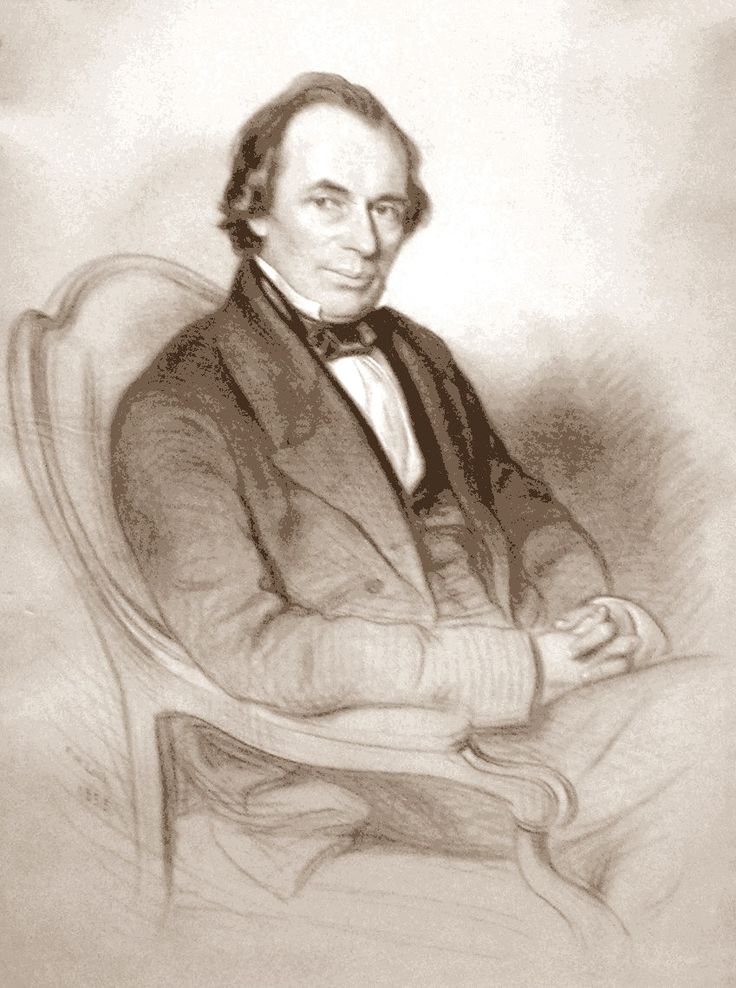
Andrews Norton, influential Harvard scholars was among the insurrectionists who founded the AUA but within a few years the so-called Unitarian Pope--was the leading voice for suppressing dissent from  a new orthodozy.

The need to compete with the Congregationalists, Episcopalians, Quakers, Universalists and other denominations with well-established national and regional press and resources for publishing tracts, pamphlets, and sermons.  After private conversations and letter exchanges William Ellery Channing; Andrews Norton, Harvard Professor of Sacred Literature  known to friends and enemies alike as “the Unitarian Pope;” and Henry Ware, the senior along with wealthy and influential laymen like convened a semi-chaotic meeting in January 1825.  The meeting call stated they were to consider “the practicality and expediency of forming a Unitarian convention or association, to consist of clergymen and laymen, to meet annually or oftener.” 

After a day of wrangling the meeting adjourned with the intent of forming a committee or commission to study and make recommendations.  Like many such committees it never really got together.   According to an account in short play by Nancy McDonald Ladd in UUWorld: 

….on May 25, 1825, an energetic group of younger ministers led by James Walker, Henry Ware Jr., and Ezra Stiles Gannet, all of whom had been present for that historic debate, went rogue. They arrived at the Berry Street Conference in Boston and personally presented their own plan for a new convention of Unitarian clergy. Met with affirmation from certain members of that body, on the very next day—May 26, 1825—they chartered the American Unitarian Association.

 undefined

 Henry Ware, Jr.  was among the young ministers who got the AUA going.

By an amazing coincidence the very same day that the British and Foreign Unitarian Association was chartered across the puddle establishing an official body for radical dissenting congregations in Britain and Ireland after restrictions on their worship were lifted by Parliament.  The kissing cousins were somewhat different in theology and Christology and significantly different in governance.  The Brits adopted a Presbyterian structure.

The new AUA was not an organizations of churches or parishes.  It was strictly a voluntary association of Ministers individual laymen with an interest in fostering the spread of Unitarianism.  It was governed by a Board and employed a part time secretary essentially someone to take notes, open the mail, and assist the elected Treasurer in the banking details of collecting and spending money.  He was also tasked with maintaining an annual roster of Ministers who were understood to be Unitarian in theology and preaching.  Within a few years the annual list became considered a more or less official recognition. 

Trouble began because it was subject to the whims, prejudices, and the reliability of information available to a clerk.  Some who wished to be included were turned down with no explanation, but usually because of some variation from an unexplained “norm” or because of scandal and perceived moral defects.  Andrews Norton became the champion of a Unitarian Orthodoxy while many younger ministers were drawn into the orbit of Transcendentalism or were influenced by Free Thinking.  Applications  were turned down from the suspected “heretics” and even from those who were suspected of any association with them.

Conversely, some enrolled ministers demanded to be removed mostly in protest to Nortons heavy hand.

Although ostracized by Unitarian traditionalist because of his outspoken abolitionism and militant support of Fugitive slaves, Rev. Theodore Parker became the inspiration for the first new minister members of the post-Civil War AUA.

There were many subsequent challenges that the barely organized AUA struggled with—divisions over slavery and the enforcement of the Fugitive Slave Act, how close to adopt radical abolitionism or distance itself from it, and especially the inability to plant new congregations outside of New England and to recruit and support missionary ministers.  Unitarians seemed doomed to be just a local tribal sect rather than a vital part of the American religious rights.  Brilliant radicals like the Rev. Theodore Parker showed a new way but were ostracized by the previous generation of rebels.

The Civil War and its aftermath demanded a new organization of congregations rather than individuals with denomination like authority—the National Conference of Unitarian and Other Christian Churches.   A special meeting of the AUA was held on December 7, 1864 which, recognized the   need of enlarged denominational activity with a resolution calling for “a convention, to consist of the pastor and two delegates from each church or parish in the Unitarian denomination, to meet in the city of New York, to consider the interests of our cause, and to institute measures for its good.”

 undefined

 Rev. Henry Bellows, prime mover and first Chair of the Board of the General Conference of Unitarian and Other Christian Churches.

The Convention was held in New York on April  5 and 6, 1865 and organized the National Conference of Unitarian and Other Christian Churches. The name was changed to General Conference of Unitarian and Other Christian Churches at Washington, D.C. 1911.  There was resistance by Cambridge Platform purist congregations and ministers who did not, at least immediately, join the new Conference.  The prime mover was the Rev. Henry Bellows, a practical second generation Transcendentalist with immense organizations skills honed as the leader of the United States Sanitary Commission which supported sick and wounded Federal troops during the Civil War.  From 1865 to 1880 was chairman of its council.

The General Conference did not replace the AUA, which continued to be active as an individual membership organization and a continuing support for Unitarian outreach.  The National Conference, and after about 1875 the semi-independent Chicago based Western Unitarian Conference provided direct support for member congregations and their ministers.  The WCA under the leadership of the Rev. Jenkin Lloyd Jones was the more social justice and labor friendly as well as embracing humanism, Free thought, and inspiration by non-Christian world religious traditions.  The General Conference wanted to keep Unitarianism in the Christian orbit for respectability among the “better classes” of people.  

 undefined

Felix Adler, the ethnic German Jew who was founder of the Ethical Humanist Movement, a close ally of Jenkin Lloyd Jone's  Unity Movement, and a prominent figure in the Free Religious Association.

Many of those rejected who rejected explicit Christian identity formed the alternative Free Religious Association in the 1870’s which flourished for a few years before gradually being reabsorbed by an evolved AUA and General Conference

Former President and Chief Justice served as President of the Conference during World War I and the Red Scare after.  He also purged pacifist ministers and those with connections to radicals in the Socialist Party and Industrial Workers of the World.

The post-Great War period matched accelerating technical and industrial innovation and pervasive shock and disillusion over the carnage.  The AUA and Conference were riven over demands by traditionalists for explicit identification as Christian and demands for or limits on freedom of conscience protections.  Compromises, unacceptable to the most passionate on each side, were made.
American Humanist Association - Wikipedia

Humanism became the dominant tendency of Unitarian and later Unitarian Universalism in the second half of the 20th Century.

Unitarian ministers, and some Universalists who were going through similar struggles, were prominent signatories to the first Humanist Manifesto in 1933.  The Manifesto gained more support during the Great Depression and another looming World War.  In 1941 the American Humanist Association was formed.  Many ministers and prominent lay people retained affiliation.   Their influence grew and by the mid-1950s Humanism was the dominant strain of Unitarianism.  They continued dominance into the early 21st Century.

Along the way the divided rolls and authority of the AUA became cumbersome and expensively duplicative.  In a major reform and reorganization the AUA subsumed the Conference but adopted much of its structure and governance including being an association of congregations.  The AUA continued to honor and accept individual members, but those members would not have much voting power at annual May Meetings (conventions) compared to representatives of congregations who cast important votes based on their membership numbers.

The post-war AUA sought to broaden to include other progressive bodies into a new Council of Liberal Religion.  Outreach went out to liberal Quakers, progressive Congregationalists, Ethical Humanists, and others.  The Congregationalists had similar goal but instead formed the new United Church of Christ with some Reform churches, and independent congregations.  Relations between the cousin organizations remained cordial and they collaborated especially on social justice issues.
undefined  

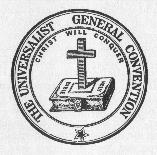
                                                        The 19th Century seal of the Universalist General Convention.

While the Council never really took off, relations with the Universalist General Convention (later the Universalist Church in America) did.  Universalists had deep roots in New England and a semi-mythological origin story.  Believers in universal salvation by a loving God and radical egalitarianism in this life, they were organized by mostly self-taught preachers  and began forming regional conferences after the Revolutionary War.  The Universalists in the early years tended to be farmers, local merchants and trades people, some respectable if not wealthy gentry, and even laborers and (in some cases) Black Freemen.  The class divide with Unitarians, especial the old Boston Brahman elite,  was intense.  But over the next century and a half each group evolved, theological divisions blurred, and shared a general liberal religious outlook.

The interesting and complex story of the Universalist is too long to consider here.  Another day perhaps.

https://www.harvardsquarelibrary.org/wp-content/uploads/2012/07/greeleyaua.jpg

Prominent  Unitarian Minister Rev. Dana McLean Greeley (center) at his inauguration as first President of the new Unitarian Universalist Association flanked by Rev. Harry B. Scholefield (left) and Lawrence G. Brooks.  The dynamic leader committed the new Association and its resources to the Civil Rights movement and anti-war protest.  He was often on the streets and front lines of the struggle and was arrested.  He set a pattern of UUA leaders as outspoken social justice activists.

In the 1950s the two faiths began sharing religious education materials, curriculum, and even a youth group—Liberal Religious Youth (LRY).  Then they began cooperating on publication.  Serious talks about a possible merger heated up culminating in the consolidation (never say merger) into the Unitarian Universalist Association (UUA) on May 15, 1961.  The Universalist had to adopt Unitarian congregational polity.  Regional conventions, stripped of any real authority, were allowed to meet but slowly faded away.  Unitarians ended individual membership except for Life Members, the last of whom passed in the early 21st century.  A statement of principles was largely adapted for Universalist practice and eventually became the Seven Principles which were the closest to a statement of faith.  After a lengthy discussion those Principles were replaced by a set of guiding values centered around Love.

UUA Logo Chalice Graphics | UUA Branding Graphics, Colors ...

                                     The current Unitarian Universalist logo in Pride Month rainbow colors.

The UUA’s continued evolution as the most visible and influential liberal religious voice in North America is also another story on a long and winding path.


Wednesday, August 24, 2022

Theodore Parker Was a Unitarian Prophet Without Honor in His Own Land

                             Rev. Theodore Parker in 1855.

Theodore Parker was born on August 24, 1810 in Lexington, Massachusetts.  His large family had deep roots in New England.  His grandfather was the Captain Parker who commanded the militia on Lexington Green in the opening skirmish of the American Revolution.

He was scholarly and devout but lost both parents and his seven of his nine siblings by the time he was 27, mostly to that scourge of the era consumption (tuberculosis.)  The losses confirmed his rejection of Calvinist orthodoxy.

As a youth he was unable to afford tuition at Harvard, so he read the entire curriculum on his own.  He dallied as a school master and toyed with the idea of becoming a lawyer before he settled on becoming a minister.  After mastering Latin, Greek, Hebrew, German, theology, church history, and biblical studies on his own, Harvard Divinity School admitted him even without an undergraduate degree in 1834.

After graduating, Parker married and was ordained by the small West Roxbury congregation.  The light duty of a small congregation allowed Parker time to study more on his own.  With his introduction to German historical Biblical criticism, his views began to evolve away from the generally accepted Unitarian theology.

                                    Young Parker while he still had hair.

First, he began to question the historical validity of miracles in the Old Testament.  That lead to questions about Christs miracles and a new view that Jesus was simply more divinely inspired than most men—although divine inspiration was open to all—and that his teachings were great not because they came from God, but because their authority was based on truth.  By the end of the decade his written speculations along these lines were beginning to cause ripples.

Parker naturally fell in with the emerging Transcendentalists.  He attended early meetings of the Club and was soon contributing to their seminal journal The Dial.  Like others in the group, he was influenced by Ralph Waldo Emerson.  After the scandal of Emerson’s Divinity School Address, which he heard in person, he was drawn into the controversy that arose after Unitarian traditionalist Andrews Norton launched his furious assault on Emerson’s infidelity.  He soon published his own defense of Transcendental liberalism in the guise of commentary by a “member in the pews”.  The pamphlet, The Previous Question, cemented Parkers reputation as a leading voice of a new movement.

                            Parker was drawn into the orbit of Ralph Waldo Emerson and the Transcendentalists.

On May 19, 1841 Parker summed up his evolving views in an ordination sermon for Charles C. Shackford at the Hawes Place Church in South Boston, much as a generation earlier William Ellery Channing had launched Unitarianism as a distinct religious movement in the United States at the ordination of Jared Sparks in Baltimore. A Discourse on the Transient and Permanent in Christianity is now considered a foundational document of the evolving Unitarian faith.  But at the time it caused a scandal

Most Boston area preachers believed Parker had abandoned Christianity altogether. He became the target an informal boycott of pulpit exchanges. While his Roxbury parish loyally stood by him, Parker went on the offensive with well attended lectures in Boson, which he collected and published as A Discourse of Matters Pertaining to Religion in the spring of 1842. Soon the informal boycott of pulpit exchanges led to an 1843 attempt to force Parker to resign from the Boston Association of Congregational Ministers, whose members were all Unitarians.   He steadfastly refused to do so and accused his colleagues of trying to impose a creed.

Later in 1843 Parker and his wife briefly escaped the growing controversy by making a European tour, during which time he began to mull social inequality and the nature of Democracy.  When he returned he began to infuse his sermons with topics of social reform as well as theological radicalism.  Whether the topic was temperance, the rights of workers, or the evils of slavery this new rabble rousing only increased hostility against him by his peers.

In 1844 John Sargeant, employed by the Beneficial Fraternity to preach at a missionary chapel for immigrants, exchanged pulpits with Parker and was reprimanded by the Ben Frat board.  He resigned in protest.  Less than a month later, in December, it was Parkers turn by rotation among all of the members to preach the weekly Thursday Lecture sponsored by the Ministerial association at First Church.  Parker delivered a blunt rebuke of Unitarian orthodoxy, The Relation of Jesus to His Age and the Ages.  The association transferred management of the lecture series to First Church so that Parker would never again be called to speak by rotation.

In January of 1845 James Freeman Clarke, one of the most esteemed Boston ministers and a theological opponent of Parker, decided that his fellows had gone too far in trying to impose conformity and invited Parker to exchange.  Fourteen of the leading families of The Church of the Redeemer resigned in protest, putting Clarke’s ministry in peril.  It would be the last time any Boston minister extended an invitation to exchange.

But Parker’s radicalism did have supporters in the pews in Boston.  They rented the Melodeon Theater to house weekly worship services in 1845.  The rest of the year he preached in the Theater on Sunday morning and in Roxbury that afternoon.  By December the group decided to form an independent congregation and call Parker.

Theodore Parker filled the seats of the Boston Music Hall, second venue for his 28th Congregational Society.

On January 4, 1846 Theodore Parker was installed as the minister of the 28th Congregational Society of Boston, a congregation created for the sole purpose of providing a platform for the maverick, outcast Unitarian and fiery abolitionist in the heart of the Hub of the Universe.  The distinguished Unitarian ministers of Boston were outraged.  Probably even more so when they learned that he broke with precedent and preached his own instillation sermon, The True Idea of a Christian Church—which could only be interpreted as an in-your-face challenge to their moral authority.

Although the core group of three hundred or so supporters who underwrote the new congregation was largely Unitarians, the new congregation was not considered a Unitarian Church, but a Free Church open to all and unbound by any dogma.   Soon upward of 1000 people were regularly attending Parker’s Sunday sermons and Wednesday evening lectures on social, political, and scientific issues.  When that venue became too crowded, services were moved to the Boston Music Hall and attendance doubled. 

Parker could be considered the first pastor of a mega church.  And like the leaders of modern mega churches, he used every medium at his disposal to spread his radical gospel.  Although banned from the Unitarian press, he published articles regularly in both Boston and national periodicals and edited his own journal, the Massachusetts Quarterly Review.  His sermons were collected and published in popular collections and he regularly churned out books on theological, moral, and reform issues.  When he was not speaking from his own pulpit, he lectured widely.  By the 1850’s he was one of the most famous men in America, adored by his followers and cordially hated by his enemies.

Parker on the lecture stump in New York City.  He was one of the most in demand speakers in the U.S.

If the local Unitarian worthies thought that Parker was trouble before, his prominent new pulpit only provided him with opportunities to go even further, particularly on social justice issues.  Parker espoused a new American industrial democracy which he proclaimed was “of all the people, by all the people, for all the people”—a phrase latter borrowed by Abraham Lincoln who had read several collections of Parker’s sermons.  To this end he advocated numerous social reforms including free public education, penal reform, and support for the emerging Women’s Rights movement.  But his greatest attention was turned to the mortal flaw that kept industrial democracy form truly flourishing—slavery.

He had already denounced the Mexican War as an attempt to expand slavery and led Boston opposition to the Fugitive Slave Act of 1850.  He was a minister at large to the Black community for the Abolitionists and as chair of their Vigilance Committee arranged for support and abetted the escape of fugitives.  He personally harbored at least two in his own home.  In 1855 he was indicted by a Federal Grand Jury for conspiracy to violate the Fugitive Slave Act.  Although his popular support in Boston led to the eventual dismissal of the charges, he was branded an enemy of the South and worked with a pistol on his desk to defend himself from constant threats on his life.

Parker was one of the secret 16 abolitionists who funded John Brown in Kansas and one of the very few to publicly defend him after the Harper's Ferry Raid.

Parker and his wife continued on their journey to Europe.  On May 10, 1860 Parker died in Florence, Italy.  He was buried in the Strangers Cemetery, the final resting place of stranded, exiled, or expatriate Protestants.  The Boston Ministerial Association declined to send condolences to the widow.

As much as Parker was despised by the old guard, he was already lionized by a whole younger generation of ministers who would go on to lead Unitarianism in the later 19th Century.  His theology broadly trumped a more conventional Christianity and he was held to be the model of prophetic ministry.

A rare, late picture of a bearded Parker illustrates a profile in a popular magazine shortly before illness forced his retirement.

In the modern Unitarian Universalist Association, with its heavy emphasis on social justice, he has become an even more canonical figure. 

Earlier in the 21st Century, a minority movement emerged that wished to tone down political action and emphasize congregational autonomy and enriched spiritual content, criticized Parker for his disruptive, un-collegial behavior, his willingness to defy the law and endorse violence, and surprisingly for one of Unitarianism’s deepest theological pioneers, for a lack of spirituality

                            Parker's grave in the Stranger's Cemetery in Florence, Italy.

Those biting gnats will did no serious damage to the reputation of the man who inspired Martin Luther King with his words, “I do not pretend to understand the moral universe; the arc is a long one, my eye reaches but little ways; I cannot calculate the curve and complete the figure by the experience of sight; I can divine it by conscience. And from what I see I am sure it bends towards justice.”


Tuesday, February 12, 2019

Lincoln and Faith—Fact and Fiction

Evangelicals have been trying to claim Lincoln for a long time.  Today's Religious Right continues to do it.

Note—On Abraham Lincoln’s 210th birthday we revisit an analysis of Honest Abe’s religious beliefs and connection.  As you read, contrast to those of the current occupant of the White House who claims to be a born again Christian and a champion of the Religious Right yet shows no knowledge of or interest in the faith he professes.

Back in 2009 the nation was in the grip of a wave of Lincoln mania in conjunction with the bi-centennial of his birth.  There was an avalanche of new books and articles examining every aspect of the Great Emancipator’s life, work, and connections.

The Religious Right—those who were not also neo-Confederates any way—was busy, as usual, trying to retroactively adopt him as an Evangelical Christian.  On the other hand the small world of the Unitarian Universalist blog-o-sphere and a spate of sermons, tried to lay claims that Lincoln was, at least in spirit, a Unitarian or a Universalist.

Scott Wells, a leading Universalist and Christian blogger from a Southern background claimed to be immune to the cult of Lincoln worship.  For his family Lincoln represented oppression, destruction, and, for them, the nightmare of Reconstruction.  He also scolded U.U.s for trying to appropriate Lincoln into our ever popular lists of famous UUs.

The following is adapted from my response to Wells.

Hagiography aside, there are many reasons to put your understandable regional bias aside and spend some time studying Abraham Lincoln. As flawed and inconsistent as any man, he is still rewarding for the subtlety and depth of his thought and his life long struggle to reconcile a true and deeply held idealism with both personal ambition and the need to act in a brutal and unforgiving environment. Even Harry Truman, a Missouri Democrat whose unreconstructed Confederate mother never forgave him for making Lincoln’s Birthday a national holiday, came to deeply admire his ancient tribal enemy
In talking about religion Lincoln often expressed a modest practicalism.
Lincoln’s relationships to religion are not a murky as some suppose. Certainly any denomination that would attempt to claim him as its own is self-delusional. Here is some of what we know.

1)   At no time in Lincoln’s life did he ever claim to be a Christian as understood at his time or to be saved.

2)  As far is known he was never baptized and never became a member of any church.

3)  Among his earliest published writings were attacks on a political rival, Peter Cartwright who was a fire-and-brimstone Methodist circuit rider who had accused Lincoln of infidelity and had used his wide Methodist connections to build a Democratic political operation.  The articles, which appeared under a nom de plume, mocked both the man’s religion and his attempts to use his followers as a political base.  Lincoln claimed never to have “denied the truth of Scripture” but did acknowledge that he was not a church member.  Lincoln defeated Cartwright for a seat in Congress, but Cartwright’s charges—and his own tart responses—would dog him for years.

4)   Like most self-educated Americans who had literary aspirations and who were not versed in the Latin and Greek of the Eastern college educated elite, Lincoln had two primary sources to draw from for both inspiration and style—The King James Version of the Bible and the popular plays of William Shakespeare. He knew both. But his writing was infused with the cadences and majesty of the Bible. He could also, if the occasion called for it, usually in response to some hypocrisy from the mouth of a believer, quote verse with ease.

5)  He deeply admired Thomas Jefferson and treasured the Declaration of Independence as the essential founding document. He borrowed from Jefferson, and from George Washington, the language of Deism in public discourse. He frequently spoke of Providence, Creator, and other Deist constructions. He did not avoid the word God, but he did not invoke an explicitly Christian God. One can search in vain for much use of the words Christ or Savior outside of the context of letters of condolence to the families of fallen soldiers often echoing back sentiments expressed by the bereaved. He was all for giving whatever comfort he could.

Springfield"s Presbyterian Church continues to call itself  Lincoln's Church and includes this inaccurate--Lincoln was still just growing his beard when he left town--illustration in their literature
6)  In Springfield he attended Mary’s Presbyterian Church and was friendly with its minister but never joined the church or partook in the Spartan Presbyterian communion.  That hasn’t stopped that congregation from calling itself “Lincoln’s Church” to this day.

7)  He read the published sermons of both William Ellery Channing and Theodore Parker and appropriated or adapted words from each—especially Parker—in his speeches. But in practice as President, despite a personally cordial relationship with Radical Republican Senator Charles Sumner, he found Abolitionist Unitarians to be pig-headed impediments to a practical prosecution of the war and a move toward post-war healing and a re-united country.  Despite this the UU congregation in Springfield proudly adopts his name.
Lincoln read, admired, and paraphrased Unitarian Theodore Parker.
8) He believed deeply and viscerally in Fate and implacable Destiny. This was part and parcel of his widely reported melancholia. Some scholars have attributed this to a sort of Calvinist hang-over. Could be. But Lincoln’s sense of fate and destiny seem to rise from far more ancient impulses.

9) There is nothing to connect Lincoln to institutional Universalism. Steven Rowe a Southern Universalist Church  historian responded to Wells with an excerpt from memoirs by Universalist minister quoting appreciative comment by Lincoln after attending a debate between a Universalist and a orthodox minister:

“I used to think that it took the smartest kind of man to preach and defend Universalism; I now think entirely different. It is the easiest faith to preach that I have ever heard.  There is more proof in its favor, than in any other doctrine I have ever heard. I  have a suit in court here to-morrow and if I had as much proof in its favor as there is in Universalism, I would go home, and leave my student to take charge of it, and I should feel perfectly certain that he would gain it.” Such were his words.

Unfortunately there are no other witnesses to Lincoln attending the debate described or speaking this assessment of it.  And I am sure a diligent search of the memoirs of ministers of other denominations can turn up appreciative Lincoln quotes, some perhaps true, others the product of devout wishful thinking.  Yet there is much to suggest that Lincoln privately embraced a kind universalism of spirit that accepted a common struggle for understanding a greater mystery that transcended mere denominationalism.
Artist Michelle L. Hamilton depicted Lincoln describing his experiences in a White House séance.
10) In the White House, with the gruesome burdens of a war-time presidency on his shoulders and the private grief over the loss of his beloved son Willie, Lincoln followed Mary’s lead and seemed to take Spiritualism, then at the height of its American popularity, with due seriousness. At the time many Universalist ministers were also toying—to considerable controversy—with Spiritualism. But again Lincoln never publicly endorsed Spiritualism, or acknowledged it as his faith.

In the post-war years both the Abolitionist preachers with whom he sparred during the war and a generation of new Unitarian leaders bloodied on the battlefields of that war—Jenkin Lloyd Jones being a prime example—participated in the myth making that turned the martyred President into a kind of a Saint. They went too far. And rubbing the defeated South’s nose in it exacerbated the regional disdain with which you grew up.

But I think many modern Unitarians and Universalists can find much with which to resonate in Lincoln’s personal spiritual journey.  It so resembles so many of our own.