Showing posts with label United Irishmen. Show all posts

Monday, February 24, 2025

The Last Invasion of Britain Was an Opéra Boufee Farce

The whole saga of The Last Invasion of Britain is told on the panoramic Fishguard Tapestry from beginning to end and is on display in its own museum in the Welsh village.  Captioned in Welsh and English it begins here with the spotting of the French fleet.

On February 24, 1797 the remnants of a star crossed French invasion surrendered to local Welsh and English forces raised mostly from the local yeomanry.

It began as a diversion to a diversion, an ill planned and worse executed scheme to draw British troops from Continental Europe where they were engaged in the struggle with revolutionary France known as the War of the First Coalition.  But for Wolfe Tone and the United Irishmen, the tawdry affair was the beginning of a collapse of a great dream of Irish Independence secured with the assistance of French arms.

At the instigation of Tone, an Anglo-Irish idealist then serving as an officer in the French Army while trying to lead from exile the growing United Irishmen movement he had founded in his homeland, the French Directory authorized a complex and ambitious plan put forward by General Louis Lazare Hoche.  Tone had promised the French that 30, 000 United Irishmen would lead a mass popular uprising with the support of a fairly modest French invasion.  As a diversion to the main effort in Ireland, Hoche planned two more limited raids on the British home island.  The most significant would land in Wales and then march to Bristol to sack and burn the city.


Wolfe Tone was a Protestant Anglo-Irish patriot and founder of the United Irishmen.  As a French officer during the post-revolutionary wars, he convinced the French Directory to lend troops to an invasion of Ireland meant to trigger a general uprising against the English. 

Tone issued bloodthirsty manifestos smuggled into Ireland calling for the uprising and urging no quarter to British troops.  The stage was set for the great adventure.

On December 15, 1796, 43 ships carrying about 14,450 men and an arsenal war material for distribution in Ireland sailed from Brest.  Tone accompanied Hoche under the nom du guerre Adjutant General Smith, a thin disguise meant to protect him should he be captured by the British. 

The planned three prong operation had already fallen apart.  The main force for the actual invasion of Ireland arrived off Bantry Bay on the west coast but was prevented by high winter seas from attempting a landing.  The naval and troop carrier commanders were, in Tone’s acid opinion, largely incompetent.  After a heavy gale nearly destroyed the fleet, it had to limp back to France.

La Légion des Francs, under General Quantain, was instructed to attack Newcastle upon Tyne and destroy local shipping. It had set out from Dunkirk in November of 1796 but turned back in Dutch waters after bad weather had swamped several of the invasion barges.  The troops, mostly impressed convicts and even British prisoners of war, mutinied back in port and refused to re-embark for a second attempt. 

Astoundingly, the third force, a flotilla of French warships, now with no main effort to support, left Brest flying Russian colors on February 16, 1797 headed for Britain.

Young French General Louis Lazare Hoche was Tone's friend and ally and devised the plan for the Irish invastion that included two diversionary raids on the British home island.   Nothing worked as planned.

The second diversionary force was La Légion Noire (The Black Legion), a fierce sounding name for a rag-tag brigade sized force of 1,400 men and 46 officers.  Like the ill-fated Légion des Francs, it was also made up mostly of half-trained conscripts described, charitably, as irregulars.  But the was a core of the force were 600 Grenadiers of the line. The unit took its name from its uniforms, which were captured English redcoats that had been poorly died to a range of colors from muddy brown to a sooty black. Their trousers were a ludicrous and unmilitary  The poor condition of their outfits was an indication that the French command saw them as doomed pawns.  The unit was under the command of an Irish American, chef de brigade (colonel) William Tate who could not speak French and had to communicate with his men through translators.  Several of his subordinate officers were Irish, as well.

At least the warships under the command of Commodore Castagnier were first rate.  They included the frigates La Vengeance and La Resistance on her maiden voyage, the corvette La Constance, and Le Vautour a smaller lugger.  The plan was to provide cover for and land troops near Bristol, then to dash north to rendezvous with Hoche’s shattered fleet to provide them cover and protection on the limp home.  Of course, that meant that the small invasion force would be abandoned on the home island of the enemy.  What could possibly go wrong?

Apparently, a lot.  The same high seas and winds that had scattered Hoche’s fleet prevented a landing as originally planned.  Castagnier was forced to turn around and try to land at secondary choice, Cardigan Bay on the west coast of Wales.  Making its way through the Bristol Channel, the flotilla was spotted from land and despite now flying English colors was identified as hostile.  Surprise was gone.

La Vegengeance and La Resistance land their Troops in Cardigan Bay in Wales, unable to land nearer their target of Bristol.  Troops under Irish-American Col. Robert Tate had already taken the crest of the shore cliffs.  What looks at first glance like and American flag on the hill and on the ships is a French ensign.

At 2 in the morning of on February 22, 1797, the French landed 17 boatloads of troops, 47 barrels of gunpowder, 50 tons of cartridges and grenades, and 2,000 stands of arms. One boat was lost in the surf and sank, with the critical loss of artillery and ammunition.Lieutenant-Colonel Thomas Knox of the 400-man local Fishguard and Newport Volunteer Infantry had already been alerted of the invasion force and was mobilizing his troops.  In addition, other units in the region were rushing to the invasion site including Lord Cawdors Castlemartin Troop of the Pembroke Yeomanry Cavalry the along with the Pembroke Volunteers and the Cardiganshire MilitiaLieutenant-Colonel Colby of the Pembrokeshire Militia assembled 250 men.  A Royal Navy pressgang, tough thugs usually employed in emptying sea side pubs of drunken sailors and swooping up un-alert farm lads from the fields, 150 strong also landed with several pieces of artillery.  All began converging on the threat.  Lord Cawdor assumed overall command.

At dawn after a three-mile forced march from the landing site, Tate’s men looked down from the surrounding hills at the small port of Fishguard.  They observed it bustling with activity, no doubt stirred by the fast flying word of the invasion.  A good many women were assembled in the market dressed in a traditional local costume which included high black hats and scarlet shawls.  From the distance they apparently were mistaken for Redcoats in black shakos sending some of the ill trained irregulars into a near panic.

None-the-less the French began to push inland, capturing several farm houses.  Some of the irregulars broke loose and began pillaging the farmsteads and rural hamlets for loot, dashing the unrealistic hopes that the Celtic Welsh might see the invasion as liberators and rise up against English rule.

Tate was left with only a handful of his irregulars, mostly Irish exiles, and his regular Grenadiers.  He set up a headquarters and occupied strong defensive positions on the high rocky outcrops of Garnwnda and Carngelli.  

On February 23 the two hundred or so local militia at Fishguard under colonel Knox, re-enforced by an influx of angry civilian volunteers armed with scythes, pitch forks, pikes, and other odd implements, began a retreat from the port after realizing that they were facing a much larger force.  But they encountered Lord Cawdor’s hastily assembled force and turned around to join his march to meet the enemy.

As they advanced, Tate’s forces began to fall apart.  Conscripts discovered a warehouse of Portuguese wine and began drinking heavily.  Many, especially impressed English prisoners of war, simply deserted.  Most of the rest were soon drunk or sick in farm houses scattered about.


Enshrined on the Fishgaurd Tapestry farm wife Jemima Nicholas single handedly captured a dozen drunk French conscripts in their shabby uniforms and became a legend along with her traditional Welsh dress and high black hat.

One local farm wife, Jemima Nicholas, armed only with a pitchfork rounded up 12 of the drunken conscripts and locked them in St. Marys Church in the town.

That evening Cawdor and 600 men advanced from Fishguard on the French strong points but turned back fearing ambush.  But Tate’s men saw the size of the well-armed forces against them, including artillery.  Knowing that the fleet had already abandoned them, his officers began to council surrender.

The Pembroke Yeomanry and and other British troops form on the sands to accept the formal French surrender on February 24.

 The morning of the 24 two French officers entered Cawdor’s camp under a white flag to attempt to negotiate an honorable surrender with safety guaranteed Irish officers.  Cawdor refused the terms and set a 10 am deadline for unconditional surrender or he would attack.  Part of that was bluff.  Cawdor still believed he was outnumbered and planned to await further reinforcements before an all-out assault.
The deadline passed, but Tate realized his position was hopeless and announced his unconditional surrender at 2 pm.  Tate and his men were taken prisoner, although rounding up all the deserters and stragglers took time.  Eventually Tate and most of the others were paroled and returned to France.  Some of the conscripts simply agreed to switch uniforms, some for the second time.

But the disaster was not over for the French.  On March 9 La Resistance, which had been crippled by the adverse weather in the Irish Sea and La Constance were captured after a short but bloody engagement with HMS St Fiorenzo and HMS Nymphe.  Both were re-fitted and commissioned in the Royal Navy.  Commodore Castagnier on board La Vengeance managed to escape to France.

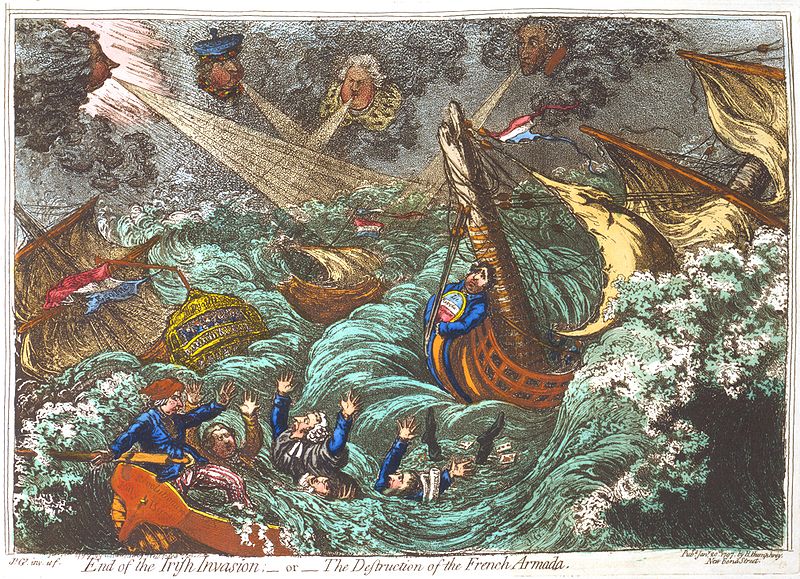
This tinted British print compared the damage to the French fleets to the destruction of the Spanish Armada more than 200 years before.  Perfect war time propaganda

As for Wolfe Tone, well he pressed for another invasion.  His ardent supporter Hoche died of tuberculosis and he found ascending French authorities, including Napoléon Bonaparte less enamored of his Irish schemes.  But when open rebellion broke out in Ireland and with Napoléon off on his Egyptian adventure, he persuaded the government to back a second expedition.

This time a force under General Humbert succeeded in landing near Killala, County Mayo and marching through the countryside gathering United Irishmen with “their pikes upon their shoulders” before it was smashed.  A second force broke up again in the raging seas, and the third, accompanied by Tone himself was intercepted by the Royal Navy.  Tone was taken prisoner.  He died of wounds of a botched suicide attempt after several days, but in time to cheat the hangman.

The pitiful and fruitless so-called Battle of Fishguard is now remembered as the last invasion of Great Britain. 

The Guidon of the Pembroke Yeomanry commemorates their famous victory.
 
In 1853 the Pembroke Yeomanry was awarded the battle honor “Fishguard” to be attached as a ribbon to their colors. It is the only regiment in the British Army, regular or territorial, which bears a battle honor for an engagement on the British mainland and the first battle honor awarded to a volunteer unit.


Thursday, February 22, 2018

The Last Invasion of Britain Was a Comic Opera Farce

The whole saga of The Last Invasion of Britain is told on the panoramic Fishguard Tapestry from beginning to end and is on display in its own museum in the Welsh village.  Captioned in Welsh and English it begins here with the spotting of the French fleet.


It began as a diversion to a diversion, an ill planned and worse executed scheme to draw British troops from Continental Europe where they were engaged in the struggle with revolutionary France known as the War of the First Coalition.  But for Wolfe Tone and the United Irishmen, the tawdry affair was the beginning of a collapse of a great dream of Irish Independence secured with the assistance of French Arms.
At the instigation of Tone, an Anglo-Irish idealist then serving as an officer in the French Army while trying to lead from exile the growing United Irishmen movement he had founded in his homeland, the French Directory authorized a complex and ambitious plan put forward by General Louis Lazare Hoche.  Tone had promised the French that 30, 000 United Irishmen would lead a mass popular uprising with the support of a fairly modest French invasion.  As a diversion to the main effort in Ireland, Hoche planned two more limited raids on the British home island.  The most significant would land in Wales and then march to Bristol to sack and burn the city.

Wolfe Tone was a Protestant Anglo-Irish Patriot and founder of the United Irishmen.  As a French officer during the post-revolutionary wars, he convinced the French Directory to lend troops to an invasion of Ireland meant to trigger a general uprising against the English. 
Tone issued bloodthirsty manifestos smuggled into Ireland calling for the uprising and urging no quarter to British troops.  The stage was set for the great adventure.
On December 15, 1796, 43 ships carrying about 14,450 men and an arsenal war material for distribution in Ireland sailed from Brest.  Tone accompanied Hoche under the nom du guerre Adjutant General Smith, a thin disguise meant to protect him should he be captured by the British. 
The planned three prong operation had already fallen apart.  The main force for the actual invasion of Ireland arrived off Bantry Bay on the west coast but was prevented by high winter seas from attempting a landing.  The naval and troop carrier commanders were, in Tone’s acid opinion, largely incompetent.  After a heavy gale nearly destroyed the fleet, it had to limp back to France.
La Légion des Francs, under General Quantain, was instructed to attack Newcastle upon Tyne and destroy local shipping. It had set out from Dunkirk in November of 1796 but turned back in Dutch waters after bad weather had swamped several of the invasion barges.  The troops, mostly impressed convicts and even British prisoners of war, mutinied back in port and refused to re-embark for a second attempt. 
Astoundingly, the third force, a flotilla of French warships, now with no main effort to support, left Brest flying Russian colors on February 16, 1797 headed for Britain.

Young French General Louis Lazare Hoche was Tone's friend and ally and devised the plan for the Irish invastion that included two diversionary raids on the British home island.   Nothing worked as planned.
The second diversionary force was La Légion Noire (The Black Legion), a fierce sounding name for a rag-tag brigade sized force of 1,400 men and 46 officers.  Like the ill-fated Légion des Francs, it was also made up mostly of half-trained conscripts described, charitably, as irregulars.  But at the was a core of the force were 600 Grenadiers of the line. The unit took its name from its uniforms, which were captured English redcoats that had been poorly died to a range of colors from muddy brown to a sooty black. Their trousers were a ludicrous and unmilitary  The poor condition of their outfits was an indication that the French command saw them as doomed pawns.  The unit was under the command of an Irish American, chef de brigade (colonel) William Tate who could not speak French and had to communicate with his men through translators.  Several of his subordinate officers were Irish, as well.
At least the warships under the command of Commodore Castagnier were first rate.  They included the frigates La Vengeance and La Resistance on her maiden voyage, the corvette La Constance, and Le Vautour a smaller lugger.  The plan was to provide cover for and land troops near Bristol, then to dash north to rendezvous with Hoche’s shattered fleet to provide them cover and protection on the limp home.  Of course, that meant that the small invasion force would be abandoned on the home island of the enemy.  What could possibly go wrong?
Apparently, a lot.  The same high seas and winds that had scattered Hoche’s fleet prevented a landing as originally planned.  Castagnier was forced to turn around and try to land at secondary choice, Cardigan Bay on the west coast of Wales.  Making its way through the Bristol Channel, the flotilla was spotted from land and despite now flying English colors was identified as hostile.  Surprise was gone.

La Vegengeance and La Resistance land their Troops in Cardigan Bay in Wales, unable to land nearer their target of Bristol.  Troops under Irish-American Col. Robert Tate had already taken the crest of the shore cliffs.  What looks at first glance like and American flag on the hill and on the ships is a French ensign. 
At 2 in the morning of on February 22, 1797, the French landed 17 boatloads of troops, 47 barrels of gunpowder, 50 tons of cartridges and grenades, and 2,000 stands of arms. One boat was lost in the surf and sank, with the critical loss of artillery and ammunition.
Lieutenant-Colonel Thomas Knox of the 400-man local Fishguard & Newport Volunteer Infantry had already been alerted of the invasion force and was mobilizing his troops.  In addition, other units in the region were rushing to the invasion site including Lord Cawdor’s Castlemartin Troop of the Pembroke Yeomanry Cavalry the along with the Pembroke Volunteers and the Cardiganshire Militia.  Lieutenant-Colonel Colby of the Pembrokeshire Militia assembled 250 men.  A Royal Navy pressgang, tough thugs usually employed in emptying sea side pubs of drunken sailors and swooping up un-alert farm lads from the fields, 150 strong also landed with several pieces of artillery.  All began converging on the threat.  Lord Cawdor assumed overall command.
At dawn after a three-mile forced march from the landing site, Tate’s men looked down from the surrounding hills at the small port of Fishguard.  They observed it bustling with activity, no doubt stirred by the fast flying word of the invasion.  A good many woman were assembled in the market dressed in a traditional local costume which included high black hats and scarlet shawls.  From the distance they apparently were mistaken for Redcoats in black shakos sending some of the ill trained irregulars into a near panic.
None-the-less the French began to push inland, capturing several farm houses.  Some of the irregulars broke loose and began pillaging the farmsteads and rural hamlets for loot, dashing the unrealistic hopes that the Celtic Welsh might see the invasion as liberators and rise up against English rule.
Tate was left with only a handful of his irregulars, mostly Irish exiles, and his regular Grenadiers.  He set up a headquarters and occupied strong defensive positions on the high rocky outcrops of Garnwnda and Carngelli. 
On February 23 the two hundred or so local militia at Fishguard under colonel Knox, re-enforced by an influx of angry civilian volunteers armed with scythes, pitch forks, pikes, and other odd implements, began a retreat from the port after realizing that they were facing a much larger force.  But they encountered Lord Cawdor’s hastily assembled force and turned around to join his march to meet the enemy.
As they advanced, Tate’s forces began to fall apart.  Conscripts discovered a warehouse of Portuguese wine and began drinking heavily.  Many, especially impressed English prisoners of war, simply deserted.  Most of the rest were soon drunk and or sick in farm houses scattered about.

Enshrined on the Fishgaurd Tapestry farm wife Jemima Nicholas single handedly captured a dozen drunk French conscripts in their shabby uniforms and became a legend along with her traditional Welsh dress and high black hat.
One local farm wife, Jemima Nicholas, armed only with a pitchfork rounded up 12 of the drunken conscripts and locked them in St. Mary’s Church in the town.
That evening Cawdor and 600 men advanced from Fishguard on the French strong points but turned back fearing ambush.  But Tate’s men saw the size of the well-armed forces against them, including artillery.  Knowing that the fleet had already abandoned them, his officers began to council surrender.
The morning of the 24 two French officers entered Cawdor’s camp under a white flag to attempt to negotiate an honorable surrender with safety guaranteed Irish officers.  Cawdor refused the terms and set a 10 am deadline for unconditional surrender or he would attack.  Part of that was bluff.  Cawdor still believed he was outnumbered and planned to await further reinforcements before an all-out assault. 

The Pembroke Yeomanry and and other British toops form on the sands to accept the formal French surrender on February 24.

The deadline passed, but Tate realized his position was hopeless and announced his unconditional surrender at 2 pm.  Tate and his men were taken prisoner, although rounding up all the deserters and stragglers took time.  Eventually Tate and most of the others were paroled and returned to France.  Some of the conscripts simply agreed to switch uniforms, some for the second time.
But the disaster was not over for the French.  On March 9 La Resistance, which had been crippled by the adverse weather in the Irish Sea and La Constance were captured after a short but bloody engagement with HMS St Fiorenzo and HMS Nymphe.  Both were re-fitted and commissioned in the Royal Navy.  Commodore Castagnier on board La Vengeance managed to escape to France.

This tinted British print compared the damage to the French fleets to the destruction of the Spanish Armada more than 200 years before.  Perfect war time propaganda.
As for Wolfe Tone, well he pressed for another invasion.  His ardent supporter Hoche died of tuberculosis and he found ascending French authorities, including Napoléon Bonaparte less enamored of his Irish schemes.  But when open rebellion broke out in Ireland and with Napoléon off on his Egyptian adventure, he persuaded the government to back a second expedition.
This time a force under General Humbert succeeded in landing near Killala, County Mayo and marching through the countryside gathering United Irishmen with “their pikes upon their shoulders” before it was smashed.  A second force broke up again in the raging seas, and the third, accompanied by Tone himself was intercepted by the Royal Navy.  Tone was taken prisoner.  He died of wounds of a botched suicide attempt after several days, but in time to cheat the hangman.
The pitiful and fruitless so-called Battle of Fishguard is now remembered as the last invasion of Great Britain. 
The Guidon of the Pembroke Yeomanry commemorates their famous victory.
In 1853 the Pembroke Yeomanry was awarded the battle honorFishguard” to be attached as a ribbon to their colors. It is the only regiment in the British Army, regular or territorial, that bears a battle honor for an engagement on the British mainland and the first battle honor awarded to a volunteer unit.

Thursday, March 17, 2016

St. Patrick’s Day—American as Apple Pie

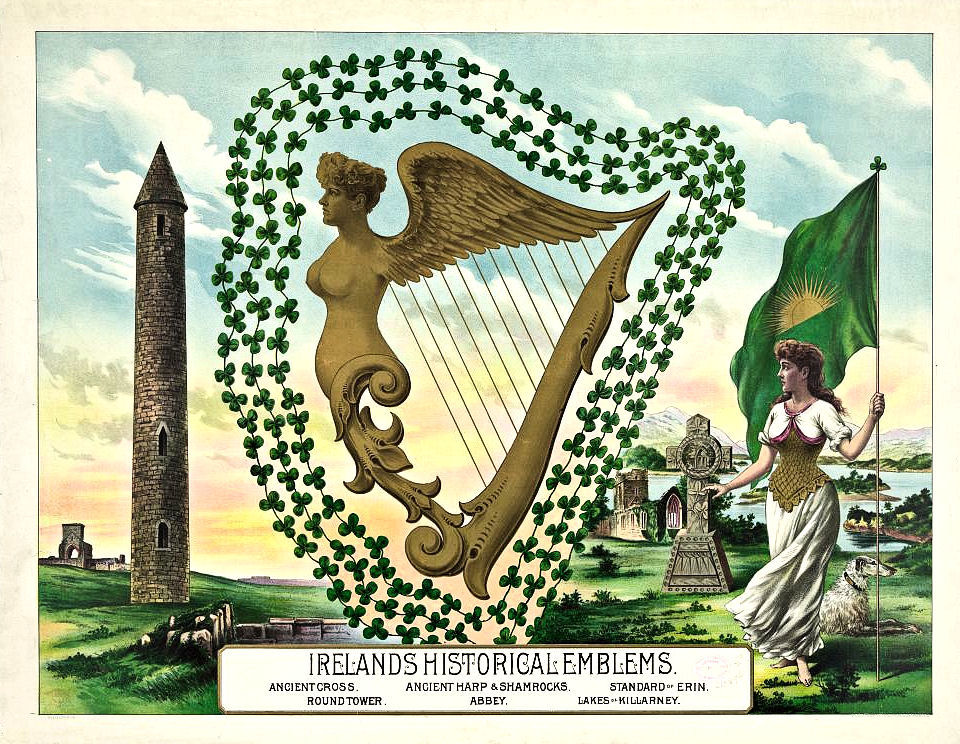
19th Century American greeting and souvenir cards blended sentimentality and and symbols of Irish nationalism especially the harp, shamrocks, and the once banned green.  Modern cards mostly feature leering and/or drunken leprechauns.


Note:  For those of you unaware, this is my natal anniversary.  Turn 67 today.  Bet you wondered how I got the name.  Anyway, I am rerunning a yearly classic. Meanwhile to the Irish and wan-a-be-Irish, enjoy the day.  Have fun, but try not to live down to some unfortunate stereotypes.   And for Christ’s sake don’t drink the damn green beer, an abomination and insult to the soul!  Have a dram of Jameson’s with a Guinness back for me!
Acknowledging the elephant in the room—today is the Feast of St. Patrick, a low-key religious celebration in the Auld Sod.  In the U.S. it’s St. Patrick’s Day, which is, as they say, a whole other kettle of fish.  For better or worse this quasi-holiday is an Irish American phenomenon.  Let’s trace the metamorphosis from religiosity, to ethnic muscle flexing, to Irish nationalism, to partisan political display, to equal opportunity public drinking festival.
It all began on March 17, 1762 with the very first St. Patrick’s Day parade anywhere in the world.  Irish soldiers in a British regiment headquartered in New York City marched behind their musicians and drew cheers from the small local Irish minority, both Catholic and Protestant—mostly Protestant in those days.  It became if not an annual event, one which was observed most years.  When the Redcoats left the city at the end of the American Revolution various local Irish mutual aid societies like the Hibernians and the Friendly Sons of St. Patrick held often competing events which, if they happened to intersect, sometimes devolved into brawls. 
After the United Irishman uprising of 1798 was crushed by the British unleashing a harsh repression including the banning of the wearing o’ the Green, a new wave of Irish refugees flooded New York, Boston, and other eastern cities.  They inoculated the annual St. Patrick’s Day observances with a new political significance and wearing green (instead of the traditional Irish colors of blue and gold) became a protest against British rule in the homeland and a call to action to overthrow that rule. 
The Potato Famine unleashed yet another wave of immigration bringing throngs of displaced peasants to the already growing slums of the city. Competing Irish aid societies finally decided to unite behind a single, massive demonstration in New York in 1848.  The theme of independence for Ireland was mixed with an act of aggressive defiance by the now largely Catholic masses against the nativists from Tammany Hall who controlled the city government, the Know Nothings, and street gangs who harassed and bullied them.
The Grand St. Patrick's Day Parade in New York in 1874 during the Fenian era featured elaborate floats and thousands of marchers, including military formations.
In 1858 the Fenian Brotherhood was organized in the United States in support the Irish Republican Brotherhood (IRB), a secret oath society agitating for the establishment of a “democratic Irish republic.”  The St. Patrick’s Day parades in New York and other cities became powerful recruiting tools for the Fenians. Social events around the day annually raised thousands of dollars, much of it to support fantastic plots and buy arms.  On more than one occasion Fenian plots to attack Canada brought the U.S. and Britain perilously close to war, which, of course was the objective. 
The failure of the Easter Rebellion in 1916 in which labor leader James Connolly, fresh from several years in America as an IWW organizer, and an Irish-American unit of Hibernian Rifles were both involved, led to a fresh round of frenzied support for independence back home.  The campaign of the Irish Republican Army (IRA), which led to the establishment of the Irish Free State in 1922 and the Irish Civil War between the Free State government and republican rebels were both largely financed by Irish Americans.  Even after the establishment of the Republic in 1937, Irish-Americans continued to fund rebel groups aimed at uniting Ulster to the rest of the island, including support for Sein Fein and the Provisional IRA in their armed struggle through The Troubles.  All of this was reflected in the parades and other celebrations of the day which had become dominated by Rebel songs.
St. Patrick’s Day celebrations also were important displays of Irish culture.  Traditional Irish music and dance was so suppressed at home that both nearly disappeared.  Irish-Americans like Chicago’s Police Chief Francis O’Neill collected and preserved the songs and began schools to teach it and traditional Irish step dancing.  Both were re-introduced into Irish culture as a result of these efforts and put on display in St. Patrick’s Day parades, banquets, and concerts

In the late 19th and early 20th Centuries Irish-Americans like the Chicago police officer Captain (Later Chief) O'Neill collected and saved traditional Irish music that was suppressed and disappearing in the old country and began schools for traditional musicians and dancers.  Performances became a mainstay of St. Patrick's Day celebration.
The Irish also excelled at political organization in this country.  Unlike other ethnic groups with large concentrations like the Germans, they were able to create viable political organizations with alliances with other ethnic groups that allowed them to control many city governments for decades.  In Chicago Mayor Richard J. Daley brought the St. Patrick’s Day Parade, previously a South Side neighborhood event, to the heart of the Loop and dyed the Chicago River green every year in a display of political power.  Politicians of all ethnicities jockeyed to be as close as possible to Hizonor in the front ranks of the parade. 

Mayor Richard J. Daley of Chicago brought the St. Patrick's Day parade down town to State Street and always led it on foot with his sash and blackthorn stick as politicians jockied for positions closest to him.


By the late 20th Century St. Patrick’s Day had spread well beyond its ethnic roots.  Everyone is Irish on St. Paddy’s Day became a byword pushed by breweries, bars, and distilleries making the day one of the biggest party days of the year.  Green beer and vomiting teenagers have become new symbols of the holiday. 
And what about St. Patrick?  Well, what about him!