Showing posts with label William Bradford. Show all posts

Tuesday, March 16, 2021

Samoset Surprised the Pilgrims in More Ways Than One

Samoset appears at Plymouth.

It seemed like a warm day by comparison to the harsh winter that had killed 45 of the 102 of them. The settlers, by now a bedraggled bunch were out and about in their small compound on the sheltered side of a hook-shaped cape that jutted into the Atlantic Ocean.  They called the place, somewhat grandly, New Plymouth.  They were religious dissenters, and the sailors and tradesmen they employed.

We call them the Pilgrims.  They called themselves the Company.  That day they were paying particular attention to the professional soldier among them.  Native tribes were moving in the vicinity and at least some seemed hostile.  The soldier, Miles Standish, was trying to organize a militia force. 

Sometime that morning, March 16, 1621, a native man startled the settlers by casually strolling from the woods into the clearing of the village.  He wore only a loin cloth and was very lightly armed with a bow and arrow which he did not display threateningly.  The frightened, agitated settlers accosted him.  Then he spoke, astonishing them all.

He greeted them in broken, but clearly understandable English! “Welcome, Englishmen! My name is Samoset.”

He did not come from the local tribes, but was visiting among them.  He was a Sagamore—local chieftain of an Algonquian people from what is now Maine.  He had met and learned English from fishermen who plied waters of Monhegan Island twelve miles off the coast.  The fishermen traded with the natives on the island.  They took Samoset whether as a slave, hostage, or visitor, with them to England but allowed him to return to his people on the next voyage to the rich fishery.

Samoset was dwelling that season with the distantly related Wampanoag led by the Sachem—the local language variant of Sagamore—Massasoit.  His extended presence among these people was indicative of the web of social and trade relations that connected tribes and clans over great distances.

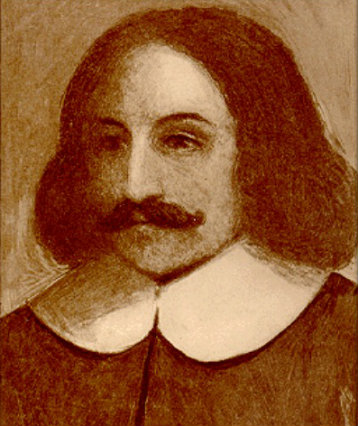
There is no known life portrait of William Bradford, Governor and historian of Plymouth, the drawing is a commonly used imaginary portrait based on scraps of physical descriptions in letters and journals.

In 1622, William Bradford described the meeting:

Friday the 16th a fair warm day towards; this morning we determined to conclude of the military orders, which we had begun to consider of before but were interrupted by the savages, as we mentioned formerly; and whilst we were busied hereabout, we were interrupted again, for there presented himself a savage, which caused an alarum. He very boldly came all alone and along the houses straight to the rendezvous, where we intercepted him, not suffering him to go in, as undoubtedly he would, out of his boldness. He saluted us in English, and bade us welcome, for he had learned some broken English among the Englishmen that came to fish at Monchiggon, and knew by name the most of the captains, nigers, and masters that usually came. He was a man free in speech, so far as he could express his mind, and of a seemly carriage. We questioned him of many things; he was the first savage we could meet withal. He said he was not of these parts, but of Morattiggon, and one of the sagamores or lords thereof, and had been eight months in these parts, it lying hence a day's sail with a great wind, and five days by land. He discoursed of the whole country, and of every province, and of their sagamores, and their number of men, and strength. The wind being to rise a little, we cast a horseman's coat about him, for he was stark naked, only a leather about his waist, with a fringe about a span long, or little more; he had a bow and two arrows, the one headed, and the other unheaded. He was a tall straight man, the hair of his head black, long behind, only short before, none on his face at all; he asked some beer, but we gave him strong water and biscuit, and butter, and cheese, and pudding, and a piece of mallard, all which he liked well, and had been acquainted with such amongst the English. He told us the place where we now live is called Patuxet, and that about four years ago all the inhabitants died of an extraordinary plague, and there is neither man, woman, nor child remaining, as indeed we have found none, so as there is none to hinder our possession, or to lay claim unto it. All the afternoon we spent in communication with him; we would gladly have been rid of him at night, but he was not willing to go this night. Then we thought to carry him on shipboard, wherewith he was well content, and went into the shallop, but the wind was high and the water scant, that it could not return back. We lodged him that night at Stephen Hopkins’ house, and watched him.

The next day he went away back to the Massasoits, from whence he said he came, who are our next bordering neighbors. They are sixty strong, as he saith. The Nausets are as near southeast of them, and are a hundred strong, and those were they of whom our people were encountered, as before related. They are much incensed and provoked against the English, and about eight months ago slew three Englishmen, and two more hardly escaped by flight to Monchiggon; they were Sir Ferdinando Gorges his men, as this savage told us, as he did likewise of the huggery, that is, fight, that our discoverers had with the Nausets, and of our tools that were taken out of the woods, which we willed him should be brought again, otherwise, we would right ourselves. These people are ill affected towards the English, by reason of one Hunt, a master of a ship, who deceived the people, and got them under color of trucking with them, twenty out of this very place where we inhabit, and seven men from Nauset, and carried them away, and sold them for slaves like a wretched man (for twenty pound a man) that cares not what mischief he doth for his profit.

Saturday, in the morning we dismissed the savage, and gave him a knife, a bracelet, and a ring; he promised within a night or two to come again, and to bring with him some of the Massasoits, our neighbors, with such beavers' skins as they had to truck with us.

Being immortalized on a cigar box was a marker of fame in 19th Century America.  Accuracy was not guaranteed.  

There you have it.  Although somewhat peevishly annoyed Samoset’s brief visit provided the settlers with a world of intelligence about the disposition, numbers, and mood of the tribes in their immediate area, information that they may only have gained at great cost of lives and peril, especially because it allowed them to differentiate between “friendly” and hostile natives.

Even better, true to his word, a few days later Samoset returned bringing with him a delegation including Squanto, who spoke even better English.  Squanto, a Pawtuxet had been kidnapped with others by a lieutenant of John Smith, and taken to Spain in 1614 to be sold as a slave in Spain.  Instead he was given refuge by Spanish Friars who instructed him in Christianity and allowed him to go to England in search of passage back to his home.  Squanto lived for some years in London and learned excellent English before securing passage back home in 1619.

Squanto discovered that his village, the very one occupying the site of New Plymouth, was virtually wiped out by a plague, possibly small pox.  He was now living with his kinsmen in Massasoit’s band.  Despite his bitter experience, he was not totally hostile to the English, although suspicious of them.  Perhaps, having seen London, he was keenly aware of how plentiful they were and how resistance to them might be futile.

At any rate Squanto and Samoset helped open up talks, mostly centered on trading for furs, with the settlers.  When he could ascertain that the talks were friendly, Massasoit himself finally entered the village.  The two sides concluded a treaty of peace and trade and pledged a military alliance against tribes hostile to one or both.

Samoset soon returned to his people in Maine.  In 1624 Captain Christopher Levett, a Yorkshire fisherman entertained Samoset and members of his band on his boat.  After that the man who made first contact with the strangers on the shore, faded into the mists of history.

Squanto helped save the colonists from starvation when he taught them native farming techniques like burying a small fish with a corn seed as fertilizer and growing corn and squash together.

Squanto, out of attachment to the place of his former village and at the behest of Massasoit, who did not fully trust the English, remained at the village and lived there, famously imparting his life saving advice on farming techniques suitable for the stony soil and sharing secret fishing spots and oyster shoals.  He also served as a guide and an envoy to surrounding tribes.

The next year he was taken captive by a Wampanoag band under the Sachem Corbitant and had to be rescued by an armed party led by Captain Standish.  In 1622 he fell ill of fever while on a mission from the settlers and died in a Nauset village near present-day Chatham.  In his dying words, he wished his English friends well, bequeathed them his few possessions, and expressed hope that their God would have mercy on them.  William Bradford reported, “His death was a great loss.”

In the early stages of King Philip's War, native warriors wiped out isolated farmsteads and burned villages sending the settlers reeling back on Plymouth and Boston.  But when the colonists regrouped and went on the offensive they wrought terrible destruction and punishment not distinguishing between hostile tribes, allies, and neutrals.  

The peace that the two English speaking natives helped secure lasted for 50 years until the bloody King Philip’s War in 1675 when Massasoit’s son rose up against the repeated land grabs of the burgeoning settler colonies of Plymouth and Massachusetts Bay.  Losses were heavy and atrocities were committed by all sides, but ultimately the friendly tribe that had saved the people we call the Pilgrims was virtually wiped out.

Thursday, November 23, 2017

Take a Pass on the Pilgrims—Thanksgiving is About Gratitude and Family

Thanksgiving is just the American iteration of nearly universal harvest festivals.


Note:  A re-run, but I’m on a crusade.
For some, the annual angst over Thanksgiving is upon us.  For years Native American protests that the Holiday represents European colonialism, American racism, cultural erasure, and actual genocide have begun to register with many of the rest of the current inhabitants of this country.  It is hard to deny that our First Nations, as the Canadians call their aboriginal peoples, have an excellent point.  The people we call Pilgrims represented one of the tips of the spears of a virtual invasion.  Despite their reliance on the wisdom and assistance of the natives to survive their first brutal year at Plymouth and the shared harvest feast they reportedly had, in less than a generation the settlers were engaged in brutal warfare to annihilate or displace their former neighbors

Within the first generation the Pilgrims and their neighbors the Puritans were engaged in genocidal war against their Native neighbors in the bloody Pequot War.  It was just a preview of comming attractions.
Growing numbers are now joining in a boycott of the holiday and are even joining Native American protests from Plymouth itself to Seattle.  Others, bowing to family pressure show up to dinner armed with arguments that the whole affair is a racist travesty.  Next to those who try and inflict their own brand of religion on a typically diverse American family or bring their political chips-on-the-shoulders to the table these folks are the cause of an epidemic of eye-rolling, groans, and occasional full blown family drama.
As if that weren’t enough, there seem to be no end of other reasons to hate on Thanksgiving—the ecological damage of factory farming, the ethical and health horrors of carnivorism, gluttony in the face of a starving world, wanton consumerism in the launch of the Holiday shopping season, and the brutal enjoyment of men hurtling themselves at each other in a modern re-creation of the Roman Gladiator spectacles.  Whew! And if all that wasn’t enough, we should not gloat in the embrace of our families and friends because too many are alone.
Now there is more than a kernel of truth to all of these criticisms.  And there is nothing wrong with taking time at the holiday to consider them—and to consider how we can all do and be better.

On the other hand, there is much to admire in Thanksgiving.  First, it is, after all at its heart, a harvest festival.  Virtually every culture that has been dependent on agriculture marked the critical completion of the harvest, which staves off starvation for another year, with some sort of festival.  Just because we are Americans, doesn’t mean that we don’t deserve a festival, too. 

Second, it is a feast day, something else common to most cultures.  Here we have no other national feast, accessible to all unless you count burgers and brats on the grill on Memorial Day.  Members of the many religious groups that populate our country may have their particular feasts—Christmas and Easter, the Passover Seder, Eid ul-Fitr, Diwali but only Thanksgiving allows us all to gather around one table.

Third, it is our national homecoming, the one day a year when families biological, adoptive, blended, or self-created come together with all of the joy—and occasional drama—that entails.  If it wasn’t for Thanksgiving, we might never see each other except at funerals.

And finally, Thanksgiving is an occasion to express simple gratitude, surely one of the most blest and basic of all spiritual practices. It does not require fealty to any God or any form of proscribed prayer.  We are free to acknowledge that our lives are blessed in a thousand ways.  We can be grateful to a Creator, the Earth, or the laboring hands of millions who together feed, clothe, and shelter us.  The recognition of our common debt to something larger than us is a very good thing.

So how can we keep the good of Thanksgiving and our consciences?  Well, we can refuse to go shopping after dinner at that Big Box Store with the huge sale, rush to the computer for on line Black Friday deals, or otherwise opt in to the orgy of consumerism.  We can prepare and serve vegetarian or vegan feast if that is our preference, or at least make sure that everyone at the table has good food that they are comfortable eating—and refrain for one day from making snide or judgmental comments on the choices of others.  We can turn off the TV if the orgy of sports offends us.  We can make sure we have made room for a homeless, forgotten, or lonely person at our tables instead of just bemoaning their plight.  They are remarkable easy to find.

But most of all, we can simply ditch the whole First Thanksgiving Myth.  Because it is just that—a myth and completely unessential to the tradition.

That meal in the fall of 1621 was not a Thanksgiving.  No one thought it was.  It was meant to consume the last of the harvest that could not be safely stored for the starvation time of winter ahead and meat from the fall hunt that had not been dried and smoked.  The natives probably invited themselves to the despair of every goodwife counting the meager larder.  At least they did bring some venison.  

Plymoth Governor William Bradford's one paragraph account of harvest feast shared with the natives written twenty years after the event and not rediscovered until 1854 is the slender thread from which a First Thankgiving myth was created as part of a campaign to establish a national holiday.  No one previously associated the traditional New England feasts with the Pilgrims.
It was not called a Thanksgiving, a religious term usually reserved for a day of fasting and prayerNor did it begin any tradition.  Indeed the whole episode was virtually forgotten within the life time of the participants.  Aside from a brief mention of the event in an official report to English investors in the colony, which was quickly forgotten on this side of the Atlantic, there was no known account of the event until Governor William Bradford’s history of the colony written twenty years later and presumed to be lost was re-discovered in 1854.  He had a one paragraph account of the two day feast.

We do owe New Englanders traditions of Thanksgivings and annual post-harvest homecoming, but they were two separate and distinct things not coming together until late 18th Century.

Their first declared Thanksgiving Day did not occur until June of 1676 when the governing council of Charlestown, Massachusetts declared a day of Thanksgiving in gratitude for being delivered from the threat of the Native American rebellion known as King Phillip’s War.  It was not a feast day, but a day of fasting and all-day prayer.  Thereafter it became more and more common for New England towns to declare Thanksgiving days at various times of the year to mark auspicious occasions.

It became customary to proclaim Thanksgivings at the end of successful harvest years.  The dates of these autumn events varied, but tended to be late in the season after all crops were in, the long hunts for venison and fowl that happened after the first snow falls were completed, and the coastal waters became too dangerous from gales for small fishing vessels to set out.  With all of the men home and idle and the larder at its peak of the year, even the dour Puritans transitioned the observances into feasts following a good long church service.

The Puritans  forbade the celebration of Christmas, which they considered corrupted by pagan practice and associated with Papist masses, so the late season Thanksgivings became an acceptable substitute early winter festival.  As younger sons emigrated to new lands in the west of Massachusetts, the Connecticut Valley, Maine, New Hampshire, Vermont, and Up-state New York they not only took the custom with them, they began to try to make pilgrimages home to be with their families.

Still, Thanksgivings—days of fasting and prayer could, and were proclaimed at any time of the year.
By the time of the American Revolution the New England custom of Thanksgivings were well established, with a fall harvest event traditional, although celebrated at various dates by local proclamation.  In October of 1777 New England delegates to the Continental Congress convinced that body to proclaim a National Day of Thanksgiving for the victory of the Continental Army over a British invasion force from Canada at the Battle of Saratoga.  The proclamation, a one-time event, was the first to extend any Thanksgiving observation over the whole infant nation.  It was also a day of prayer, rather than feasting.

In 1782 Congress under the Articles of Confederation, proclaimed another Thanksgiving for the successful conclusion of the War of Independence.  It was signed by John Hanson, as President of Congress, the man some hold up as the true first President of the United States.

Shortly after his inauguration, George Washington, the first President under the Constitution found himself under pressure from leaders of the  established churches—the Episcopalians in the South, Quakers in Pennsylvania, and especially the Standing Order of New England to affirm a religious basis for the new nation.  They were alarmed that the Constitution had omitted any reference to God.  On the other hand the growing ranks of dissenting sectsBaptists, Methodists, Anabaptists of various sorts, Quakers in states in which they were a minority, and Universalists—as well a large number of the educated elite who were steeped in Deism were bitterly opposed to any breach of what Thomas Jefferson was already calling “a wall of separation between church and state.”
George Washington's Thanksgiving Proclimation of 1789 as published in the Massechusetts Centinel.
Trying to thread the needle, Washington issued a carefully worded proclamation of National Thanksgiving for Thursday, November 26, 1789.  He made no mention of Jesus Christ and he only used the word God once.  Instead he called for a day of general piety, reflection, and prayer and invoked the broad terms of Deism—“that great and glorious Being who is the beneficent author of all the good that was, that is, or that will be,” and the “great Lord and Ruler of Nations.”  Despite his best intentions, the proclamation satisfied neither side and drew criticism from both.  Washington tried it one more time in 1795 to even louder complaints.  Later, similar proclamations by John Adams were met by literal riots in the streets.  After his ascension to the Presidency in the Revolution of 1800, Thomas Jefferson, the champion of religious liberty and separation of church and state, put an end to these exercises in public piety.

By the mid-19th Century the New England tradition of Thanksgiving was firmly established as an occation of family reunion.
So Thanksgiving remained a regional celebration, but one which was spreading rapidly.  The New England Diaspora was rapidly spreading it throughout the North and into the newly settled lands of Ohio and the Old Northwest Territories.  The introduction of canals, turnpikes, and railroads which made transportation easier, cheaper, quicker, and safer increased the homecomings associated with the holiday.

The South was absolutely immune to the charms of the Yankee observation and staunchly resisted all efforts to introduce it in their region.  Christmas was their holiday of choice and rising sectional tensions over tariffs, western expansion, and especially slavery made the Southern aristocracy loathe to adopt any whiff of expanding Yankee influence.

Sarah Josepha Hale was famous for two things--writing Mary Had a Little Lamb and her relentless 40 year long campaign to establish Thanksgiving as a national, not a regional celebration.  She single handedly created the First Thanksgiving myth from Bradford's single paragraph.

Enter Sarah Josepha Hale, the editor of the Boston Ladies Magazine, and later Gode’s Lady’s Book, two of the leading women’s publications in the country, thought that whatever the protests of the South might be, the creation of regular national Day of Thanksgiving would help heal the nation and prevent conflict.  She inaugurated a relentless 40 year campaign of editorials and letters to governors, Congressmen, and Presidents promoting a national celebration.  When Governor Bradford’s book was re-discovered and published it was Hale who created the First Thanksgiving myth from that one scant paragraph and tied it to the noble Pilgrims, as the Plymouth settlers were now called, and their friendly Indian guests.  It was a flawless marketing campaign and branding that in short order convinced the public that there was an unbroken tradition stretching back to a Pilgrim First Thanksgiving.  Although the campaign won wider and wider support and helped codify traditions around the observance, no official action was taken until 1862.

In the midst of the Civil War another President with unorthodox religious beliefs, felt the need to unite what was left of the shattered union.  It was a bleak time.  Military disaster seemed to be the rule on every front.  Agitation for peace on terms of Southern separation was on the increase.

Abraham Lincoln may not have been much—if any kind—of a traditional Christian.  But he believed in the hand of Providence and more than once contemplated on whether the trials of the nation were not the just punishments of that hand.  Moreover he needed, now more than ever, the support of the powerful Protestant clergy, who had never ceased to agitate for the return of periodic Thanksgiving proclamations.  So it was natural that he turned to such a proclamation in the dark hour of 1862.  It was that act that would nationalize the holiday permanently and why the celebration today is more Lincoln’s than the Pilgrims’.

Inspired by Washington’s Proclamation, Lincoln set the last Thursday of November as the date.  He issued fresh proclamations each year of his presidency and all future Chief Executives followed suit.  So did most state governors, timing their proclamations to the Federal observance.  Eventually, if reluctantly, even Southern States fell into line.  By the early 20th Century the emerging Fundamentalists of the Bible Belt would become among the most ardent supporters of the Holiday but insisting that it be imbued with specifically Christian trappings.

Still, for all of its wide-spread observation, Thanksgiving was not yet an annual, repeating national holiday.  It remained dependent on new yearly Presidential proclamations.  After his election, Franklin D. Roosevelt proposed the establishment of a Federal Holiday.  Congress, worried about the expense of paying Federal employees for a day off of work, ignored his plea.  So Roosevelt continued to follow precedent.  But in 1939 with the nation struggling to get out of the second dip of the Great Depression, Roosevelt took advantage of the five Thursdays in November that year and Proclaimed Thanksgiving for the Fourth Thursday instead of the last to extend the shopping season and boost lagging sales.  He made it clear that he intended to keep his proclamations at the second to last Thursday through his presidency.  

The change immediately became a political hot potato.  Republicans charged that FDR was desecrating the memory of Lincoln.  Preachers decried the secularizations of our ancient sacred holiday.  Twenty-two states followed the President’s lead.  Most of the rest issued their proclamations for the last Thursday.  Texas, unable to decide kept both days.  The later celebration was referred to as Republican Thanksgiving while the earlier one was derided as Franksgiving.  In 1940 and ’41 FDR stayed true to his promise and issued proclamations for the next to last Thursday, continuing the confusion and controversy.

In 1941 both Houses of Congress voted to create an annual Federal Holliday on the last Thursday in November beginning in 1942 but in December the Senate changed that to the fourth Thursday, which is usually, but not always, the last one of the month.

By the 1950's the elements of modern Thanksgiving including the Macy's Parade and football on the livingroom TV set  were all in place and already felt steeped in tradition. 

By the 1950’s many employers and school districts were also giving the Friday after Thanksgiving off with pay.  The creation of a wide-spread four day weekend led to even more long distance travel for family reunions.  And soon Friday was the busiest shopping day of the year, eventually dubbed Black Friday because it was supposedly the first day of the calendar year when most retailers finally entered black ink.

So there you have it.  Despite the ubiquitous presence of Pilgrims and smiling Indians in school pageants and commercials, they really don’t have much to do with the actual tradition of Thanksgiving.  Then why not, at long last dispose of them.  Disassociate them from Thanksgiving.  Suddenly our traditional harvest, homecoming, and gratitude feast has nothing to do with colonialism and genocide.  Maybe we can all sit down together in peace—at least until drunk uncle Morrie starts up about Donald Trump.


Monday, March 16, 2015

Samoset Surprises the Pilgrims in More Ways Than One

Samoset appears at Plymouth.


It seemed like a warm day by comparison to the harsh winter that had killed 45 of the 102 of them that first winter. The settlers, by now a bedraggled bunch were out and about in their small compound on the sheltered side of a hook shaped cape that jutted into the Atlantic Ocean.  They called the place, somewhat grandly, New Plymouth.  They were religious dissenters and the soldiers, sailors, and tradesmen they employed.
We call them the Pilgrims.  They called themselves the Company.  That day they were paying particular attention to the professional soldier among them.  Native tribes were moving in the vicinity and at least some seemed hostile.  The soldiers were trying to organize a militia force.  Miles Standish was elected captain.
Sometime that morning, March 16, 1621, a native man startled the settlers by casually strolling from the woods into the clearing of the village.  He wore only a loin cloth and was very lightly armed with a bow and arrow which he did not display threateningly.  The frightened, agitated settlers accosted him.  Then he spoke, astonishing them all.
He greeted them in broken, but clearly understandable English! “Welcome, Englishmen! My name is Samoset.”
He did not come from the local tribes, but was visiting among them.  He was a Sagamore—local chieftain of an Algonquian people from what is now Maine.  He had met and learned English from fishermen who plied waters of Monhegan Island twelve miles off the coast.  The fishermen traded with the natives on the island.  They took Samoset whether as a slave, hostage, or visitor, with them to England but allowed him to return to his people on the next voyage to the rich fishery.
Samoset was dwelling that season with the distantly related Wampanoag led by the Sachem—the local language variant of Sagamore—Massasoit.  His extended presence among these people was indicative of the web of social and trade relations that connected tribes and clans over great distances.

There is no known life portrait of William Bradford, Governor and historian of Plymouth, the drawing is a commonly used imaginary portrait based on scraps of physical descriptions in letters and journals.

In 1622, William Bradford described the meeting:
Friday the 16th a fair warm day towards; this morning we determined to conclude of the military orders, which we had begun to consider of before but were interrupted by the savages, as we mentioned formerly; and whilst we were busied hereabout, we were interrupted again, for there presented himself a savage, which caused an alarum. He very boldly came all alone and along the houses straight to the rendezvous, where we intercepted him, not suffering him to go in, as undoubtedly he would, out of his boldness. He saluted us in English, and bade us welcome, for he had learned some broken English among the Englishmen that came to fish at Monchiggon, and knew by name the most of the captains, nigers, and masters that usually came. He was a man free in speech, so far as he could express his mind, and of a seemly carriage. We questioned him of many things; he was the first savage we could meet withal. He said he was not of these parts, but of Morattiggon, and one of the sagamores or lords thereof, and had been eight months in these parts, it lying hence a day's sail with a great wind, and five days by land. He discoursed of the whole country, and of every province, and of their sagamores, and their number of men, and strength. The wind being to rise a little, we cast a horseman's coat about him, for he was stark naked, only a leather about his waist, with a fringe about a span long, or little more; he had a bow and two arrows, the one headed, and the other unheaded. He was a tall straight man, the hair of his head black, long behind, only short before, none on his face at all; he asked some beer, but we gave him strong water and biscuit, and butter, and cheese, and pudding, and a piece of mallard, all which he liked well, and had been acquainted with such amongst the English. He told us the place where we now live is called Patuxet, and that about four years ago all the inhabitants died of an extraordinary plague, and there is neither man, woman, nor child remaining, as indeed we have found none, so as there is none to hinder our possession, or to lay claim unto it. All the afternoon we spent in communication with him; we would gladly have been rid of him at night, but he was not willing to go this night. Then we thought to carry him on shipboard, wherewith he was well content, and went into the shallop, but the wind was high and the water scant, that it could not return back. We lodged him that night at Stephen Hopkins’ house, and watched him.
The next day he went away back to the Massasoits, from whence he said he came, who are our next bordering neighbors. They are sixty strong, as he saith. The Nausets are as near southeast of them, and are a hundred strong, and those were they of whom our people were encountered, as before related. They are much incensed and provoked against the English, and about eight months ago slew three Englishmen, and two more hardly escaped by flight to Monchiggon; they were Sir Ferdinando Gorges his men, as this savage told us, as he did likewise of the huggery, that is, fight, that our discoverers had with the Nausets, and of our tools that were taken out of the woods, which we willed him should be brought again, otherwise, we would right ourselves. These people are ill affected towards the English, by reason of one Hunt, a master of a ship, who deceived the people, and got them under color of trucking with them, twenty out of this very place where we inhabit, and seven men from Nauset, and carried them away, and sold them for slaves like a wretched man (for twenty pound a man) that cares not what mischief he doth for his profit.
Saturday, in the morning we dismissed the savage, and gave him a knife, a bracelet, and a ring; he promised within a night or two to come again, and to bring with him some of the Massasoits, our neighbors, with such beavers' skins as they had to truck with us.
Being immortalized on a cigar box was a marker of fame in 19th Century America.  Accuracy was not guaranteed.  

There you have it.  Although somewhat peevishly annoyed Samoset’s brief visit provides the settlers with a world of intelligence about the disposition, numbers, and mood of the tribes in their immediate area, information that they may only have gained at great cost of lives and peril, especially because it allowed them to differentiate between “friendly” and hostile natives.
Even better, true to his word, a few days later Samoset returned bringing with him a delegation including Squanto, who spoke even better English.  Squanto, a Pawtuxet had been kidnapped with others by a lieutenant of John Smith, and taken to Spain in 1614 to be sold as a slave in Spain.  Instead he was given refuge by Spanish Friars who instructed him in Christianity and allowed him to go to England in search of passage back to his home.  Squanto lived for some years in London and learned excellent English before securing passage back home in 1619.
Squanto discovered that his village, the very one occupying the site of New Plymouth, was virtually wiped out a plague, possibly small pox.  He was now living with his kinsmen in Massasoit’s band.  Despite his bitter experience, he was not totally hostile to the English, although suspicious of them.  Perhaps, having seen London, he was keenly aware of how plentiful they were and how resistance to them might be futile.
At any rate Squanto and Samoset helped open up talks, mostly centered on trading for furs, with the settlers.  When he could ascertain that the talks were friendly, Massasoit himself finally entered the village.  The two sides concluded a treaty of peace and trade and pledged a military alliance against tribes hostile to one or both.
Samoset soon returned to his people in Maine.  In 1624 Captain Christopher Levett, a Yorkshire fisherman entertained Samoset and members of his band on his boat.  After that the man who made first contact with the strangers on the shore, faded into the mists of history.
Squanto, out of attachment to the place of his former village and at the behest of Massasoit, who did not fully trust the English, remained at the village and lived there, famously imparting his life saving advice on farming techniques suitable for the stony soil and sharing secret fishing spots and oyster shoals.  He also served as a guide and an envoy to surrounding tribes.
The next year he was taken captive by a Wampanoag band under the Sachem Corbitant and had to be rescued by an armed party led by Captain Standish.  In 1622 he fell ill of fever while on a mission from the settlers and died in a Nauset village near present-day Chatham.  In his dying words, he wished his English friends well, bequeathed them his few possessions, and expressed hope that their God would have mercy on the.  William Bradford reported, “His death was a great loss.”
The peace that the two English speaking natives helped secure lasted for 50 years until the bloody King Philip’s War in 1675 when Massasoit’s son rose up against the repeated land grabs of the burgeoning settler colonies of Plymouth and Massachusetts Bay.  Losses were heavy and atrocities committed by all sides, but ultimately the friendly tribe that had saved the people we call the Pilgrims was virtually wiped out.