Showing posts with label actor. Show all posts

Tuesday, September 21, 2021

The Founder of the Dynasty—Maurice Barrymore


                                    Maurice Barrymore--matinee idol of the American Gilded Age stage.

The man who founded a theatrical dynasty that is still going strong in its fourth generation with actress/producer Drew Barrymore was born in far off and exotic Fort Agra, India practically within shade of the Taj Mahal on September 21, 1849. 

Herbert Arthur Chamberlayne Blythe was the son of a surveyor for the British East India Company and his wife Charlotte Matilda Chamberlayne de Tankerville.  The youngest of seven children, his mother died of complications from his birth.  He was largely raised by his double aunt Amelia Blythe, his mother’s sister who had married his father’s brother. 

When he was old enough young Herbert was sent to England for an elite education at Harrow and then on to Oxford to prepare for the law—the profession chosen by his father.  At Oxford the strapping young man preferred athletics.  He was captain of the football (soccer) team.  He also took up the manly sport of boxing.  Although the Marquess of Queensberry Rules were established, bare knuckle bouts were still popular, and the wayward young scholar fought in several.  In fact, he was a damn fine fighter and in 1872 won the Middleweight Championship of England.

As if the sporting life was not enough of an embarrassment to his family Blythe took up with actors and soon abandoned his father’s chosen profession for a life on the stage.  To spare the family humiliation he assumed the last name of noted early 19th Century thespian William Barrymore after seeing his name on an old poster.  He adopted a French first name in honor of his mother’s heritage.  As Maurice Barrymore he sat for his first theatrical photo portrait shortly after winning his boxing title.

Two years later he was on board the SS America sailing to Boston and putting an ocean between himself and the disapproving Blythes.  Soon after arriving he joined the established touring company of Augustine Daly and made his American debut in Under the Gaslight.  A year later in 1876 he was starring on Broadway in Pique.

                                    Georgina "Gorgie" Drew, the young actress Barrymore wooed and wed.

During the run of that play Barrymore became enamored of a young actress with a small part, Georgiana Drew, the sister of his friend and established star John Drew.   After a whirlwind courtship the couple married on New Year’s Eve, December 31, 1876.  Georgiana, affectionately known as Gerogie, was a great beauty and would rise to stardom herself.  The two appeared both together and separately causing sometimes lengthy separations during which Barrymore frequently indulged in affairs with co-stars or star struck ingĂ©nues.  The couple had three children, Lionel born in 1878, Ethel born in 1879, and John born in 1882.  While the couple toured, the children were left in the keeping of Georgiana’s mother in Philadelphia and spent summer on their father’s Staten Island farm where he kept a collection of exotic animals. 

The handsome Barrymore quickly became one of the most famous leading men on the American stage appearing opposite almost all the top female stars of the day including Helena Modjeska, Mrs. Fiske, Mrs. Leslie Carter, Olga Nethersole, Lillian Russell, and Lily Langtry.

But his career was nearly cut short while on tour in Marshall, Texas on March 19, 1879.  Barrymore and cast mate Ben Porter had indulged in a poker game—a common pastime for an actor who prided himself on being a sporting man—and had relieved a notorious gunslinger named Jim Currie of a tidy sum of money.  Later that evening after a performance Barrymore, Porter and actress Ellen Cummins went to the White House Saloon for a late supper.  A drunken and enraged Currie confronted them.  Barrymore stood to and challenged him to a fist fight, confident in his skills as a boxer.  Unfortunately, Currie preferred pistols.  He drew and shot Barrymore point blank in the chest and Porter in the stomach.  Porter died in agony and Barrymore was rushed to a doctor’s office where the physician worked feverishly to save his life with an operation

Texas gunman Jim Currie awaiting trial for the murder of actor Ben Porter and the near fatal shooting of Barrymore.  Wealth and family connections helped get him aquitted despite the testimony of Barrymore and several eye witnesses.

Seven months pregnant with Ethel, Georgiana rushed from New York to be with her husband.   Barrymore recovered due largely to his strength and constitution.  Currie was brought to trial for murder and attempted murder.  Barrymore returned to Texas to testify, and dozens of witnesses saw the shooting of the un-armed men.  But it took a Texas jury ten minutes to clear Currie.  Perhaps because his brother was Shreveport, Louisiana Mayor Andy Currie  and the family had plenty of money and clout to spread around.

During his recovery Barrymore wrote a melodrama.  He invited Georgiana to accompany him on a touring production along with her close friend the Polish born actress Helena Modjeska who had convinced her to convert to Catholicism and baptize the children.  Despite their closeness, Georgiana knew that her friend had been one of her husband’s lovers.   On tour she discovered that Barrymore and Helena had renewed their romance under her nose.  For some reason Barrymore had signed over the rights to the play to his wife, who promptly withdrew them in mid tour causing the play to shut down.  The producer’s sued but did not prevail.  The reason for the abrupt closure was never explained to the press, although the gossips columns of the day often noted the actor’s indiscretions.

                                    Maurice and Georgie with their children Ethel, Lionel, and John about the time they sailed for England.

Barrymore continued to write plays and Georgie remained watchful but loyal.  In 1884 the couple and their small children sailed to England where he was to collect an inheritance from his aunt Amelia and hoped to impress the rest of his family with his success in America.  Returning from an American tour on the same ship was French legend Sara Bernhardt.  In hopes of enticing her to produce it, he gave the actress an un-copyrighted copy of his new play Nadjezda.  Two years later Bernhardt premiered in Paris in another new play, La Tosca by Victorien Sardou which is now best remembered as the source material for Puccini’s opera.  Barrymore detected similarities between that play and his and sued the author for stealing his work.  He suffered a humiliating defeat in court.  A judge ruled that the only similarity between the two plays was the sacrifice of the heroine’s honor to save her lover, but that was an old plot device that had been used many times going back to Shakespeare’s Measure for Measure.

Aside from his continued indiscretions with young women, Barrymore liked to spend time with athletes, especially boxers and wrestlers.  He kept fit by sometimes working out with them.  Among his pals were wrestler William Muldoon, and Heavyweight Champions John L. Sullivan, James J. Corbett.  He may have coached them on their own forays on the stage.  He encouraged his growing sons to take up the support and actually arranged an amateur bout between Lionel and actor Hobart Bosworth.

Tragedy struck on July 2, 1893 when the frail Georgiana succumbed to consumption.  Barrymore was both heartbroken and set adrift without his anchor.  He hardly knew what to do with the children, who were left for most of the summer on the Staten Island farm attended only by the man hired to feed the animals.  In need of a mother for his brood, Barrymore wed as soon as a respectable mourning period was complete.  On the one year anniversary of Georgiana’s death, he married Mamie Floyd.  Fifteen year old Ethel, who doted on her father, was crushed and shocked to see her mother replaced.  Lionel would leave home as soon as he was able, following his father on the stage.

                                    One of Barrymore's greatest success wan in The Heart of Maryland in 1899 opposite Mrs. Leslie Carter.

In the later years of the Gay 90’s Barrymore had some of the greatest success of his career.  In 1895 he co-starred with Mrs. Leslie Carter in the Civil War romance The Heart of Maryland. 

The following year he became the first genuine star of the Broadway stage to perform in Vaudeville.  The variety stage was rapidly gaining in audiences and, as elegant theaters were built just for it, in respectability.  Barrymore would tour doing scenes from his most famous roles or doing Shakespearian soliloquies.  Barrymore found it a good way to earn money between stage engagements and tours—his lavish lifestyle often left him embarrassed for cash.  The tours also built audiences for play appearances.  In the wake of Barrymore’s success, other actors would follow his example.

In 1899 he had his biggest Broadway success to date opposite Mrs. Fisk in Becky Thatcher, an adaptation of Thackeray’s novel Vanity Fair.  Then he set off on a lengthy tour in The Battle of the Strong, a mediocre melodrama.  Back in New York Barrymore returned to booking Vaudeville shows.

In 1901 Barrymore was on a vaudeville stage in Harlem when, according to the New York Times “he suddenly dropped his lines and began to rave.”  The next day he became violent had to be taken to Belleview by his son John was admitted to a ward for the insane.  He was found to be suffering from an advanced stage of syphilis which often led to mental collapse and was then incurable

                                Ethel Barrymore cared for her father during his descent into insanity caused by syphilis.

All three children were now working on the stage, but Ethel, a young beauty, was already a star she undertook her father’s medical expenses and had him transferred to a more comfortable private institution in Amityville.  She visited him almost daily, but his condition continued to deteriorate, and violent episodes became more common.  On one visit he attempted to strangle her.  Another time the still athletic patient picked up an attendant, lifted him over his head in the manner of a wrestler and threw the man several feet.

On March 25, 1905 Maurice Barrymore died in his sleep at the age of 55.  Ethel had him interred next to her mother in Philadelphia.  Later, when that cemetery was closed both of their graves were moved to Mount Vernon Cemetery in the same city. 

Thursday, July 23, 2015

Theodore Bikel—Mozel Tov to a Mensa Mensch

Theodore Bikel at his 90th birthday celebration at the Washington Hebrew Congregation with his forth wife Aimee Ginsberg-Bikel and fan Supreme Court Justice Ruth Bader Ginsburg.


Actor, singer, composer, folklorist, impresario, humanitarian, unionist, and social activist.  In his long and varied career Theodore Bikel did it all.  The curtain rang down on an extraordinarily productive life on Monday, July 20 in Los Angeles.  The man with at least three nationalities and who was fluent in dozens of European and Near East languages was 91 years old and active almost to his final days.
Theodore Meir Bikel was born in Vienna, Austria on May 2, 1924.  The city, the former capital of one of Europe’s last multi-national and ethnic empires, was perhaps the most cosmopolitan place on earth, a cultural crossroads where the influences of Western and Eastern Europe and the Balkans all intersected.  The extraordinarily intelligent boy seemed to absorb all of it, including multiple languages in addition to German and Yiddish.
His parents, Josef and Miriam, were originally from Bukovina, which had been stripped from the Austro-Hungarian Empire by Romania after World War I.  Josef was an active Zionist of the old school, which is to say a largely secular Jew with strong socialist ideals.  He named his son for the founder of the Zionist movement, Theodor Herzl.
Following Adolf Hitler’s announcement of German Anschluss—union—with Austria on March 12, 1938 the family recognized the danger that they were in and managed to flee the country to British Mandatory Palestine.  Through his father’s connections to the World Zionist Movement headquarters in London the family was able to obtain hard to get British passports.
Filled with Zionist zeal to build a progressive Jewish homeland, 14 year old Theo enrolled in the  Mikve Yisrael agricultural school and then joined the Kibbutz Kfar HaMaccabi which had been founded by members of the  Maccabi youth movement.  Bikel later wistfully recalled his experience as a Kibbutznik:
I tried for awhile to be an agricultural worker and was hopelessly bored. I would stand around in heaps of manure and sing about the beauty of the work I wasn't doing.
Instead young Bikel was instinctively drawn to the arts, particularly theater.  He made his stage debut in 1943 with the Habimah Theater in Tel Aviv, perhaps prophetically in a small role in a Yiddish production of Tevye, the Dairyman based on Sholem Aleichem’s stories.
After the end of World War II Bikel moved to London to study at the Royal Academy of Dramatic Arts where his gifts were quickly recognized. He began to appear, and even star in small productions around the city where in 1947 he attracted the attention of Lawrence Olivier who gave him a small part and made him a principle understudy in his production of A Streetcar Named Desire.  Later in the run he stepped into the part of Mitch, Blanche Du Bois’s would-be suitor played by Vivien Leigh.  His career was off to a fast start.
Bikel became a busy actor in the London theater, in demand for his versatility and especially his ability to assume a wide variety of ethnic identities complete with authentic accents and even gestures and postures.
 
Bikel in his screen debut as the German First Officer of the Louisa in The African Queen.
In 1951 on a visit to London John Huston spotted him and cast him as the German First Officer of the armed steamer Louisa which dominates Lake Victoria and is the object of the African Queen’s daring search.  It was a small, but memorable role.  The first of many.   In fact Bikel would frequently be cast as naval officers or soldier of many nations and like his debut, his film appearances were often small gems, character parts that stood out from the ordinary.  He quickly became a familiar face in the movies.
The next year Huston used him again as the King of Serbia enjoying the Paris night life in Moulin Rouge.  Over the next three years he also had small but memorable roles in a number of British films and a BBC television mini-series.
In 1955 Bikel crossed the Atlantic to work on the Broadway stage.  He made his New York debut that year in Tonight in Samarkand and quickly established himself as major supporting player.
Not long after arriving on these shores Bikel launched a second career as a folk singer. He recalled singing since “before I could talk.”  Throughout his life he had learned and collected hundreds of songs from dozens of European, Levant, and African sources.  Skillfully accompanying himself on guitar, lute, mandolin, banjo, and assorted other traditional string instruments, Bikel sang in 21 different languages including Yiddish, Hebrew, German, Russian, Lardo, medieval Spanish, Arabic, and Zulu. He released albums on Electra beginning in ’55 with Israeli Folk Songs.  By 1960 he had recorded 10 popular albums including A Young Man and a Maid with Cynthia Gooding, Songs of a Russian Gypsy, Folk Songs from Just About Everywhere, Bravo Bikel! a live recording of a sold out Carnegie Hall concert, and Songs of Russia Old and New.

One of Bikel's popular Electra folk albums.
Before Bikel the American folk music scene had been pretty much dominated by Appalachian Childe Ballads, hillbilly songs, sea shanties, blues, and lefty protest songs.  He broadened the horizon with world music previously unfamiliar to Americans outside of ethnic enclaves.  In the process he became particularly close to another fan and promoter of music from around the world, Pete Seeger.
Bikel’s importance to the emerging Folk music scene is hard to underestimate.  In addition to becoming a fixture on the New York coffee house scene when he was not on stage, he performed concerts at synagogues, on college campuses, civic auditoriums across country.  With Seeger, Oscar Brand, and Albert Grossman he was on the founding board of the Newport Folk Festival in 1959.  In the early ’60 Bikel opened two clubs in Los Angeles, The Unicorn and Cosmic Ally which brought the east coast folk club scene to Southern California for the first time.  He was also an early supporter of Bob Dylan and the first one other than Dylan himself to publicly perform Blowin’ In the Wind.
He continued to do concerts and make records for the rest of his life.  His last recording was Our Song with Alberto Mizrahi  in 2007.
Bikel in the late ‘50’s was a busy man juggling his sometimes competing careers.  On stage he nominated for a Tony Award in 1958 for his part in The Rope Dancers.  The next year he landed what for many actors would be the part of a lifetime—Captain Von Trapp in the original Broadway production of The Sound of Music opposite Mary Martin as Maria.  Ironically he had been cast for his strength as an actor and composer/producer Richard Rogers was actually unaware that he was a singer until nearly opening night when he overheard Bikel noodling around with his guitar in his dressing room.  Originally the Captain had no songs.  When Rogers heard Bikel, he sat down and dashed off Edelweiss, a pseudo-Austrian folksong for the Captain to sing and accompany himself on guitar.  

Bikel as Captain Georg von Trapp sing Edelweiss  to Marian Marlowe as Elsa Schraeder in The Sound of Music.
Although he earned his second Tony nomination and the play was one of the biggest musical hits ever, Bikel was restless in the part.  He found doing the same show night after endless night boring. After a two year run, he walked away from the part leaving others to carry on.  Many considered it career suicide.
But Bikel had plenty to do.  He was in demand on for films. Standout performances for this period included as French General Jouvet in the Napoleonic War epic The Pride and the Passion as U-boat officer Heinie Schwaffer in the taught naval war drama The Enemy Below, as a Russian occupation officer in the post-war Germany melodrama Fräulein, as a rare humane Southern Sheriff in pursuit of escaped convicts in Stanly Kramer’s The Defiant Ones for which he was nominated for an Academy Award, as a troubled Flemish painter in Dog of Flanders, and as the smarmy boss of lurid night club troupe in a remake of the classic The Blue Angel.

Playing against type and stereotype, Bikel earned as Best Supporting Actor nomination for a humane Southern Sheriff in The Defiant Ones.
As if all of this, and a lot of television work to boot, were not enough, Bikel dedicated himself to progressive causes.  He was naturally supportive of Israel, but not uncritically so.  In fact as the years went on he became shocked at the monolithic and uncritical backing of Israel by American Jews.  He noted Jews in the Israel held widely divergent political and religious opinions and engaged in complex and nuanced debate. 
But it was the American Civil Rights Movement that really compelled him.  Seeger first brought him to the Deep South and he spent a lot of time in the early ’60s down there marching and entertaining activists.  Up north Bikel helped raise money for the NAACP, Southern Christian Leadership Conference, and the Student Non-Violent Coordinating Committee.  In 1963 he and Seeger were planning to travel to Greenwood, Mississippi for a rally.  He secretly paid Dylan’s fare to accompany them so that he could perform Only a Pawn in the Game about the murders of Medgar Evers. He told Albert Grossman, Dylan’s manager, “…Buy him a ticket. Don’t tell him where it came from. Tell him it’s time to go down and experience the South.”

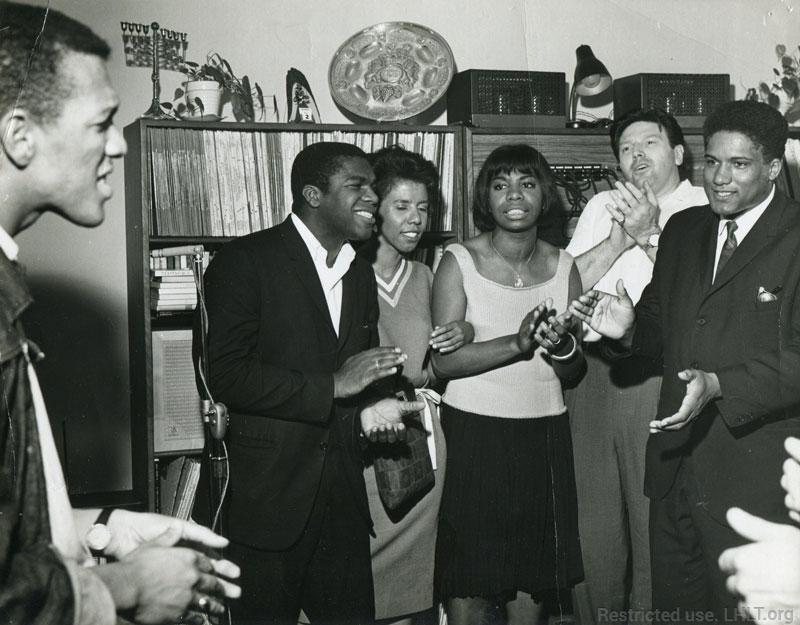
Bikel hosted this fundraiser for SNCC in his home and led an impromptu sing along with, from left to right, Ivanhoe Donaldson, Chuck McDew, playwright Lorraine Hansberry, Nina Simone, and SNCC Executive Director James Foreman.

Bikel was also concerned with the well being of his fellow actors and performers who often eked out a tenuous existence.  He was an active member and rising leader of his union, Actor’s Equity since first arriving in New York.  He also had cards in The Screen Actors Guild, and the broadcast union American Federation of Television and Radio Artists (AFTRA).  In 1962 he co-founded the Actors Federal Credit Union.  From 1977 to 1982 he served as an activist President of Actors Equity.  From 1988 to his death Bikel as President of Associated Actors and Artistes of America, the federation of unions for performing artists which unites the AFL-CIO affiliated Screen Actors Guild, the American Guild of Musical Artists, The American Guild of Variety Artists, the now merged SAG-AFTRA, and the unaffiliated  Guild of Italian American Actors.  Until its demise the Hebrew Actors Union representing the Yiddish Theater was also a member of the so-called 4A’s.
Bikel was also an active liberal Democrat.  He famously campaigned for John F. Kennedy in 1960 even before he became a U.S. Citizen in 1961.  Later in the decade he was an anti-war delegate to the stormy Democratic Convention in Chicago in 1968.  President Jimmy Carter named him to the National Council for the Arts in 1977 for a six-year term.
Most recently, since 2007 Bikel served as Chair of the Board of Directors of Meretz USA, now called Partners for Progressive Israel which advocates “a two-state solution to the Israeli–Palestinian conflict, social justice, human rights (especially for ethnic and sexual minorities), religious freedom, and environmentalism.”
Oh, and in his spare time he enjoyed his meetings of Mensa, that outfit for certified geniuses.  Bikel, not one to hide his light under a bushel, would not want that left out.
Despite all of these interests and commitments, Bikel remained an unflagging performer across all platforms.  On film he appeared in 1964 as the “oily Hungarian” former pupil of Henry Higgins in the ballroom scene of My Fair Lady; as the Soviet submarine captain run aground in the classic comedy The Russians are Coming, The Russians Are Coming; as a fatherly wandering folk singer in the coming of age/survival story The Other Side of the Mountain; and in Frank Zappa’s psychedelic musical 200 Motels.

The role of a life time as Tevye in Fiddler on the Roof.

Even greater triumph awaited on the stage.  In 1967 Bikel became the third actor after Zero Mostel and Herschel Bernardi to play Tevye in the Broadway production of Fiddler on the Roof.  He would go on to play the part in various tours, revivals and remounts more 2,000 times, more than any other actor in the part.  He last stepped into the role for a few performances when Topol, who starred in the movie version, was sidelined by an injury in 2010.
In his later years much of his work was on television and in voice over.  He was always willing to work whether as a series guest star, or in a top billed role in a TV movies like 1989’s The Final Days about the downfall of Richard Nixon as Henry Kissinger.
In 1994 he published Theo: The Autobiography of Theodore Bikel which he has updated and revised in two subsequent editions, the last in 2007.
Last year just before his 90th birthday Bikel released a new documentary film that he produced and starred in, a labor of love called Theodore Bikel: In the Shoes of Sholom Aleichem with a gala premier at the Castro Theater as part of the San Francisco Jewish Film Festival.  Bikel took to the stage and performed some songs.
  On the personal side Bikel was married four times.  The first marriage in Israel to Ofra Ichilov in 1942 was virtually a youthful indiscretion and lasted less than a year.  In 1967 he married Rita Weinberg Call with whom he had two sons, Rob and Danny.  They divorced in 2008.  Later that year he married conductor Tamara Brooks who died in 2012.  He spent his last years with Aimee Ginsburg-Bikel.