Showing posts with label conservative. Show all posts

Friday, March 1, 2013

Yellowstone National Park—An Endangered Treasure

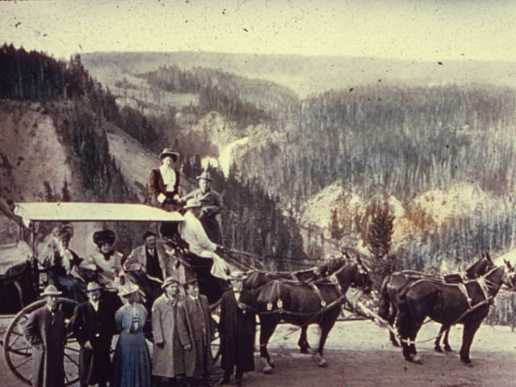
Tourists visit the Grand Canyon of the Yellowstone about 1900 on a typical coach tour.


Today is a milestone in conservation/preservation history, one with deep personal connections for me.  On March 1, 1872 President Ulysses S. Grant signed into law the act creating Yellowstone National Park.  It was the first National Park not only in the U.S. but in the world. It became a model for conservation and habitat protection as well as an example of the huge economic impact on local economies such parks could provide.
The park occupies the northwest corner of Wyoming and strips of Montana and Idaho.  It contains the most active area of geothermal vents—hot springs, geysers, mud pots—in North America. 
The region was a center of trade from Clovis Culture era for fine arrowheads made from local obsidian found at archeological sites along Mississippi River in Missouri and Illinois. Much later it was a hunting ground for Native American tribes, notably the Nez Perce, Shoshone, Crow and Blackfoot.
In the winter of 1807-08 John Coulter, a young trapper who had left the Lewis and Clark Expedition in search of furs, encountered some of the geothermal sites.  After he was injured in a fight with the Blackfoot and made an epic “naked run” over hundreds of miles to escape, he stumbled into Saint Louis.  His tales of boiling mud and water shooting out of the ground were widely dismissed as the ravings of a mad man and derided as Coulter’s Hell.
The legendary Jim Bridger himself confirmed the reports after an 1856 expedition causing the government to decide on an official survey.  In 1860 Bridger guided a small party led by Captain William F. Reynolds and including geologist Ferdinand Vandeveer Hayden which tried to enter the area from the Wind River Range but was turned back by heavy snow. 
The Civil War prevented further exploration until the privately funded Cook, Folsom, and Peterson party followed the Yellowstone River to Lake Yellowstone.  Their notes guided another expedition by Montana Surveyor General Henry Washburn, Army Lt. Gustavus Doan, and Nathaniel P. Langford.  Reports from that trip generated support in Montana for somehow protecting the unusual area. 
In 1871, eleven years after his first failed attempt, F. V. Hayden was finally able to get into the area as the head of the Hayden Geological Survey.  His party included pioneering landscape photographer William Henry Jackson and landscape painter Thomas Moran.  Hayden’s official report and the striking images of Jackson and Morn convinced Congress to withdraw the area from sale as public land and to create the new National Park. 
Langford was appointed the first Superintendent of the Park but Congress did not vote him any funding or staff.  In fact they didn’t even pay his salary.  Langford was helpless as poachers roamed the Park threatening the large herds of elk, mule deer, antelope, and bison. Langford was reduced to pleading for funds and trying to arouse public support. 
In 1875 an Army expedition under Colonel William Ludlow reported the wide spread decimation of wild life by hide hunters.  His report caused the removal of the hapless Langford.  His replacement, Philetus Norris was granted a salary and a small budget with which he build crude roads into the Park and some permanent facilities.  Despite the addition of Harry Yount, sometimes called the first Park Ranger, as “official game keeper” in 1880, there was still not enough staff to prevent poaching. 
Native Americans, including a small band of Shoshone who lived within the park boundaries and others who used it as traditional hunting ground were excluded from the Park.  Chief Joseph’s band of Nez Perce was pursued across the Park in their attempt to reach Canada. 
In 1886, with the Indian Wars largely behind them, the U.S. Army was charged with policing the Park and preventing poaching.  They built their first post at Mammoth Hot Springs and later established Fort Yellowstone.  They slowly made progress against poachers while creating policies enabling other visitors. 
Tourism to the park grew, especially after the Northern Pacific created access from a spur from Livingston, Montana in the 1880s and the Union Pacific connected via West Yellowstone, Montana 1908.  Visitors traveled the park by stage coach or horseback and could stay at crude campgrounds and rustic lodges or beginning in 1908, the historic Old Faithful Inn.  By 1915 1000 automobiles a year were making the trip. 
The newly created National Park Service assumed control of the Park from the Army in 1918. 
During the Depression the Civilian Conservation Corps (CCC) built the current road system, visitor centers and improved campgrounds. 
In August of 1959 the Park was the epicenter of an earthquake measured between 7.3 and 7.8 on the Richter scale. The quake caused a huge landslide resulting in over 28 fatalities, blocked the flow of the Madison River resulting in the creation of Quake Lake, and left $11 million in damage.   German scientists studying the quake have recently concluded that the event was one that was likely caused by human activity.
The Hebgen Lake area in the northwest corner of the Park has also experienced earthquakes again in 1964, 1974, 1977 and 1985. The Park remains a seismic hot spot.  A swarm of moderate quakes hit the park in October 2012. 
The whole area essentially sits on top of an enormous potential volcano whose pressure dome is growing.  When it eventually bursts, the eruption could be one of the greatest and most devastating of all time.
Today the park boasts of having saved the bison from extinction—the largest surviving herd found refuge and protection within the park and has been used to repopulate the species elsewhere.  In a controversial move, wolves were re-introduced and have successfully rebounded. 
Local ranchers have pushed back on both preservation efforts, shooting bison and wolves that wander out of the Park.  The state of Wyoming has even asked the Park Service to allow hunting of wolves in the park and bounties on ears.
The Park draws over three million visitors a year.  Despite this more than a decade of deep cuts to the National Park Service has left facilities in deteriorating conditions.  Damage to the ecosystem by the exhaust of nearly a million vehicles a year has caused the Park Service to limit the total number admitted each year and implemented steep visitor fees. But with the formerly excellent rail and motor coach services to the Park gone, that limits its accessibility to many families
On a personal note, my father was licensed as a hunter to thin the elk herds—their natural predators having all been eradicated—and ran a guide service to the Park out of his West Yellowstone sporting goods store 1946-48.  We traveled frequently in the Park with him in the 1950’s when he was Secretary of the Wyoming Travel Commission.  Somewhere there are black and white snap shots of Old Faithful erupting that I captured on my Kodak Brownie.

Friday, September 7, 2012

Getting’ Sentimental for When All Republicans Weren’t Bat Shit Crazy

Dirksen honored for passing Civil Rights legislation.


The Republican National Convention last week was a sad display of raging paranoia, delusion, projection, and unbridled sociopathic behavior.  Blissfully unaware of how they were looking to ordinary Americans, they forged relentlessly ahead convinced that they had found the secret formula to defeating the Power of Darkness a/k/a Barack Obama.  Most Americans not already infected with the same delusions, even those who had scarcely been paying attention before, looked at the freak show and uttered a collective yuck.
A good way to see just how far the modern Republican Party has gone off the rails in the direction of populist neo-fascist theocracy is to review the career of Illinois Senator Everett McKinley Dirksen, a self-proclaimed party conservative who died on September 7, 1969 having served nearly 19 years including 10 years as Senate Minority Leader. 
Dirksen and his fraternal twin brother were born on his parent’s farm near downstate Pekin, Illinois on January 4, 1896.  His parents were both German immigrants and his father, like most Midwestern Germans, was a staunch Republican.  He named his son in honor the legendary orator Edward Everett and President William McKinley. 
The boy was educated in local schools and attended the University of Minnesota Law School before dropping out to enlist in the Army during World War I.  He served in France as a second lieutenant of artillery.
After the war he returned to Pekin and took up private business.  His political career began with election to the city council in 1927.  He had his eye on bigger things.  He failed to win the GOP nomination for the House of Representatives in 1930, but won both nomination and election in 1932.
Dirksen entered Congress as a minority Republican in the Democratic landslide that brought Franklin D. Roosevelt to the White House.  Despite the ingrained conservatism of a small town businessman, Dirksen recognized the severity of the national emergency of the Great Depression and supported much, but not all, of F.D.R.’s New Deal legislation despite pressure from party leaders.  It marked a willingness to work across party lines that was the hallmark of his long career.
Roosevelt, however, could not rely on the Illinois Congressman for support as he steered the country to support of the Allies in World War II.  Dirksen was an ardent isolationist in the mold of one of his most influential political supporters, Col. Robert R. McCormack, publisher of the Chicago Tribune.  He showed his considerable skill as a legislative tactician during the debate over Roosevelt’s Lend Lease Act.  He recognized that there were not enough Republican votes to stop passage in the House, but took advantage of sixty-five Democrats leaving the floor for lunch to successfully attach an amendment that gave the Senate and House to power to revoke the President’s authority by a concurring resolution that could be passed by a simple majority in both houses.
Dirksen made an abortive bid for the 1944 Republican Presidential nomination, which observers believed was mostly an attempt to derail the re-nomination of liberal Wendell Willkie or a ploy to get the Vice Presidential nomination.  In any event on the eve of the convention he signaled that he would not be a contender and although he allowed himself to be nominated as a favorite son of Illinois, did not get a single vote.
In 1948, citing an eye ailment that would plague him the rest of his life, Dirksen announced that he would not seek re-election.  He was evidently feeling better in 1950 when he beat incumbent Senator Scott Lucas, the sitting Majority Leader and a key ally of President Harry Truman.  Dirksen campaigned with the help of Wisconsin Senator Joseph McCarthy who accused Lucas of being soft on Communism.
Dirksen remained loyal to McCarthy, but tried to convince him to admit to “misstatements” and apologize to avoid censure by the Senate.  When the vote came down, he supported McCarthy while privately acknowledging that his friend had, “lost his senses.”
Even as a freshman Dirksen quickly became a power in the Senate where he was known for his 19th Century style florid oratory, deceptively folksy demeanor, and considerable skill at building legislative coalitions.  By 1952 he was well enough thought of to be the voice of Mid Western conservatives at the Republican National Convention in support of Senator Robert Taft of Ohio and against Dwight Eisenhower.  In a blistering speech to the convention he went directly after Eisenhower’s biggest supporter, former two time nominee Thomas E. Dewey.  Pointing at Dewey on the floor he thundered, “Don't take us down the path to defeat again!” to a mixed chorus of boos and cheers.
Dirksen, however, dutifully supported Eisenhower that fall and soon became his most reliable ally in the Senate, a tribute to the practicality of both men.
When the Senate reorganized in 1959, Dirksen was elected Minority Leader over more liberal John Sherman Cooper of Kentucky, but he moved quickly to heal rifts between wings of the party and molded a solid caucus.  As John F. Kennedy came to the Presidency, he became the face of the Republican Party, along with House Minority Leader Charles Halleck of Indiana.   Their weekly joint news conference, dubbed the Ev and Charley Show, became goldmine of television sound bites, usually featuring Dirksen’s folksy wit.  His weathered face, mop of unruly curls, and distinctive voice made him a regular on Meet the Press and Face the Nation.
Dirksen became famous for his quips such as, “A billion here, a billion there, pretty soon, you're talking real money,” when talking about the budget and his story of two Quaker ladies discussing taxes, “Don’t tax me, don’t tax thee, tax the fellow behind the tree.”
Although a moderate conservative on economic policy and an anti-Communist hawk in foreign affairs, Dirksen, in the tradition of Illinois Republicans, was passionate about civil rights.  Working across the aisle with Democratic Majority Leader Mike Mansfield of Montana, he was critical in rounding up Republican votes to break filibusters against both the Civil Rights Act of 1963 and the Open Housing Act of 1968.
Reversing his traditional isolationism, Dirksen became an early supporter of the War in Vietnam.  His advice to his old Senate friend Lyndon B. Johnson was said to be critical to Johnson’s decision not only to continue Kennedy’s commitment of troops there, but to dramatically escalate the war against his own nagging doubts.
Dirksen recorded several spoken word albums.  A single from one of them The Gallant Men became an unexpected radio hit and earned him a Grammy.
The Senator was also famous for his passion for the common marigold and his frequent attempts to have the hardy plant name the national flower.  He waxed eloquent about the topic at a drop of a hat.
Dirksen died of complications following surgery for lung cancer at Walter Reed Army Hospital at the age of 77.  He was so well thought of by his Senate colleagues that they re-named the main Senate office building in his honor.  The new 1972 Federal Court Building in Chicago was also named for him.  His portrait hangs in honor in the Illinois State Capitol and a bronze statue stands on the lawn.

Thursday, August 18, 2011

Through a PONY League Lens—The Conservative/Liberal Divide

Note—This is re-posted from an entry made almost exactly five years ago, on August 17, 2006 in the infancy of this blog.  When I stumbled on it, I realized that it was every bit as apt today.

I want to talk about sports today.  About baseball.  Not the Cubs (the object of my longings, disappointment and shame.)  The Bountiful, Utah Red Sox and their arch foes, the Yankees of the PONY League.  That’s right we’re talking about ten year old baseball.
 
 I first heard the story discussed on WGN Radio, on the John Williams Show.  He was talking about a Sports Illustrated column by Rick Reilly called You Make the Call.  The story related events between the Red Sox and Yankees in the PONY league championship.  This is a “fun” league in which all players are supposed to get to bat, games are limited to one hour, there is an assortment of rules meant to curb cut throat competition, and in which everyone is supposed to go home happy after a game knowing that they had done their best.
 
The situation was this:  It was the bottom of the final inning.  The Yankees led by one run.  Red Sox at bat, two outs with a runner at third.  Up to the plate strode the mighty Jordan, the Sox most fearsome hitter.  On deck was puny Romney, a hapless athlete almost sure to strike out.  A no brainer, right?  The Yankee manager Bob Farley ordered an intentional pass to Jordan and pitched to Romney  who dutifully struck out winning the championship for the Yankees. 
 
Hardly a remarkable baseball story.  But consider this:  Romney is an underweight cancer survivor with a shunt in his brain who wears a batting helmet even in the outfield to protect his fragile head.  He takes human growth hormone in a failing attempt to get to normal size.  Because of radiation treatments he need cortisone shot immediately if he is injured or he could go into a life threatening shock.  All coaches in the league, as well as on the field officials were informed of Romney’s condition.

No, Romney didn’t triumph over adversity and hit one out over the left field fence.  This wasn’t an up lifting movie.  As he was expected to do, Romney feebly struck out.  The boy hung his head in shame.  He felt responsible for his team’s loss.  His father reported that he cried himself to sleep that night.

So it was no surprise that fans packing the stands booed manager Farley’s decision to humiliate Romney.   After the game instead of celebrating, the two coaching staff nearly came to blows.  Farley was denounced in harsh terms by a local sports editor, Ben De Voe of the Davis Clipper,  Hopefully these coaches enjoy the trophy on their mantle, right next to their dunce caps.”  Did I forget to mention that this was the only intentional walk called in the entire league over the entire season?

Bountiful was bitterly divided in the ensuing controversy.  Yankee coaches were vilified. Some sprang to their defense as “Great Men” who had made the only logical baseball decision.  They were voracious in demanding that Voe of the Clipper be fired for reviling the Yankees.  Partisans on both sides were smeared in the letters to the editor columns.  Threats of actual physical violence were made.

Williams on his WGN program, like Reilly in the Sports Illustrated  piece, clearly thought that the Yankee manager was way out of line.  “It’s a no brainer,” he said, “This isn’t the major leagues.  We’re talking about a ten year old fun league, for crying out loud!”  He seemed surprised when traffic reporter and banter partner Leslie Keiling opined that the Yankees had made exactly the right decision.  In the phone calls that followed, a significant minority took the same position, many voraciously.

Taken aback, Williams made the issue his Newsclick of the Day.  The next day he reported that more than 40% of those who had voted favored walking the star to get to the sad sack.

 So What?  Why is this whole topic worth even an inch of screen space on my blog, let alone the lengthy set up this has required?  Because listening to the comments from callers on Williams’s program, I was struck that the whole controversy was a mirror of the conservative/liberal split in this country.  I’ll tell you how.

It has to do with values.  To the true conservative, the highest value is unfettered competition.  This is supposed to separate the sheep from the goats, the losers from the winners.  The cream will rise to the top and be justifiably rewarded for their talent/hard work/beauty/brains/wealth. 

The losers need to shut up and stop whining.  The world owes them nothing they can’t take for themselves.  In fact any sign of “compassion” is giving in to weakness and is in itself morally reprehensible.  At best the losers will learn from their humiliation, gird their loins and go on to be winners themselves, having had their character improved by the beating administered by their betters.  And if they cannot, they deserve all of the misery resulting from their own manifest failures as human beings.   In the end society will benefit from this rough and tumble process which is the only engine of progress.

A corollary to this is a respect for authority and The Rules.  Anything that is within The Rules is permissible and there is no moral consideration out side of them.  It can’t be wrong to walk a batter to pitch to a sick child if The Rules allow it.  (Of course the Conservative makes an exception for those strong enough to make The Rules, and the truly powerful can actually ignore them as a reward for becoming powerful.)  The leader—or team manager—being an authority figure can do no wrong. 
 
The liberal doesn’t deny the virtue of competition.  Only that it is the sole value or that it at all times must triumph over all other concerns.  Liberals believe that compassion can be a good thing.  That it is a virtue in looking  out for one another and  protecting the weak.   That moral choices are complex and that the right choice is not always the one that scrapes by because it is narrowly permissible under  The Rules.  That sometimes a sick ten year old is more important than a plastic trophy awarded at a rubber chicken banquet.

What do you think?