Showing posts with label cutter. Show all posts

Tuesday, December 8, 2020

Jingle Bells—Murfin ’s Carols for Corona and Winter Holiday Music Festival

                                                     Diana Krall recording Jingle Bells.

Today we delve into the category of Christmas songs that really aren’tJingle Bells never mentions Christmas and was never meant to be associated with the holiday at all.  Yet it has become the most oft-recorded secular seasonal song because its catchy, bouncy melody is easily adaptable to almost any musical style.  Also because it is in the public domain and thus a cheap addition to any holiday album.

The song’s origins stretch back more than 150 years. James Lord Pierpont was the prodigal younger son of the Rev. John Pierpont, a close associate of William Ellery Channing and an influential figure in the founding of American Unitarianism who latter rose to prominence as an ardent abolitionist . Among James’s siblings were John Jr., another future Unitarian cleric and a sister, Juliet, who became the mother of arch capitalist J.P. Morgan.

                      James Lord Pierpont.

The artistically inclined young James was the preverbal preacher’s son—restless with restrictions at home, rebellious, and often in trouble. Born in 1822, he ran away to sea at the age of 14 aboard the clipper ship Shark. Another rebellious Unitarian lad of the same period was Richard Henry Dana, whose account of misery at sea in his book Two Years Before the Mast that shocked the sensibilities of mercantile New England.

Returning to New England he married and fathered three children while casting about in a series of failed business ventures. Lured to California by the Gold Rush of 1849 he thought to strike it rich not by mining himself, but by taking tin types of the newly rich prospectors. But like his other ventures, his San Francisco photography shop ended in failure.


The historic Savannah Unitarian Church, the largest in the South, where James Pierpont's brother was the minister and where he was employed as the organist.  The church posts it claim on Jingle Bells on the historical marker out front.


After his first wife died in 1853 he took his young family to join his brother, the Rev. John Pierpont, Jr., minister of the Unitarian Church in Savannah, Georgia, which was the largest Unitarian congregation in the South.  He took up residence and earned a modest living as organist in his brother’s church. Eventually he also set himself up in business selling house paint, varnish, wallpaper, window glass, and art supplies.  In 1857 he married the daughter of a prominent Savannah civic leader who would go on to serve as the city’s Civil War mayor.

Sometime during those years, restless as ever and lonesome for his lost New England childhood, he penned a song he called The One Horse Open Sleigh.  He may have drawn as inspiration a sleighing party that he had rapturously reported to his mother in an 1832 letter.

This popular Currier & Ives print embodied the fun and romance of New England winter sleighing, although this couple was pulled by a pair of horses and their tails have not been bobbed.

In snow bound New England the sleigh was both a necessary form of transportation and a winter diversion. There was a whole genre of sleighing songs. The best known today, Over the River and Through the Woods is associated with that quiescently New England holiday, Thanksgiving.  But it accounted a family expedition in a large, multi-passenger sled of the sort often pulled by a team. Pierpont's song was about a cutter, a fast two seat light sleigh often pulled by a thoroughbred trotter. It is a courtship song, with a young man out to impress Miss Fanny Bright with his speed and daring until he miscalculates the depth of a drift and the sleigh becomes “up sot.”

The song may have mystified his brother’s Southern parishioners, but James mailed copies home and it was sung in Medford, Massachusetts at Thanksgiving parties sometime in the mid 1850’s. This would lead to a later spurious claim that the song had been written there.

James copyrighted and published the song in 1857. Two years later it was issued in a new edition as Jingle Bells or the One Horse Open Sleigh. Within a decade it was a popular American parlor sing-a-long favorite, linked in the public’s mind with the colorful Currier & Ives prints of sleighing scenes that adorned many homes.  It was considered a winter song, but not a Christmas one.

Unfortunately, James never profited much from royalties from the song. 

Dark clouds were gathering that would change his life forever.  As  the  passions  stirred  by  the  1860 presidential election grew heated brother John,  an  abolitionist  like his  father,  was  forced to give up his pulpit and return to the North costing James his job  at  church.  James remained in Savannah, now an ardent supporter of the Southern cause.  After war broke out the combination of a war economy and the increasingly effective blockade of Southern ports destroyed James’s shaky business venture.

At the age of 40 he enlisted as a clerk in the First Georgia Battalion, which became a part of the 5th Georgia Cavalry. Although he was a gentleman with connections to a leading aristocratic family, James never rose above the rank of private. He remained in the Confederate Army for the duration of the war, although his rear echelon unit saw little action, mostly patrolling in defense of railroad lines and later scouting Yankee positions during the Atlanta campaign.  His greatest contribution to the Confederate war effort came as the composer of patriotic songs including We Conquer or Die, Our Battle Flag, and Strike for the South.   Meanwhile his father and brother served as chaplains in the Union Army.

After the war there were hard times in the South and James and his family shared in them. Eventually he found a niche as professor of music at Quitman Academy. He spent his last years in Florida at his son’s home in Winter Haven before dying in 1893.

Jingle Bells may not have been his only contribution to seasonal music. According to the 1994 book American Christmas by Jim Harrison, “For many years Martin Luther was credited with writing one of the best loved Christmas songs, Away in a Manger .. .but history now has evidence to dispute his authorship. An American, James Pierpont, is currently believed to be the author.” UUA historian Peter Hughes doubted the claim, however. Although the song is undoubtedly American dating from some time in the 1880’s, its origins are murky, probably Lutheran although the lyrics were first published as a poem in a Universalist periodical.

Sleigh bells are featured in many recordings of Jingle Bells.

Away in a Manger aside, James Pierpont’s claim on our seasonal culture is indisputable.  By the early 20th Century, as the automobile was replacing the horse, Jingle Bells was being melded into the general sentimentality of the Christmas season. In the days before the explosion of popular secular holiday songs like White Christmas, I’ll Be Home for Christmas, Have Yourself a Merry Little Christmas, and The Christmas Song, it provided a much needed non­ religious song suitable for performance in public schools and in mixed gatherings. The simple, lively tune was easy to sing and easy to adapt to a host of musical styles. It has become an indisputable Christmas classic.

Diana Krall is a contemporary jazz pianist and vocalist with pop appeal.

There are so many versions of Jingle Bells in so many styles that it is difficult to pick one.  This year let’s go with some sleek, modern jazz   courtesy of this 2005 Verve recording session featuring Diana Krall and a swinging studio band.         


Tuesday, November 10, 2015

Lt. Allen Meets the Pirates

The top sail schooner of war the USS Alligator was built to chase slavers and pirates.


When we think of Caribbean pirates we think of Robert Lewis Stevenson, Errol Flynn, Johnny Depp, and the swashbuckling Golden Age of Buccaneering on the Spanish Main from the 16th through 18th Centuries.  But it persisted on a somewhat reduced scale well into the 19th Century and never entirely went away.  Modern day pirates still prey occasionally on luxury yachts and on drug smuggling boats.  Back in the early decades of the 1800’s pirates were still enough of a nuisance to American shipping the U.S. Navy launched the West Indies Anti-Piracy Operations in 1817 which continued for eight years.
The Navy and the Revenue Cutter Service—forerunner of the Coast Guard—engaged in several sometimes violent actions before the USS Grampus defeated the pirate ships Palyrma and the El Mosquito and captured the one of the main pirate captains, Roberto Cofresi in 1825 greatly curtailing depredations on the bounding main.     
Our story today is about a genuine American hero who is not much remembered today.
In the matter-of-fact style of Naval bureaucracy it is officially known as the Action of 9 November 1822.  Because no sovereign nation or its naval forces were engaged, the bloody affair could not rise to the official dignity of a battle.
The USS Alligator, the last of five 12-gun topsail schooners built for special purposes of suppression of the slave trade and action against Caribbean pirates set sail from Boston under the command of Lieutenant William Howard Allen.  It was the third cruise of the fast little war ship.  The first two, under the command of future hero Master Commandant Robert .F. Stockton had been anti-slave trade patrols off of West Africa and had included a bloody victory over the Portuguese pirate and slaver Marianna Flora and the capture of several other prizes in 1821.  Now the veteran crew was headed to the waters off of Cuba under a new skipper.  
Allen was also an experienced officer with a solid war record, although this was his first command of a warship.  During the War of 1812 Allen had been a junior officer on board the brig USS Argo which was boldly raiding British shipping in the English Channel and Irish Sea.  She was attacked by the Royal Navy’s HMS Pelican.  The two ships exchanged broadsides for nearly 4 hours.  Commanding officer Master Commander William Henry Allen (no relation to the younger officer) lost a leg early in the battle and the First Lieutenant was also badly wounded.  Second Lieutenant William Allen assumed command and valiantly kept up fire until the Argo was dead in the water  and was about to be overwhelmed by a boarding party.  Young Allen spent the rest of the war in England as a prisoner of war, but the Navy took note of his bravery and fighting spirit.   
In early November 1822 Allen brought the Alligator into port at Matanzas on the northwest coast of Cuba for fresh water and supplies.    While in port he found two Americans trying to raise $7000 to ransom   their trading ships which had been captured by pirates and were being held in a cove some 15 league—about 45 nautical miles—away.   Allen would not hear of allowing the merchants to pay the ransom.  Instead he brought the men aboard to lead him to the cove with the intention of attacking the pirates and releasing several captive ships.
It was a bold plan considering that the pirates had three armed schooners—the 80-ton Revenge, armed with five cannon and 35 men, a 90-ton ship with six guns and 30 men, a 60-ton vessel was with three cannon and 60 men.    Thus the pirate flotilla out gunned the Alligator and its crew was out numbered.  The pirates held five American merchantmenWilliam Henry, a ship-rigged vessel from New York; the brigs Iris and Sarah Morril from Boston; and schooners out of Rochester and Salem.     

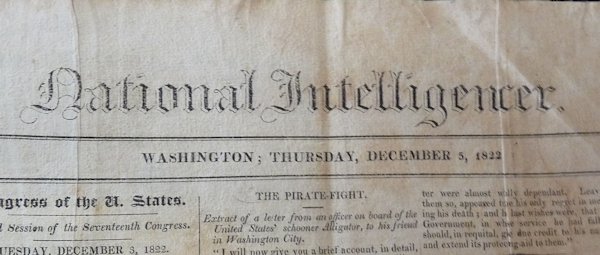
The first newspaper account of  the action appeared in the form of a letter from an Alligator officer that appeared in early December in the National Intligencer, the Monroe administration's press mouthpiece. 


Upon arrival Allen discovered that the Alligator’s draft was too deep to enter the harbor.  The conventional naval strategy for such a situation would be so blockade and hope to pick off the pirates if they tried to make a break.  That could take days or weeks.  And there was the danger that the pirates could land their booty and captured crews and escape overland after burning the prizes. 
Allen boldly decided to go on the attack with his small boats—the launch, largest of the boats carried on the Alligator; a medium size cutter; and a gig, the small boat used as a messenger.  He manned his boats with 40 sailors including his small compliment of Marines armed with muskets, pistols, and naval swords.  Allen took personal command of the launch, Lieutenant Dale the cutter, and Midshipman Henley the gig.  The aim was to surprise and board the pirates and avoid their cannon by speed and by presenting only their bows until the last moment.
The Revenge spotted the small attacking flotilla and got under way despite almost no wind by the crew manning her sweeps.  The American boats pursued the Revenge for nearly 10 miles, nearly exhausting their crews.  Then the pirate ship came about and attacked the small boats with both solid and grape shot, most of which missed the targets.  When the boats came within range, they opened up with deadly accurate musket fire and moved within boarding range.  Rather than fight a boarding party, the pirates abandoned ship, many leaping into the sea where presumably several drown.
While Allen and the crew of the launch attempted to secure the Revenge, a second pirate ship attacked the cutter and gig, who presented their broadsides to the attacker.    The men in the small boats were faltering against the heavy fire, especially the cutter which had taken enough casualties to make manning the oars difficult.  Allen on the launch turned his boat to rally his other boats and stood up waving his sword in encouragement.  He was struck by musket fire in the head and torso and was mortally wounded. 
In the confusion the two other pirate ships were able to escape, but they left behind the Revenge and all of their merchant prizes.  The battle was a bloody little encounter.  The Americans found 14 bodies on the Revenge in addition to the men presumed drown in the escape attempt.  The Navy lost three dead in addition to Allen and three wounded. 
The Revenge and liberated merchantmen were escorted back to Matanzas where Allen was buried with honors and a ceremonial escort was provided by the Spanish Governor. 
On November 18 the Alligator left the Cuban port to return to Boston escorting her freed prizes.   Perhaps Lt. Dale was not as experienced a sailor as Allen, or perhaps it was a bad chart, or just blind misfortune, but the Alligator ran aground on a coral reef in the Florida Keys ripping a hole in her hull.  The crew was unable to re-float her but salvaged all of her guns, logs, and papers.  She was then burned to prevent the hulk from being salvaged.  The reef she was believed to be lost on was named Alligator Reef in her honor, but the exact location of her wreck was long considered lost.   The crew proceeded home on the merchantmen.

Lt. Allen's remains were repatriated from Cuba to his home town of Hudson, New York where the citizens paid to erect a column monument in his honor.
Allen was recognized as a hero within the Navy.  The next year his name became a rallying cry  USS Galliniper and USS Mosquito engaged and defeated a band of pirates led by Diabolito—perhaps including those who escaped in  near the same area where the American lieutenant had been slain.  A monument to his honor was erected along the banks of the Hudson in Allen’s hometown.  But he never got the public recognition of other early naval heroes, perhaps because the campaign against the pirates was obscure even it its own time and unpopular in the South because the same ships were used to interdict the now forbidden international slave trade.
   
The most important legacy of Lt. Allen was a change in Naval policy in the campaign against the pirates.  Instead of deploying individual ships to operate independently Secretary of the Navy Smith Thompson authorized Commodore David Porter to assemble the ships for a new West Indies Squadron consisting of eight new shallow draft schooners, five large barges, a steam powered riverboat, and a store ship schooner.  Placed under the operational command of Commodore James Biddle it was authorized to cooperate with a British anti-piracy squadron and ships of any other nation fighting the pirates.  Their combined efforts pretty much cleared the Caribbean and secured the sea lanes in just a few short years.