Showing posts with label Murfin ’s Carols for Corona and Winter Holiday Music Festival. Show all posts

Tuesday, December 15, 2020

The Christmas Waltz Nancy Wilson—Murfin ’s Carols for Corona and Winter Holiday Music Festival

                                                        The Christmas Waltz sung by Nancy Wilson.

The silken voice of jazz and pop chanteuse Nancy Wilson was stilled two years ago in the Christmas season when she died at age 81 after a long illness at her Pioneertown, California.  Although often identified as a jazz artist, she preferred to characterize herself as a song interpreter for the way she caressed lyrics, she said, “I do not do runs and—you know. I take a lyric and make it mine. I consider myself an interpreter of the lyric.”

Wilson was born on February 20, 1939 in Chillicothe, Ohio to working class parents who filled their home with recording by Billy Eckstine, Nat King Cole, Jimmy Scott with Lionel Hampton’s Big Band, and especially Dinah Washington.  At an early age she was singing their songs around the house and was also featured in her church choir.  She said she knew she would be a singer by age 12.

The family moved to Columbus, Ohio where at the age of 15 and still in high school she won a talent contest.  The prize was an appearance on Skyline Melodies, a twice-a-week local TV show on WTVN. She so impressed the station that she was soon made the regular host of the program.  Until graduating from high school two years later she regularly performed in local clubs.

Her parents were leery of the chances for a successful career as a singer, so she enrolled in Central State College, a historically Black school to prepare to be a teacher.  That did not last long.  She dropped out to pursue her dreams.  Wilson won a spot with Rusty Bryant’s Carolyn Club Big Band in 1956 and toured with them throughout Canada and the Midwest for two years.  She made her first recordings with the band on Dot Records.

Nancy Wilson with jazz sax legend Cannonball Adderley, her mentor and sometimes collaborator.

Her big break came when she met saxophonist and jazz superstar Cannonball Adderley who became her mentor and eventually collaborator.  He encouraged her to abandon touring with the band and to move to New York City where there was opportunity for a singer of her talent.  Within weeks she secured a regular four-night-a-week gig at the popular night club The Blue Morocco.  Adderley’s manager John Levy hooked her up with Capital Records which released her first solo single Guess Who I Saw Today which was so successful that Capital released five of her albums from 1960 to 62 beginning with Like in Love showcasing a Rhythm & Blues style.  The collaboration Nancy Wilson and Cannonball Adderley cemented her reputation as a jazz singer. 

By the mid-60’s Wilson was a star in her own right.  1964 she released what became her biggest hit on the Billboard Hot 100, (You Don't Know) How Glad I Am, which peaked at No. 11.  From 1963 to 1971 Wilson logged eleven songs on the Hot 100, including two Christmas singles.

                                    Nancy Wilson at the peak of her career.

Wilson was featured on all of the top variety shows including the Ed Sullivan Show, the Smothers Brothers Comedy Show, and Carol Burnett as well as on talk shows from the Tonight Show with both Jack Paar and Johnny Carson, to Mike Douglas, and Arsenio Hall.  She had her own series on NBC, The Nancy Wilson Show in the 1967–1968 season—a stunning breakthrough for a Black female artist—for which she won an Emmy.

Her good looks and statuesque figure led to acting.  At first appearing as herself or fictional singers on programs like I Spy and The FBI she was soon doing dramatic guest spots on several series including Room 222, Hawaii Five-O, and Police Story.  More recently she had recurring roles on Moesha, and The Parkers.

Nancy Wilson, Eartha Kitt, Sydney Poitier, and Sammy Davis Jr. at Martin Luther King's funeral.

Despite a booming career in the ‘60’s and ‘70’s and warning that it would kill her career with white audiences, Wilson found time to be an active supporter of and participant in the Civil Rights Movement including participation in the Selma to Montgomery March for voting rights.  In recognition of that work she was won the Urban Leagues Whitney Young Award, and NAACP Image Award, was honored by the Martin Luther King Jr. Center for Nonviolent Social Change, and was inducted into the International Civil Rights Walk of Fame at the Martin Luther King Jr. National Historic Site of which she said, “This award means more to me than anything else I have ever received.”

Although her days of hit singles were over by the mid-70’s Wilson continued to record critically praised albums for decades.  She won two of her three Grammy Awards—the first was in 1965 for Best R&B Recording for How Glad I Am—for jazz albums late in her career, R.S.V.P. (Rare Songs, Very Personal) in 2005 and Turned to Blue in 2007, both on the MCG Jazz label.

Wilson at the 2007 Grammy Awards.

Wilson reaped many more honors and continued to record, tour, and act until ill health forced her to retire from touring 2008.  She made a final public appearance on September 10, 2011, at Ohio University in Athens, Ohio where she noted “I’m not going to be doing it anymore, and what better place to end it than where I started—in Ohio.”

In 2001 Wilson released A Nancy Wilson Christmas with all proceeds benefiting the Manchester Craftsmen’s Guild, a Pittsburg non-profit that promotes music and the arts to poor and minority children.  That fine LP, did not, however, include her wonderful 1969 cover of The Christmas Waltz originally written by Sammy Cahn and Jule Styne for Frank Sinatra in 1954.  No one has ever done that lovely song better.

Monday, December 14, 2020

Christmas in My Home Town Charlie Pride—Murfin ’s Carols for Corona and Winter Holiday Music Festival

                                            Christmas in My Home Town by Charley Pride.
 

Word came Saturday the Charley Pride, the first Black singer to carve out a long and successful career in country music died of complications of the Coronavirus at the age of 86.  Some other performers have speculated that he might have been exposed at the Country Music Association Awards (CMA), which were held indoors at the Music City Center in Nashville, Tennessee, on November 11 and where he was presented the Willie Nelson Lifetime Achievement Award.  

Although the CMA said it screened attendees for the virus and “took precautions” social distancing was not practiced and few, if any, wore masks.  Several acts had to cancel appearances when they or members of their bands or crew tested positive including Lee Price, Lady A, Rascal Flats, and Florida Georgia Line.  Pride was reported to have tested negative “multiple times” after returning to his Dallas, Texas home, but those tests might have been conducted after he had become exposed but before he was symptomatic.

Charley Pride's performance on the CMA Awards show in November was his last major public appearance.

Despite the pandemic, 2020 had been a career crowning year for Price.  In addition to his CMA Lifetime Achievement Award he was at long last inducted into the Country Music Hall of FamePrevious honors included three American Music Awards, four Grammys including a Lifetime achievement award, the Academy of Country Music Pioneer Award, and three previous CMA Awards for Entertainer of the Year and Male Vocalist of the Year.  He was one of just three Black members of the Grand Ol’ Opry along with harmonica whiz DeFord Bailey and Darius Rucker.

Country music roots were tangled inexorably with Black folk music, each influencing the other.  African slaves brought the banjo and Scotch-Irish fiddling was adapted to Black dancingBallads like John Henry, Frankie and Johnnie, and House of the Rising Sun were sung and adopted by both.  European hymns became Black gospel music and showed up again in White churches in the new form. Field calls and shout and response laid the foundation of the blues.  Delta bluesmen introduced the slide guitar style that would become a backbone of country music and Western Swing on the electric steel pedal guitarLouis Armstrong played on Jimmer Rodgers’ famous Blue Yodel #9 recording.

According to Patrick Huber, a history professor at Missouri University of Science and Technology in his 2013 essay Black Hillbillies: African American Musicians on Old-Time Records, 1924-1932, hillbilly featured a higher frequency of integrated recording sessions than any other genre except vaudeville blues. Nearly 50 African-American singers and musicians appeared on commercial hillbilly records between those years because the music was not a white agrarian tradition, but a fluid phenomenon passed back and forth between the races.  Black and white musicians often played the same barn dances even in the Deep South.

DeFord Bailey with a megaphone strapped to his harmonica at the WSM microphone.  He was a founding member of the Grand Ol' Opry and the last until Charley Pride.

But by the early 1930’s recording companies were splitting their record labels and marketing into white hillbilly music and “race music.”  Only occasionally on the vaudeville stage were a handful of African-Americans allowed to perform with white acts as comic relief and usually adopting minstrel show stereotypes and even blackface.  DeFord Bailey was the only performer from the cross-fertilization period to finally allowed to join the early WSM Grand Ol’ Opry. But Bailey’s race was mostly hidden from his radio audience, and when he did go on tour with the Opry, he was forced to find separate accommodations in a segregated South. “He was a mascot—he was very much treated paternalistically,” Huber said. Bailey was fired unceremoniously in 1941 and spent the rest of his life shining shoes

As hillbilly music, cowboy music, and western swing blended together in post-World War II America as country music it was as whites only as a Mississippi drinking fountain or lunch counter.

Ray Charles' Modern Sounds in Country and Western Music was a smash hit on the Country, R&B, and pop charts, but it was an anomaly. 

Rhythm & Blues (R&B) star Ray Charles first breached the wall in 1962 with his phenomenally popular Modern Sounds in Country and Western Music which included his hit I Can’t Stop Loving You.   Not only did he top the R&B and Country Charts but also crossed over to pop chart success.  The album was so successful that it helped boost all of country music to a mainstream audience. Charles went on to make a follow-up Vol. II, but afterwards turned from country music to play bluesy jazz and soul music and to take a career hiatus while he battled heroin addiction.

That was the world Charlie Pride found himself in when he tried to break into country music in the mid-1960

Pride was born on March 18, 1934, in Sledge, Mississippi, the fourth of eleven children of poor sharecroppers.  He came by his love of country music because it was all he heard on the radio.  By his teens he was noodling around on an old guitar and trying to imitate the twang of his heroes like Roy Acuff, Hank Williams, and Ernest Tubbs.  

A baseball card from Charley Pride's time with the Memphis Red Sox of the Negro American League.

But his dream was to follow his older brother into baseball.  In 1952, he pitched for the Memphis Red Sox of the Negro American League. In 1953, he signed a contract with the Boise Yankees, the Class C farm team of the New York Yankees. During that season, an injury caused him to lose the mustard on his fastball, and he was sent to the Yankees' Class D team in Fond du Lac, Wisconsin.  His career was interrupted when he was drafted into the Army in 1956. After basic training, he was stationed at Fort Carson, Colorado, where he was a quartermaster and played baseball team which won the All Army championship. When discharged in 1958, he rejoined the Memphis Red Sox.  As a Negro League player he was a two-time All Star and tried out with the Major League Angels and Mets in the early ‘60s but failed to make either team.

He was out of baseball and working construction in Helena, Montana when he was recruited to play for the semi-pro East Helena Smelterites where most of his earnings were from a job reserved for players at local Asarco lead smelter.  That was grueling, hot work and exposed him to all of the hazards of toxic lead.  But his seemingly dead-end baseball career open a door to another possibility when Pride’s manager heard him singing in the locker room and hired him to sing for 15 minutes before home games.  He was paid $10 for each performance, the same as he was paid to play.  Soon he was playing around Montana covering country music favorites with his rich baritone voice and authentic twang.

Before he even left Montana Price was trying to get Nashville interested in his music.  He was encouraged by some important singers like Red Sovine and Red Foley,  But in several trips there he found doors shut in his Black face at record labels.  Finally guitar legend and producer/executive Chet Atkins submitted a demo tape to the company without identifying him as Black.  The label signed him in 1966 and he released his is first two singles with little fanfare or support but they got behind the third, Just Between You and Me, received the full support of the label’s A&R team.  Copies were brought to disc jockeys with promotional brochures calling the artist Country Charlie Pride but the customary photo was omitted, as was any mention of Price’s race.  The song reached #9 on Hot Country Songs list in 1967 and was nominated for the Song the of Year Grammy the next year.

Charley Pride in the 1960s.  His first singles were sent to DJs without promo photos like this.

Pride race was not a total secret.  He and a back-up combo had played club dates in Montana, Tennessee, and Texas, but most radio listeners and record buyers were still unaware.  He had a hard time booking major venues or joining packaged tours of country star until he got a shot at a show at Olympia Stadium in Detroit. The Motor City was the home of a large Appalachian diaspora community attracted by the auto industry and World War II Defense plants.  Since no biographical information had been included with his singles, few of the 10,000 country fans who came to the show knew Pride was Black until he walked out on the and only discovered the fact when he walked onto the stage.  Enthusiastic audience applause trickled off to silence Pride later remembered. “I told the audience, ‘Friends, I realize it’s a little unique, me coming out here—with a permanent suntan—to sing country and western to you. But that’s the way it is."  His strong show won them over.

About the same time after 10 years in Montana, Pride moved his family to Texas where he could more effectively pursue his career.  Not moving to Nashville was intentional.

He never became involved in the Civil Rights Movement or made political statements, which helped the country audience eventually accept him as a “good Negro.” He was criticized for this by some Black leaders, but it was the only way his career could thrive.  Even so some of his appearances in the Deep South drew protests and occasional threats.  The public support of some of the biggest names in the business like Johnny Cash gave him some protection.

Pride’s career really took off with several singles charting over the next few years, his albums selling well, and he was booked on national TV shows.  In 1967, he became the first Black performer to appear at the Grand Ol’ Opry since founding member DeFord Bailey, who had last appeared in 1941—but he was not invited to officially join the Opry until 1993,

Between 1969 and 1971, Pride had eight singles that reached #1 on the US Country Hit Parade and also charted on the Billboard Hot 100 culminating in his 1971 crossover hit Kiss an Angel Good Mornin’ which became his signature tune and most honored song.  In 1969, his compilation album, The Best of Charley Pride, sold more than one million copies, and was awarded a Gold Record. Elvis Presley was the only artist who sold more records than Pride for RCA Victor. 

He continued to chart hits through the ‘70s and early 80s.  Eventually, like most other older country stars he was banished by the new tightly formatted country radio stations that favored hot younger acts with a rock-influenced style.  But a loyal fan base continued to attend Pride’s concerts.

In the first two decades of the 21st Century Pride was re-discovered by young country artists.  While the genre remained white dominated, he paved the way for Darius Rucker, the former front man of the pop group Hootie & the Blowfish and now a handful of new artists including Mickey Guytonr, Rhiannon Giddens, and even rapper Lil Nas X.  He was also showered with career capping honors.

Today we will turn to Charlie Pride’s title song from his 1970 RCA Victor album Christmas in My Home Town.

Sunday, December 13, 2020

People Look East—Murfin ’s Carols for Corona and Winter Holiday Music Festival

                            People Look East, an Advent carol sung by the Houston Chamber Choir.

Today is the Third Sunday in Advent and past time to share a true Advent Carol.  As you might recall churches that honor the liturgical calendar traditionally did not sing Christmas hymns and carols until Christmas Eve and continued singing them until the Feast of the Epiphany.  The Advent season had its own songs, the best known of which is O Come O Come Emanuel.  In practice many American churches blur the distinction these days.

Each Christian denomination has its own selection of Advent carols in their hymnals, some widely shared with others, some unique and tailored to the sect’s particular Christology or theology.

British poet and writer Eleanor Farjeon wrote the words for People Look East.

Among the loveliest is People Look East. The lyrics were written by London poet/writer Eleanor Farjeon (1881-1965) best known for her text to the Irish tune Bunessan, and Morning Has Broken which became a pop hit for Cat Stevens as well as children’s poems.   Originally titled Carol of Advent, it appeared in the Oxford Book of Carols in 1928 as a “Modern text written or adapted to a traditional tune.  The tune was Besançon, a spritely French carol or dance melody from the Franche-Comté region.  Its popularity grew when it was included in the annual Festival of Nine Lessons and Carols at King's College, Cambridge which was broadcast nationally by the BBC.


It took a while to catch on in the U.S.  Neither the 1948 or 1981 editions of the Episcopal Hymnal included it.  It has since become a favorite of choir directors especially among High Church Anglicans and Lutherans but has also made it into the Unitarian Universalist Singing the Living Tradition. 

The Houston Chamber Choir with musical director Robert Simpson.

Today’s version was featured by the impressive Houston Chamber Choir under the direction of Robert Simpson in their 2013 Christmas concert.

Saturday, December 12, 2020

Candlelight The Maccabeats—Murfin ’s Carols for Corona and Winter Holiday Music Festival

                                            Candlelight by The Maccabeats.

One more for Hanukkah!  This might be the most popular contemporary Hanukkah song with over 15 million YouTube views since it was released 20 years ago by The Maccabeats.  It has since become a mainstay in Jewish religious education and music classes for its hip retelling of the Maccabean rebellion against the Greeks and the customs surrounding the observance of the Miracle of the Temple Lamp.

A hip retelling if the story of the Maccbees who whooped Seleucid Greek ass and reconquered Jerusalem after a long, bloody war.  Hanukkah celebrates the miracle of the Temple Lamp burning for eight days although only one day's worth of ritually purified oil was on hand.

Candlelight was the first of what became annual holiday videos by The Maccabeats, then students at the Orthodox Yeshiva University in New York City.  The 14 member a cappella group was organized by Julian (Chaim) Horowitz in 2007.  By 2010 the were in the university’s graduate school when they released their first CD, Voices from the Heights which was underwritten by a grant from the school.  The album initially sold only 5,000 copies but their Hanukkah video attracted two million hits in its first ten days.  The group was invited to sing at both the Israeli Knesset and twice at Barack Obama’s White House.

Now all graduated, members married, started secular careers, and moved all over the country but they continue to meet virtually weekly to rehearse and record.  A quartet of the members makes personal appearances

In 2015 they released an EP collection of their first five Hanukkah songs, A Maccabeats Hanukkah

All 14 members of the Orthodox Jewish  a capella group The Maccabeats. 

Candlelight is a parody of Mike Tompkins’ a cappella music video for Taio Cruz’s Dynamite.  The video was directed by fellow Yeshiva student Uri Westrich who left medical school to pursue a career in filmmaking and continues to direct all of The Maccabeats’ videos. 

Friday, December 11, 2020

Hanukkah’s Flame by Woody Guthrie—Murfin ’s Carols for Corona and Winter Holiday Music Festival

                        Hanukkah's Flame by Woody Guthrie performed by Nefesh Mountain.
 

Today’s Hanukkah song may come to a surprise to many.  It was penned by a non-Jewish OkieWoody Guthrie, the American folk music icon and radical activist.

When Nazi Germany invaded the USSR Guthrie and the other members of the loose collaboration of musicians known as the Almanac Singers had to pivot on a dime and abandon their earlier anti-war pacifism and become anti-fascist/anti-Nazi.  In songs like The Good Ruben James about an American freighter torpedoed and sunk by a U-boat Guthrie and his pals tried to whip up public sentiment to enter the war. 

When the U.S. finally did get in the fight after the attack on Pearl Harbor Guthrie joined the Merchant Marine with Almanac pals Cisco Huston and Jim Longhi.  He shipped out in trans-Atlantic convoys during the Battle of the Atlantic until the government yanked his seaman’s papers for being a “premature anti-fascist” and probable Communist. 

Woody Guthrie in his Army fatigues in 1945.  The rebellious Okie was not a very good soldier.

Beached he was drafted into the Army in 1945.  Entering the service late in the war as an over-age private, Guthrie never got overseas and his deep natural anti-authoritarian streak made him a bad soldier.  He spent most of his time on KP. 

But he did make it back to New York from time to time on leave.  He had divorced his first wife Mary Etta Jennings and soon took up with Marjorie Mazia, the former principal dancer in Martha Graham’s famous troupe and a dance teacher.  They already had their first child together, Cathy, in 1943.  The couple wed on one of those leaves in 1945. 

                        Woody and Marjorie--a happy couple in Coney Island.

Marjorie was Jewish and the couple settled in Coney Island, a working class neighborhood around the famous amusement park.  Guthrie became entranced with her religion and traditions learning from and collaborating with his mother-in-law, the Yiddish poet Aliza Greenblatt and also enjoyed playing on neighborhood stoops for the Jewish, Italian, and other immigrant children.

During this time he wrote several poems or song lyrics inspired by Judaism in his voluminous notebooks.  Among them was Hanukkah’s Flame.  It is unclear what melody Guthrie intended for the song, or if he ever performed it even for the local children. 

Nefesh Mountian--Old Timey music with a Jewish twist.

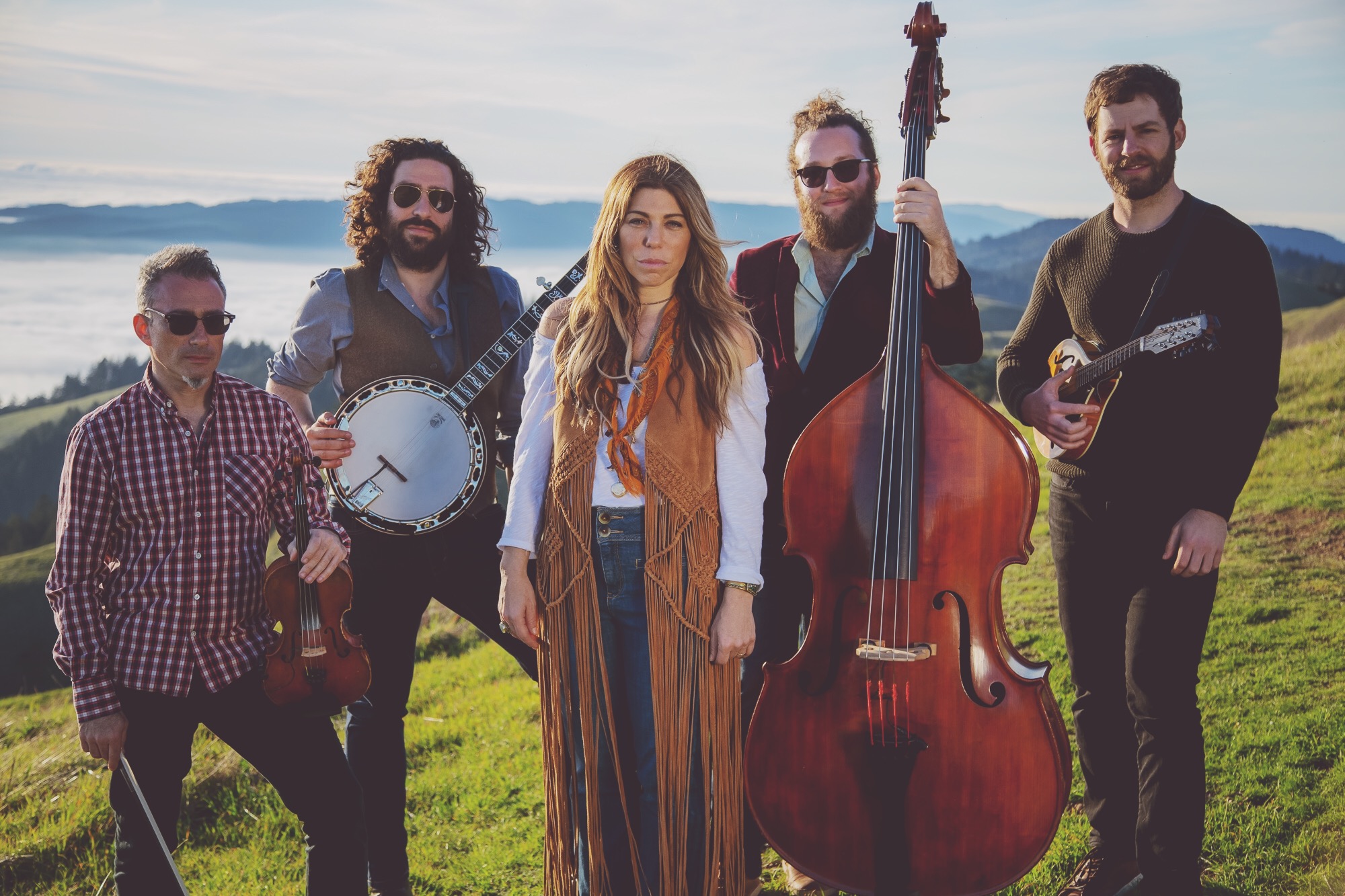
Years after her father’s death Nora Guthrie, Marjorie’s daughter and Arlo’s sister began to curate Woody’s notebooks and launched a project to give the unpublished songs in them new life by asking contemporary musicians to put them to original music in a wide variety of genre.  Music for Hanukkah’s Flame was written by Frank London and recorded Nefesh Mountain, a bluegrass and old-time band with a Jewish perspective at the Chapel at Beth Elohim in Park Slope Brooklyn with founders, and husband and wife, Eric Lindberg and Doni Zasloff, with Alan Grubner on violin and Tim Kiah on bass.

Thursday, December 10, 2020

Hanukkah Songs—Murfin ’s Carols for Corona and Winter Holiday Music Festival

                                            Yiddish Hanukkah songs from Israel.

Hanukkah begins tonight with the lighting of the first candle on the Menorah at sundown.  This is the celebration of the miracle of light that occurred when Judah Maccabee liberated the Temple in Jerusalem but only had enough purified oil to burn one night.  But the oil was enough to light the Menorah for 8 days until more could be ritually purified.  It is a joyful celebration of liberation and of enduring through dark and dangerous times.  It is primarily observed privately over eight days in Jewish homes rather than being a synagogue ritual.  It is especially treasured because it persisted through the darkest hours of the Holocaust and was even kept secretly in Nazi death camps.


This year this coincides with Human Rights Day, a United Nations celebration commemorating the adoption and proclamation, of the Universal Declaration of Human Rights (UDHR) on this date of that charter which was shepherded to adoption by former U.S. First Lady Eleanor Roosevelt.  The declaration was deeply influenced by the horror of the Holocaust.

For years American Jews swamp upstream against the torrent of Christmas music this time of year.  Only the children’s song about a traditional gambling game, Dreidel, Dreidel, Dreidel was commonly played.  That is what encouraged comedian Adam Sandler to write and perform The Chanukah Song on Saturday Night Live in 1994.  Since then a number of artists, including American singer/song writers and Israeli ensembles have added new music.  


Today we will begin with a selection taken from the album Hanukkah Songs—a comprehensive collection of Hanukkah songs including songs in Hebrew, English and Yiddish featuring traditional and folk performances by leading artists from Israel.

Wednesday, December 9, 2020

Happy Holiday—Murfin ’s Carols for Corona and Winter Holiday Music Festival

                                            Irving Berlin's Happy Holiday by Peggy Lee.
 

Hanukah, which begins at sunset tomorrow night, reminds us why many folks use Happy Holidays or Season’s Greetings as an alternative greeting this time of year when there are multiple holidays celebrated by different faiths.  And until not so very long ago folks were just fine with that.  Then came the ludicrous and entirely mythical War on Christmas which was cooked up by right wing propagandists as a hand grenade to be lobbed at Jews, secularists, and liberals to rally conservative Evangelicals and Catholics to a real culture war.  Now enraged guys in MAGA hats are out screaming at harried retail clerks, filling newspaper letters to the editor columns with vitriol, and of course trolling social media.  So much for the season of Peace on Earth, Goodwill to Men.

Happy Holiday was the opening number of the Irving Berlin movie musical Holiday Inn 

Irving Berlin penned the song Happy Holiday for the 1942 Paramount musical Holiday Inn staring starring Bing Crosby and Fred Astaire, with Marjorie Reynolds, and Virginia Dale.  It was a frothy confection thin on plot but featuring a dozen of Berlin’s holiday themed songs including the introduction of the secular classic White Christmas and Easter Parade.  The song Happy Holiday commonly regarded as a Christmas song, was performed as the movie’s opening number on New Year’s Eve, and expressed a wish to enjoy “happy holidays” throughout the entire year.  Recorded many times by various artists it was called the plural Happy Holidays as often as not.

It is unclear if Berlin, a very secular Jew married to a Catholic woman, had a broader sense of holiday inclusion when he wrote the song.  But many have embraced Happy Holidays as a cheerfully inclusive seasonal song.

But it wasn’t until the mid-1950s that the song became a staple of holiday albums.  Jo Stafford was the first to release it on a Christmas album in 1955.  In 1963 Andy Williams sang it in a medley with The Holiday Season Kay Thompson on his album and it has become an oft-played staple of specialty Christmas radio.

Peggy Lee's Happy Holiday album cover as re-mastered for stereo.

Two years later sultry jazz chanteuse Peggy Lee included it as Happy Holliday on her album of the same name.  It became her seasonal signature song and was repackaged on several other albums.  The version we are sharing today features a charming animation that is currently making the rounds.


Wishing you all Happy Holidays plural!

Tuesday, December 8, 2020

Jingle Bells—Murfin ’s Carols for Corona and Winter Holiday Music Festival

                                                     Diana Krall recording Jingle Bells.

Today we delve into the category of Christmas songs that really aren’tJingle Bells never mentions Christmas and was never meant to be associated with the holiday at all.  Yet it has become the most oft-recorded secular seasonal song because its catchy, bouncy melody is easily adaptable to almost any musical style.  Also because it is in the public domain and thus a cheap addition to any holiday album.

The song’s origins stretch back more than 150 years. James Lord Pierpont was the prodigal younger son of the Rev. John Pierpont, a close associate of William Ellery Channing and an influential figure in the founding of American Unitarianism who latter rose to prominence as an ardent abolitionist . Among James’s siblings were John Jr., another future Unitarian cleric and a sister, Juliet, who became the mother of arch capitalist J.P. Morgan.

                      James Lord Pierpont.

The artistically inclined young James was the preverbal preacher’s son—restless with restrictions at home, rebellious, and often in trouble. Born in 1822, he ran away to sea at the age of 14 aboard the clipper ship Shark. Another rebellious Unitarian lad of the same period was Richard Henry Dana, whose account of misery at sea in his book Two Years Before the Mast that shocked the sensibilities of mercantile New England.

Returning to New England he married and fathered three children while casting about in a series of failed business ventures. Lured to California by the Gold Rush of 1849 he thought to strike it rich not by mining himself, but by taking tin types of the newly rich prospectors. But like his other ventures, his San Francisco photography shop ended in failure.


The historic Savannah Unitarian Church, the largest in the South, where James Pierpont's brother was the minister and where he was employed as the organist.  The church posts it claim on Jingle Bells on the historical marker out front.


After his first wife died in 1853 he took his young family to join his brother, the Rev. John Pierpont, Jr., minister of the Unitarian Church in Savannah, Georgia, which was the largest Unitarian congregation in the South.  He took up residence and earned a modest living as organist in his brother’s church. Eventually he also set himself up in business selling house paint, varnish, wallpaper, window glass, and art supplies.  In 1857 he married the daughter of a prominent Savannah civic leader who would go on to serve as the city’s Civil War mayor.

Sometime during those years, restless as ever and lonesome for his lost New England childhood, he penned a song he called The One Horse Open Sleigh.  He may have drawn as inspiration a sleighing party that he had rapturously reported to his mother in an 1832 letter.

This popular Currier & Ives print embodied the fun and romance of New England winter sleighing, although this couple was pulled by a pair of horses and their tails have not been bobbed.

In snow bound New England the sleigh was both a necessary form of transportation and a winter diversion. There was a whole genre of sleighing songs. The best known today, Over the River and Through the Woods is associated with that quiescently New England holiday, Thanksgiving.  But it accounted a family expedition in a large, multi-passenger sled of the sort often pulled by a team. Pierpont's song was about a cutter, a fast two seat light sleigh often pulled by a thoroughbred trotter. It is a courtship song, with a young man out to impress Miss Fanny Bright with his speed and daring until he miscalculates the depth of a drift and the sleigh becomes “up sot.”

The song may have mystified his brother’s Southern parishioners, but James mailed copies home and it was sung in Medford, Massachusetts at Thanksgiving parties sometime in the mid 1850’s. This would lead to a later spurious claim that the song had been written there.

James copyrighted and published the song in 1857. Two years later it was issued in a new edition as Jingle Bells or the One Horse Open Sleigh. Within a decade it was a popular American parlor sing-a-long favorite, linked in the public’s mind with the colorful Currier & Ives prints of sleighing scenes that adorned many homes.  It was considered a winter song, but not a Christmas one.

Unfortunately, James never profited much from royalties from the song. 

Dark clouds were gathering that would change his life forever.  As  the  passions  stirred  by  the  1860 presidential election grew heated brother John,  an  abolitionist  like his  father,  was  forced to give up his pulpit and return to the North costing James his job  at  church.  James remained in Savannah, now an ardent supporter of the Southern cause.  After war broke out the combination of a war economy and the increasingly effective blockade of Southern ports destroyed James’s shaky business venture.

At the age of 40 he enlisted as a clerk in the First Georgia Battalion, which became a part of the 5th Georgia Cavalry. Although he was a gentleman with connections to a leading aristocratic family, James never rose above the rank of private. He remained in the Confederate Army for the duration of the war, although his rear echelon unit saw little action, mostly patrolling in defense of railroad lines and later scouting Yankee positions during the Atlanta campaign.  His greatest contribution to the Confederate war effort came as the composer of patriotic songs including We Conquer or Die, Our Battle Flag, and Strike for the South.   Meanwhile his father and brother served as chaplains in the Union Army.

After the war there were hard times in the South and James and his family shared in them. Eventually he found a niche as professor of music at Quitman Academy. He spent his last years in Florida at his son’s home in Winter Haven before dying in 1893.

Jingle Bells may not have been his only contribution to seasonal music. According to the 1994 book American Christmas by Jim Harrison, “For many years Martin Luther was credited with writing one of the best loved Christmas songs, Away in a Manger .. .but history now has evidence to dispute his authorship. An American, James Pierpont, is currently believed to be the author.” UUA historian Peter Hughes doubted the claim, however. Although the song is undoubtedly American dating from some time in the 1880’s, its origins are murky, probably Lutheran although the lyrics were first published as a poem in a Universalist periodical.

Sleigh bells are featured in many recordings of Jingle Bells.

Away in a Manger aside, James Pierpont’s claim on our seasonal culture is indisputable.  By the early 20th Century, as the automobile was replacing the horse, Jingle Bells was being melded into the general sentimentality of the Christmas season. In the days before the explosion of popular secular holiday songs like White Christmas, I’ll Be Home for Christmas, Have Yourself a Merry Little Christmas, and The Christmas Song, it provided a much needed non­ religious song suitable for performance in public schools and in mixed gatherings. The simple, lively tune was easy to sing and easy to adapt to a host of musical styles. It has become an indisputable Christmas classic.

Diana Krall is a contemporary jazz pianist and vocalist with pop appeal.

There are so many versions of Jingle Bells in so many styles that it is difficult to pick one.  This year let’s go with some sleek, modern jazz   courtesy of this 2005 Verve recording session featuring Diana Krall and a swinging studio band.