Showing posts with label deportation. Show all posts

Tuesday, May 5, 2026

Cinco de Mayo is America's Mexican Holiday


Note:  This is at least the 14th year I have run essentially the same post with a little tinkering on the margins. I keep running it because the same shit happens again every year and my Mexican and Chicano friends keep asking me to bring it back.

Today is, as every hearty partyer will tell you, is Cinco de Mayo.  In the U.S. it has become kind of second St. Patricks Day decked out in sombreros and serapes instead of emerald green, toasted with Coronas with lime and shots of tequila instead of Guinness and Jamisons, and laid out with two-for-one taco deals instead of corn beef and cabbage.  It is celebrated without apparent irony even by those who adore Trumpardor for rounding up, abusing, jailing, and deporting brown skin immigrants even if some of them turn out to be citizens. 

Chicago Cinco de Mayo Parade 2025 canceled due to fears over President  Donald Trump's immigration policies, organizers say - ABC7 Chicago 

Cinco de Mayo has become as much as an American celebration as Mexican holiday and has become the occasion for public displays of Mexican cultural pride.  This year the signature Chicago Cinco de Mayo Parade was canceled for the second year in a row amid wide-spread concern that the event and the movement of people around it could become targets of opportunity for none-to-careful immigration enforcement sweeps.  Other communities have done the same.  Stark fear stalks even long-time and well established Mexican-American communities.


 Part of the problem--commercialized party-til-you puke.

Still, in many places Mexican-American restaurant owners and importers of spirits and trinkets appreciate the business.  Grade schools kids make paper hats and sing Spanish songs for a one day lesson in Mexican culture.  And immigrant communities try to hold the fiestas and parades, glad for one day of the year when the rest of the country is paying attention to them in sort of a good way.  If you ask most of the revelers what they are celebrating, they will mumble something vague about Mexican Independence Day. 

Of course, they are wrong.  Independence Day is Diez y Seis de Septiembre (September 16th) celebrating the day in 1810 when Father Miguel Hidalgo read the Gritto de Hidalgo  beginning Mexico’s War of Independence from Spain.  


At its best in Mexican-American communities across the US popular Cinco de Mayo celebrations are a rare opportunity to share Mexican culture and traditions with parades and festivals.  Promotion by those communities have elevated the celebration in the US much higher than its modest and regional observations south of the border. 

In Mexico Cinco de Mayo is a minor patriotic holiday observed mostly in the State of Puebla It celebrates the victory Mexican patriots over a large, modern and well-equipped French army in the Battle of Puebla on May 5, 1862.  It was not even the final victory of the war against the French, who did not evacuate the country until 1866.  


 This mural in Mexico City by Antonio González Oroaco depicts Juarez as the “Symbol of the Republic” during the Battle of Puebla.

In 1861 the Mexican President Benito Juarez had been forced to default on Mexico’s heavy debt to European powers.  Britain, France and other powers all made threats to redeem their debts by force if necessary.  They were warned by the United States, which invoked the Monroe Doctrine, not to intervene in Mexico.  French Emperor Napoleon III recognized the U.S. would be too preoccupied with its own Civil War to take action and dispatched a large French Army to take control of the country.  


A panoramic painting of the Battle of Puebla, a moral boosting but not final victory of the Mexican Republic under Benito Juarez against the invading French. 

After initial success the occupying French Army with its Mexican allies, numbering 8,000 men was met by 4,000 Mexican troops loyal to Juarez under the command of General Ignacio Zaragoza Seguín and soundly defeated.  It was an enormous moral boost for the Mexicans but only delayed the French march on the capital of Mexico City

In 1864 a plebiscite conducted under French guns invited the Austrian Hapsburg Prince Ferdinand Maximilian to sit as Emperor of Mexico with his wife Carlota as Empress.  Maximilian did have support of some Mexican conservatives, large landowners, and the Catholic Church, but despite his liberal bent—he continued many of Juarez’s land reforms and even offered the former President the post of Prime Minister—Mexican patriots refused to recognize his rule or the French occupation that made it possible. 

Juarez and his supporters engaged in a grizzly war of attrition against French forces.  With his army slowly bleeding away and the costs of occupation far outstripping any profits to the empire, Napoleon III began to withdraw his support.  When the American Civil War ended and American intervention with a new, modern, and battle-hardened army became a distinct possibility, the French Emperor finally withdrew his troops.  


Emperor Maximilian badly miscalculated his popularity and paid for it with his life.

Maximilian, deluding himself that he was truly the popular Emperor of Mexico stayed behind with his loyal generals to fight it out with the Juaristas.  Carlota made a desperate trip to Europe in which she traveled from capitol to capitol begging for aid for her husband.  When she failed, she suffered an emotional and mental breakdown.  One by one Maximilian’s loyal armies were defeated.  He was captured by republican troops after trying to make a break-out from the besieged city of Santiago de Querétaro on May 15, 1867.  The would-be Emperor was tried by court martial and executed by firing squad on June 19.  


But if you ask any reveler at the bar tonight about any of this, all you will probably get is a blank stare and, if you’re lucky, a Margarita.


Monday, May 5, 2025

America’s Mexican Holiday Cinco de Mayo is Celebrating Under a Cloud


Note:  This is at least the 13th year I have run essentially the same post with a little tinkering on the margins. I keep running it because the same shit happens again every year and my Mexican and Chicano friends keeps asking me to bring it back.

Today is, as every hearty partyer will tell you, is Cinco de Mayo.  In the U.S. it has become kind of second St. Patricks Day decked out in sombreros and serapes instead of emerald green, toasted with Coronas with lime and shots of tequila instead of Guinness and Jamisons, and laid out with two-for-one taco deals instead of corn beef and cabbage.  It is celebrated without apparent irony even by those who adore Trumps ardor for rounding up, abusing, jailing, and deporting brown skin immigrants even if some of them turn out to be citizens. 

Chicago Cinco de Mayo Parade 2025 canceled due to fears over President  Donald Trump's immigration policies, organizers say - ABC7 Chicago 

Cinco de Mayo has become as much as an American celebration as Mexican holiday and has become the occasion for public displays of Mexican cultural pride.  This year the signature Chicago Cinco de Mayo Parade was canceled amid wide spread concern that the event and the movement of people around it could become targets of opportunity for none-to-careful immigration enforcement sweeps.  Other communities have done the same.  Stark fear stalks even long time and well established Mexican-American communities.


 Part of the problem--commercialized party-til-you puke.

Still, in many places Mexican-American restaurant owners and importers of spirits and trinkets appreciate the business.  Grade schools kids make paper hats and sing Spanish songs for a one day lesson in Mexican culture.  And immigrant communities try to hold the fiestas and parades, glad for one day of the year when the rest of the country is paying attention to them in sort of a good way.  If you ask most of the revelers what they are celebrating, they will mumble something vague about Mexican Independence Day. 

Of course, they are wrong.  Independence Day is Diez y Seis de Septiembre (September 16th) celebrating the day in 1810 when Father Miguel Hidalgo read the Gritto de Hidalgo  beginning Mexico’s War of Independence from Spain.  


At its best in Mexican-American communities across the US  popular Cinco de Mayo celebrations are a rare opportunity to share Mexican culture and traditions with parades and festivals.  Promotion by those communities have elevated the celebration in the US much higher than its modest and regional observations south of the border. 

In Mexico Cinco de Mayo is a minor patriotic holiday observed mostly in the State of Puebla It celebrates the victory Mexican patriots over a large, modern and well equipped French army in the Battle of Puebla on May 5, 1862.  It was not even the final victory of the war against the French, who did not evacuate the country until 1866.  


 This mural in Mexico City by Antonio González Oroaco depicts Juarez as the “Symbol of the Republic” during the Battle of Puebla.

In 1861 the Mexican President Benito Juarez had been forced to default on Mexico’s heavy debt to European powers.  Britain, France and other powers all made threats to redeem their debts by force if necessary.  They were warned by the United States, which invoked the Monroe Doctrine, not to intervene in Mexico.  French Emperor Napoleon III recognized the U.S. would be too preoccupied with its own Civil War to take action and dispatched a large French Army to take control of the country.  


A panoramic painting of the Battle of Puebla, a moral boosting but not final victory of the Mexican Republic under Benito Juarez against the invading French. 

After initial success the occupying French Army with its Mexican allies, numbering 8,000 men was met by 4,000 Mexican troops loyal to Juarez under the command of General Ignacio Zaragoza Seguín and soundly defeated.  It was an enormous moral boost for the Mexicans but only delayed the French march on the capital of Mexico City

In 1864 a plebiscite conducted under French guns invited the Austrian Hapsburg Prince Ferdinand Maximilian to sit as Emperor of Mexico with his wife Carlota as Empress.  Maximilian did have support of some Mexican conservatives, large landowners, and the Catholic Church, but despite his liberal bent—he continued many of Juarez’s land reforms and even offered the former President the post of Prime Minister—Mexican patriots refused to recognize his rule or the French occupation that made it possible. 

Juarez and his supporters engaged in a grizzly war of attrition against French forces.  With his army slowly bleeding away and the costs of occupation far outstripping any profits to the empire, Napoleon III began to withdraw his support.  When the American Civil War ended and American intervention with a new, modern, and battle hardened army became a distinct possibility, the French Emperor finally withdrew his troops.  


Emperor Maximilian badly miscalculated his popularity and paid for it with his life.

Maximilian, deluding himself that he was truly the popular Emperor of Mexico stayed behind with his loyal generals to fight it out with the Juaristas.  Carlota made a desperate trip to Europe in which she traveled from capitol to capitol begging for aid for her husband.  When she failed, she suffered an emotional and mental breakdown.  One by one Maximilian’s loyal armies were defeated.  He was captured by republican troops after trying to make a break-out from the besieged city of Santiago de Querétaro on May 15, 1867.  The would-be Emperor was tried by court martial and executed by firing squad on June 19.  


But if you ask any reveler at the bar tonight about any of this, all you will probably get is a blank stare and, if you’re lucky, a Margarita.


Thursday, December 1, 2016

The Germans are not Amused —Two Beatles and a Flaming Condom

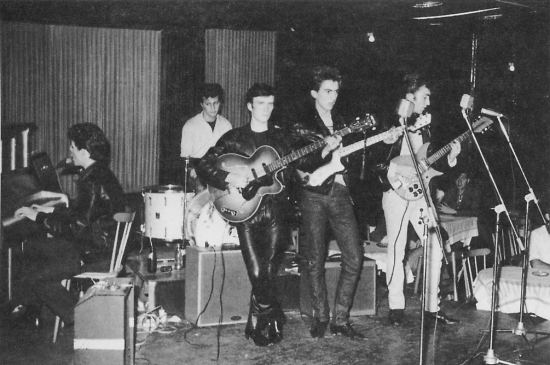
The Beatles in Hamburg as a quintet--Paul McCartny on piano, Pete Best at the drum kit, Stuart Sutcliffe on bass, lead guitarist Geroge Harrison, and John Lennon.


Even the causal Beatles fan knows that the lads from Liverpool had some of their first success playing in Hamburg, Germany red light district.  From 1960 to ’62 the band made five trips to the port city under contract to club owner and producer Bruno Koschmider.  It was a sometimes stormy relationship with ups and downs but during the time the band spent playing in the German dives they tightened up and matured as musicians.  After the first stay they began to get a following at the Cavern and other Liverpool clubs where the Mersey Beat sound was being born.
Their first stay in Hamburg ended disastrously when on December 1, 1960 Paul McCartney and drummer Pete Best were arrested and deported back to England within hours. Just what happened is the stuff of underground legend.
The Beatles—they had finally settled on that name after running through The Beetles and the Silver Beetles—was quintet when they first arrived in Germany.  Longtime pals McCartney and John Lennon, who had played together since high school in pick-up and skiffle bands shared lead singing and played around at song writing.  The younger George Harrison, not yet 18, was the lead guitarist.  Lennon’s best pal from art school, Stuart Sutcliffe, sold his first painting and on a lark had bought a bass guitar and was learning to play it on the fly.  The group had been getting by with pick-up drummers for gigs in England but needed a steady stick man for their new engagement.  Lennon and McCartney had settled on Pete Best who had been knocking around in small time rock bands.

The Indra Club in Hamburg where the Liverpool lads first played in the port city's Red Light District.
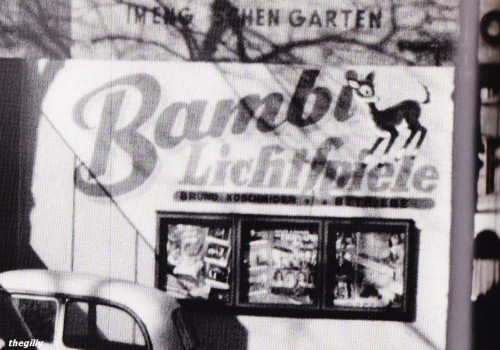
They arrived in Hamburg in August where Koschmider had converted a couple of former striptease joints/whore houses into music clubs.  He put his new act into the Indra Club as the house band.  The frugal Koschmider was not going to waste good money on comfortable accommodations for the band and the boys did not make enough money to rent rooms on their own.  He converted space behind the screen of his movie theater, the Bambi-Filmkunsttheater.  The accommodations for the five were Spartan at best.  The room was poorly lit, damp, crowded, they had to use the theater’s public restroom which was inconveniently located in the front of the theater.  But they were young and on an adventure and took it in stride.

Producer Bruno Koschmider put the band up in a make-shift room behind the screen of  his Bambi-Filmkunstertheater, a porn house.

After a few weeks Koschminder had to close the Indra Club due to noise complaints from neighbors.  He moved the Beatles to his other club, the Kaiserkeller in October.  The band was quickly picking up a local following and the club was doing a robust business.  Band members, however, were not seeing much money from the gate.  For extra money they began playing at the rival Top Ten Club on their nights off.  When Koshminder heard of it, he was furious.  He informed the boys on November 1 that he was terminating their contract, originally scheduled to run six months, in 30 days.  
But he was not finished taking his revenge.  He went to the authorities and informed them that Harrison had lied about his age to get a work permit.  Harrison was quickly deported leaving the band scrambling without a lead guitarist.  Lennon and McCartney, neither as gifted as Harrison, divided the duties.  During their remaining month the handsome Sutcliffe moved out of the cinema and into his photographer girl friend Astrid Kirchherr’s pad. 
The band planned to stay in Hamburg and shift their primary venue to the Top Ten Club.  They had begun to move some of their equipment to an attic room over the Club and Lennon had already moved in there.
On their final day, November 30, McCartney and Best were gathering their belongings at the theater.  They had been drinking and popping pills.  Irked by the dim light in the room they decided to illuminate things by burning something.  Here accounts conflict.  Some say they used rags or towels, but according the version of the story that has entered folklore—and which Pete Best later told a radio interviewer—they decided that a pack of new latex condoms was just the ticket.  They lit them one by one and were amused by how they “burned and popped.”  In the excitement of the moment McCartney either threw one burning rubber against the wall or he pinned it there and lit it.  At any rate, it left a small scorch mark.  Thinking nothing further of it, the two collected their belongings and moved to the new room over the Top Ten.
That’s where the German police found them the next day.  Koschminder had found the scorch mark and was furious.  He went to the police and charged that Best and McCartney had tried to burn his theater down.  Most likely he simply wanted to find a way to keep the act he had helped make popular from headlining a rival club.  But the police took the charge seriously without much investigation of the facts.
They held the two Beatles most of the day.  Neither McCartney nor Best spoke German and did not understand why they were being held.   A request to speak to the British Consul was denied.  Late in the afternoon they were taken back to the Top Ten room and given five minutes to collect their belongings.  Best had to abandon his drum kit, but McCartney was able to salvage his guitar and a suitcase sized amp.  That evening they were placed on a plane and deported to London.
They arrived in the city broke and dazed.  They rang up friends and borrowed money for train fare back home to Liverpool.  Lennon, now without a band, returned on his own a few days later.  Sutcliffe stayed with his girlfriend through February.

Backing up fellow English rocker Tony Sheridan as the Beat Boys, the Beatles recorded a moderate German hit version of My Bonnie.


Amazingly, the band and the German impresario patched things up and they returned for another engagement at the Kaiserkeller in 1961.  During that stay Koschminder got them into the studio to play back-up and sing harmonies on a rock version of the old Scottish song My Bonnie Lies Over the Ocean behind another British rocker, Tony Sheridan.  My Bonnie was released as a German single credited to Tony Sheridan and the Beat Brothers and became a modest hit—#35 on the local charts.
After this stay, Sutcliffe decided to return to art school in Germany and became engaged to Astrid, officially leaving the group without a bass player.  McCartney, who had never touched a bass, volunteered to replace him and in a matter of weeks back home in Liverpool learned the instrument, playing it upside down and backwards because he was left handed.
The band was getting hot back home at the Cavern club and had attracted a new manager, Brian Epstein and a record producer, George Martin.  But they were contractually obligated to Koschinder for more appearances in Hamburg and another German recording session.  Epstein negotiated a deal requiring a quick trip so that they could begin work at the Abby Road Studios for English releases on EMI and two more short appearances.
They arrived in Hamburg on April 11, 1962 only to be greeted with the devastating news that Sutcliffe had died of a brain aneurism the day before at the age of 21.   

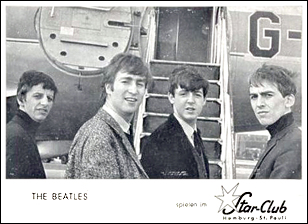
Now with Ringo Starr on drums and Sutcliffe tragically dead, the Beatles made one last Hamburg appearance at the Star Club in 1962.

The band returned twice more for brief appearances in Hamburg that year.  In between they began working with Martin and recording their early work with him.  At Martin’s urging they sacked Best, a drummer of limited ability and replaced him with journeyman drummer Ringo Starr, most lately of Rory Storm and the Hurricanes, who became the oldest member of the group.  They released their first English single, Love Me Do in October, and it went to #17 on the charts. 
Ringo accompanied the Band to Hamburg in December for their last engagement there.  Bigger things were on the horizon.