
On
February 1, 1893 Thomas Edison completed
construction of what was the world’s first film
production studio building to accommodate making product for his new
money-making project—ultimately the public
exhibition of films employing his recently patented Kinetoscope. The building, literally
a tar paper shack on the grounds of
Edison’s laboratories at West Orange, New Jersey, was nearly as innovative as the camera and exhibition
equipment it was meant to accommodate.
May be more so since Edison had no more than broadly conceived the
devices and left development to his employee William Kennedy Laurie Dickson and had returned from the Exposition
Universelle in Paris in 1889 and
incorporated advanced features of systems developed in France by Étienne-Jules Marey and Charles-Émile Reynaud. In his patent applications and the
intense publicity campaigns that followed, Edison, true to form, took sole
credit.
The
building—more of a shed, actually—was slapped together on a wood frame, its
exterior walls and ceiling covered in black tar paper. A slanting roof over the filming chamber was
hinged and could be raised to admit sunlight, necessary because none of Edison’s
electric lights were bright enough
to accommodate indoor filming. The whole
thing was built on a turn table so
that the open roof could catch the light of the sun all day as it moved across
the sky.
Construction
had begun in mid-December of 1892 and did not take long taking into account interruptions
for normal New Jersey winter. Edison’s
meticulous records show that it cost a grand total of $637.67 to build. That’s about $15,275 in current dollars or
roughly the cost of a home garage.
It
was an uncomfortable place to work. Cold
and drafty—virtually unheatable when the roof was raised—in the winter and a
stuffy, sweltering hot box in the
steamy summers. Officially Edison named
the building the Kinetographic Theater although
no films were ever exhibited there.
Informally he called it the Doghouse. The underpaid employees who worked in it
uncomfortably in had an even less flattering name—the Black Maria, after a common nickname
for a police patrol or Paddy wagon.
Production
began almost immediately on short—a few seconds to just over a minute long—films
intended not yet for commercial exhibition but for publicity purposes to when the
public’s appetite. Edison had no thought
of trying to tell stories. For him the thrill would be in simply the novelty of
seeing photographic images move.
Edison
had already demonstrated short films he had shot outdoors. In May he demonstrated film produced in the
Black Maria for the first time at the Brooklyn
Institute of Arts and Sciences. The
public could view—one at a time—a clip of three men pretending to be blacksmiths—by peering into the eye
piece of a Kinetoscope machine.
 | |
| A Harpers Weekly illustration of filming in the Black Maria. |
Dickson
was placed in charge of production at the studio. In August of 1893 he sent the first film to
the Library of Congress for copyright protection—a few second of
Edison employee Fred Ott sneezing. This was also a promotional film and stills
from it were published in Harper's Weekly accompanied by a
suitably breathless article on Edison’s latest triumph.
When
the Holland Brothers agreed to
exhibit Edison’s product at their Kinetoscope Parlor at 1155 Broadway
in New York City, production ramped
up of clips for commercial exhibition.
Among the earliest efforts which we loaded into two rows of five Kinetoscopes
included titles such as Barber Shop, Blacksmiths, Cock
Fight, Wrestling, and Trapeze.
500 patrons plucked down 25 cents to view the marvels on opening
day, April 14, 1894.
The
idea caught on and more Kinetoscope Parlors were opened in cities across the
country.
 | |
| A San Fransisco Kinetoscope Parlor. |
Over
the next few years Edison would churn out hundreds of short films, both actualities filmed on the street of
daily life and clips made in the Black Maria.
Edison invited a parade of dancers,
jugglers, circus performers, boxers
and wrestlers, vaudeville and Broadway stars
to make the trek out to New Jersey. Many
were flattered and others took advantage of the publicity associated with
having their name attached to the latest fad.
Several performers from Buffalo
Bill’s Wild West Show including Annie
Oakley herself and Sioux Ghost
Dancers were filmed.
Other
famous films included the Butterfly Dance by Annabelle Whitford which was enhanced
by hand tinting and The
Kiss featuring plump Broadway stars Mary Irwin and John Rice.
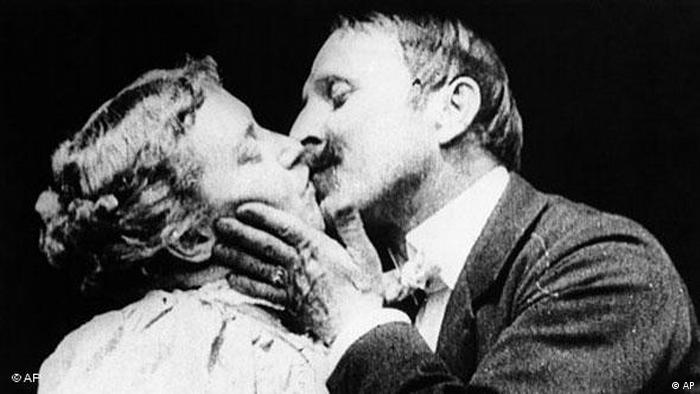 |
| The Kiss, Edison sell sex in 1896. |
In
1901 Edison allowed, somewhat reluctantly, the exhibition of his films by
projection on a screen in Oberlin, Ohio. As usual, the French had beaten him to it and
he was worried that they would enter the American market so he developed his
own projection system. The innovation made
Kinetoscope Parlor obsolete almost overnight.
To accommodate demand for production suited for the screen, Edison made
his first film with a plot, The Great Train Robbery in 1903 in
the process inventing the western movie and
creating the first movie star, Bronco
Billy Anderson.
The
Black Maria was rendered obsolete for production for the screen. Edison built a new glass roofed studio in New York and abandoned the old shed in 1901,
shortly after the first screenings. The
building was unsentimentally razed in 1903 and its lumber recycled for other
use at the laboratory complex.
It
was recreated in 1938 for the movie Edison, the Man starring Spencer Tracy and re-erected on the
Laboratory ground near the original site.
The National Park Service,
which maintains what is now the Thomas
Edison National Historical Park, has since built and maintains a
replacement reproduction.


