Showing posts with label hydrogen. Show all posts

Wednesday, October 15, 2025

The Frenchman Who Went Up Up and Away in His Beautiful Balloon


                                            Montgolfier Brothers hot air balloon with specifications after the demonstration flight for Louis XVI. 

On October 15, 1783 Jacques-Étienne Montgolfier became the first human being to leave the surface of the Earth and rise in the air in a man-made contraption.  And what a contraption!  The enormous hot air balloon that Étienne and his brother Joseph-Michel Montgolfier constructed was seventy-five feet tall and about fifty feet in diameter with a 60,000 cubic foot capacity.  It was elaborately decorated in gold and deep blue with Fleur-de-lis, signs of the Zodiac, and Suns emblazoned with the face of Louis XVI interlaced with the royal monogram.  The balloon rose in the morning sky over Paris on a tether from the workshop where it had been created.  A second flight the same day carried to an even greater height—80 feet with passenger Pilâtre de Rozier, a chemist and teacher who had become interested in the experiments. 


Despite this rendition it is highly unlikely that the Brazilian priest Bartolomen Lourenco de Gusmão's fanciful hot air balloon ever flew with a passenger.  He did make sketches and constructed models. 

This is generally cited as the beginning of manned aviation.  But there is one conflicting claim, passionately supported in Portuguese speaking lands.  Bartolomeu Lourenço de Gusmão a Brazilian born priest, sketched elaborate drawings for an airship lifted by hot air, certainly built models, and may have even left the ground in a prototype back in 1720.  His fantastic creation was in the shape of a bird and even included a propulsion systemsails which could be filled with bellows in the event of no wind.  An account written in 1786, three years after the Motgolfier flight claimed:

…in 1720, a Brazilian Jesuit, named Bartholomew Gusmão, possessed of abilities, imagination, and address, by permission of [King] John V. fabricated a balloon in a place contiguous to the Royal Palace, and one day, in presence of their Majesties, and an immense crowd of spectators, raised himself, by means of a fire lighted in the machine, as high as the cornice of the building; but through the negligence and want of experience of those who held the cords, the machine took an oblique direction, and, touching the cornice, burst and fell.…The balloon was in the form of a bird with a tail and wings. The inventor proposed to make new experiments, but, chagrined at the raillery of the common people, who called him wizard, and terrified by the Inquisition, he took the advice of his friends, burned his manuscripts, disguised himself, and fled to Spain, where he soon after died in a hospital.

Although some of Gusmão’s drawing and papers have been found along with accounts of displays with toys and models, most historians discount a flight in a full scale craft.  This pisses the Portuguese off, who feel they have been snubbed.  But then they don’t have the evidence of thousands of Parisian eyewitnesses and numerous artist renderings from further flights. 

The brothers Montgolfier were younger members of the 19 children of paper maker Pierre Montgolfier of Annonay, Ardèche.  Joseph, the 12th child was born in 1740 and Étienne, the 15h, came five years later.  Joseph was brilliant but rebellious and was sent away by the family to study architecture in Paris.

When the eldest brother and heir to their father unexpectedly died, Joseph was recalled from Paris, promoted over older siblings, and put in charge of the family business.  He made many innovations, including introducing the most modern techniques.  His efforts gained the Royal notice and the company was commissioned to construct a new mill and factory as a model for the whole French paper industry—then one of the most important in the country.
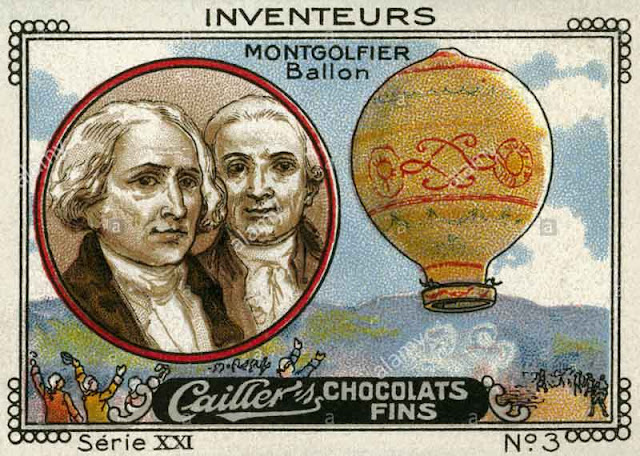
 

The Montogolfier Brothers and their balloon on a 19th Century French Trading card, Joseph was the inventor, Jquis-Ettiene was the test pilot. 

In 1777 Joseph idly observed laundry drying over a fire.  Sheets billowed and rose.  Something was lifting them.  He concluded that it was an as yet undiscovered gas released by combustion which he modestly named Montgolfier Gas, with a property he called levity.

It was while contemplating a military problem—the long siege of the impregnable British fortress of Gibraltar by French and Spanish forces—that he began to tinker with devises based on his discovery.  After months of bombardment and attacks by sea and land, the Rock stood and along with it controlled the gateway between the Mediterranean Sea and Atlantic Ocean.  What if troops could be carried over the fortress and landed with in it, he wondered.  Could his gas provide the lift for such an undertaking?

He began building models at Avignon in November of 1782.  His first construction was a box-like chamber 3’ x 3’ x 4 out of a thin wood frame covered on the sides and top with lightweight taffeta cloth.  He ignited some crumpled paper under the box which quickly rose up in the air until it banged on the ceiling.  Joseph excitedly summoned his younger brother from home to join him on his project, urging him to bring “a supply of taffeta and cordage.”

The brothers built a new model three times as large which they tested outdoors in December.  It floated for nearly 1.2 miles before landing and being destroyed by a frightened peasant.  


                                 The demonstration at Annonay in June 1783.

The brothers refined their invention for a formal first public display.  Their new model was globular and constructed of sackcloth lined with three layers of thin paper.  It had a capacity for 28,000 cubic feet of air and weighed about 500 pounds.  An invited audience, including dignitaries from the États particuliers assembled at Annonay on June 4, 1783 to witness flight of 1.2 mile reaching an altitude of 6,000 feet lasting 10 minutes.  Officials present naturally wrote enthusiastic reports to the government in Paris.

The government equally naturally called them to Paris for further demonstrations.  Joseph, shy and clumsy in society, sent Étienne to the capital to collaborate with wallpaper manufacturer Jean-Baptiste Réveillon, for a full scale model of the device were calling a globe aérostatique and he named Aérostat Réveillon.  The first test of the glorious new device flew from the grounds of la Folie Titon near Réveillon’s home.


The first test flight with test animals has become a favorite children's book story. 

Because of concern that the upper air might be dangerous to humans, the King graciously offered two the loan of two condemned felons as passengers for the next public demonstration.  Étienne demurred and elected to send aloft a duck as sort of a control animal known to withstand heights, a rooster thought not to be capable of flying at the expected altitude, and a sheep about the same weight as a man.  The animals were suspended below the balloon in a basket.

A crowd of thousands gathered to watch the flight, including the King himself and Marie Antoinette on the ground of Versailles.  The flight lasted approximately eight minutes, covered two miles, and obtained an altitude of about 1,500 feet before landing safely.  


Pilâtre de Rozier and the Marquis d'Arlandes on the free and untethered flight over Paris. 

After the manned ascent test in October, it was time for the great unveiling of for an untethered manned flight.  On November 21 Pilâtre de Rozier was again in the basket, accompanied by the Marquis dArlandes, an army officer.  They took off from the Château de la Muette near to the Bois de Boulogne and were carried for miles above Paris at altitudes of up to 3,000 feet for 25 minutes.  The craft landed outside the city wall between two picturesque windmills with enough fuel left to travel four times as far.  But embers from the fire set fire to the edge of the envelope which Pilâtre had to beat out with his coat.  Despite the harrowing landing, the voyage was a success, the talk of Paris for days, and commemorated in numerous etchings and on commemorative plates.


A cheap  commemorative plate for he common folk got the year wrong. Much more elaborate plates were produced for the elite. 

The King raised the Montgolfier to the nobility.  Several subsequent flights were also made.  But just as it looked like a rosy future for all concerned, fate intervened in two ways.

First, Jacques Charles and brothers Anne-Jean and Nicolas-Louis Robert, were simultaneously experimenting with balloons using hydrogen for lift.  They flew an unmanned demonstration in August 1783 and on December 1 over a thousand people paid to watch Charles and Nicolas-Louis Robert take off in La Charlière, the first manned hydrogen balloon.  That flight lasted over two hours and covered over 22 miles.


Jacques Charles and brothers Anne-Jean and Nicolas-Louis Robert's successful demonstration of a hydrogen balloon caused the King to back development of the gas balloon for military purposes and made the Montgolfier's hot air craft a mere novelty. 

The French government concluded that hydrogen balloons were the future of viable flight, and most subsequent energy went into that.  Hot air ballooning remained a novelty, as it is to this day.

The Montgolfier returned to their paper business, which thrived and continues to this day.  Étienne died in Switzerland in 1799 and Joseph at Balaruc-les-Bains in 1810.  Neither left children and the family business came into the hands of other relatives.

Watching the flight of the magnificent balloon festooned with his own image was one of the last great triumphs of Louis XVI and Marie Antoinette.  Fate—in the form of the Paris Mob—would not be kind to them.


The death of Pilâtre de Rozier and a companion in the crash of a hydrogen and hot air hybrid balloon in an attempt to cross the English Channel.  The volatile gas and the fire necessary to inflate the hot air were a disastrous combination. 

Pilâtre de Rozier became a dedicated balloon enthusiast and constructed his own.  He piloted several flights.  But on June 19, 1785 he and a companion, Pierre Romain were killed trying to cross the English Channel in a hybrid hot air-hydrogen balloon—not a good idea considering the volatility of hydrogen around a flame.  They were the first known casualties in aviation.

De Rozier’s companion on the first untethered flight, the Marquis d’Arlandes, like the King and Queen, suffered the catastrophic separation of his head from his body during the Revolution.


Friday, July 21, 2023

Raining Death on Chicago—The Plunge of the Wingfoot Express

Wingfoot Express takes off from Grant Park on July 21, 1919.

There were many horrific Chicago disasters in the early 20th Century like the Iroquois Theater Fire of 1903 and the Eastland capsize in the Chicago River in 1915 which are not only well documented but they have become iconic in the city’s history.  But an air disaster back in the summer of 1919 is far less remembered.

Of course, fewer people died when the flaming Wingfoot Express crashed through the skylight of the Illinois Trust & Savings Bank at in the Loop at LaSalle Street and Jackson Boulevard on July 21.  Seventeen were killed and 27 injured compared to more than 800 drowned on the Eastland.  But you would think for shear drama, nothing could beat an air ship disaster on the cusp of rush hour on a summer afternoon in the downtown of one of the busiest cities in America.

Despite the great advances in airplane technology during The Great War, fixed wing powered aircraft were still too limited in lifting capacity and operational range to be considered viable for commercial use.  As it had done since the days of Jules Verne, the world still looked at lighter-than-air craft as the future of commercial aviation.  The Germans under the skillful hand of Count Ferdinand von Zeppelin led the world in the development of dirigibles, which had famously bombed London in the War.  The British, French, and Italians were all scrambling to catch up, mostly using German Zeppelins surrendered as war reparations as models.

The United States was lagging far behind.  The Navy, which had operated blimps for anti-submarine patrol, had the most experience and was preparing to go into the dirigible business using one of those German aircraft.  In 1917 the Navy had contracted with Goodyear Tire and Rubber to design and construct its Blimp fleet mostly because the company had developed a rubberized fabric ideal for the construction of the aircraft’s gas bag.

Now in the post war era, Goodyear was eager to find a commercial use for its technology.  And Chicago business tycoons were just as eager to secure the city’s place as the nations transportation hub by making it the center for air ship packet and mail service.  By early 1919 local investors had agreed to bankroll a demonstration aircraft with the hope that it would lead to regular inter-city service.

Goodyear was ambitious.  It recognized the fragility of its blimps, essentially just streamlined balloons with engines and a passenger compartment slung underneath, meaning that any rupture to the skin of the bag would lead to the crash of the aircraft.  It decided to jump to the construction of a small dirigible. 

A dirigible has a rigid frame holding tanks of buoyant gas inside the envelope.  Theoretically this would be safer as a puncture might only affect one tank allowing the aircraft to stay aloft or descend safely, and dirigibles could be built much larger and therefore have greater lift capacity.

But there were some major problems.  First was that Goodyear engineers had no experience with dirigibles.  Second was that the contract called for construction and delivery to Chicago in just a few months.  Finally, despite the availability of non-flammable helium in the U.S. they decided to go with cheaper and more widely available hydrogen as the lift gas.  Unfortunately hydrogen is explosively flammable.

Goodyear also decided to experiment with new, more powerful rotary engines with which it was unfamiliar.  In the rush to complete construction the two engines were slung below the airframe without being tested—or balanced.  As events would show they were slung too close to the envelope.

Still, everyone was excited when the Wingfoot Express, named for Goodyear’s Mercury foot logo, was built in a hanger at the White City Amusement Park on the grounds of the old Columbian Exposition on the city’s South Side. Heavily promoted in the press, especially in the Chicago Tribune, crowds flocked to the park to get a glimpse at the ship.  The plan was to demonstrate its airworthiness by using it on short excursions between White City the downtown Grant Park.

The troublesome twin rotary engines and the open gondola slung beneath the envelope.  Captain Jack Boettner at the controls.

The Wingfoot Express successfully made two test flights on the morning of Monday, July 21 on a route that took the aircraft safely over Lake Michigan.  The lead engineer observed the twin engines throwing off sparks and hot oil that splattered on the envelope.  Moreover the unbalanced engines made the ship hard to control.

Despite these observations, plans went ahead for a third trip later that afternoon. 

The ship was smaller than those Goodyear envisioned for packet service—the envelope 180 feet long and 30 feet in diameter.  On board was a full 200 gallon tank of gasoline, enough fuel for days of excursion flights.

It was a hot but near picture perfect late afternoon on when the Wingfoot Express took off from Grant Park for her third trip.  This time it was a virtual press junket.  On board were pilot Jack Boettner, mechanics Henry Wacker and Carl Buck Weaver, White City press agent and well known former sportswriter Earl Davenport, and Tribune photographer William G. Norton.

After they were airborne, Norton asked Captain Boettner to deviate from his flight plan and fly over the Loop so he could take pictures.  Despite the fact that he was operating an experimental aircraft with less than two hours flight time and that he was just as new as the airship having never before that day operated a ship with the rotary engines, Boettner likely at the urging of Davenport, agreed.  It was a fatal mistake.

When the Wingfoot Express appeared over the Loop shortly before 5 pm flying at a relatively low 1300 feet, it naturally attracted a lot of attention.  People had never seen anything like it.  Pedestrians on the ground craned their necks.  Denizens of downtown buildings leaned far out of their open office windows to catch a glimpse.  Others climbed out on fire escapes or made their way to roof tops.  So there were an astonishing number of eye witnesses to all or part of what happened next.

In the most frequently quoted eyewitness account, Irwin A. Phillips later testified that

I saw a little black spot above the equator line on the bag, and then a yellow flame broke out. Then the flame spread up and down and on both sides. I saw the men jump and I saw the bag fall. When it passed from my view the rear end of the bag was (still) inflated.”

This testimony brings up an interesting point.  Various sources writing about the disaster refer to the ship as a blimp—a powered balloon—or as a dirigible.  The non-technical public used the terms interchangeably, although blimp was more familiar to American ears.  Phillips’ testimony which refers to a “gas bag” clearly indicates he thought it was a blimp even as he noted it did not lose its shape as it sank.

The confusion persists.  One writer tries to split the difference and calls the ship a “non-rigid blimp” containing individual gas cells like a dirigible.  But a blimp could not have maintained its shape without the internal pressure of the lifting gas.  The Wingfoot Express had to have had a rigid frame to support the envelope.  Which is why Phillips noted that it had maintained its shape.

When the passengers and crew first noticed the fire, there was obvious panic on board.  There was a scramble for the parachutes, which would not have been worn but stowed for quick retrieval.  One by one the men scrambled to put one on and jump. 

Captain Boettner was the first man out, for which he was heavily criticized by those who held with the romantic notion that the captain should go down with the ship.  Maybe not a hero, but smart.  He cleared the wreckage and landed safely.  The chief mechanic also got out with minor injuries.  The other mechanic’s parachute snagged on the ship and he was dragged down to his death under the wreckage.  Photographer Norton jumped clinging to his heavy camera equipment and exposed glass plates—a bad mistake.  He landed hard breaking both legs and incurring massive internal injuries.  His photographic equipment was destroyed.  He died days later asking if his precious photographs had survived.  Weaver, the press agent, never got out of the gondola.

The ship was fully engulfed in flames in seconds. As the envelope disintegrated, the gondola, engines and gas tank became detached and fell—right into the glass skylight of the Illinois Trust & Savings Bank.  

The Illinois Trust & Savings Bank before the disaster.

It was 4:56 pm.  Banking operations for customers had ended at the then customary 3 pm and employees were finishing up the days business were just getting ready to leave.  Caught directly under the skylight were the mostly women clerks on the top floor.  Many died instantly, crushed by the heavy equipment and in the raining fire.  The heavy engines and the gas tank plummeted to the ground floor where the gas tanks burst, spreading the fire.  The heat was so intense that the glass and frame of the skylight melted adding their molten destructive heat to the inferno.

On the first floor many found some protection under the heavy marble teller counters, but others were trapped there.  Those who could scrambled for exits or even jumped out windows.  Survivors recounted scenes of unspeakable horror.

The Fire Department responded quickly but there was little that they could do but let the fuel burn itself out and attempt sometimes heroic rescues.  But the core of the smoking rubble was too intensely hot to enter for hours.  The final toll on the ground either killed immediately or dying of wounds was 10 bank employees, mostly women but including ten year old and 14 year old boy messengers.  27 others were injured badly enough to require hospitalization, scores more burned, bruised, or battered.  The total death toll including one crewman and the two passengers on the ship was 13, an unlucky number.

The charred bank lobby after the crash and fire.

The public was both aghast and fascinated by the accident, snapping up each new updated extra edition of the newspapers as they hit the streets.  It was a newsboys once in a lifetime opportunity.  Meanwhile various players swung into action.

With the fire still smoldering bank officials tapped the huge reservoir of “the reserve army of the unemployedhiring hungry men off the streets to enter the building to salvage anything they could.  They were working side by side Firemen and police digging for the bodies of victims through the night.

By morning the Bank had secured near-by space and using equipment salvaged from their building and borrowed from other banks, opened for business on time on Tuesday morning.  Employees not dead or still hospitalized were required to report for work, despite being traumatized and many were still bandaged.

Missing was flamboyant Republican Mayor William Hale Big Bill Thompson and a gaggle of Chicago movers and shakers who were off playing cowboy at a Western dude ranch and declined to break up the fun to come home to deal with the disaster.  The City Council, however, swung into action at a meeting the next day.  It considered an ordinance banning flights over the congested central city, but after the immediate howls of businessmen still hoping to cash in on future air commerce elected instead to study regulating such flights.  Any regulations developed promptly went into a drawer and were forgotten.

The Chicago Daily News, competitor of the Tribune which lost a photographer in the crash, ran a screaming banner head in it's last edition the day after the disaster.  But it seemed to focus on the bank funds endangered rather than lives lost.

The States Attorney launched an immediate investigation which included the arrest of all of the survivors of the crash, including those in their hospital beds and the dying reporter.  After interrogations, Captain Boettner was put in jail and indicted.  Joining him was Goodyears project manager for the construction and operation of the Wingfoot Express, W.C. Young. 

To its credit, Goodyear stepped up and accepted responsibility, promising to pay the medical expenses of all of the injured, as well as the funerals of the dead.  The company, in what modern public relations experts would call “getting ahead of the story,” publicly instructed its employees to fully cooperate with authorities and provided without protest all documentation on the design, construction, and brief flight life of the dirigible.  It made no attempt to cover-up the hurried construction, the use of untried and untested engines, lack of engineering standards and adequate testing. 

At the trial Boettner admitted that prior to the day of the crash he had no experience with the aircraft and had trouble controlling the unbalanced engines.  Young testified that he was unfamiliar with the engines he selected, the need to balance their speed and torque, and had not tested operations for a safe distance from the envelope.

The dead from the memorial service program for the victims.  Tribune photographer William G. Norton died of his injuries later.

Other testimony at the trial included hearsay reports from one of the injured crew that one of the passengers may have been at the controls when the ship caught fire.  Boettner leapt to his feet calling that charge a “damnable lie.  But the injured man was never called to testify if the reports of his hospital bed conversations were accurate.

Several expert witnesses offered contradictory testimony about possible causes for the fire that led to the disaster which made it difficult for the prosecutors to prove criminal negligence.  One of the most absurd speculations came from Army Colonel Joseph C. Morrow, the head of training and operations from the Armys new lighter-than-air craft program headquartered at Goodyear’s Ohio facility at Wingfoot Lake.  That sounds more credible than it was, because the Army was far behind the Navy and had no operational experience beyond a few Signal Corpsmen who had gone up in observation balloons.  In fact, Morrow was being trained for his job by Goodyear.

He was the sole passenger on the second flight of the day and testified on what he had observed of the ships performance.  He seemed unaware of the problems of sparks and hot oil being thrown off the engines as reported by the chief mechanic from his hospital bed.  Col. Marrow speculated that the fire may have started from sparks generated by the silk gas bladders inside the envelope rubbing against each other, a virtual impossibility which ignored eyewitness testimony that the fire seemed to originate on the envelope, not inside of it.

In the end no firm cause was determined, although modern researchers give heavy credence to theories involving overheated engines.

The prosecution was unable to prove criminal charges against the two defendants, both of whom returned to work for Goodyear.

One of the more tangible long-term results of the crash was the closing of the air terminal in Grant Park and the eventual authorization of the Chicago Air Park on the South Side, a comfortable distance from the center city which opened with a single runway in 1923.  That facility would eventually be named Midway Airport.

But none of this explains why the memory of the crash seemed to fade so quickly.  Perhaps it was because of another event which erupted just five days later—the deadly Chicago Race Riots of 1919 which raged until August 3.  At least 38 died—most of them Blacks—and hundreds were injured in fighting across the South Side that included widespread arson and looting. 

And then there was the fact that the most important newspaper in town, the Chicago Tribune—the one which heavily promoted the project and whose photographer had been held as partially responsible downplayed the investigation as much as possible and let the story disappear at the earliest opportunity.

After all of the excitement and terror, the crash of Wingfoot Express was almost erased from memory.