Showing posts with label First flight. Show all posts

Wednesday, October 15, 2025

The Frenchman Who Went Up Up and Away in His Beautiful Balloon


                                            Montgolfier Brothers hot air balloon with specifications after the demonstration flight for Louis XVI. 

On October 15, 1783 Jacques-Étienne Montgolfier became the first human being to leave the surface of the Earth and rise in the air in a man-made contraption.  And what a contraption!  The enormous hot air balloon that Étienne and his brother Joseph-Michel Montgolfier constructed was seventy-five feet tall and about fifty feet in diameter with a 60,000 cubic foot capacity.  It was elaborately decorated in gold and deep blue with Fleur-de-lis, signs of the Zodiac, and Suns emblazoned with the face of Louis XVI interlaced with the royal monogram.  The balloon rose in the morning sky over Paris on a tether from the workshop where it had been created.  A second flight the same day carried to an even greater height—80 feet with passenger Pilâtre de Rozier, a chemist and teacher who had become interested in the experiments. 


Despite this rendition it is highly unlikely that the Brazilian priest Bartolomen Lourenco de Gusmão's fanciful hot air balloon ever flew with a passenger.  He did make sketches and constructed models. 

This is generally cited as the beginning of manned aviation.  But there is one conflicting claim, passionately supported in Portuguese speaking lands.  Bartolomeu Lourenço de Gusmão a Brazilian born priest, sketched elaborate drawings for an airship lifted by hot air, certainly built models, and may have even left the ground in a prototype back in 1720.  His fantastic creation was in the shape of a bird and even included a propulsion systemsails which could be filled with bellows in the event of no wind.  An account written in 1786, three years after the Motgolfier flight claimed:

…in 1720, a Brazilian Jesuit, named Bartholomew Gusmão, possessed of abilities, imagination, and address, by permission of [King] John V. fabricated a balloon in a place contiguous to the Royal Palace, and one day, in presence of their Majesties, and an immense crowd of spectators, raised himself, by means of a fire lighted in the machine, as high as the cornice of the building; but through the negligence and want of experience of those who held the cords, the machine took an oblique direction, and, touching the cornice, burst and fell.…The balloon was in the form of a bird with a tail and wings. The inventor proposed to make new experiments, but, chagrined at the raillery of the common people, who called him wizard, and terrified by the Inquisition, he took the advice of his friends, burned his manuscripts, disguised himself, and fled to Spain, where he soon after died in a hospital.

Although some of Gusmão’s drawing and papers have been found along with accounts of displays with toys and models, most historians discount a flight in a full scale craft.  This pisses the Portuguese off, who feel they have been snubbed.  But then they don’t have the evidence of thousands of Parisian eyewitnesses and numerous artist renderings from further flights. 

The brothers Montgolfier were younger members of the 19 children of paper maker Pierre Montgolfier of Annonay, Ardèche.  Joseph, the 12th child was born in 1740 and Étienne, the 15h, came five years later.  Joseph was brilliant but rebellious and was sent away by the family to study architecture in Paris.

When the eldest brother and heir to their father unexpectedly died, Joseph was recalled from Paris, promoted over older siblings, and put in charge of the family business.  He made many innovations, including introducing the most modern techniques.  His efforts gained the Royal notice and the company was commissioned to construct a new mill and factory as a model for the whole French paper industry—then one of the most important in the country.


The Montogolfier Brothers and their balloon on a 19th Century French Trading card, Joseph was the inventor, Jquis-Ettiene was the test pilot. 

In 1777 Joseph idly observed laundry drying over a fire.  Sheets billowed and rose.  Something was lifting them.  He concluded that it was an as yet undiscovered gas released by combustion which he modestly named Montgolfier Gas, with a property he called levity.

It was while contemplating a military problem—the long siege of the impregnable British fortress of Gibraltar by French and Spanish forces—that he began to tinker with devises based on his discovery.  After months of bombardment and attacks by sea and land, the Rock stood and along with it controlled the gateway between the Mediterranean Sea and Atlantic Ocean.  What if troops could be carried over the fortress and landed with in it, he wondered.  Could his gas provide the lift for such an undertaking?

He began building models at Avignon in November of 1782.  His first construction was a box-like chamber 3’ x 3’ x 4 out of a thin wood frame covered on the sides and top with lightweight taffeta cloth.  He ignited some crumpled paper under the box which quickly rose up in the air until it banged on the ceiling.  Joseph excitedly summoned his younger brother from home to join him on his project, urging him to bring “a supply of taffeta and cordage.”

The brothers built a new model three times as large which they tested outdoors in December.  It floated for nearly 1.2 miles before landing and being destroyed by a frightened peasant.  


                                 The demonstration at Annonay in June 1783.

The brothers refined their invention for a formal first public display.  Their new model was globular and constructed of sackcloth lined with three layers of thin paper.  It had a capacity for 28,000 cubic feet of air and weighed about 500 pounds.  An invited audience, including dignitaries from the États particuliers assembled at Annonay on June 4, 1783 to witness flight of 1.2 mile reaching an altitude of 6,000 feet lasting 10 minutes.  Officials present naturally wrote enthusiastic reports to the government in Paris.

The government equally naturally called them to Paris for further demonstrations.  Joseph, shy and clumsy in society, sent Étienne to the capital to collaborate with wallpaper manufacturer Jean-Baptiste Réveillon, for a full scale model of the device were calling a globe aérostatique and he named Aérostat Réveillon.  The first test of the glorious new device flew from the grounds of la Folie Titon near Réveillon’s home.


The first test flight with test animals has become a favorite children's book story. 

Because of concern that the upper air might be dangerous to humans, the King graciously offered two the loan of two condemned felons as passengers for the next public demonstration.  Étienne demurred and elected to send aloft a duck as sort of a control animal known to withstand heights, a rooster thought not to be capable of flying at the expected altitude, and a sheep about the same weight as a man.  The animals were suspended below the balloon in a basket.

A crowd of thousands gathered to watch the flight, including the King himself and Marie Antoinette on the ground of Versailles.  The flight lasted approximately eight minutes, covered two miles, and obtained an altitude of about 1,500 feet before landing safely.  


Pilâtre de Rozier and the Marquis d'Arlandes on the free and untethered flight over Paris. 

After the manned ascent test in October, it was time for the great unveiling of for an untethered manned flight.  On November 21 Pilâtre de Rozier was again in the basket, accompanied by the Marquis dArlandes, an army officer.  They took off from the Château de la Muette near to the Bois de Boulogne and were carried for miles above Paris at altitudes of up to 3,000 feet for 25 minutes.  The craft landed outside the city wall between two picturesque windmills with enough fuel left to travel four times as far.  But embers from the fire set fire to the edge of the envelope which Pilâtre had to beat out with his coat.  Despite the harrowing landing, the voyage was a success, the talk of Paris for days, and commemorated in numerous etchings and on commemorative plates.


A cheap  commemorative plate for he common folk got the year wrong. Much more elaborate plates were produced for the elite. 

The King raised the Montgolfier to the nobility.  Several subsequent flights were also made.  But just as it looked like a rosy future for all concerned, fate intervened in two ways.

First, Jacques Charles and brothers Anne-Jean and Nicolas-Louis Robert, were simultaneously experimenting with balloons using hydrogen for lift.  They flew an unmanned demonstration in August 1783 and on December 1 over a thousand people paid to watch Charles and Nicolas-Louis Robert take off in La Charlière, the first manned hydrogen balloon.  That flight lasted over two hours and covered over 22 miles.


Jacques Charles and brothers Anne-Jean and Nicolas-Louis Robert's successful demonstration of a hydrogen balloon caused the King to back development of the gas balloon for military purposes and made the Montgolfier's hot air craft a mere novelty. 

The French government concluded that hydrogen balloons were the future of viable flight, and most subsequent energy went into that.  Hot air ballooning remained a novelty, as it is to this day.

The Montgolfier returned to their paper business, which thrived and continues to this day.  Étienne died in Switzerland in 1799 and Joseph at Balaruc-les-Bains in 1810.  Neither left children and the family business came into the hands of other relatives.

Watching the flight of the magnificent balloon festooned with his own image was one of the last great triumphs of Louis XVI and Marie Antoinette.  Fate—in the form of the Paris Mob—would not be kind to them.


The death of Pilâtre de Rozier and a companion in the crash of a hydrogen and hot air hybrid balloon in an attempt to cross the English Channel.  The volatile gas and the fire necessary to inflate the hot air were a disastrous combination. 

Pilâtre de Rozier became a dedicated balloon enthusiast and constructed his own.  He piloted several flights.  But on June 19, 1785 he and a companion, Pierre Romain were killed trying to cross the English Channel in a hybrid hot air-hydrogen balloon—not a good idea considering the volatility of hydrogen around a flame.  They were the first known casualties in aviation.

De Rozier’s companion on the first untethered flight, the Marquis d’Arlandes, like the King and Queen, suffered the catastrophic separation of his head from his body during the Revolution.


Saturday, October 15, 2022

Jacques-Étienne Montgolfier Went Up Up and Away in His Beautiful Balloon


                            Montgolfier Brothers hot air balloon with specifications after the demonstration flight for Louis XVI.

On October 15, 1783 Jacques-Étienne Montgolfier became the first human being to leave the surface of the Earth and rise in the air in a man-made contraption.  And what a contraption!  The enormous hot air balloon that Étienne and his brother Joseph-Michel Montgolfier constructed was seventy-five feet tall and about fifty feet in diameter with a 60,000 cubic foot capacity.  It was elaborately decorated in gold and deep blue with Fleur-de-lis, signs of the Zodiac, and suns emblazoned with the face of Louis XVI interlaced with the royal monogram.  The balloon rose in the morning sky over Paris on a tether from the workshop where it had been created.  A second flight the same day carried to an even greater height—80 feet with passenger Pilâtre de Rozier, a chemist and teacher who had become interested in the experiments.

Despite this rendition it is highly unlikely that the Brazilian priest Bartolomen Lourenco de Gusmão's fanciful hot air balloon ever flew with a passenger.  He did make sketches and constructed models.

This is generally cited as the beginning of manned aviation.  But there is one conflicting claim, passionately supported in Portuguese speaking lands.  Bartolomeu Lourenço de Gusmão a Brazilian born priest, sketched elaborate drawings for an airship lifted by hot air, certainly built models, and may have even left the ground in a prototype back in 1720.  His fantastic creation was in the shape of a bird and even included a propulsion systemsails which could be filled with bellows in the event of no wind.  An account written in 1786, three years after the Motgolfier flight claimed:

…in 1720, a Brazilian Jesuit, named Bartholomew Gusmão, possessed of abilities, imagination, and address, by permission of [King] John V. fabricated a balloon in a place contiguous to the Royal Palace, and one day, in presence of their Majesties, and an immense crowd of spectators, raised himself, by means of a fire lighted in the machine, as high as the cornice of the building; but through the negligence and want of experience of those who held the cords, the machine took an oblique direction, and, touching the cornice, burst and fell.…The balloon was in the form of a bird with a tail and wings. The inventor proposed to make new experiments, but, chagrined at the raillery of the common people, who called him wizard, and terrified by the Inquisition, he took the advice of his friends, burned his manuscripts, disguised himself, and fled to Spain, where he soon after died in an hospital.

Although some of Gusmão’s drawing and papers have been found along with accounts of displays with toys and models, most historians discount a flight in a full scale craft.  This pisses the Portuguese off, who feel they have been snubbed.  But then they don’t have the evidence of thousands of Parisian eyewitnesses and numerous artist renderings from further flights. 

The brothers Montgolfier were younger members of the 19 children of paper maker Pierre Montgolfier of Annonay, Ardèche.  Joseph, the 12th child was born in 1740 and Étienne, the 15h, came five years later.  Joseph was brilliant but rebellious and sent away by the family to study architecture in Paris.

When the eldest brother and heir to their father unexpectedly died, Joseph was recalled from Paris, promoted over older siblings, and put in charge of the family business.  He made many innovations, including introducing the most modern techniques.  His efforts gained the Royal notice and the company was commissioned to construct a new mill and factory as a model for the whole French paper industry—then one of the most important in the country.
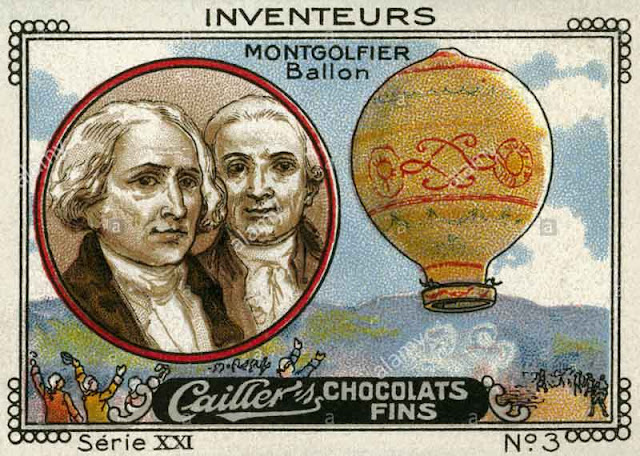
The Montogolfier Brothers and their balloon on a 19th Century French Trading card, Joseph was the inventor, Jquis-Ettiene was the test pilot.   

In 1777 Joseph idly observed laundry drying over a fire.  Sheets billowed and rose.  Something was lifting them.  He concluded that it was an as yet undiscovered gas released by combustion which he modestly named Montgolfier Gas, with a property he called levity.

It was while contemplating a military problem—the long siege of the impregnable British fortress of Gibraltar by French and Spanish forces—that he began to tinker with devises based on his discovery.  After months of bombardment and attacks by sea and land, the Rock stood and along with it control of the gateway between the Mediterranean Sea and Atlantic Ocean.  What if troops could be carried over the fortress and landed with in it, he wondered.  Could his gas provide the lift for such an undertaking?

He began building models at Avignon in November of 1782.  His first construction was a box-like chamber 3’ x 3’ x 4 out of a thin wood frame covered on the sides and top with lightweight taffeta cloth.  He ignited some crumpled paper under the box which quickly rose up in the air until it banged on the ceiling.  Joseph excitedly summoned his younger brother from home to join him on his project, urging him to bring “a supply of taffeta and cordage.”

The brothers built a new model three times as large which they tested outdoors in December.  It floated for nearly 1.2 miles before landing and being destroyed by a frightened peasant. 

                                    The demonstration at Annonay in June 1783.

The brothers refined their invention for a formal first public display.  Their new model was globular and constructed of sackcloth lined with three layers of thin paper.  It had a capacity for 28,000 cubic feet of air and weighed about 500 pounds.  An invited audience, including dignitaries from the États particuliers assembled at Annonay on June 4, 1783 to witness flight of 1.2 mile reaching an altitude of 6,000 feet lasting 10 minutes.  Officials present naturally wrote enthusiastic reports to the government in Paris.

The government equally naturally called them to Paris for further demonstrations.  Joseph, shy and clumsy in society, sent Étienne to the capital to collaborate with wallpaper manufacturer Jean-Baptiste Réveillon, for a full scale model of the device were calling a globe aérostatique and he named Aérostat Réveillon.  The first test of the glorious new device flew from the grounds of la Folie Titon near Réveillon’s home.

The first test flight with test animals has become a favorite children's book story.

Because of concern that the upper air might be dangerous to humans, the King graciously offered two the loan of two condemned felons as passengers for the next public demonstration.  Étienne demurred and elected to send aloft a duck as sort of a control animal known to withstand heights, a rooster thought not to be capable of flying at the expected altitude, and a sheep about the same weight as a man.  The animals were suspended below the balloon in a basket.

A crowd of thousands gathered to watch the flight, including the King himself and Marie Antoinette on the ground of Versailles.  The flight lasted approximately eight minutes, covered two miles, and obtained an altitude of about 1,500 feet before landing safely. 

Pilâtre de Rozier and the Marquis d'Arlandes on the free and untethered flight over Paris.

After the manned ascent test in October, it was time for the great unveiling of for an untethered manned flight.  On November 21 Pilâtre de Rozier was again in the basket, accompanied by the Marquis d’Arlandes, an army officer.  They took off from the Château de la Muette near to the Bois de Boulogne and were carried for miles above Paris at altitudes of up to 3,000 feet for 25 minutes.  The craft landed outside the city wall between two picturesque windmills with enough fuel left to travel four times as far.  But embers from the fire set fire to the edge of the envelope which Pilâtre had to beat out with his coat.  Despite the harrowing landing, the voyage was a success, the talk of Paris for days, and commemorated in numerous etchings and on commemorative plates.


A cheap  commemorative plate for he common folk got the year wrong. Much more elaborate plates were produced for the elite.

The King raised the Montgolfier to the nobility.  Several subsequent flights were also made.  But just as it looked like a rosy future for all concerned, fate intervened in two ways.

First, Jacques Charles and brothers Anne-Jean and Nicolas-Louis Robert, were simultaneously experimenting with balloons using hydrogen for lift.  They flew an unmanned demonstration in August 1783 and on December 1 over a thousand people paid to watch Charles and Nicolas-Louis Robert take off in La Charlière, the first manned hydrogen balloon.  That flight lasted over two hours and covered over 22 miles.

Jacques Charles and brothers Anne-Jean and Nicolas-Louis Robert's successful demonstration of a hydrogen balloon caused the King to back development of the gas balloon for military purposes and made the Montgolfier's hot air craft a mere novelty.

The French government concluded that hydrogen balloons were the future of viable flight, and most subsequent energy went into that.  Hot air ballooning remained a novelty, as it is to this day.

The Montgolfier returned to their paper business, which thrived and continues to this day.  Étienne died in Switzerland in 1799 and Joseph at Balaruc-les-Bains in 1810.  Neither left children and the family business came into the hands of other relatives.

Watching the flight of the magnificent balloon festooned with his own image was one of the last great triumphs of Louis XVI and Marie Antoinette.  Fate—in the form of the Paris Mob—would not be kind to them.

The death of Pilâtre de Rozier and a companion in the crash of a hydrogen and hot air hybrid balloon in an attempt to cross the English Channel.  The volatile gas and the fire necessary to inflate the hot air were a disastrous combination.

Pilâtre de Rozier became a dedicated balloon enthusiast and constructed his own.  He piloted several flights.  But on June 19, 1785 he and a companion, Pierre Romain were killed trying to cross the English Channel in a hybrid hot air-hydrogen balloon—not a good idea considering the volatility of hydrogen around a flame.  They were the first known casualties in aviation.

De Rozier’s companion on the first untethered flight, the Marquis d’Arlandes, like the King and Queen, suffered the catastrophic separation of his head from his body during the Revolution.


Saturday, December 17, 2016

First in Flight But Left Behind —The Wright Brothers


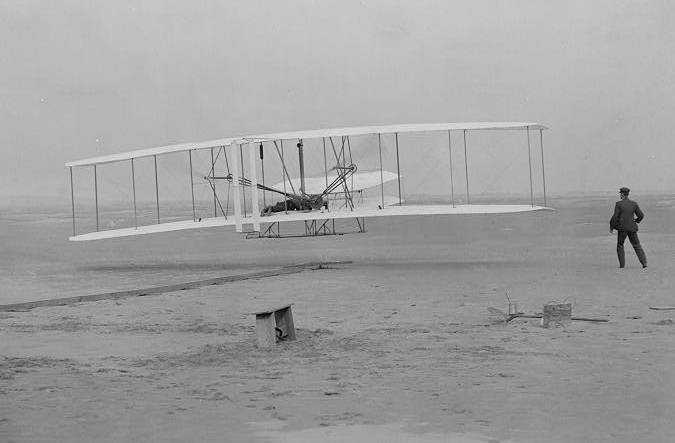
On December 17, 1903 two bicycle builders from Dayton, Ohio launched a flimsy looking craft on a flight of 120 feet in 12 seconds, at a speed of 6.8 miles per hour on the remote sands of Kitty Hawk, North Carolina.  They would complete three more flights that day, trading time piloting the craft from a prone position on the bi-plane’s lower wing.  The longest flight covered 852 feet, achieved an altitude of about 10 feet, and lasted 59 seconds.  Damaged on the final landing, but reparable, a gust of wind flipped the plane several times as it was being moved.  It never flew again.  The two inventors, brothers Orville and Wilber Wright, and five witnesses were on hand for the flights.  Three of the men were from a nearby U.S. Life Saving Service station.  One of them, John T. Daniels snapped a photo of the first flight with a camera that had been pre-positioned by Orville. 

At the end of the day the brothers sent a telegram to their father tersely announcing their success and instructing him to “inform the press.”  It turned out most of the press wasn’t interested.  The Wright’s hometown Dayton paper refused to print the story, skeptical that it was true and convinced that even if the story were true, the flights were “too short to be of importance.”  A telegrapher picked up the story and gave it unauthorized to a Virginia paper, which the next day carried a wildly inaccurate story, which was devoid of details.  The secretive Wrights did not issue their own statement and full description of the flight until January.  Even then, their claims were widely doubted and mocked.

Octave Chanute's glider experiments inspired the Wright Brothers and the older scientist became a mentor to them.


Most people who kept abreast of rapidly developing technology knew that manned flight was imminent.  Nobody expected the obscure Wright Brothers to be the ones to make the breakthrough.  The 1890’s had produced an explosion of experimentation on flight, most of it using kites and gliders.  In 1895 Octave Chanute   had gathered several enthusiasts to test glider designs on the shores of Lake Michigan and himself had developed a bi-plane kite/glider which could carry a man hanging below it.  

It was press reports of these experiments that first interested the Wright Brothers in flight.  Soon they were building their own kites, based generally on Chanute’s design.  They were in contact with Chanute from 1900 and he was impressed by their work.  He encouraged them and even helped them locate Kitty Hawk as an ideal place to conduct manned flight experiments.  He also visited them there and witnessed their glider flights.

In Canada Alexander Graham Bell, one of the most respected inventors in the world, was also intrigued and began his own kite experiments.  Even earlier German Otto Lilienthal was soaring with his single winged hang-glider, making over 2,000 flights by leaping from hills from 1891 until he was killed in a crash in 1895.  Other Europeans were taking up his work.

But most experts expected the final breakthrough to be made by Charles Langley, Secretary of the Smithsonian Institution.  With the assistance of the Smithsonian staff, Langley had constructed model aircraft he called Aerodromes.  These featured tandem wings, one in front of the other.  After success with gliders, he mounted a steam-engine on two models and successfully launched them with a catapult from a deck on a houseboat on the Potomac River near Quantico, Virginia on May 6, 1896.  The second of the unmanned models flew at 25 mph more than 5,000 feet.  Realizing that a steam engine would be too heavy for a manned version, Langley secured a $50,000 contract from the War Department to test and develop a full size Aerodrome capable of carrying a man.  In development since 1898, the plane, now powered by a 25hp internal combustion engine was ready for testing by the fall of 1903.  In a test in October the plane had fallen like a rock into the water after being launched.  A second test on December 8 failed just as spectacularly drawing derision from the press, which had been breathlessly covering with expectations of success. Discouraged, Langley gave up his experiments.  Langley had failed because his engine was still too heavy for his air frame and the frame was too delicate for the unanticipated stress of flight.

The Wrights had already solved these problems, along with a major obstacle to manned flight—how to control the aircraft in flight—make it turn, rise, and descend.  This is where their meticulous scientific approach, their technical skills as builders and mechanics, and a well appointed machine shop at their disposal made all of the difference
They had observed how birds, particularly soaring birds like gulls, controlled their flight by altering the angle of one wing relative to another allowing them to bank into a turn into finding a way to make a man-made wing do the same thing.  The eventual result was wing warping, by which a system of pulleys and cables were used to twist the trailing edges of the wings in opposite directions.


The Wrights tested and developed their wing warping technique in glider flights.  A minor crash with Orvil at the controls and Wilber running to his aid.


The wing warping technique was first used by Wilber on a 5 foot box kite built like a bi-plane in 1899.  It was so successful that the brothers went to Kitty Hawk to test a full size model the next year.  The plane had cambered wings—a curving rather than flat surface and an elevator to control risings and descending in the front.  It had no tail, as the brothers at this time did not believe one was necessary for control.  For several days they flew the plane as a kite in the stiff winds.  One day they took it to the sand dunes to be launched as a glider with Wilber as the pilot.  About a dozen flights were made on one day.  The glider’s lift was lower than expected and they did not get enough air time to fully test the wing warping technology. 
A larger glider tested in 1901 was a disappointment.  Lift was not efficient and the craft sometimes responded to wing warping by turning the opposite direction intended, an effect called adverse yaw.  Discouraged the brother returned home.  They determined that the data on wing lift derived from Lilienthal’s experiments was unreliable.  They built a crude wind tunnel to test various wing configurations and kept meticulous records of the results.  That fall Chanute invited Wilber to address the Western Society of Engineers about the results of their tests.  It was the first public airing of their work, but attracted little attention at the time.
Using the results of more than 200 wind tunnel tests of various airfoil shapes, the brother designed a new glider for 1902 with longer, narrower, and flatter wings.  As tests proceeded a vertical rear rudder was added which was controlled by the same cable as the wing warping.  The rudder stabilized the craft as the wing warping allowed it to bank into turns.  They achieved true control in turns for the first time on October 2.  They made hundreds of glides of a few hundred feet each successfully maneuvering with the new control system.
They returned to Dayton convinced that they were ready to progress to powered flight.  They were also so confident that they applied for a patent on the Flying Machine on March 23, 1903.  Specifically they protected their system of three-axis control—a front elevator for pitch, wing warping for roll, and rudder for yaw.  However in a sentence of the patent application that would be important in future years, they admitted that other techniques than wing warping might be developed for adjusting the outer portions of a machine's wings to different angles on the right and left sides to achieve lateral control.

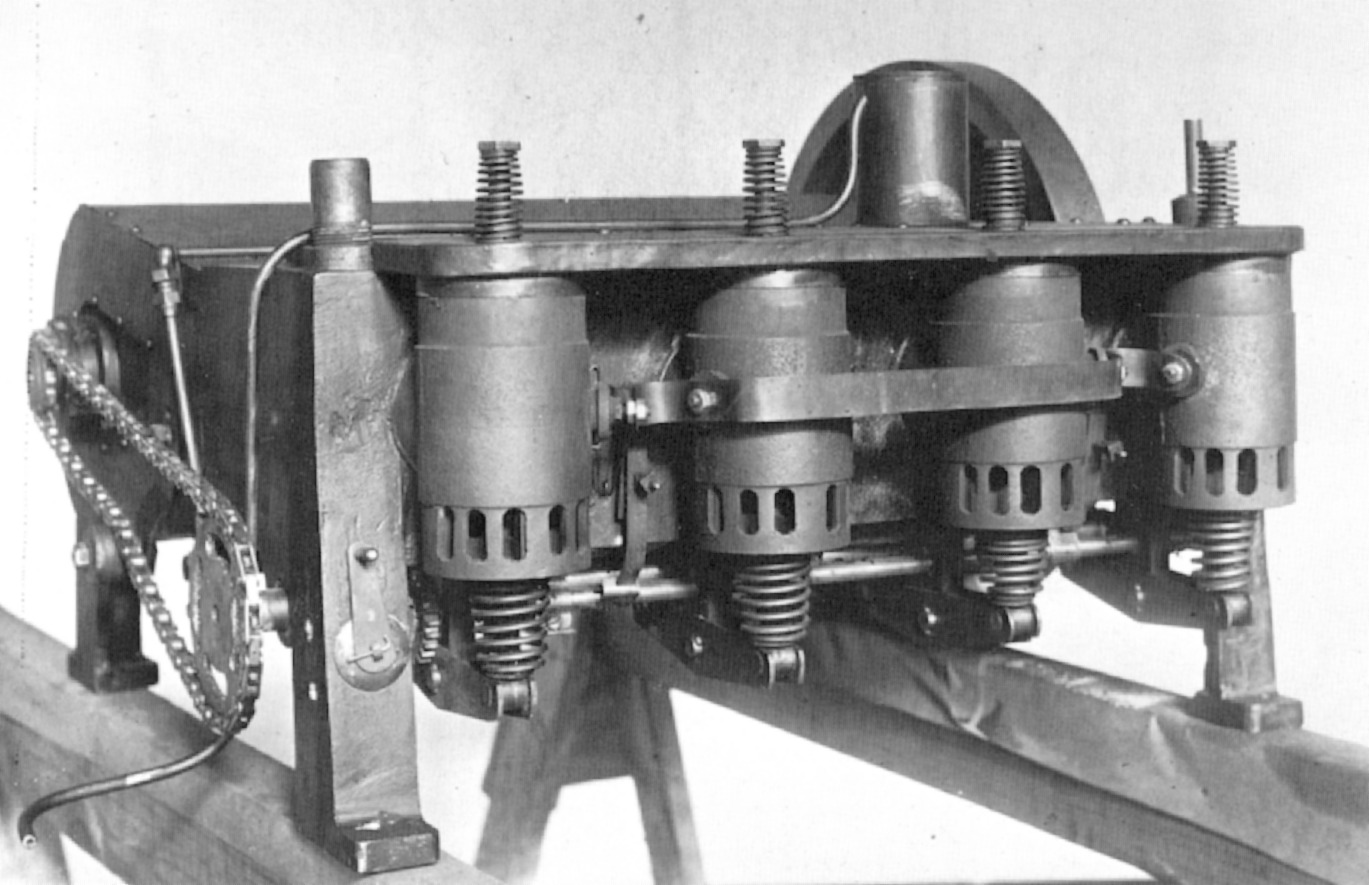
The light weight 4 cylinder aluminum block engine built by the Wrights and their machinist Charlie Taylor solved the problem that had doomed Charles Langly's expensive but doomed experiments.
Having devised an air frame and control system, the brothers turned to a power source.  Avoiding Langley’s pit fall, the brother knew that they needed a light weight internal combustion engine.  Unable to find one from existing manufacturers, the Wrights decided to build their own engine from scrap in their shop.  They had all of the machine tools necessary and a skilled mechanic, Charlie Taylor.  Their major innovation was using light weight aluminum for the block.  The 4-cycle vertical 12 hp, 180 lb engine had a gravity feed for the fuel instead of a carburetor—sort of a primitive fuel injection system.  The efficient motor was intended to power two push propellers via a chain drive.
The propellers were another challenge.  The brothers discovered that no one had ever done studies on propeller design.  After deciding that in an aircraft a propeller was essentially a rapidly rotating airfoil. They again turned to extensive wind tunnel tests to determine the best configuration.  Each hand-made blade was eight foot long and made of three laminations of specially dried spruce.  They proved to be amazingly efficient—even better than the brothers suspected.  Modern tests show them to have a peak efficiency of 82% comparing well to the best performing modern blades at 85%.
The finished Flyer had a wingspan of 40.3 feet and weighed 605 lbs. By the Wrights careful calculations it cost less than $1,000 to build compared to the government’s $50,000 investment in Langley’s failure.
The famous First Flight photo snapped by  John T. Daniels of  the near-by Kitty Hawk Life Boat Station.
Back at Kitty Hawk in the fall of 1903 and feeling the pressure from Langley’s anticipated attempts, things at first did not go well.  There were weeks of delay caused by propeller shafts broken in testing which required two trips back to Dayton to supervise machining new parts to exacting specifications.  On December 14 with Wilber at the controls, they finally attempted a flight, but the engine stalled after just three seconds and the Flyer was damaged. Finally, they succeeded three days later.
In 1904 using a new machine, the Flyer II, the brothers set up an airfield in a pasture near Dayton to continue their tests.  Lighter winds and lower air density reduced lift and made flights more difficult.  Of the first two attempts with the local press in attendance, the first was a failure and the second was unimpressive.  As what little public interest there was waned, the brothers adapted to the new circumstances by extending the rail along which the Flyer was launched and using a catapult to give it extra air speed for takeoff.  By fall, using these techniques they were achieving longer and longer flights.  On September 20 Wilber flew the first complete circle flight.  They solved persistent control problems by enlarging both the elevator and the rudder and moving them farther from the wings.  Soon they were going substantial distances over a ¾ mile course.  On October 5 the Flyer II made the last and longest flight of the year—24.5 miles in 38 minutes. 
The Wrights were now convinced that they had a commercially viable product and began to transition out of the bicycle business to concentrate on manufacturing and sale of airplanes.  The problem was selling them.  Only sketchy local press coverage described the progress of 1904 and the Wright’s claims were skeptically received both in the U.S. and Europe.
The Wright’s business strategy was risky at best, fueled by their fears that their secrets might be revealed and their patents stolen.  They abandoned flying and testing entirely.  They sent letters to the U.S. and European governments offering the Flyer for sale but declining to demonstrate it, or even show a photograph of a plane in flight until a signed contract was in hand.  With public skepticism of their achievement mounting, they failed to attract much, if any interest.
Meanwhile others were ramping up their own efforts at flight. The Aéro-Club de France, whose members included many of the foremost engineers in Europe, stepped up their support for experimenters.  On October 23, 1906 Brazilian born Alberto Santos-Dumont, already famous as the developer of the dirigible, made public flights in Paris in his 14-bis bi-plane.  Although the longest flight of the day lasted only 22 second under power and spanned 700 feet and the aircraft was incapable of making controlled turns, the Aéro-Club certified it as the first powered heavier than air flight
In Nova Scotia, Bell formed the Aerial Experiment Association (AEA) in 1907 to support and sponsor experimentation.  Early members included American motorcycle racer Glenn Curtis, U.S. Army Lieutenant Thomas Selfridge, and two University of Toronto students, Fredrick Baldwin, and John H. D. McCurdy. They built the Red Wing and on March 12, 1908 made the first public flight in North America over Keuka Lake in Up State New York.  The innovative bi-plane was the first with an enclosed cockpit.  Continuing their work the AEA developed the aileron—a hinged control surface attached to the trailing edge of a wing to control the aircraft in roll.  This dramatic advancement immediately made wing warping—and the Wright Flyersobsolete
Curtis designed and flew the June Bug, a third AEA plane, incorporating the aileron.  On July 4, 1908, he flew 5,080 feet, to win the Scientific American Trophy for the first public flight of more than 1 kilometer and its $2,500 purse.  This was considered the first pre-announced public flight in America.  Curtis bought the rights to the June Bug from the AEA and used it as the basis for his Curtis No. 1. When he went into production, he became a competitor of the Wrights who had stayed on the sidelines too long.

During their hiatus from flying, the Wright’s finally received their patent on the Flyer in 1906 and journeyed to Europe to try to interest governments there in the machine.  In 1908 they finally got contracts from the French and U.S. governments for the delivery of a Flyer each, pending demonstration flights.  The U.S. contract called for the plane to carry a passenger.

Back in Kitty Hawk, the brothers modified a version of the 1905 Flyer III with side-by-side seats on the lower wing and upright control levers.  Three years out of practice flying they had trouble adapting.  Wilber had a near fatal crash on May 14.  After ironing out problems, Wilber went to Europe to meet the French, and Orville went to Washington for a demonstration of his own.

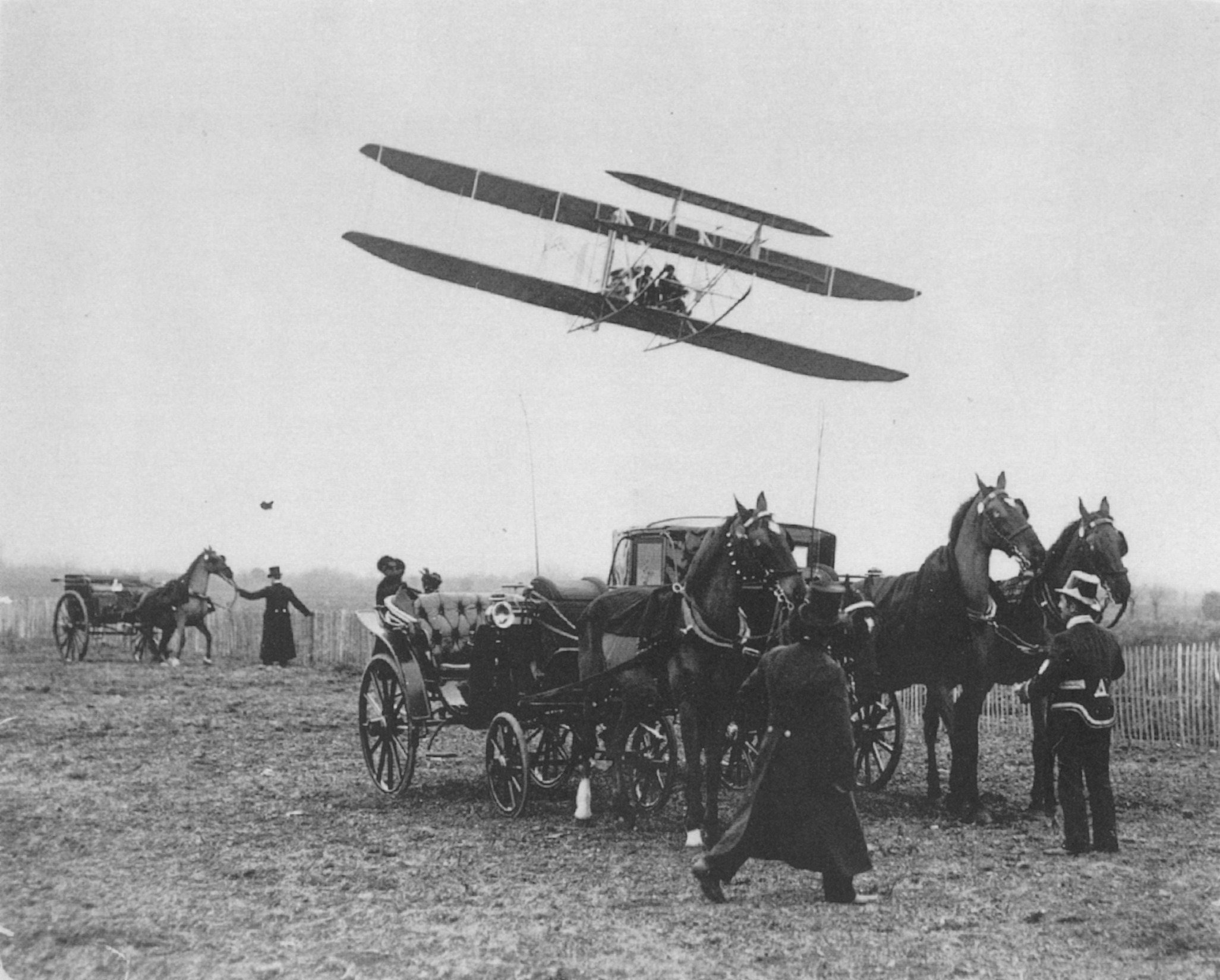
To say that the French were skeptical of Wright is putting it mildly.  By 1908 there were several aviation pioneers taking to French skies.  Wilber began public demonstrations on August 8 near Le Mans.  In several flights that day he demonstrated superiority to anything the French had in the air conducting challenging figure-8 turns and making flights of impressive length and altitude.  In a single day Wilber swept away doubt.  Overnight he and his machine were celebrities.  At last the Wrights were getting the attention they deserved.

Wilber Wright pilots a demonstration for dignitaries on his succesful 1909 tour of Europe.


Orville duplicated his brother’s success for the Army at Ft. Myer in Virginia on September 3.  As demonstrations continued, the flights grew longer.  By September 9 he became the first man to be airborne for more than an hour. But tragedy struck on September 17 when with Lt. Selfridge aboard a propeller shattered and the Flyer crashed.  Selfridge was killed, the world’s first aviation fatality, and Orville grievously injured.  Despite the accident, the Army granted a year extension on the contract so that Orville could recover and continue demonstrations in a new aircraft.

After months of recuperation Orville and his sister Kathleen sailed to Europe to join Wilber’s successful sales trip.  The now famous pair were entertained by royalty and presidents and—more important—sold planes and trained pilots before returning to the U.S. in 1909 to yet more accolades, including a meeting with President William Howard Taft.

Back home, their Wright’s first priority was defending their patents.  They sued Glenn Curtis and anyone else who attempted to build, fly, or market airplanes.  The bitter litigation dragged on for years.  Curtiss went about building a major aviation company concentrating on engines and sea planes.  The Wrights, distracted by the suits, failed to continue to make significant improvement in their Fliers, which were obsolete by 1911.  The whole American aviation industry languished.  Soon the French, Germans, and even the Dutch were leapfrogging American products.
Wilber, who spearheaded the relentless round of lawsuits, died of typhus in 1912.  In 1914 the Supreme Court finally ruled in the Wright’s favor in the patent case with Curtis.  Vindicated by the decision, Orville decided to sell the company and retire.  With the World War I, the government demanded that all aviation manufactures join in the Manufacturers Aircraft Association, to which member companies paid a blanket fee for the use of aviation patents.  Both the company then known as Wright-Martin and Curtis received what were essentially $2 million dollar bribes by the government to join the consortium
By that time both faced tough sledding with the Army.  By 1913 11 Army pilots had been killed in crashes.  All six Wright Model C planes were destroyed in fatal crashes.  The Army determined that the pusher type planes built by both the Wrights and Curtis were inherently unstable and announced that henceforth they would purse on tractor aircraft with the engines in front.  Orville had resisted changing over, fearing the new style might void his patents.
When America entered World War I, the domestic aviation industry was so backward that no company could be found to produce planes capable of modern combat.  The Army Air Corps had to go to war in planes purchased in Europe from the French and English.  Eventually French designed Spads were produced under license in the States and by war’s end American technology was finally catching up.  The Curtis Company, which had adapted more readily, was in better shape.
By 1929 the companies founded by the former bitter rivals were merged as the Curtis-Wright Corporation, still a major aerospace company.

A lonely Orville Wright in his later years.
Orville had a long, bittersweet retirement.  He became estranged from his sister because he did not approve of her husband.  Never married, he lived alone in a Dayton mansion. He feuded with the Smithsonian, which had honored Langley with the instillation of his Aerodrome and a claim that it was the first aircraft “capable” of flight.  He served on the board of the National Advisory Committee for Aeronautics (NACA), predecessor agency to the National Aeronautics and Space Administration (NASA). 
Orville Wright died as the honored elder statesman of aviation on January 30, 1948.