Showing posts with label refugees. Show all posts

Friday, December 16, 2022

Pedir Posadas—The Murfin Winter Holidays Music Festival 2022-‘23

                                             Pedir Posadas, a traditional Mexican Posadas song with Spanish lyrics.

Today is the first day of the traditional Mexican celebration of Las Posadas, a novenario or novena—an extended nine day devotional prayer observed between December 16 and Christmas Eve December 24.  The more than 400 year-old custom has spread to other Latin American nations and to the Mexican diaspora in the United States.

A neighborhood Posada procession in a painting by Carmen Lomas Garza in the National Museum of Mexican Art in Chicago.

Las Posadas derives from the Spanish word posada for a lodging, or inn and during the nine-day period during Advent it re-enacts the Holy Familys search for shelter in Bethlehem.

Typically, in villages and city neighborhoods two people are dressed as María and José and certain houses are designated to be inns.  They are led by a procession carrying luminariacandles inside a paper shade or bag.  The actors travel to one house each night for nine nights. At each house, the resident responds by singing a song, the pair are recognized and allowed to enter; the guests come into the home and kneel around the Nativity scene to pray, usually, the Rosary. The final location may be a church instead of a home.

A Posada procession with José and María riding on a burro in search of shelter.

Mary usually rides a burro if one is available.  Attendants such as angels and shepherds join the procession and along the way, or pilgrims may carry icons of the holy personages instead.  Children often carry poinsettias. The procession is followed by musicians, with the entire procession singing posada songs like Pedir Posada. At the end of each night, carols are sung, children break open star-shaped clay piñatas laden with sweets, and everyone sits for a feast.  In Mexico and in Mexican neighborhoods in the U.S. homemade tamales are traditional.

A Posada procession at the Alamo in San Antonio, Texas.

In many cities there are even larger and more elaborate public processions.  In the U.S. the largest and most notable of these takes place along the River Walk of San Antonio, Texas where landmarks like the Alamo, Arneson River Theater, Museo Alameda, and the Spanish Governors Palace replace private homes and ends at the Cathedral of San Fernando. The River Walk is lined with luminarias in addition to elaborate Christmas light displays.

In Chicago the Pilsen and Little Village neighborhoods have notable Posadas and many Latino Catholic parishes and Protestant congregations stage their own, often ending with a living Nativity on Christmas Eve. 

In the U.S. the Posada tradition has taken on new significance as an allegory for the search of refugees, asylum seekers, and undocumented residents for a safe haven.

                                 The Holy Family as modern refugees and asylum seekers.

There are many Posada songs.  Pedir Posada is probably the best known.  Here it is presented with Spanish lyrics and images of celebrations. 


Friday, April 1, 2022

Our National Poetry Month Series for 2022 Kicks off With One for Ukraine


It’s National Poetry Month Again!  If you have been visiting here for a while, you know what that means—it’s our 11th annual round-up of daily doses of verse!  If you are new, here’s the scoop.  Every day all month I will feature poets and their poems.  I aim to be as broad and inclusive as possible to style, subject, period, gender, race, and neglected voices

I don’t want just a parade of the usual dead white men, but a lot of them did write some damn fine poetry, so they have their place here too.  As always, selections follow my own tastes and whims.  Yours may be different.  But I am open toeager for—suggestions, especially for contemporary writers.  I do not subscribe to dozens of little magazines or prowl the internet for poetry posts.  I often only stumble on new and unknown poets and I am sure I miss some great stuff.  Please feel free to turn me on to some. 

Here is a challenge—Poets, send me your own best stuff be it personal, political, or polemical I don’t and can’t promise to use everything.  E-mail me at pmurfin@sbcglobal.net.

Lyuba Yakimchuk in Aberdeen Scotland recently reading and speaking out for Ukraine.

This year we will segue from our March Women’s History Month posts to poetry via the important work of Ukrainian poet Lyuba Yakimchuk whose poem Prayer based on her personal experiences has caught the riveted attention of readers around the world.

Yakimchuk was born and raised in Pervomaisk, Luhansk Oblast, a small coal-mining town near Luhansk in Ukraine’s industrial east.  She graduated from the University of Luhansk and the National University of Kyiv-Mohyla Academy and won early attention for her verse.

Living and working in Kyiv (formerly known as Kiev in outdated geography texts) the cosmopolitan national capitol.  But in 2011 she happened to be home In Pervomaisk visiting her family when ethnic Russian separatists backed by the Putin regime in Moscow attacked and captured the city.  Her parents and sister became internally displaced—refugees in their own country.

This was part of the long simmering if often low-grade war for the border regions coveted by Russia—the same one’s who “independence” was the declared objective for Putin’s “military operation” a/k/a invasion this year.  It was also this continuing conflict for which Ukrainian President Volodymyr Zelenskyy begged for arms and aid from the former criminal U.S. President who tried to use the assistance as a bribe for the Ukrainian government digging up dirt of Joe Biden’s son Hunter.  Failure to provide the aid despite overwhelming support of Congress for it helped make Ukraine more vulnerable to the current war.

Apricots of Donbas was based on Yakimchuk's personal experiences 2011 during the Russian sponsored revolt in the eastern Ukraine region.

Yakimchuk’s book of poems, Apricots of Donbas in 2015 focused on that time and the conflict in the area based on her own experience and eyewitness accounts.  Reviewer Maria G. Rewakowicz in the Los Angeles Review of Books wrote that “…Yakimchuk come[s] from the conflict-ridden Donbas and…have emerged as the region’s trusted spokespersons.”  The book has been translated and published in Polish, Latvian, and English and further translations are in the pipeline.

Since then, her play The Wall was produced at the Ivan Franko National Academic Drama Theater in Kyiv. And she wrote the script for the film “Slovo” House: Unfinished Novel  in 2021), about Ukrainian artists living in the Slovo Building, persecuted by the Soviet totalitarianism against the backdrop of the Holodomor—also known as the Terror-Famine or the Great Famine, when Stalin’s policies in 1932 to 1933 killed millions of Ukrainians in the hope of depopulating the region and replacing its people with ethnic Russians.  Yakimchuk’s work has necessarily dealt with heavy topics.

When the current war broke out Yakimchuk was living with her husband Max Rosochinsky and 11 year-old son north of Kyiv.  She sent her son to relatives in the western city of Lviv.  Like all adult men her husband has stayed in country to serve in the military or in the civilian resistance.  She has managed to travel to speak at cultural events in Paris, Warsaw, and St. Andrews in Scotland and is rousing support for her nation and its people.  Despite the dangers she has vowed to return to Kyiv.

Her powerful poem Prayer was included in Apricots of Donbas.  It is remarkable that she mixed sadness and rage but also recognized the devastating costs to both sides of the war.

The English translation is by Oksana Maksymchuk and Yakimchuk’s husband Max Rosochinsky both award-winning literary translators, poets, and scholars. In 2017, they co-edited an anthology of Ukrainian poetry titled Words for War: New Poems from Ukraine.

Ukrainian refugees struggling to reach safety in Poland.

The Prayer

Our Father, who art in heaven
of the full moon
and the hollow sun

shield from death my parents
whose house stands in the line of fire 
and who won’t abandon it
like a tomb

shield my husband
on the other side of the war 
as if on the other side of a river
pointing his gun at a breast
he used to kiss

I carry on me this bulletproof vest
and cannot take it off
it clings to me like a skin

I carry inside me his child
and cannot force it out
for he owns my body through it

I carry within me a Motherland
and cannot puke it out
for it circulates like blood 
through my heart 

our daily bread give to the hungry
and let them stop devouring one another

our light give to the deceived
and let them gain clarity 

and forgive us our destroyed cities 
even though we do not forgive for them our enemies

and lead us not into temptation
to go down with this rotting world 
but deliver us from evil 
to get rid of the burden of a Motherland – 
heavy and hardly useful

shield from me 
my husband, my parents
my child and my Motherland

—Lyuba Yakimchuk

Thursday, December 16, 2021

Pedir Posadas—The Murfin Winter Holidays Music Festival


                                                    Pedir Posadas, a traditional Mexican Posadas song with Spanish lyrics.

Today is the first day of the traditional Mexican celebration of Las Posadas, a novenario or novena—an extended nine day devotional prayer observed between December 16 and Christmas Eve December 24.  The more than 400 year-old custom has spread to other Latin American nations and to the Mexican diaspora in the United States.

A neighborhood Posada procession in a painting by Carmen Lomas Garza in the National Museum of Mexican Art in Chicago.

Las Posadas derives from the Spanish word posada for a lodging, or inn and during the nine-day period during Advent it re-enacts the Holy Family’s search for shelter in Bethlehem.

Typically, in villages and city neighborhoods two people are dressed as María and José and certain houses are designated to be inns.  They are led by a procession carrying luminariacandles inside a paper shade or bag.  They actors travel to one house each night for nine nights. At each house, the resident responds by singing a song, the pair are recognized and allowed to enter; the guests come into the home and kneel around the Nativity scene to pray, usually, the Rosary. The final location may be a church instead of a home.

A Posada procession with José and María riding on a burro in search of shelter.

Mary usually rides a burro if one is available.  Attendants such as angels and shepherds join the procession and along the way, or pilgrims may carry icons of the holy personages instead.  Children often carry poinsettias The procession is followed by musicians, with the entire procession singing posada songs like Pedir Posada. At the end of each night, carols are sung, children break open star-shaped clay piñatas laden with sweets, and everyone sits for a feast.  In Mexico and in Mexican neighborhoods in the U.S. homemade tamales are featured.

A Posada procession at the Alamo in San Antonio, Texas.

In many cities there are even larger and more elaborate public processions.  In the U.S. the largest and most notable of these takes place along the River Walk of San Antonio, Texas where landmarks like the Alamo, Arneson River Theater, Museo Alameda, and the Spanish Governor’s Palace replace private homes and ends at the Cathedral of San Fernando. The River Walk is lined with luminarias in addition to elaborate Christmas light displays.

In Chicago the Pilsen and Little Village neighborhoods have notable Posadas and many Latino Catholic parishes and Protestant congregations stage their own, often ending with a living Nativity on Christmas Eve.

In the U.S. the Posada tradition has taken on new significance as an allegory for the search of refugees, asylum seekers, and undocumented residents for a safe haven.

                            The Holy Family as modern refugees and asylum seekers. 

There are many Posada songs.  Pedir Posada is probably the best known.  Here it is presented with Spanish lyrics and images of celebrations. 

Monday, November 15, 2021

Tree of Life Presents Documentary on Jewish Rescuers Martha and Rev. Waitstill Sharp via Zoom


Martha Sharp; her son Waitstill, Jr.; husband Rev. Waitstill Sharp; and daughter Martha after their return from Nazi occupied Europe.  In 1939 the Unitarian minister and his wife left their church and children to aid and rescue Jews and intellectuals in Prague, Czechoslovakia in a daring mission under the noses of the Nazis.  They returned to Europe to rescue Jews from occupied France. Photo from Two Who Dared: The Sharps Story.

Two Who Dared: The Sharps Story, a documentary film about the Unitarian couple who rescued Jews in Prague and France during World War II will be shown on Zoom this Thursday, November 18 at 6:30 pm by the Tree of Life Unitarian Universalist Congregation in McHenry, Illinois.  The film will be introduced by the congregation’s interim Minister, Rev. Jenn Gracen who has preached about the couple’s dangerous missions and will be available after the showing to answer questions and facilitate discussion.

In 1939 Rev. Waitstill Sharp, minister of the Unitarian Church of Wellesley Hills in Wellesley, Massachusetts responded to an urgent plea to go as quickly as possible to Prague, Czechoslovakia to help endangered writers, artists, intellectuals, and Jews out of the country before the Nazis occupied the city.  Dozens of other ministers had already turned down the dangerous assignment.  Not only did Waitstill agree but his young wife Martha determined to join her husband.  Not only did they leave their church, but they had to leave their 8-year old son and 3-year old daughter in the care of friends.

They arrived in Prague weeks for German troops to occupy the city.  Despite this as neutral Americans they established a refugee aid office and began work.  Waitstill navigated the Nazi bureaucracy to try to arrange travel documents and when he couldn’t obtain them lied to the authorities and had forged documents created.  Martha often played a cloak and dagger role dodging police to deliver documents and move endangered individuals to safe house locations.  Eventually she escorted 35 refugees—journalists, political leaders, and orphaned children—to England crossing occupied Poland and Germany in a sealed railway car.  Waitstill left Prague for Switzerland a few weeks later.  The couple returned to the U.S.

The logo of the Unitarian Service Committee was devised in France to make documents look official.  The Untiarian Universalist Association later adopted the flaming chalice as the symbol for the faith.

After a reunion with their children and a short respite, they accepted a new assignment to France as the newly established Unitarian Service Committee’sambassadors extraordinary.” But before they could arrive in Paris to set up an office, the Germans occupied the city. Instead, the Sharps opened an office in Lisbon, since thousands of refugees were escaping to neutral Portugal, hoping to find safety and a ship to take them to the United States or other destinations outside of Europe.  Martha Sharp worked at a new Unitarian Service Committee office in Marseilles, which was the primary port in unoccupied Vichy France from which refugees could escape where she distributed milk and food to those crowding the port.  She doggedly battled numerous bureaucracies to secure exit visas, transit permits, and identity papers for 29 children and 10 adults then led them on a perilous trek by foot across the Pyrenees Mountains into Franco’s Spain and from there to Lisbon from which they sailed to New York.

Martha Sharp, second from right with a load of milk for distribution to refugee children at the Unitarian Service Committee office in Marseilles in unoccupied Vichy France.  Some of her other work had to be conducted more clandestinely. 

For these lifesaving services both Waitstill and Martha were honored as The Righteous Among Nations by Yad Vashem, Israel’s Holocaust memorial, for risking their lives to aid Jews during the Holocaust.  They were the second and third Americans so honored.

In 1944, Waitstill was appointed to a United Nations Relief and Rehabilitation Administration (UNRRA) position in Cairo. Martha returned to Spain and Portugal, assisting refugees, mainly Spanish Republicans, to emigrate to South America.  In 1946, Martha ran for Congress, but lost, in part because of accusations that the USC was a leftist or communist-supporting organization

Although the couple divorced after the war, due to the strains of prolonged separations, both continued to serve.  Marth continued to advocate for refugees and was a strong supporter of Israel.  Waitstill returned to parish ministry before retiring. He died at age 80 in 1983.  Martha was 94 when she died in 2099.

Two Who Dared: The Sharps Story was a years-long effort of the Sharp’s grandson Artemis Joukowsky who never knew anything about their war-time accomplishments until he literally stumbled on them while researching a class project in high school.  Neither grandparent had ever mentioned it.  He conducted hours of interviews, especially with Martha, and uncovered various troves of documents and family photos.  Eventually he interviewed some of those who they saved and other witnesses.  He directed and co-wrote the documentary which was released in 2012.

The Ken Burns, PBS version of the story.

The film so impressed Ken Burns that he signed on as a producer and co-director of an expanded version aired on PBS in 2016 as Defying the Nazis: Sharps’ War.  The main difference between the two versions was the addition of Tom Hanks as the voice of Waitstill.  Tree of Life will be sharing the original version.

The showing is free to the public but free-will donations can be made to the Unitarian Universalist Service Committee (UUSC), the continuation of the Unitarian Service Committee.  It partners with local grass roots organizations around the world and in the US on social justice projects including refugee emergencies and immigration justice.

To join the Zoom program log into.

For more information contact Tree of Life at https://treeoflifeuu.org/ or visit the Facebook event.

Back in February Rev. Jenn Gracen preached on the Sharps.  Her sermon and my work at the time on with The Coalition to End the ICE Contract in McHenry County moved me to once again commit poetry. 
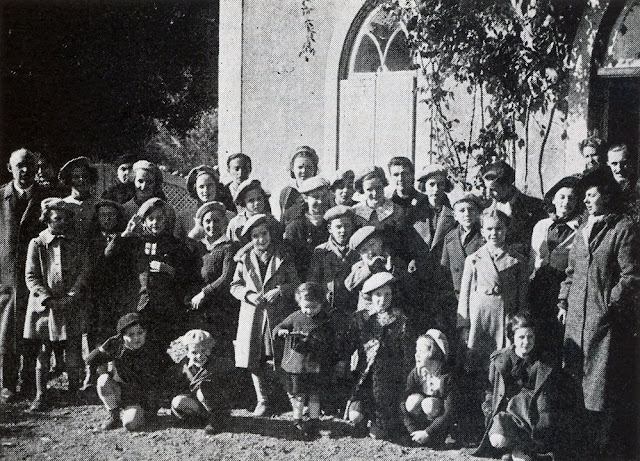
 

Martha Sharp, far right, and twenty seven children she shepherded from France to New York in 1940.  Most would otherwise not have survived the war.

Meditation on Saving Terror Targets

Inspired by Rev. Waitstill and Martha Sharp

and Rev. Jenn Gracen Sermon


Those very nice New Englanders heeded a call

            ignored by many

            and left children and comfort

            for Prague on the edge of doom.

Before they quite knew what had happened

            they were doing un-Unitarian things—

            lying to authorities, forging documents,

laundering money, consorting with outcasts,

playing cloak and dagger on dark rainy streets.

He did most of the paper work and keeping accounts,

            spending money, working the phone

            and playing shell games with the Gestapo.

The demure Mrs. was the secret agent

            making rendezvous, shaking tails,

            using code names and passing notes

            in invisible ink.

At the very last possible moment

            she, using documents faked and fudged by him

            got thirty-seven marked men on a train

            out of Prague on a train that

            had to cross Germany

            to get to France

            batting her pretty, innocent eyelashes

            at Nazi agents.

Back in America by the skin of their teeth

            they played with the children 

            who hardly knew them

            and then were sent back to Europe at war.

They made their way to Vichy France

            and she came out with twenty-seven Jewish girls,

            leading them on foot across the Pyrenees

            neutral but hostile Spain

and eventually to New York

on an ocean liner that narrowly avoided

being sunk by a U-boat.


That’s the tale we’ve been told.

            We wonder if we could have done it.

            we wonder if we even should—

            their own children, after all,

            were scarred

            and their marriage shattered.


There is still plenty of horror in the world

            yet who is dashing off to Kurdistan

            to defy Syrians and Turks,

            to bloody Yemen where our drones rain death,

            or to a dozen other would-be holocausts

            in the making.


What if we didn’t even need to leave the county,

            our own warm beds,

            the bosoms of our families?


What if we sheltered the undocumented

            and despised,

            confronted ICE raids,

            freed children from cages,

            brick by brick             

and bar by bar

            tore down that

            concentration camp

            just down the street?


What if….


—Patrick Murfin


Saturday, November 28, 2020

Lotta Hitschmanova—A Canadian Hero in a Unitarian Uniform

Lotta Hitschmanova as she began service as the Executive Director of the Unitarian Service Committee of Canada in October 1946.

If you live this side of the border of the Land of the Great White Grandmother, chances are that you never heard of Lotta Hitschmanova.  But you should learn about her.  She was awesome.

Canadians of a certain age will remember her for her once ubiquitous annual fund raising appeals on radio and television and in smartly produced short films for the Unitarian Service Committee of Canada (USCC) which she served as Executive Director for many years.

Her story begins in Prague when the Czech city was still a part of the Austro-Hungarian Empire on November 28, 1909.  Her birth name was Lotte Hitschmann.  Her father was a prosperous malt merchant and the secularized Jewish family lived in modest wealth and comfort.

She was a gifted student who excelled at the progressive and co-educational Stephans Gymnasium. She studied philosophy and mastered several European languages at the University of Prague and then went on to study political science and journalism at the Sorbonne in hopes of entering a career in international diplomacy.

In 1935 Lotte returned to Prague where she completed her Ph.D. studies and launched a successful career as a freelance journalist often contributing material to Czechoslovak, Rumanian, and Yugoslav newspapers.  As the menace of Hitler and Nazism rose she became noted for her outspoken anti-fascist beliefs and articles.  By 1938 she changed her name to the Slavic Lotta Hitschmanova as a protest to German hegemonic ambitions. 

When Germany annexed the Sudetenland Hitschmanova learned that she was on a list of hostile journalists to be detained.  She was forced to flee her homeland leaving her parents and a younger sister behind. She first fled to back to Paris and from there she went to Brussels, Belgium, where she resumed her journalistic career.  But the war kept catching up with her and for the next few years she alternated between a variety of journalism and humanitarian jobs while often finding herself a stateless refugee. By late 1941 she was in Marseilles in Vichy France where she worked as a secretary at charity for refugees.  It paid next to nothing and the tiny woman fainted on the streets of starvation after which she was taken to a clinic run by Unitarian Service Committee.

After being taken to an Unitarian Service Committee clinic in Marseilles, Hitschmanova went to work for the agency as a translator.  The USC was a rare beacon of hope for desperate refugees from all over Europe.  Here the agency distributes relief bundles.

It was a fortuitous match.  Soon she was volunteering her services with the USC as a translator and then as a liaison officer with the Czech relief agency, Centre d’Aide Tsechoslovaque.  Her work was valued by the USC, but officials recognized that she was still in danger.  In 1942 they arranged her escape from Europe via Lisbon on a converted freighter crammed with other refugees and headed to New York.

Like many Jewish refugees even with the help of the USC, Hitschmanova could not gain permanent refuge in the U.S.  After stopping in Boston to deliver highly sensitive documents detailing the dangerous work of the USC in Europe, she went to Canada, which offered her asylum.

She later recalled “exhausted, with a feeling of absolute solitude in an entirely strange country...I came with $60 in my pocket. I had an unpronounceable name. I weighed less than 100 lbs, and I was completely lost.”  Yet relentlessly resourceful, within two days she found employment as a secretary and three months later was in Ottawa where she worked as a Department of War Services postal censor.  She read the letters of German prisoners of war and scoured them for useful military intelligence.

Still deeply impressed by the selfless work of the USC, Hitschmanova joined the Unitarian Church of Ottawa.  She also continued her work for refugees with the Czechoslovakian National Alliance and by raising money for Czech War Services in London.  She regularly contributed articles to the Canadian press and made speeches on behalf of her causes.  Toward the end of the war she went to work for the United Nations Relief and Rehabilitation Administration.

All during the war she never gave up a desperate search for her parents and sister Lilly.  She learned that for a while her parents were held at Terezin, a model concentration camp used as a showplace for the Red Cross and international diplomats.  Then she got the devastating news that they had been taken from that relative comfort and safety and had died in the gas chambers of Auschwitz.  Eventually she located her sister living in Palestine with her husband.  Both eventually joined her in Canada.

With no family to return to, Hitschmanova decided to remain in Canada.  She turned down several excellent job offers.  Instead, she determined to serve the uprooted refugees still in Europe.  In July 1945, she helped to organize the Canadian branch of the Unitarian Service Committee, which was affiliated with both American Unitarian Association and the Unitarian Church in Canada.  Senator Cairine Wilson, a liberal icon in Canada, was named the Honorary Chairwoman, but as Executive Director, Hitschmanova ran the show with systematic energy and efficiency.

At first registered under the War Charities Act the Canadian committee was restricted to fundraising only through Unitarian congregations and to individual Unitarians.  When the law changed in February 1946 Hitschmanova energetically began her public appeals citing the great need.  At first funds were directed to Czechoslovakia and France.

That spring she made her first annual tour to inspect the work in the field.  She adopted a military style uniform modeled after that worn by American WACs.  She found the outfits useful in gaining admission to even restricted areas.  Besides they were comfortable and made packing for her extended trips easy.  She wore the uniforms at home and abroad for the rest of her life.  They became her trademark as she rose as a public figure in Canada.

Despite her affection for the Boston based USC, it didn’t take long for her to come into conflict with its leadership.  They insisted that all field operations be headed by an American.  She felt that those on the ground and familiar with the situation knew best.  She preferred to empower local partner organizations and their leadership by providing them with needed funds and perhaps technical support.  Her secondary goal was to make those partner organizations self-sustaining and independent as quickly as possible.

There are three basic principles in the field of the art of giving aid. To come as an open-minded friend and good listener, when offering help; to say goodbye to a project when it can continue on its own; to serve with a personal touch, because a relationship of confidence must lift your aid beyond the realm of a simple business proposition and prove that you really care.

To accommodate that philosophy in 1948 she re-organized the Canadian Committee completely independent of not only the Boston based USC, but of the Canadian churches as well.  Despite its independent status, the USC Canada continued to draw support and volunteers from Unitarian congregations and most proudly considered it “ours.”


The current logo of the Unitarian Service Committee Canada.

In the first full year of operations in 1946, Hitschmanova set a pattern which she would repeat yearly—three months of intense fund-raising in Canada, four months overseas to supervise programs and investigate possible new partners, and months at home reporting on her findings and producing an annual film about the Committee’s achievements.  That first year she raised $40,000 and collected 30,000 kg of clothing for distribution in the refugee camps.

She particularly homed in on the needs of children, making a project to supply prosthetic limbs to maimed victims a high priority, and establishing one of the first adopt-a-child sponsorship programs that became a model for many others. 

Hitschmanova with Korean orphans on one of her annual world-girdling inspection tours of  USCC humanitarian aid projects.  The organization expanded beyond Europe to include projects like this in Korea and others in India, Africa, and serving Palestinian refugees.

She found herself showered with honors.  According to a biographical sketch in the Dictionary of Unitarian and Universalist Biography by Joyce Thierry:

Dr. Hitschmanova received numerous awards, including the 1975 Woman of the Year for India by Prime Minister Indira Gandhi. By this time, grateful governments around the world had acknowledged her work in their countries in a variety of ways: the Chevalier of Public Health from the Government of France and the Gold Medal from the Red Cross of France, 1950; the Medal of St. Paul from Greece, 1952; Public Service Medal from the Government of South Korea, 1962; Athena Mesolora Gold Medal from the Government of Greece, 1967; Officer of the Order of Canada, 1972; the Royal Bank of Canada Award, 1979; and Companion of the Order of Canada, 1980. In 1983, she received Officer of Meritorious Order of Mohlomi, Lesotho, and was only the third person to be given the Rotary Award for World Understanding. She refused to accept honorary doctorates from universities, saying she had worked hard enough in Paris and Prague to earn her own doctorate.

In 1982 after 37 years at the helm, ill health finally forced Hitschmanova to retire.  Sadly in her remaining years she suffered from Alzheimers.  She died of cancer on August 1, 1990 at the age of 79.  She was widely mourned across Canada and by the hundreds of thousands whose lives she touched around the world.  Her memorial service was held at her beloved Ottawa Unitarian Church.

In perhaps an even more profound tribute to her vision the modern Unitarian Universalist Service Committee, heir to the old Boston based organization, now follows Hitschmanova’s model of partnering and nurturing organizations on the ground.