Showing posts with label old town. Show all posts

Thursday, August 15, 2024

My Chicago Summer of ’68 Part IV—The Shit Hits the Fan

A Chicago Police line advances behind a haze of tear gas to push demonstrators out of Lincoln Park Sunday night.  A handful of  Marshals moved between the cops and the retreating protesters as they spilled out of the park into the streets of Old Town.

Yesterday I ambled to Lincoln Park to check out the territory and checked in to my Movement Center assignment.  Now on Sunday things first come to a head.

The high school kids at the Movement Center at the Methodist Church on Diversey staggered out of their bed rolls late on Sunday morning. The church service upstairs finally woke the last of them. We served them a breakfast of Cheerios in re-constituted non-fat dry milk, powdered eggs, toast, and coffee made by the gallon in an industrial urn. Breakfast conversation was confined mostly to grunts and groans. A few asked about the day’s activities as if they were back at summer camp.

We volunteers slapped together more peanut butter and jelly sandwiches and wrapped them in waxed paper as rations for the day. As the kids straggled out the door, a few of us cleaned up the kitchen. I hauled a couple of galvanized garbage cans out to the dumpster in the alley. As I was heaving the second one, I was surprised by two burly guys.

When the burly cops rousted and questioned me, my mind flashed on all of the old movies I had seen.  I had to bite my tongue to keep from answering "What about it, flatfoot."

“We wanna talk wit you,” one of them said. My mind flashed on dialogue from an old gangster flick. Luckily I restrained myself from replying, “What about, flatfoot?”

It turns out they wanted to know just who was inside. “We know the SDS is here. You one of them?” “No” I replied quite truthfully. Having no SDS chapter at Shimer, I had never taken out a card.

“We know who’s in there, we just need you to confirm it,” the second cop said. “It’ll go easier on you if you do.” He rattled off a couple of names I didn’t recognize anyway. They could have been there, but I was blissfully ignorant.

We danced around for a bit, me not giving any info, them asking questions they knew I would not answer. After a few minutes another guy emerged from the Church with more garbage. He took one look at us and ducked back in.

“Well, I guess that’s all we need,” said cop #2. They let me go and climbed into a dark sedan. I realized that the whole point of the exercise was for me to be seen talking to them. They hoped that the others would assume I was a spy. Did it work? I have no idea.

***

Nobody remembers how cool Chicago was that week. Freakishly cool. August in Chicago was usually the month of sweltering temperatures and TV news stories about the eternal battle between the Fire Department and neighborhood kids about open hydrants. Many mini-riots erupted when the hydrants were shut down. And many Chicagoans escaped the heat by coming to the Lake Front parks to sleep. Whole families would do it.

Not that year. Starting Sunday daytime temperatures hovered in the low ‘70’s and even high 60’s. Nights were downright chilly. That may have been good for the folks who usually spent heat waves in the park because that year Mayor Daley had camping in the parks made illegal to head off the Yippies. Parks, he announced, would be closed by police at exactly 11 pm. No exceptions. Thus were the battle lines drawn.

The cool weather changed my outfit. Gone were the short-sleeve white shirts, replaced with cheap plaid flannels bought at Woolworths for $2 each. It was even cool enough for a jacket. I had a jean jacket borrowed from my pal Bill Delaney that had the Rocking Bar D brand of his family’s South Dakota ranch emblazoned on the back. I pinned on a peace button. The red kerchief stayed. To prepare for the expected clashes with police, I lined my battered white Stetson with rolled-up newspaper in the crown as a makeshift helmet. Around my waist I strapped my dad’s World War II utility belt—the same one I used as a kid to play endless hours of Army. Hung on the belt was a G.I. canteen and ammo pouches stuffed with first aid supplies. I had appointed myself a volunteer medic. In addition to the expected gauze, bandages, band-aids and iodine, there were a dozen or more white pocket handkerchiefs filched from Dad—in those distant days men had drawerfuls of them.

That’s how I set out from the church sometime after noon that Sunday. This time I cut down Clark Street then over into Lincoln Park north of the Zoo. The park, which would be teaming with families on most weekend days, was nearly deserted. On Stockton Drive I saw two more of Chicago’s finest. They were bending over at the rear of their unmarked car. As I grew closer I could see that they were using masking tape to cover the numbers on the license plate. 

Two plain clothes cops in Lincoln Park were taping over the municipal license plates on their unmarked car.  I decided to ask why.

I walked up to them. For some reason, I decided it would be a good idea to talk to them. This can only be ascribed to a case of serious mental illness. “What you doin’” I ask. In a split second I found my face being pushed into the trunk of the car, my glasses falling off to the side. My arms were twisted up my back and my feet were being kicked wide apart. If you are from Chicago, you know the position. One cop was screaming at me “What the fuck is it to you, asshole!” or words to that effect. I was sure I was going to be beaten senseless and thrown into the back of the car, perhaps never to be seen again.

But the second cop pulls the guy off. “Let him go…we don’t have time for this shit…we got bigger fish to fry.” Cop number one let me up and gave me a hard shove. “I’ll be looking for you, kid.” They drove off as I searched for my glasses and felt the first rush of adrenaline that I would experience several more times that week.

Phil Ochs and Country Joe McDonald played from park benches and makeshift stages in Lincoln Park on Sunday.  They seemed to be everywhere Convention week, especially Ochs.

As I approached the south end of the Park, I saw a growing crowd milling about.   The Yippies had promised a free concert as a lure to bring more kids to the park.  Of course they had no permit.  But all summer long regular happenings in Lincoln Park on Sunday afternoons included musical performances, including rock bands, and no permits were needed.  Abbie Hoffman, I would learn later, was frantically trying to get last minute permission.  Meanwhile acoustic performers like Phil Ochs and Country Joe McDonald stood on park benches and tried to keep the crowd entertained.  Only one rock band—the self-proclaimed Detroit revolutionaries MC5 had shown up.  Late in the afternoon police allowed the band to begin to play, but prevented a flatbed truck from coming in to act as a stage and denied them city power.  Hoffman tapped the electric service of nearby concession stands and the band began to play.

The concessionaires complained and police ordered the power disconnected.  The crowd was getting restless and angry. They started taunting police who were standing by in large numbers.  The Yippies again attempted to bring in the flatbed truck, nearly reaching the planned stage area.  MC5 tried to set up on it as Hoffman and others encouraged the crowd.  Police demanded that the truck be moved out of the Park.  Hoffman evidently agreed to move it to the street by the park.  When the truck started retreating fighting broke out between cops and kids.  Several were arrested and hauled away as police began to form cordons around the crowd. 

Listening to speakers Sunday afternoon.  The crowd was less stereotypical hippie than in the public imagination.  A lot of students, little really long hair.  A good many local kids from the neighborhood like the kid in the t-shirt to the left and more Black faces than usually credited from near-by Cabrini Green and the Wells Street scene.

That’s when Hoffman told the crowd that “the Pigs had shut the festival down.”  Speeches replaced music.  They tried to organize the crowd.  Don’t fight to stay in the park at closing, we were told, “Take it to the streets.”

All evening long tensions rose in the park.  Police formed skirmish lines and pushed into the crowd with batons swinging two or three times.  Kids responded with anything they could throw.  Some tear gas was used. 

After dark things grew even more chaotic in the park.  Word circulated for designated Marshalls to move into position.  That was me.  A dozen or so of us took up space on a low ridge not far inside the park, ready to move.  We lay among the trees and watched a movie unfold as police advanced across the park.  A large knot of protesters rallied around a kid with a Vietcong flag riding on the shoulders of others.  The crowd held at the edge of the park, surged back in, and retreated again a few times.  The long line of Police advanced throwing tear gas ahead.

All at once the knot around the flag poured into the street.  That was our signal.  With my stomach doing things I never imagined possible, the other marshals and I took our places in a line between the police and the crowd.  We were stretched thin.    Miraculously, the maneuver seemed to work.  The police line halted at the park’s edge.  The crowd moved out and began to disappear at Clark and North, scattering into side streets.  Tear gas hung in the air.  But the whole thing seemed to me to be suddenly over without the major battle I had envisioned.

There was no one around to tell us what to do.  I decided to head back to the Movement Center.  I headed up Wells to Lincoln.  There was almost no traffic.  The streets were dark.  Behind me I could hear occasional sirens.

By the time I made it to Dickens I was tired and thirsty.  There was a large bar in the corner with big plate glass windows.  The lights were dimmed inside but it was open.  I decided I needed a beer.  There were just two men at the long bar.  I settled down a few stools away from them and ordered a tap beer.  It was delivered in a schooner.  Maybe the best beer of my life.

I met SDS leader Carl Oglesby in a darkened Lincoln Avenue tavern, shared a beer with him, and sent him into trouble.

One of the men, a tall fellow with a dark beard, glasses and a Greek fisherman’s cap asked me if I had been in the park.  I told them I was.  They called me over and bought me another beer.  The bearded one introduced them.  “I’m Carl Oglesby, this is Carl Davidson.”

“I’ve heard of you,” I stammered foolishly.  Of course I had.  These guys were real movement heavyweights—the President and Vice President respectively of SDS.  I was flattered by their attention.  They asked me what had happened.  I gave them my account of the evening.

“How is it back there now?” they asked.  I told them that it looked to me like everything was over for the night.  “I guess we’ll go have a look.”  So we left.   They headed south on Lincoln on my intelligence.  I headed north.

When I got back to the Church, I found folks huddling around a radio.  It seems that after I left protesters reformed around the Clark/LaSalle/North Ave. intersection.  The police surged out of the park to meet them.  A running battle in the streets of Old Town with protestors and cops playing tag and the streets choking with gas went on until morning.  A few of our kids straggled in with horror stories.

I wondered what I had sent the two Carls into.

Next—Monday turned out to be my labor day of Convention week.  First an unexpected invitation that would change my life then joining the SDS on a CTA strike picket line.


Sunday, May 23, 2021

The Seed and I—The Beginning a Murfin Memoir

The 50th Anniversary Seed Reunion in Chicago, 2017--youth culture gone gray.  Too many to identify but Abe Peck, the event organizer and MC is in the front row center and Bernie Farber who was on the staff with me if in appropriate tie-dye in front. 

Note—Four years ago on Chicago’s Northwest side there was be an assemblage of wrecks, relics, geezers, and survivors who gathered to celebrate the 50th anniversary of the first issue of the Seed, the Windy City’s semi-legendary hippie/Yippie/psychedelic/radical/underground newspaper.  Your scribe was one of the former staff members, associates, street peddlers, allies, drug suppliers, and hangers on in attendance at the reunion.  Stories were told.  Some of them were true.

In the spring of 1967 Old Town and a four or five block strip of Wells Street with spill-over east and west on North Avenue was the Mid Continent epicenter of an exploding counter culture.  Nothing between Washington Square in New York and the Haight in San Francisco had anything like it—a vibrant street scene the nurtured music, the arts, and all forms of eccentric self-expression.  Wells and North were lined with music bar venues, bookstores, quaint cafes, specialty shops, and attractions like Piper’s Alley and Second City.  It was a magnate for young people who thronged the sidewalks on weekends and warm evening.  Dope of all sorts was casually plentiful and cheap, and there was an electrifying possibility of sexual adventure with the supposedly free spirited/free love Hippie chicks and semi-shirtless young dudes.  What went largely unacknowledged was that many of the runaway/throw away street kids were drifting into and sometimes coerced into prostitution.  But, hey, it made the whole scene more exotic and alluring.

A post card of Old Town from the '60's.  It was all happening there, babe!

Not only college kids and weekend hippies from the suburbs crowded those streets, but Old Town had become a major tourist attraction.  Plenty of curious parents, businessmen on the prowl, Division Street swingers, out of town Conventioneers, and Great Lakes Sailors joined the crowds especially on weekend nights.  There were even tour buses.

What the scene did not yet have was an alternative press like the venerable Village Voice or the Berkley Barb.  Enter Eric Segal (aka The Mole), proprietor of the Molehole, a pioneering headshop and poster palace, and artist Don Lewis who had designed psychedelic posters for the shop.  The Mole had the bankroll.  Lewis had a vision and friends who could fill the pages with art work, photos, articles, poetry, and music reviews.  There was every expectation that the street crowds would snap up a paper both as guide and a souvenir and the local merchants, bar owners as well a concert promoters and record labels would be eager to buy adverting to reach them.  Or so it was hoped.

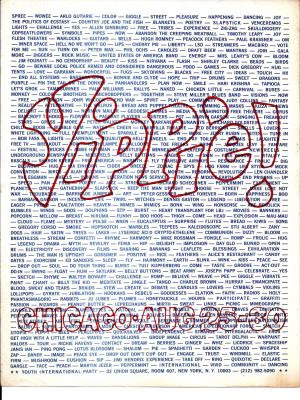
                                            Volume 1, No. 1 of the Seed, May, 1967.  Unsurprisingly, it sold out.

The Seed premiered with a splash.  The Village Voice and Berkley Barb still resembled conventional newspapers with headlines, photos, and text on their front pages.  The tabloid size Seed would have a more magazine style with an eye catch full cover illustration—and a radical declaration of full throttle counter culture.  The paper would not just be the alternative press—it would be a damn the torpedoes underground newspaper.  The first cover featured a photo cameo of a beautiful, topless waif framed by San Francisco psychedelic lettering.  Yet she was not lurid like a South State Street burlesque queen, or one of Hugh Heffner’s fantasy inflatables.  She exuded a kind of innocence and fresh vulnerability.  This was something new indeed.  And as predicted the first issue sold out almost before the ink was dry. 

The City stood up and took noticeGate keepers of morality predictably clucked loudly.  The Seed was denounced by the Chicago Tribune, decried from pulpits, and the police made threatening noises of busting the street venders if such outrages continued.  All of which just stepped up demand for the next issue.  There may not have been any more cover photo nudes, but naked nymphs continued to be seen in imaginative illustrated covers.

I probably picked up my first copy, maybe No. 3 that June one of my regular forays to Wells Street from Skokie.  I had just graduated from Niles West High School and was working as a dishwasher at a Howard Johnson’s Restaurant to earn money for school that fall at Shimer College in Mt. Carroll, Illinois.  All summer long I brought home copies.  To me they were instruction manuals.

Before the first year was out the founders had a business falling out and the paper was sold.  The new management kept the counter cultural feel and even more talented artists like Lester Dore took over the graphic design which made the paper “the most beautiful underground paper ever produced.” 

Seed editor Abe Peck became the news as the Yippies planned to descend on Chicago in 1968.

The paper was not heavily radical in its early editions, concentrating instead on culture.  But growing resistance to the Vietnam War and the approach of the 1968 Democratic Convention changed that.  Under the more radical leadership of Abe Peck the Seed became something of a house organ for Yippies! despite his initial prediction that their plans would end in disaster.  Under the leadership of Abby Hoffman, Jerry Rubin, and Paul Krasner of The Realist, the Yippies were plotting a total disruption of the Democrat’s nominating party.  In the spring of ’68 covers changed from flower power to Yippie!

Back from Shimer for the summer, I came into the city to take classes from radical professor Staughton Lynd at the Free University at Roosevelt University.  He wanted to mobilize our class as participant observers of upcoming Convention demonstrations, which in addition to the Yippies had more conventional marches and rallies planned by the New Mobe and others.  I volunteered to investigate the Yippies, about whom I knew next to nothing except that I could probably find them from the Seed.

The Yippie! Call to the Democratic Convention protests.  The Seed would be up to its eyeballs with preparations, the police riots, and the subsequent trials and protests for the next two years.

The following is an excerpt from my Convention days memoirs, Chicago, Summer of ’68:

I made my way to the one place in Chicago where I knew any Yippies could likely be found—the offices of the underground newspaper the Seed then on LaSalle Street just south of North Avenue within blocks of ground zero for the staging area for the Yippies in Lincoln Park.

The door was wide open to a dimly lit, cluttered, and chaotic office a few steps below street level. Two dudes with suitably long and unkempt hair were sweating over a table. “Hi!” I said, “I’m looking for Abbie Hoffman or Jerry Rubin.” I was greeted with incredulous stares and deep suspicion.

Let’s review how I looked that summer—the frayed white short sleeve salesman-cast-off shirt, the store brand jeans with the cuffs turned up, the heavy Wellington work boots, the natty red kerchief knotted at the throat, scroungy orange goatee, thick horn rim glasses, topped by a battered white Stetson. I looked like I may have just graduated from the J. Edgar Hoover Academy for Stool Pigeons and Spies.

“They’re not here,” one of the guys said without volunteering any information on their whereabouts or how I could contact them. I could have been staring at both of them that very minute and I wouldn’t have known it.

A brief but cool conversation followed. I was beginning to detect full blown drug induced paranoia from them. But they did give me some handbills and other information about the publicly announced plans for Convention week, all of which relied on free camping in the Park.

It would be my first in-the-flesh encounter with Seedlings.  It would not be my last.

Coming up: Intersecting Existences 1969 

Friday, August 24, 2018

Murfin’s Chicago Summer of ‘68—The Shit Hits the Fan


A Chicago Police line advances behind a haze of tear gas to push demonstrators out of Lincoln Park Sunday night.  A handful of  Marshals moved between the cops and the retreating protesters as they spilled out of the park into the streets of Old Town.
Note:  This is the fourth installment in my series of memory posts about the Democratic Convention in Chicago in 1968 and my small role in the streets action surrounding it. In this episode on Sunday I make the personal acquaintance of the Chicago Police Department’s finest—twice—and then in mass.
The high school kids at the Movement Center at the Methodist Church on Diversey staggered out of their bed rolls late on Sunday morning. The church service upstairs finally woke the last of them. We served them a breakfast of Cheerios in re-constituted non-fat dry milk, powdered eggs, toast, and coffee made by the gallon in an industrial urn. Breakfast conversation was confined mostly to grunts and groans. A few asked about the day’s activities as if they were back at summer camp.
We slapped together more peanut butter and jelly sandwiches and wrapped them in waxed paper as rations for the day. As they straggled out the door, a few of us cleaned up the kitchen. I hauled a couple of galvanized garbage cans out to the dumpster in the ally. As I was heaving the second one in, I was surprised by two burly guys.


When the burly cops rousted and questioned me, my mind flashed on all of the old movies I had seen.  I had to bite my tongue to keep from answering "What about it, flatfoot."
“We wanna talk wit you,” one of them said. My mind flashed on dialogue from an old gangster flick. Luckily I restrained myself from replying, “What about, flatfoot?”
It turns out they wanted to know just who was inside. “We know the SDS is here. You one of them?” “No” I replied quite truthfully. Having no SDS chapter at Shimer, I had never taken out a card.
“We know who’s in there, we just need you to confirm it,” the second cop said. “It’ll go easier on you if you do.” He rattled off a couple of names I didn’t recognize anyway. They could have been there, but I was blissfully ignorant.
We danced around for a bit, me not giving any info, them asking questions they knew I would not answer. After a few minutes another guy emerged from the Church with more garbage. He took one look at us and ducked back in.
“Well, I guess that’s all we need,” said cop #2. They let me go and climbed into a dark sedan. I realized that the whole point of the exercise was for me to be seen talking to them. They hoped that the others would assume I was a spy. Did it work? I have no idea.
Nobody remembers how cool Chicago was that week. Freakishly cool. August in Chicago was usually the month of sweltering temperatures and TV news stories about the eternal battle between the Fire Department and neighborhood kids about open hydrants. Many mini-riots erupted when the hydrants were shut down. And many Chicagoans escaped the heat by coming to the Lake Front parks to sleep. Whole families would do it.
Not that year. Starting Sunday daytime temperatures hovered in the low ‘70’s and even high 60’s. Nights were downright chilly. That may have been good for the folks who usually spent heat waves in the park because that year Mayor Daley had camping in the parks made illegal to head off the Yippies. Parks, he announced, would be closed by police at exactly 11 pm. No exceptions. Thus were the battle lines drawn.
The cool weather changed my outfit. Gone were the short-sleeve white shirts, replaced with cheap plaid flannels bought at Woolworths for $2 each. It was even cool enough for a jacket. I had a jean jacket borrowed from my pal Bill Delaney that had the Rocking Bar D brand of his family’s South Dakota ranch emblazoned on the back. I pinned on a peace button. The red kerchief stayed. To prepare for the expected clashes with police, I lined my battered white Stetson with rolled-up newspaper in the crown as a makeshift helmet. Around my waist I strapped my dad’s World War II utility belt—the same one I used as a kid to play endless hours of Army. Hung on the belt was a G.I. canteen and ammo pouches stuffed with first aid supplies. I had appointed myself a volunteer medic. In addition to the expected gauze, bandages, band-aids and iodine, there were a dozen or more white pocket handkerchiefs filched from Dad—in those distant days men had drawerfuls of them.
That’s how I set out from the church some time after noon that Sunday. This time I cut down Clark Street then over into Lincoln Park north of the Zoo. The park, which would be teaming with families on most weekend days, was nearly deserted. On Stockton Drive I saw two more of Chicago’s finest. They were bending over at the rear of their unmarked car. As I grew closer I could see that they were using masking tape to cover the numbers on the license plate.

Two plain clothes cops in Lincoln Park were taping over the municipal license plates on their unmarked car.  I decided to ask why.
I walked up to them. For some reason, I decided it would be a good idea to talk to them. This can only be ascribed to a case of serious mental illness. “What you doin’” I ask. In a split second I found my face being pushed into the trunk of the car, my glasses falling off to the side. My arms were twisted up my back and my feet were being kicked wide apart. If you are from Chicago, you know the position. One cop was screaming at me “What the fuck is it to you, asshole!” or words to that effect. I was sure I was going to be beaten senseless and thrown into the back of the car, perhaps never to be seen again.
But the second cop pulls the guy off. “Let him go…we don’t have time for this shit…we got bigger fish to fry.” Cop number one let me up and gave me a hard shove. “I’ll be looking for you, kid.” They drove off as I searched for my glasses and felt the first rush of adrenaline that I would experience several more times that week.

Phil Ochs and Country Joe McDonald played from park benches and makeshift stages in Lincoln Park on Sunday,  They seemed to be everywhere Convention week, especially Ochs.
As I approached the south end of the Park, I saw a growing crowd milling about.   The Yippies had promised a free concert as a lure to bring more kids to the park.  Of course they had no permit.  But all summer long regular happenings in Lincoln Park on Sunday afternoons had included musical performances, including rock bands, and no permits were needed.  Abbie Hoffman, I would learn later, was frantically trying to get last minute permission.  Meanwhile acoustic performers like Phil Ochs and Country Joe McDonald stood on park benches and tried to keep the crowd entertained.  Only one rock band—the self-proclaimed Detroit revolutionaries MC5 had shown up.  Late in the afternoon police allowed the band to begin to play, but prevented a flat bed truck from coming in to act as a stage and denied them city power.  Hoffman tapped the electric service of nearby concession stands and the band began to play.
The concessionaires complained and police ordered the power disconnected.  The crowd was getting restless and angry. They started taunting police who were standing by in large numbers.  The Yippies again attempted to bring in the flatbed truck, nearly reaching the planned stage area.  MC5 tried to set up on it as Hoffman and others encouraged the crowd.  Police demanded that the truck be moved out of the Park.  Hoffman evidently agreed to move it to the street by the park.  When the truck started retreating fighting broke out between cops and kids.  Several were arrested and hauled away as police began to form cordons around the crowd.

Listening to speakers Sunday afternoon.  The crowd was less stereotypical hippie than in the public imagination.  A lot of students, little really long hair.  A good many local kids from the neighborhood like the kid in the t-shirt to the left and more Black faces than usually credited from near-by Cabrini Green and the Wells Street scene. 
That’s when Hoffman told the crowd that “the Pigs had shut the festival down.”  Speeches replaced music.  They tried to organize the crowd.  Don’t fight to stay in the park at closing, we were told, “Take it to the streets.”
All evening long tensions rose in the park.  Police formed skirmish lines and pushed into the crowd with batons swinging two or three times.  Kids responded with anything they could throw.  Some tear gas was used. 
After dark things grew even more chaotic in the park.  Word circulated for designated Marshalls to move into position.  That was me.  A dozen or so of us took up space on a low ridge not far inside the park, ready to move.  We lay among the trees and watched a movie unfold as police advanced across the park.  A large knot of protesters rallied around a kid with a Vietcong flag riding on the shoulders of others.  The crowd held at the edge of the park, surged back in, and retreated again a few times.  The long line of Police advanced throwing tear gas ahead.
All at once the knot around the flag poured into the street.  That was our signal.  With my stomach doing things I never imagined possible, the other marshals and I took our places in a line between the police and the crowd.  We were stretched thin.    Miraculously, the maneuver seemed to work.  The police line halted at the park’s edge.  The crowd moved out and began to disappear at Clark and North, scattering into side streets.  Tear gas hung in the air.  But the whole thing seemed to me to be suddenly over without the major battle I had envisioned.
There was no one around to tell us what to do.  I decided to head back to the Movement Center.  I headed up Wells to Lincoln.  There was almost no traffic.  The streets were dark.  Behind me I could hear occasional sirens.
By the time I made it to Dickens I was tired and thirsty.  There was a large bar at the corner with big plate glass windows.  The lights were dimmed inside but it was open.  I decided I need a beer.  There were just two men at the long bar.  I settled down a few stools away from them and ordered a tap beer.  It was delivered in a schooner.  Maybe the best beer of my life.

I met SDS leader Carl Oglesby in a darkened Lincoln Avenue tavern, shared a beer with him, and sent him into trouble.

One of the men, a tall fellow with a dark beard, glasses and a Greek fisherman’s cap asked me if I had been in the park.  I told them I was.  They called me over and bought me another beer.  The bearded one introduced them.  “I’m Carl Oglesby, this is Carl Davidson.”
“I’ve heard of you,” I stammered foolishly.  Of course I had.  These guys were real movement heavyweights—the President and Vice President respectively of SDS.  I was flattered by their attention.  They asked me what had happened.  I gave them my account of the evening.
“How is it back there now?” they asked.  I told them that it looked to me like everything was over for the night.  “I guess we’ll go have a look.”  So we left.   Them headed south on Lincoln on my intelligence.  I headed north.
When I got back to the Church, I found folks huddling around a radio.  It seems that after I left protesters reformed around the Clark/LaSalle/North Ave. intersection.  The police surged out of the park to meet them.  A running battle in the streets of Old Town with protestors and cops playing tag and the streets choking with gas went on until morning.  A few of our kids straggled in with horror stories.
I wondered what I had sent the two Carls into.
Next—Monday turned out to be my labor day of Convention week.  First an unexpected invitation that would change my life then joining the SDS on a CTA strike picket line.