Showing posts with label Murfin memoir. Show all posts

Wednesday, August 12, 2026

In My Chicago Summer of '68 I Go to a Party--Part I of a Murfin Memoir

The Skokie Swift, derided as the Tooterville Trolley, pulls into Howard Street in Chicago where I transferred to the L for my expedition to an exotic party.

Note—It has been 58 years since the 1968 Democratic National Convention in Chicago and all the tumult in the streets.  The whole world was watching, briefly, a slice of police mayhem embedded itself in fading tribal memories.  

This seems a good time to resurrect a look back on the events of 1968 by an awfully young and naïve boy with shiny ideals and not much sense.  I have run this series of memory stories before.  These which will run for the next several days, have been somewhat buffed and edited.  

I Go To a Party

It was the summer of 1968.  I was back at the folks’ house in Skokie—for the last time—after my first year at Shimer College and working on the assembly line at Koldwave/Heat Exchangers, an air conditioning plant.   It was a time between times, a time of waiting for that thing that would change—I was sure of it—everything.  That “thing” was the Democratic National Convention in August and the massive street protests that we all knew were coming.

One warm evening I took the Skokie Swift and the L down into the City for a party.  It was my first Chicago party.  People my own age with an apartment of their own in the gritty, mysterious city!  Eileen Claire was quite beautiful and brilliant.  She played cello and read French.  We had gone to different Niles Township Highs Schools—she to East and I to West.  We met in LYNT (Liberal Youth of Niles Township) and worked together on a program about the draft, Uptight About the Draft? which was inscribed on the flyer in San Francisco psychedelic lettering.  She pushed the rest of us to be more militant.

Now she had the second floor of a three flat on Bissell Street, not far from the Armitage El.  The building backed up against the tracks.   Trains roared by at eye level to the back porch.  Ramshackle furniture was scattered around.  Posters—Janis Joplin’s peek-a-boo breast and demonstration calls—were tacked to the grimy walls.  There was a hole in the wall in the bathroom and the toilet rocked when you sat on it.  Beautiful. Bohemian. Dangerous.


A three flat on Bissel like this one would now sell for far more than a million dollars.  In 1968 it was seedy, rundown, cheap, and in a gang-infested neighborhood--perfect for an aspiring revolutionary just starting out.

The apartment was jammed when I got there.  Claire waved at me from across a room, smoking intently and engaged in an animated conversation with a knot of earnest young men. She pointed to a keg in galvanized tub in the kitchen.  I think that was as close to communication with me as she got all evening. 

I couldn’t blame her. Compared to the sophisticates here, I was sure that I must be something of an embarrassing relic from the past, someone casually invited pro-forma without any expectation that he would actually show up.

My appearance was a combination of naiveté, nerdiness, and an ardent yearning for bohemia.  Black Wellington boots.  Western cut jeans from Monkey Wards where I still shopped for huskies   A frayed white short sleeve dress shirt—my uncle had given me a drawer full of them—past prime salesman crispness, pocket stuffed with pens and an address book stuffed with scrap notes of lofty ideas.  A red bandana knotted to the side of the throat.  The first bloom of an orange goatee, sideburns down to the jaw line.  Hair full behind the ears and just a tad over the collar hoping for Byronic heroism.  Thick horn rim glasses fit for a middle aged accountant from Queens.  All topped off by a dingy white Open Road Stetson, front brim snapped down, sides curled. A symphony in incongruity.

The crowd skewed slightly older than I—college juniors and seniors, a smattering of graduate students, even a sprinkling of  hip young junior professors, the kind who mixed high minded idealism with sleeping with adoring students.  Some had dropped out and were now organizing the masses.  The men could be recognized by their uniform—blue chambray work shirts, sleeves rolled up just below the elbow, jeans, and engineer boots, sometimes a Greek fisherman’s or newsboy cap. The girls wore peasant blouses or loose t-shirts, full skirts with bare legs or jeans, hair long or loosely tied behind the ears, scrubbed faces defiant of make-up.

This was not a crowd of hippies or flower children.  Even amid the flowing alcohol and passed joints there was an air of seriousness, of conspiracy, of danger. Eileens’s friends were self-described militants, SDS, and Communists.  Some of them I would later come to recognize as movement heavies.  Eileen herself, in just a couple of years, would ascend to  leadership in a Maoist sect which would briefly hold the official American China franchise, and helped litter radical America with vinyl covered Quotations from Chairman Mao, blue People’s Army caps with red stars, and garish red and gold Mao buttons.


In  a few short years Eileen Claire would rise to co-chair of a Maoist sect that would briefly hold the official China franchise in the U.S. and would help make Mao buttons and plastic-covered Little Red Books ubiquitous.

That night was the first time I heard the word revolution bandied about as if it were the most natural thing in the world, not something to do with Redcoats and embattled farmers in tri-corn hats, not something that erupted in exotic foreign places like St. Petersburg, but something that we were going to do right here, right now, next week at the latest.

I was telling folks that summer that I was a socialist.  But then I would expound on my firm belief that what American needed was a Fabian Movement of intellectuals that could make socialism respectable to the middle classes.  Mention of this theory in these circles drew only eye rolling, dismissive snorts and long, jargon filled lectures on abandoning bourgeois sentimentality, casting my lot with the proletariat, and recognizing the central role of the vanguard party in creating a real revolution.  Evidently they were less impressed by George Bernard Shaw than by Vladimir Ilyich Lenin.

When they learned that I actually, if only temporarily, worked in a real factory, something that very few, if any, of them had ever actually done, I was sort of patted on the head with an expectation that I would learn about exploitation.  A couple of them asked if I would take red bannered newspapers to work with me and pass them out to my comrades.  I didn’t think that anything with a huge hammer and cycle on it was apt appeal to the hillbillies, Poles, Mexicans and Blacks who sweltered with me on the air conditioning assembly line.

Under the circumstances, I soon drew apart.  I drank scotch, which I believed was the official beverage of the aspiring young writer and caught a hit on whatever joints might come my way.  And I watched.

I was sitting on a sagging couch, squeezed among strangers acutely into my buzz when a large man with a bushy, bright red beard pulled up a milk crate in front of us and fished a crinkled clipping from his pocket.  “Here,” he said thrusting it at a girl sitting on an arm of the sofa, “Can anyone tell me who this is?”

When it was passed down to me, I saw a clipping on glossy paper, the photo image sharp.  Probably from a newsmagazine.  In it a portly middle-aged man in a three piece suit with a receding mop of mildly unruly hair gestured emphatically with one hand and clutching a large mug with the other.  The photo was taken from a low angle, looking up at a platform or stage.

We all studied the picture for a moment, trying to focus our un-focused brains.  A couple of folks thought it might be Alan Ginsberg.  But he had no beard, and no one could imagine Ginsberg in a suit.  One, sensing an air of menace in the man’s scowling expression, was sure it was a Republican Senator.  But in the end, we had to give up.

Red Beard waited a moment.  “It’s Norman Mailer!  With the famous cup of bourbon the night before the March on the Pentagon!”


I searched for years for the photo of Norman Mailer with the cup of bourbon I was shown at the party and have never found it.  The next morning he was at the head of the March on the Pentagon in October 1967 with poet Robert Lowell, labor and anti-war activist Sidney Lens, and Dr. Benjamin Spock at the far right among other notables

Mailer, I was informed, had taken to the stage and launched into a long, incoherent rant.  The next day he was busted on the march and spent an un-Thoreau like night in jail.  All of this had happened the previous October while I was getting used to being stoned every night at Shimer.  It was news to me.

But I did know Mailer.  Who didn’t. He was one of a handful of American writers who were more famous than their books at a time when serious writers had some of the same air of celebrity about them as movie stars.  In fact, these writers seemed to move in the same orbits as movie stars.  Hadn’t Arthur Miller married Marilyn Monroe?  And didn’t Truman Capote, Gore Vidal, and George Plimpton breezily pop up on Johnny Carson’s couch?  And Mailer was bigger than any of them, the most famous American writer since Hemmingway and just as pugnacious.

So, I was impressed that Mailer, drunk or not, had thrown his lot in with war protestors and radicals.  I had been vaguely aware that the writer was anti-establishment.  His journalism appeared not only in glossy mainstream magazines but in hipper journals.  Like a lot of folks my age, I read Why Are We in Vietnam? and was a bit perplexed by the connection of a Texas adolescent’s Alaska hunting trip to the title.  I gathered it was an allegory.

I knew Mailer from my mother’s wide collection of best sellers, mostly in paperback editions.  She prided herself on keeping up with good books.  And in the days when the best seller lists often were dominated by many of the authors destined for admission to the pantheon great American literature, those old, dog-eared Pocket Books and Cardinal Editions provided me with a deeper and better education than I ever received in high school English.  F. Scott Fitzgerald, Sinclair Lewis, Edna Ferber, Pearl S. Buck (these older writers in cheap book club hard cover editions), Hemmingway, Steinbeck, Robert Penn Warren, Faulkner, James Jones.

My father’s books were another thing entirely.  Slender pulp genre shoot-‘em-ups, heavy on westerns, hard boiled detectives, and war stories. 

But The Naked and the Dead may have been one of the few books both of my folks may have read.  It was serious literature and a rip-snorting yarn, even if it did take more than one night to read.

Of course, I read it, too.  It was one of the books that changed my impression of war from the brutal glory of the old John Wayne movies I saw on TV, to something more personal and ambivalent.  Without The Naked and the Dead, and a handful of other books I might have been swept along by enthusiasm for a good ol’ martial crusade in Vietnam.  Certainly, my earliest impulses had been in that direction.  But these dusty old paperbacks readied me to view things differently.

That early Mailer, not the current radical, had primed my pump.

Tomorrow—Getting ready for the Big Event.


Tuesday, August 11, 2026

In My Chicago Summer of '68 The Run Up to the Big Event--Part II of a Murfin Memoir


Roosevelt University on Michigan Avenue in the Auditorium Building was home of the Free University where I took a class with Staughton Lynd every Wednesday.

Yesterday—A party in the big city set the stage for a radical adventure.

The party at Eileen Claire’s was not the only time I got into the city that summer. I was weekly visitor. I signed up for a class at something called the Free University at Roosevelt University. Every Wednesday I made the long trip via the Skokie Swift and the L to take a class with Staughton Lynd.

Lynd was a pretty big deal in those days in left wing and academic circles—a prolific writer who lost his job at Yale for his activism and outspoken opposition to the war, leader of a delegation to Hanoi, advisor to SDS, and pal of Tom Hayden. He relocated to Chicago to give community organizing a go.


Activist/scholar Staughton Lynd was my instructor at the Free University.  Seen here in a Vietnam war protest in Chicago with Dave Dellinger of The Progressive (left) and civil rights organizer Robert Moses (right).

To tell the truth, I remember more about those long train rides, reading Ramparts, Evergreen, The Progressive and other lefty magazines than I do about the classes. That is until the one where Lynd suggested that we try to document the demonstrations planned for the upcoming Democratic National Convention as “participant observers.” That got my attention. One after another students volunteered for this or that demonstration, march or program—mostly serious and sober actions by recognized liberal and radical groups or Clean for Gene McCarthy supporters. But no one picked the obvious one.

“Doesn’t anyone want to do the Yippies?” Lynd asked. Immediately my hand shot up. I’m not sure why. I didn’t know much about them except that the press was outraged, City Hall was in a near panic at being invaded by hordes of drug crazed hippies who were probably planning to put LSD in the water supply, and it sounded like fun. Looking back, it is possible that my classmates may have known something I didn’t.

A week or so later on a hot night, I made my way to the one place in Chicago where I knew any Yippies could likely be found—the offices of the underground newspaper the Seed then on LaSalle Street just off of North Avenue within blocks of ground zero for the staging area for the Yippies in Lincoln Park.

                            A pre-convention cover of the the Seed promoting the arrival of the Yippies.

The door was wide open to a dimly lit, cluttered and chaotic office a few steps below street level. Two dudes with suitably long and unkempt hair were sweating over a table. “Hi!” I said, “I’m looking for Abbie Hoffman or Jerry Rubin.” I was greeted with incredulous stares and deep suspicion.

Let’s review how I looked that summer—the frayed white short-sleeve salesman-cast-off shirt, the store brand jeans with the cuffs turned up, the heavy Wellington work boots, the natty red kerchief knotted at the throat, scroungy orange goatee, thick horn rim glasses, topped by a battered white Stetson. I looked like I may have just graduated from the J. Edgar Hoover Academy for Stool Pigeons and Spies.

“They’re not here,” one of the guys said without volunteering any information on their whereabouts or how I could contact them. I could have been staring at both of them that very minute and I wouldn’t have known it.

A brief but cool conversation followed. I was beginning to detect full blown drug induced paranoia from them. But they did give me some handbills and other information about the publicly announced plans for Convention week, all of which relied on free camping in the Park.

Armed with this intelligence, I retreated to Skokie to contemplate my next move.

*** 

The Friday before the Convention was my last day at the air conditioner plant in Skokie. Joe, the Iranian foreman knew that I was not due back at college for two weeks and was put out that I was leaving early. I spent the summer covering for vacationing workers in different parts of the plant and rotated through sub-assembly, polishing and buffing, coil making, and the final assembly line. Despite a few mishaps, I had apparently done well enough to be asked to come back to work over my six-week semester break.

                    Among my duties at the Skokie air conditioning plant when I worked on the final assembly line was snapping this logo onto the nearly completed units.

My co-workers viewed my plans to leave work to participate in what was being advertised in the hysterical press as a planned riot with some amusement. Ralph, the chief inspector, a middle-aged man with a grey brush cut and the only Hitler mustache I ever saw on a live human being, had opinions on the limits of free speech. He considered himself the plant intellectual. Because we both read books at lunch time, he had taken a reluctant shine to me, even though I may have been the cause of more air conditioners being rejected than any other worker.

On the whole I got a warm send off from most of the guys. Buckwheat—I’m not making that nickname up folks—the skinny black dude with the pomade hair, pegged pants and Cab Calloway mustache who ruled the tool room. Mingo, the grinning little Mexican dude and gang banger proud as punch of his club sweater who was always asking me to line him up with hippy chicks. Roy, the young hillbilly who introduced me to the joys of listening to country hits on WJJD as we sweated in sub-assembly. The assorted Pollacks and D.P.s on the assembly line. They were all so cheerful that I suspected there was a pool on the date and time of my demise.

Next—I come to the City the weekend before the Convention starts, become a Marshall, get some training in Lincoln Park, and settle into a church basement Movement Center

Monday, July 6, 2026

Geezer Whining--What Ever Became of the Picnic?


The American family picnic 1950s.  Was it ever really like this?  Pretty close.

I don’t want to be one of those old fuddy-duddies who bitch and moan that everything was better in the good ol’ days.  Trust me.  It wasn’t.  Take polio, segregation, child labor, and push lawn mowers for example.  And as much as I once loved banging away on my trusty Smith-Corona, the computer I am working on is way better and I can get the fruits of my writing labor in front of you eyeballs in a trice.  Nifty.

But what the hell happened to picnics?  I don’t mean just eating outside which humans have been doing since they came down from trees, or wherever they hung out before the magic pixie dust made them something a little different than the other apes.  We have no end of cook outs and barbeques on private decks and patios.  We munch Red Hots at ballparks.  We grab fast food on the fly and have lunch at the little tables outside, in sprawling urban plazas adorned with monumental modern sculpture.   There are church events, concerts, carnivals, and family reunions.  We eat outside all the time, weather permitting, and sometimes even when it is discouraging.


Coronavirus pandemic street dining in Chicago.

It takes more than chowing down outside for a picnic. A picnic was an event and an adventure, the highlight of a week. 

When I was a boy in Cheyenne it meant loading up my Mom’s ’51 Chevy or my Dad’s official State of Wyoming station wagonnot for unofficial use—and heading out on a Sunday Drive—another lost tradition. 

Out from the city we would go, often down gravel roads, in search of, I don’t know, nature of some kind or something.  Maybe out Happy Jack Road, or Vedauwoo Canyon, along some creek out on the Wyoming Herford Ranch, by the Tree Growing Out of the Rock along Highway 30 to Laramie, down to Colorado, or just any enticing spot with shade and a pull-off along the road.


Of all of our picnic destinations around Cheyenne, the rocks at Vedauwoo Canyon offered the highest adventure opportunities for boys--and the most dangerous.

When we found a spot, out would come a blanket or two to spread on the ground, which, being Wyoming, was often a little stony, strewn with pine needles and cones, covered in clumps of prairie grass and burrs.  Once smoothed out to my mother’s satisfaction we would unload the wicker hamper, a gallon thermos jug filled with iced tea, tin plates, aluminum tumblers that originally came with cottage cheese in them from the milk man, red checkered napkins, and Woolworth’s stainless steel flat ware.

The menu?  Glad you asked.  Most likely cold fried chicken.  We always had chicken on Sunday, and it was surely a Sunday afternoon, roasted if we were home.  But sometimes, for a more impromptu picnic, just cheese sandwiches with yellow mustard and Miracle Whip cut in half and wrapped in waxed paper.  Sometimes there was a bag of potato chipsrare treat not often on Mom’s shopping lists—or her favorite shoestring potatoes out of a can.  There might also be in covered dishes a potato salad and Van Camp’s Pork & Beans.  On a real good day there would be a plate of deviled eggs.  For dessert, watermelon by the slice or if it had been a cool enough week to use the oven, a homemade cherry pie.

Generally, there was nothing that needed cooking or heating, but when we knew there would be a park grill pit, maybe wieners to roast on a sick and marshmallows to toast if we lingered to dusk. 

Not much planned for amusement.  The picnic was the main fun.  Maybe we would bring a rubber ball to toss around between my twin brother Tim, me, and Dad after eating.  If there was a running creek nearby, we could roll up our jeans and go wading.  We might have even brought our rods and a coffee can of worms for a little fishing.  But Dad, a great fly fisherman, was bored by our drowning the worms under a bobber but dared not pull out his gear for fear of snagging one of our ears on a back cast.  Besides, for him fly fishing was a holy and solitary rite not compatible with noisy children.

Sometimes my brother and I snapped photos with our Kodak Brownies and got back little glossy prints in a week or so from the drug store.  Wish I could find some of those pix now. 

Quite often we would go hiking and exploring, which often quickly became an extension of our back yard cowboy and Indian games.  If we were at Vedauwoo, we would try to scamper up the steep sides of the box canyon.  When I was twelve, I broke my ankle there, but my Mom thought I was just being whiney about a simple turn.  It was not until it swelled to the size of a grapefruit and turned an angry, ugly color, that she believed me and reluctantly took me to the doctor the next day.

Few picnics ended with anything near that drama, although there could be bickering and yelling in the car on the way home if we were all tired and cranky.  But the next week we were rarin’ to go again.


American folk art circa 1800, probably Pennsylvania, shows the gentry on a picnic with a liveried servant--free or slave?

Millions of American families did more or less the same thing going back to when buggies and farm wagons were used instead of Chevys and substituting farm pastures, beaches, lakes, and city parks for destination.  Graveyards were a surprisingly frequent choice.  In the city the family might have to lug everything on trollies or busses to get to the park or walk for miles with everything packed in a Radio Flyer red wagon.  The menu and other particulars may have varied.  But the idea was the same.

Can you imagine rounding up children today for such an expedition?  “What are we going to do?” “Eat”  “That’s it?”  “Mostly.”  “There’s nothing to do!”  Oh, the wails, oh, the moans.  I know that after a few disastrous tries with our daughters when they were small, we gave up.


                                        Picnic romance--innocent privacy and sometimes something more.

Of course, picnics were not just for families.  They were a great cheap date.  An innocent enough sounding activity that otherwise closely watched young people often got time away from prying eyes.  It could be perfectly romantic; it could also become a sweaty rutting ground.  I suspect more than a few children were conceived on a picnic blanket.

But no need for that now. 


The French had more interesting picnics according to
Édouard Manet in 1863.

Of course, picnics were not even uniquely American, we know, because a lot of French artists found them attractive subjects and displayed that the French often had a more adventuresome take on it than did prudish Americans.

And even the English, especially the gentry and toffs enjoyed a picnic outing if it was accompanied by servants and elegant accouterments.  But they always looked stiff in acres of crinoline and huge hats for the ladies with gentlemen buttoned up in sporting wool tweeds.

I’ll take our old American version, informality, dirt, dust, ants, mosquitos, sunburn and all.  If only I could find one…. 

Wednesday, May 20, 2026

The Man Who Put America in Denim With a Murfin Memoir Growing up in Jeans


In high cowboy blue jean splendor for Cheyenne Frontier Days circa 1958 or '59--Tim Murfin, next door neighbor Sharon Niddlekoff, Patrick, and cousin Linda Strom.

Like most American guys, I grew up in my blue jeans, at least after my twin brother and I prevailed upon our mother not to make us go back to school in corduroy slacks and suspenders for-christ-sakes.  We had to have them.  All of our favorite cowboys in the old two reel westerns that played on TV every afternoon wore them and so must we.  We rolled the bottoms up, which was good for mom, because they gave us growing room.  A sturdy pair could last a couple of years.  When they inevitably wore out at the knees, Mom would repair them with iron-on patches.

Mom was too cheap to pay for Levis or Lee Riders.  She generally stocked up on ours with store brands from J.C. Penneys or Montgomery Wards.  Like real Levis, they were stiff and scratchy when new—chapped the hell out of my inner thighs when I walked.  Mom liked that look and at first starched our jeans to preserve it.  Stopping that was an epic battle all its own.  The dye in these off brands ran even more than Levis.  Our Jockey Shorts were the same color of blue as an old church lady’s hair for the first few wearings.  Eventually, however, the jeans settled down to soft comfort and a far lighter hue. Neither of the high schools I attended allowed jeans at school.  But I was out of slacks as soon as possible after school and on weekends.  They were all I took to college, except for one pair of slacks for chapel services and faculty dinners.

From then on, it was all about the jeans.  I will even admit to a pair or two of elephant bells, then flairs and boot cuts before going back to old straight leg jeans like I wore in school.  But now I could buy them by length as well as waist so no more roll-ups.  I settled into a daily uniform of jeans and a chambray work shirt, denim pearl snap, or plaid flannel depending on the season.  So did a lot of other guys. 


 At an IWW CTA fair hike picket in Chicago in 1970--boot cut jeans and a fringed leather hippie sash for flare.

By the time I was in my mid-40s I had teen-age daughters who were all about designer jeans.  I remember the near heart-attack the first time Carolynne demanded a pair of Jordache jeans that cost more than I made in a day.  I grew even more perplexed and outraged when first stone wash, then acid wash, and finally pre-worn complete with rips and tears became teen must-haves. 

It was all about denim in the ’80s.  But fashion was also pressing prices of my work-a-day attire of choice up.  Wranglers, the least expensive of the big three brands got to $40 a pair and house brands only $5 or so less.  To keep my daughters fashionable, I sank to the cheapest jeans of all—no-names from discount houses.  The dye wasn’t really denim blue, it was a sort of purple and the stitching was in white thread instead of gold or blue.  They tended to fall apart after two or three washings, so the $5 investment in a pair was not worth it.

I swallowed hard and began paying the damn $40.  But not for long.  My body was changing—and not for the better.  Jeans made for 20 year olds didn’t fit right anymore and even relaxed fits or embarrassing pairs with elastic waist bands did not entirely solve the problem which was caused by the combination of my expanding waistline, lack of ass, and short, stubby legs.  My funny looking body made up its 6’2” height in a freakishly long torso.  I started wearing pants out not in the knees, but along the seams of the crotch where the material began to pull apart after just a few washings.  After my last pair of $40 jeans bit the dust in this way after only a dozen or so launderings, I had enough.

I gave up my beloved jeans, which were as much a part of my identity and image as my cowboy hats.  But khaki slacks were $15 a pair if you took a pass on Dockers and bought the house brands at Wards or K-Mart.  And they were versatile.  They were fine for everyday wear with just a buttoned sport shirt.  Throw on a dress shirt, tie, and sport coat and they were fine for almost all business and dress up occasions short of a wedding or a funeral.

For my work as a school custodian I got blue work pants to go with my uniform shirts.  The same worked when I began working second jobs as a gas station/convenience store clerk. When I had the part-time job as maintenance at a local mall, I had similar brown twill pants for my tan shirts.

But most of the time it was khakis for many years, a choice made by a lot of other duffers and men who just don’t give a damn anymore.  I never had to match my pants with my shirt or jacket.  Didn’t have to even think about them.  Just pulled ‘em from the closet and put ‘em on until the cuffs frayed or I stained them with some kind of food or drink catastrophe.  Even then they were good a while longer to mow the lawn in or do other dirty work that I couldn’t shirk or avoid.

                                The khaki years.  Reading poetry at a Tree of Life coffee house circa 2016.

I got older yet and began to see men my age still in their jeans.  A lot of them looked good.  They looked comfortable.  Some, the guys with big bellies like mine hanging over the belt and pushing the jeans down past the ass crack, looked ridiculous.  But not as ridiculous as the guys in sweats, cargo pants, and most shorts.  I may have been square, but at least I had my dignity.  Or so I told myself.

Then about ten years ago I found some house brand jeans that looked durable for about what I was paying for my khakis.  I bought a pair on a whim.  They were roomier than what I wore in my younger days but skinny jeans are just for young dudes and hipsters.  The pants were comfortable.  I bought another pair and then another.

Takin' the jeans to the street for a Black Lives Matter march in Crystal Lake.  Daughter Maureen derided these Menard's sale jeans as baggy and droopy for old men.

After I retired from my day job they were about all I wore except for church on Sundays then after a while decided that a sport coat and jeans were as acceptable as a jacket, tie, and khakis.  Since the Coronavirus lock down, I haven’t worn anything else.  But that still makes me more formal than the many guys my age who haven’t been out of sweats or shorts

All of this is a useless, rambling introduction to the true topic—tomorrow is the official birthday of blue jeans as we know them.  On May 20, 1873 Levi Strauss and Jacob Davis obtained a patent on a new style of rugged and durable work pants.


Levi Strauss about the time he was establishing himself in San Francisco. 

Strauss was born to an Ashkenazi Jewish family in Buttenheim, Germany on February 26, 1829.  When he was 16 he accompanied his mother and two sisters to the United States to join two brothers who had an established J. Strauss Brother & Co a successful wholesale dry goods business in New York City.  Young Levi moved quickly to Louisville, Kentucky where he dealt in his brother’s dry goods.

After the Gold Rush of 1849 Levi was selected by the family to open up operations in bustling San Francisco where one sister was already in residence.  He arrived by ship from New York in 1853 with a load of goods from his brothers and set up an emporium he called Levi Strauss & Company.  He resisted the impulse of other would-be merchants to go to the gold fields to find riches in the mines, a decision that ruined most of them.  Instead he was content to collect the gold from the miners by supplying them with hard-to-get-dry goods at steep prices.  With the added cost of transportation by ship and merchandise of all types scarce, Strauss was able to charge all that the market would bear and still thrive.


Employees of Levi Strauss & Company circa 1880--mostly office workers and clerks but three men sitting on or standing by a crate are wearing the company's signature jeans both over and tucked into boots.

His well-established business outlasted the Gold Rush and was soon supplying goods to far flung corners of the rapidly developing West.  A big demand was always for durable trousers that could hold up under the rugged conditions of placer and hard rock mining.  In 1872 a major customer of Straus’s fabric, a tailor named Jacob Davis approached Levi with an idea to reinforce pockets and other points of stress like the bottom of the fly with copper rivets.  The pair entered business together and obtained their patent for “Improvement in Fastening Pocket-Opening.”  They called their product waist overalls, because they eliminated the bib common on a lot of work pants.


 Hard working miners seldom looked this neat in Levi's products as in this advertisement .  Note denim blouse--the ancestor of today's popular jean jackets.

Legend has it that the first pants were made from coarse brown duck fabric.  And some early pairs were made this way.  But the company soon found denim, by tradition dyed blue, was far more durable and was marketing most pairs in that fabric within the first year.  In an early example of trademark branding, the company began to affix a leather tag to the back of the waist band with an illustration of two mules trying to pull a pair of trousers apart.  The illustration of strength helped sell the product, which was ubiquitous among miners and other hard working outdoor laborers in the West by the turn of the 20th Century.


Levi Strauss' trademark and label advertised the rugged strength of the pants.

Some folk believe that Strauss introduced denim to the States, importing his fabric from Nimes, France where it had been produced for centuries.  But Strauss bought his denim from well-established American weavers and dyers who had been producing the cloth for decades for use in overalls and dungarees. 

Many fabrics were commonly used for work pants—home spun, coarse woolens, and Irish laborers introduced mole skin.  Dungarees were among the most common.  They were originally made from Dungi, a durable and heavy cotton fabric first used as sail cloth and imported by the English from India.  Like European denim or jeans, the cloth was commonly dyed with indigo.

As early as the Revolutionary War George Washington specified blue died dungarees as the field uniform of artillerymen who often had to do hard labor moving heavy cannon over muddy ground.


                                                The Master of the Blue Jeans portrayed this beggar boy in a tattered jean jacket circa 1600.

Dungi was similar to, but not identical with denim and jeans, two fabrics which originated in Renaissance Europe.  Jeans were originated in Genoa, Italy in the 17th Century.  The material was a kind of fine wale cotton corduroy which was died blue and became in inexpensive fabric widely used in work garments of the poor.  An unknown artist now known simply as the Master of the Blue Jeans left 14 exquisite paintings of poor people in the easily recognized fabric.

Soon another fabric center, Nimes, was trying to duplicate the cloth that they named after the French pronunciation of Genoa—Gênes.  The fabric of Nimes was not identical to the original.  It was coarser and heavier, although nearly identical in color.  Because it was heavier it was popular in work smocks and jackets and was also used as a cover for merchandise lashed to the decks of sailing ships.  Their fabric became known as d’Nimes—literally of Nimes—or denim.

By the early 19 both fabrics were circulating in world trade and manufactures in Britain and the United States began to copy them.  Jeans and denim became interchangeable.

Early American work pants were very loose fitting often held up by one incorporated diagonal strap running from the waist on one side to the opposite shoulder or were bib style.  When no strap or bib was present they were held up by suspenders.  Sailors often wore light cotton pants held up by rope belts.  But belts were uncommon in most men’s pants.

When Levi introduced belt loops to some models of their jeans around the turn of the 20th Century, the pants quickly gained wide acceptance with another group of rugged outdoor workers—cowboys—who found that suspenders often snagged on brush or gear.  Range photos show that the adoption spread quickly.

 Levi Strauss: A History Of American StyleAntiques And The Arts Weekly

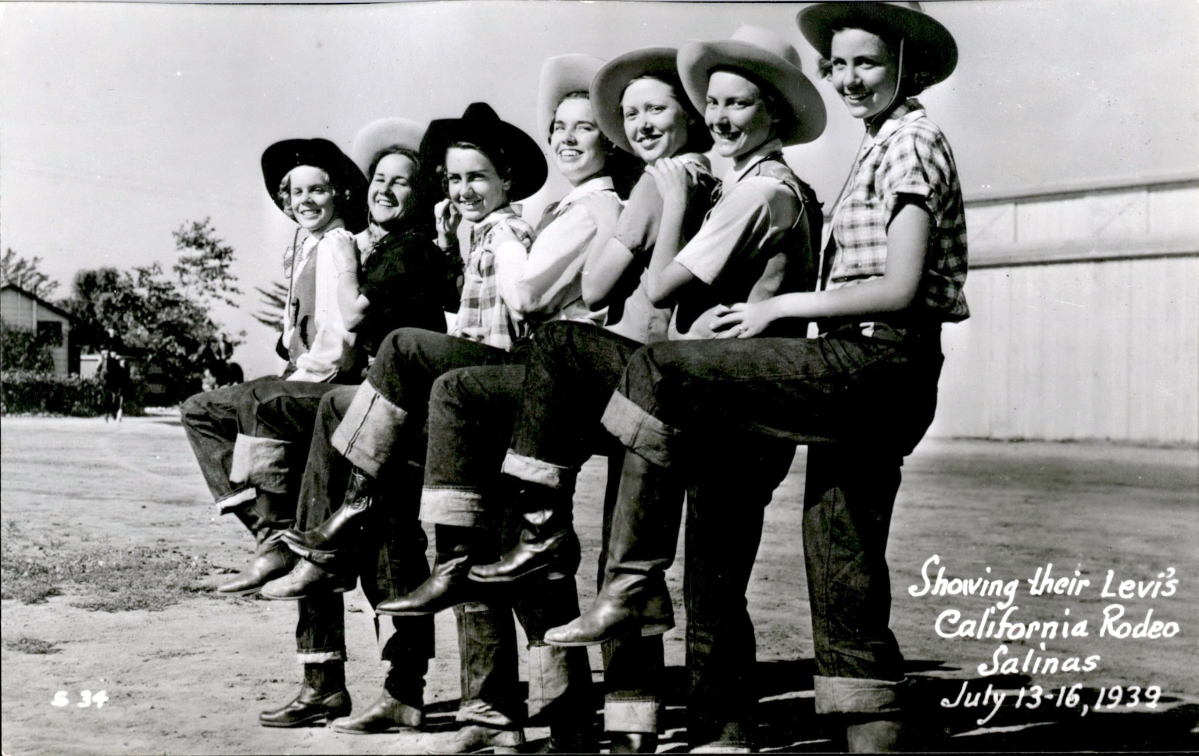
                             Rodeo cowgirls in their Levi's.

Real cowboys were used in many of the early two reel western movies and so were blue jeans, rolled up at the bottom to display highly tooled Texas styled boots.  Little boys and little girls across the country saw and wanted the same look.  Soon Levis and other jean companies had a whole new market.  But school officials, churches, and places like theaters often found jeans unacceptably informal and they were banned from those places routinely.  Which helped give the pants the extra allure of forbidden fruit.

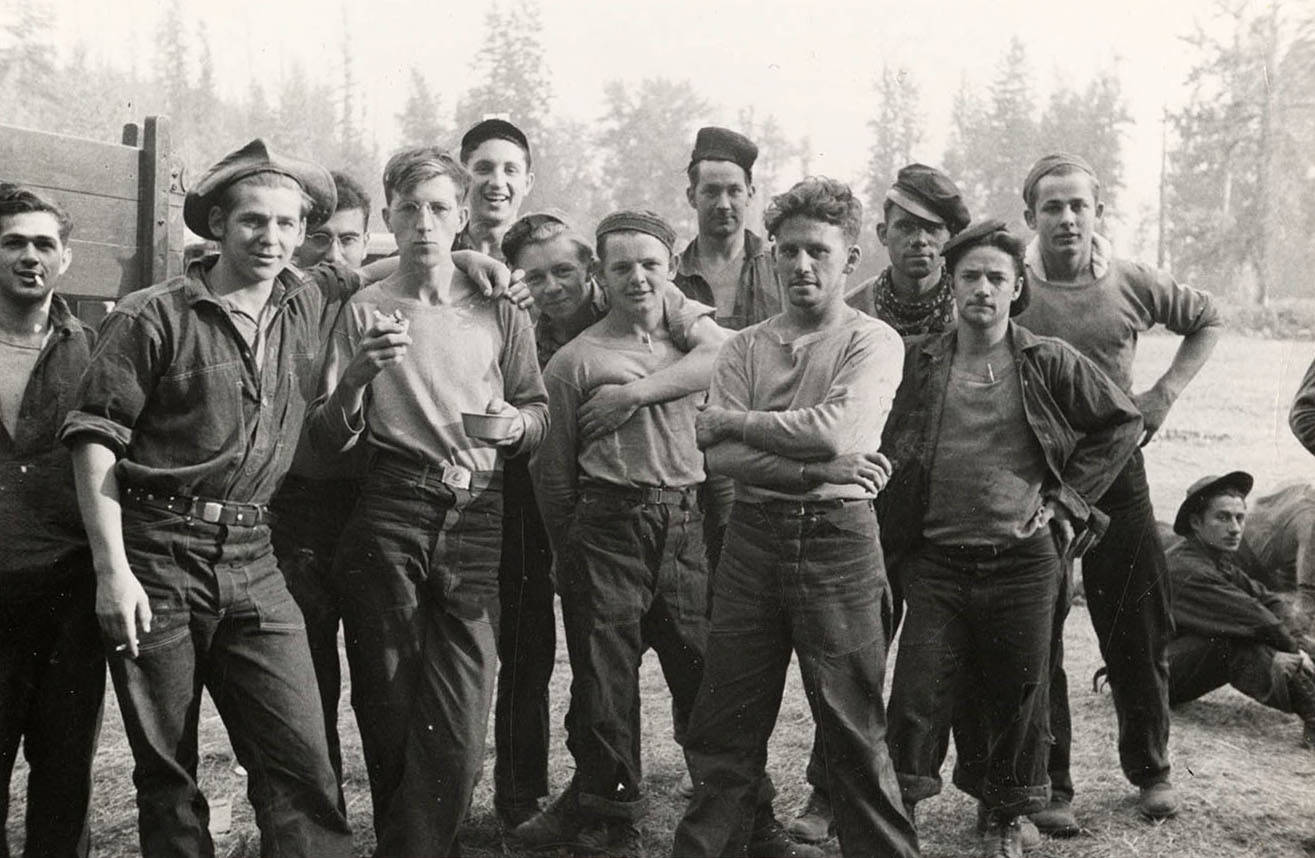
Jeans also spread slowly east as they were adopted by more and more factory and construction workers.  Hundreds of thousands of men first encountered them in Civilian Conservation Corps (CCC) camps during the Great Depression.  During World War II the Army issued loose fitting dungarees as fatigues for stateside duty.  Navy enlisted men eschewed traditional white bell bottoms for a tighter fitting style of jeans for everyday work and battle wear aboard ship.  And women flocking to the defense plants got their own jeans—usually buttoning up the side instead of the front.

CCC Fire Crew | Civilian Conservation Corps in Idaho Collection

                     An Idaho CCC fire fighting crew in blue dungarees.

After the war both sexes took to wearing jeans as weekend wear or for chores like gardening.  When James Dean wore a pair in Rebel Without a Cause, they became the instant uniform of rebellious youth.  Marilyn Monroe did the same thing for tight fitting, shape enhancing jeans for women in The River of No Return.


                                                It turned out that James Dean's jeans made a more enduring fashion statement than his red jacket in Rebel Without a Cause.

In 1973 Levis revolutionized the jeans business by introducing their 501 Jeans which were preshrunk.  It was now possible to buy jeans close to the size you could actually wear—being made of cotton there was still some, although much less, shrinkage.  That also meant you could buy jeans the right length.  Good bye rolled up pant legs.  Other manufactures followed.  Jeans also generally replaced the traditional fly buttons with heavy duty copper zippers.

The first pre-washed jeans and decorated jeans were introduced by retailers in New York City in the mid ‘60s inevitably leading to the era of designer jeans.

1982 #JordacheJeans // Jordache.com

                                                        My jaw dropped at the price of Jordache jeans with embroidered pocket that daughter Carolynne "had to have" in the '80s.

Today, even though their peak popularity in the 1980’s has passed, jeans are still probably the most common leisure and work wear in the United States.  Most people own three or more pair at any time.  And the look has been just as popular in France where the fabric originated and where nearly as many jeans are now sold annually as in the United States.

Kathy and the Old Man in sport coat, jeans, and a new dress hat rocked New Years Eve at Tree of Life in 2025