Showing posts with label patent. Show all posts

Thursday, May 21, 2026

Cyrill Demian, the Squeeze Box and Why Momma Doesn't Sleep


A French peasant in his smock and wooden sabots dances with his wife at village café in this early post card.

I’ve heard it called the second most dreaded instrument in the world, after the banjo.  But I am partial to the banjo.  I admit to having a harder time warming up to the accordion which I associate mostly with amateur musicians in local talent contests, and polka, a popular form of dance music to which I never took a shrine to even though my wife’s father Art Brady and her uncle Al Wilczynski played on Chicago radio in successful polka bands after World War II.

But I may have been harsh in my judgment.  It turns out that the instrument can be versatile and applied to a wide range of musical styles.  It also made making music affordable, portable, and easy to learn for the working poor of Europe, many of who participated in one of the great mass migrations in human history.
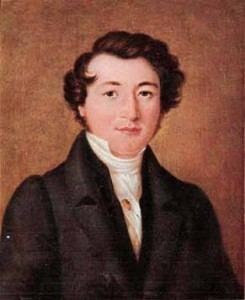

                                Although others may have preceded him, Cyrill Demian got the first patent on an accordion and is generally credited as the inventor.

We can credit—or blame—Cyrill Demian, an Armenian piano and organ maker who was living in Vienna, Austria.  On May 23, 1829 he was granted a patent on a new musical instrument that he called the accordion.  In his application papers he described it thusly:

Its appearance essentially consists of a little box with feathers of metal plates and bellows fixed to it, in such a way that it can easily be carried, and therefore traveling visitors to the country will appreciate the instrument….It is possible to perform marches, arias, melodies, even by an amateur of music with little practice, and to play the loveliest and most pleasant chords of 3, 4, 5 etc. voices after instruction.

Demian was not the first one to tinker with a portable instrument using free reeds which produce sound as air flows past them vibrating the reed in a frame.  Nor was he the first to use a bellows device to produce the airflow rather than direct wind from blowing in a tube or from air pushed from mouth-inflated bags.  Some Russian instrument makers had employed bellows boxes as early as 1820.  Christian Friedrich Buschmann is often credited with building the first such instrument in Berlin in 1822.

But it was Demian who obtained a patent and who went into commercial production on at least a modest scale.  The left hand on the bellows box musicians could press buttons regulating air flow over the reeds.  An entire chord could be produced by depressing a single key. There were only eight buttons in the model described in the patent, but he noted that more could be easily added. There were no buttons or keys on the right side, the player used the strength of the usually dominant arm to push and pull the bellows. Demian’s instrument was bisonoricit could produce two different chords with the same key, one for each bellows direction.

Whoever has the best origin claims, the accordion was clearly an instrument whose time had come.  Its popularity spread like wildfire, especially in Russia and Eastern Europe, but soon in Italy, Germany, and France as well.  It seems like every maker made his “improvements.” Dozens of different button arrangements were designed.  Some were unisonic, producing the same notes or chords on the draw or the push.  In Eastern and Southern Europe, they were tuned to be able to play in minor keys.

By the mid 1830’s tens of thousands were being produced in centers across Europe.  They were sold mostly to amateur musicians or to the lowest grade of professional—those who played in cafés and taverns or on the street for tips.  The instruments were easy to learn and to become proficient on and perfect for playing by ear.  They were also loud and easily heard.  Most importantly they could be used to play traditional folk music of all sorts of people.  The accordion could assume the voice of a church organ, a violin, various stringed instruments, and horns.  And the player was free to sing along.  Some played single notes instead of chords so they could be used to play melody, often in combination with other accordions playing chords and harmonies.

Accordions reached London by 1832 where newspapers reviewed public performances poorly.  But they rapidly caught on with the public.  They were demonstrated in New York City in 1841.

In 1844 English inventor Charles Wheatstone came up with a compact instrument which could play both chords and melody in one squeezebox. He called it a concertina.  In different forms they became very popular in Italy as well as in the British islands and were favored by sailors who took them around the world.

But it was the political turmoil of the 1848 Revolutions that swept Europe, the Irish Famine, and decade of pogroms in Russia and Eastern Europe that gave squeeze boxes of all types of legs.  Refugees and immigrants brought them wherever they went along with the familiar folk songs of home.  Many, of course came to the United States.


M. Hohner company of Germany mass produced early accordions like this which quickly swept Europe.

In the late 1800’s the piano accordion was perfected in Germany.  Larger and heavier than most other instruments, the right hand played melody on a piano keyboard of white and black keys while arrays of buttons on the left side played an array of chords in multiple keys.  The instrument became popular with professional pianists and organists who felt comfortable on it and who appreciated the musical possibilities it offered.  Honer, one of the principle German manufacturers, encouraged this and promoted its piano accordions as concert instruments and began publishing transcriptions of classical music for it.

One result of that was its use in formal ballroom dance styles which were being written by the finest composers in Europe.  These included waltzes but especially polkas.  This was, at the time, considered a major break from being rooted in folk music styles.  The dances, however, especially polkas, became very popular with Poles and Germans, many of whom immigrated to the United States.  Semi-trained emigrant and American musicians began writing their own lively Polkas that were far less refined than those played where dashing officers in comic opera uniforms swept the floor with belles in enormous dresses.  German immigrants brought these kinds of polkas and accordions to the Rio Grande Valley, where they became the basis of Tex-Mex Music and can be heard in Mariachi.


                                    Less than two decades after its introduction in England, this young Black boy was playing a concertina as a Union Army musician.

Eastern European Jews brought their special accordions along with traditional melodies and Klezmer music evolved, eventually incorporating jazz elements.  And speaking of jazz, in multicultural New Orleans Black musicians incorporated accordions into their street marching bands and with riffs from Spanish military music and the distinctive Acadian sound of the bayous.  Many early jazz bands included accordions.


Mother Maybelle Carter and the Carter Sisters on the Grand Ol' Opry with Anita Carter on accordion.

They began to encroach even on traditional fiddle, guitar, and banjo Appalachian and Southern folk music.  Mother Maybelle Carter sometimes played one, as did her daughter June.  Accordions were incorporated into many bands, even on the super traditionalist early years of the Grand Ol’ Opry.  Bill Monroes Bluegrass Boys sometimes included an accordionist.


Piano accordion playing twins entertain at a mid-'60' USO show.

The so-called golden age of American accordion really took off with the huge popularity of Pietro Frosini and the two brothers Count Guido Deiro and Pietro Deiro who performed largely classical repertoire on the American concert and vaudeville stage in the early decades of the 20th Century along with Honer’s relentless promotion.  Music schools began offering classes and music stores offered the instruments on time.  Although not cheap, the instruments were less expensive than pianos or home organs, so parents enrolled their children in classes by the hundreds of thousands well into the 1950s.  Despite the heavy weight of piano accordions, they were especially popular among young women.  Accordion ensembles were common.  There were even accordion marching bands.


The Johnny Vednal Orchestra was a popular Cleveland polka band of the 1950's. Note the bandstand admonition.

Dance bands like Paul Whitman’s, Guy Lombardo and the Royal Canadians, and, of course, Lawrence Welk featured accordions, but so did more cutting-edge swing bands.  In the early years of rock & roll the accordion was alongside the chattering saxophones at the heart of several bands.


Buckwheat Zydeco introduced jazzy Cajun style music to a new generation in his folk festival appearances and roots music concerts.

But eventually the guitar triumphed as THE instrument of rock & roll, and the extended folk revival drew many young people to abandon the accordion, which was now seen as hopelessly square, in favor of six strings.  By the early 21st Century it had virtually disappeared from popular music except for novelty acts like Weird Al Yankovic and  Judy Tanuta. 

Today, partly because they have been out of favor for so long that they have become ironic, accordions are reappearing in cutting edge music.  They may even become hipster like little fedoras, skinny ties, and bushy beards.


Wednesday, May 20, 2026

The Man Who Put America in Denim With a Murfin Memoir Growing up in Jeans


In high cowboy blue jean splendor for Cheyenne Frontier Days circa 1958 or '59--Tim Murfin, next door neighbor Sharon Niddlekoff, Patrick, and cousin Linda Strom.

Like most American guys, I grew up in my blue jeans, at least after my twin brother and I prevailed upon our mother not to make us go back to school in corduroy slacks and suspenders for-christ-sakes.  We had to have them.  All of our favorite cowboys in the old two reel westerns that played on TV every afternoon wore them and so must we.  We rolled the bottoms up, which was good for mom, because they gave us growing room.  A sturdy pair could last a couple of years.  When they inevitably wore out at the knees, Mom would repair them with iron-on patches.

Mom was too cheap to pay for Levis or Lee Riders.  She generally stocked up on ours with store brands from J.C. Penneys or Montgomery Wards.  Like real Levis, they were stiff and scratchy when new—chapped the hell out of my inner thighs when I walked.  Mom liked that look and at first starched our jeans to preserve it.  Stopping that was an epic battle all its own.  The dye in these off brands ran even more than Levis.  Our Jockey Shorts were the same color of blue as an old church lady’s hair for the first few wearings.  Eventually, however, the jeans settled down to soft comfort and a far lighter hue. Neither of the high schools I attended allowed jeans at school.  But I was out of slacks as soon as possible after school and on weekends.  They were all I took to college, except for one pair of slacks for chapel services and faculty dinners.

From then on, it was all about the jeans.  I will even admit to a pair or two of elephant bells, then flairs and boot cuts before going back to old straight leg jeans like I wore in school.  But now I could buy them by length as well as waist so no more roll-ups.  I settled into a daily uniform of jeans and a chambray work shirt, denim pearl snap, or plaid flannel depending on the season.  So did a lot of other guys. 


 At an IWW CTA fair hike picket in Chicago in 1970--boot cut jeans and a fringed leather hippie sash for flare.

By the time I was in my mid-40s I had teen-age daughters who were all about designer jeans.  I remember the near heart-attack the first time Carolynne demanded a pair of Jordache jeans that cost more than I made in a day.  I grew even more perplexed and outraged when first stone wash, then acid wash, and finally pre-worn complete with rips and tears became teen must-haves. 

It was all about denim in the ’80s.  But fashion was also pressing prices of my work-a-day attire of choice up.  Wranglers, the least expensive of the big three brands got to $40 a pair and house brands only $5 or so less.  To keep my daughters fashionable, I sank to the cheapest jeans of all—no-names from discount houses.  The dye wasn’t really denim blue, it was a sort of purple and the stitching was in white thread instead of gold or blue.  They tended to fall apart after two or three washings, so the $5 investment in a pair was not worth it.

I swallowed hard and began paying the damn $40.  But not for long.  My body was changing—and not for the better.  Jeans made for 20 year olds didn’t fit right anymore and even relaxed fits or embarrassing pairs with elastic waist bands did not entirely solve the problem which was caused by the combination of my expanding waistline, lack of ass, and short, stubby legs.  My funny looking body made up its 6’2” height in a freakishly long torso.  I started wearing pants out not in the knees, but along the seams of the crotch where the material began to pull apart after just a few washings.  After my last pair of $40 jeans bit the dust in this way after only a dozen or so launderings, I had enough.

I gave up my beloved jeans, which were as much a part of my identity and image as my cowboy hats.  But khaki slacks were $15 a pair if you took a pass on Dockers and bought the house brands at Wards or K-Mart.  And they were versatile.  They were fine for everyday wear with just a buttoned sport shirt.  Throw on a dress shirt, tie, and sport coat and they were fine for almost all business and dress up occasions short of a wedding or a funeral.

For my work as a school custodian I got blue work pants to go with my uniform shirts.  The same worked when I began working second jobs as a gas station/convenience store clerk. When I had the part-time job as maintenance at a local mall, I had similar brown twill pants for my tan shirts.

But most of the time it was khakis for many years, a choice made by a lot of other duffers and men who just don’t give a damn anymore.  I never had to match my pants with my shirt or jacket.  Didn’t have to even think about them.  Just pulled ‘em from the closet and put ‘em on until the cuffs frayed or I stained them with some kind of food or drink catastrophe.  Even then they were good a while longer to mow the lawn in or do other dirty work that I couldn’t shirk or avoid.

                                The khaki years.  Reading poetry at a Tree of Life coffee house circa 2016.

I got older yet and began to see men my age still in their jeans.  A lot of them looked good.  They looked comfortable.  Some, the guys with big bellies like mine hanging over the belt and pushing the jeans down past the ass crack, looked ridiculous.  But not as ridiculous as the guys in sweats, cargo pants, and most shorts.  I may have been square, but at least I had my dignity.  Or so I told myself.

Then about ten years ago I found some house brand jeans that looked durable for about what I was paying for my khakis.  I bought a pair on a whim.  They were roomier than what I wore in my younger days but skinny jeans are just for young dudes and hipsters.  The pants were comfortable.  I bought another pair and then another.

Takin' the jeans to the street for a Black Lives Matter march in Crystal Lake.  Daughter Maureen derided these Menard's sale jeans as baggy and droopy for old men.

After I retired from my day job they were about all I wore except for church on Sundays then after a while decided that a sport coat and jeans were as acceptable as a jacket, tie, and khakis.  Since the Coronavirus lock down, I haven’t worn anything else.  But that still makes me more formal than the many guys my age who haven’t been out of sweats or shorts

All of this is a useless, rambling introduction to the true topic—tomorrow is the official birthday of blue jeans as we know them.  On May 20, 1873 Levi Strauss and Jacob Davis obtained a patent on a new style of rugged and durable work pants.


Levi Strauss about the time he was establishing himself in San Francisco. 

Strauss was born to an Ashkenazi Jewish family in Buttenheim, Germany on February 26, 1829.  When he was 16 he accompanied his mother and two sisters to the United States to join two brothers who had an established J. Strauss Brother & Co a successful wholesale dry goods business in New York City.  Young Levi moved quickly to Louisville, Kentucky where he dealt in his brother’s dry goods.

After the Gold Rush of 1849 Levi was selected by the family to open up operations in bustling San Francisco where one sister was already in residence.  He arrived by ship from New York in 1853 with a load of goods from his brothers and set up an emporium he called Levi Strauss & Company.  He resisted the impulse of other would-be merchants to go to the gold fields to find riches in the mines, a decision that ruined most of them.  Instead he was content to collect the gold from the miners by supplying them with hard-to-get-dry goods at steep prices.  With the added cost of transportation by ship and merchandise of all types scarce, Strauss was able to charge all that the market would bear and still thrive.


Employees of Levi Strauss & Company circa 1880--mostly office workers and clerks but three men sitting on or standing by a crate are wearing the company's signature jeans both over and tucked into boots.

His well-established business outlasted the Gold Rush and was soon supplying goods to far flung corners of the rapidly developing West.  A big demand was always for durable trousers that could hold up under the rugged conditions of placer and hard rock mining.  In 1872 a major customer of Straus’s fabric, a tailor named Jacob Davis approached Levi with an idea to reinforce pockets and other points of stress like the bottom of the fly with copper rivets.  The pair entered business together and obtained their patent for “Improvement in Fastening Pocket-Opening.”  They called their product waist overalls, because they eliminated the bib common on a lot of work pants.


 Hard working miners seldom looked this neat in Levi's products as in this advertisement .  Note denim blouse--the ancestor of today's popular jean jackets.

Legend has it that the first pants were made from coarse brown duck fabric.  And some early pairs were made this way.  But the company soon found denim, by tradition dyed blue, was far more durable and was marketing most pairs in that fabric within the first year.  In an early example of trademark branding, the company began to affix a leather tag to the back of the waist band with an illustration of two mules trying to pull a pair of trousers apart.  The illustration of strength helped sell the product, which was ubiquitous among miners and other hard working outdoor laborers in the West by the turn of the 20th Century.


Levi Strauss' trademark and label advertised the rugged strength of the pants.

Some folk believe that Strauss introduced denim to the States, importing his fabric from Nimes, France where it had been produced for centuries.  But Strauss bought his denim from well-established American weavers and dyers who had been producing the cloth for decades for use in overalls and dungarees. 

Many fabrics were commonly used for work pants—home spun, coarse woolens, and Irish laborers introduced mole skin.  Dungarees were among the most common.  They were originally made from Dungi, a durable and heavy cotton fabric first used as sail cloth and imported by the English from India.  Like European denim or jeans, the cloth was commonly dyed with indigo.

As early as the Revolutionary War George Washington specified blue died dungarees as the field uniform of artillerymen who often had to do hard labor moving heavy cannon over muddy ground.


                                                The Master of the Blue Jeans portrayed this beggar boy in a tattered jean jacket circa 1600.

Dungi was similar to, but not identical with denim and jeans, two fabrics which originated in Renaissance Europe.  Jeans were originated in Genoa, Italy in the 17th Century.  The material was a kind of fine wale cotton corduroy which was died blue and became in inexpensive fabric widely used in work garments of the poor.  An unknown artist now known simply as the Master of the Blue Jeans left 14 exquisite paintings of poor people in the easily recognized fabric.

Soon another fabric center, Nimes, was trying to duplicate the cloth that they named after the French pronunciation of Genoa—Gênes.  The fabric of Nimes was not identical to the original.  It was coarser and heavier, although nearly identical in color.  Because it was heavier it was popular in work smocks and jackets and was also used as a cover for merchandise lashed to the decks of sailing ships.  Their fabric became known as d’Nimes—literally of Nimes—or denim.

By the early 19 both fabrics were circulating in world trade and manufactures in Britain and the United States began to copy them.  Jeans and denim became interchangeable.

Early American work pants were very loose fitting often held up by one incorporated diagonal strap running from the waist on one side to the opposite shoulder or were bib style.  When no strap or bib was present they were held up by suspenders.  Sailors often wore light cotton pants held up by rope belts.  But belts were uncommon in most men’s pants.

When Levi introduced belt loops to some models of their jeans around the turn of the 20th Century, the pants quickly gained wide acceptance with another group of rugged outdoor workers—cowboys—who found that suspenders often snagged on brush or gear.  Range photos show that the adoption spread quickly.

 Levi Strauss: A History Of American StyleAntiques And The Arts Weekly

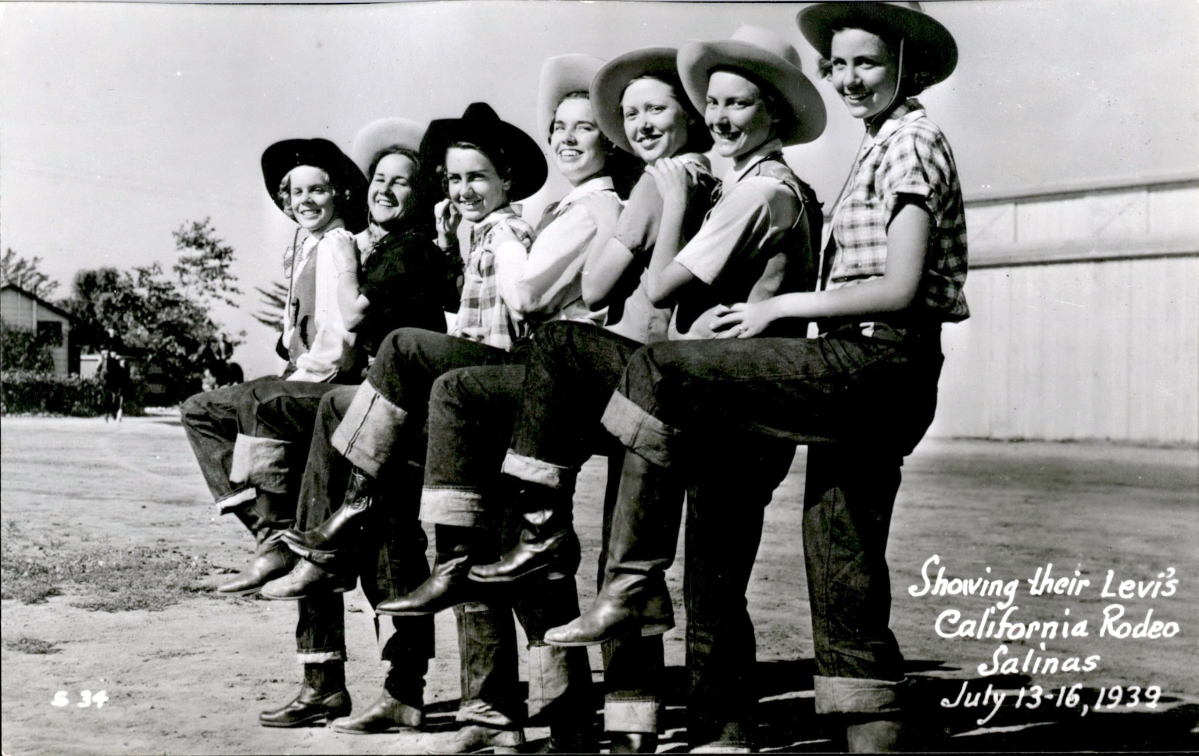
                             Rodeo cowgirls in their Levi's.

Real cowboys were used in many of the early two reel western movies and so were blue jeans, rolled up at the bottom to display highly tooled Texas styled boots.  Little boys and little girls across the country saw and wanted the same look.  Soon Levis and other jean companies had a whole new market.  But school officials, churches, and places like theaters often found jeans unacceptably informal and they were banned from those places routinely.  Which helped give the pants the extra allure of forbidden fruit.

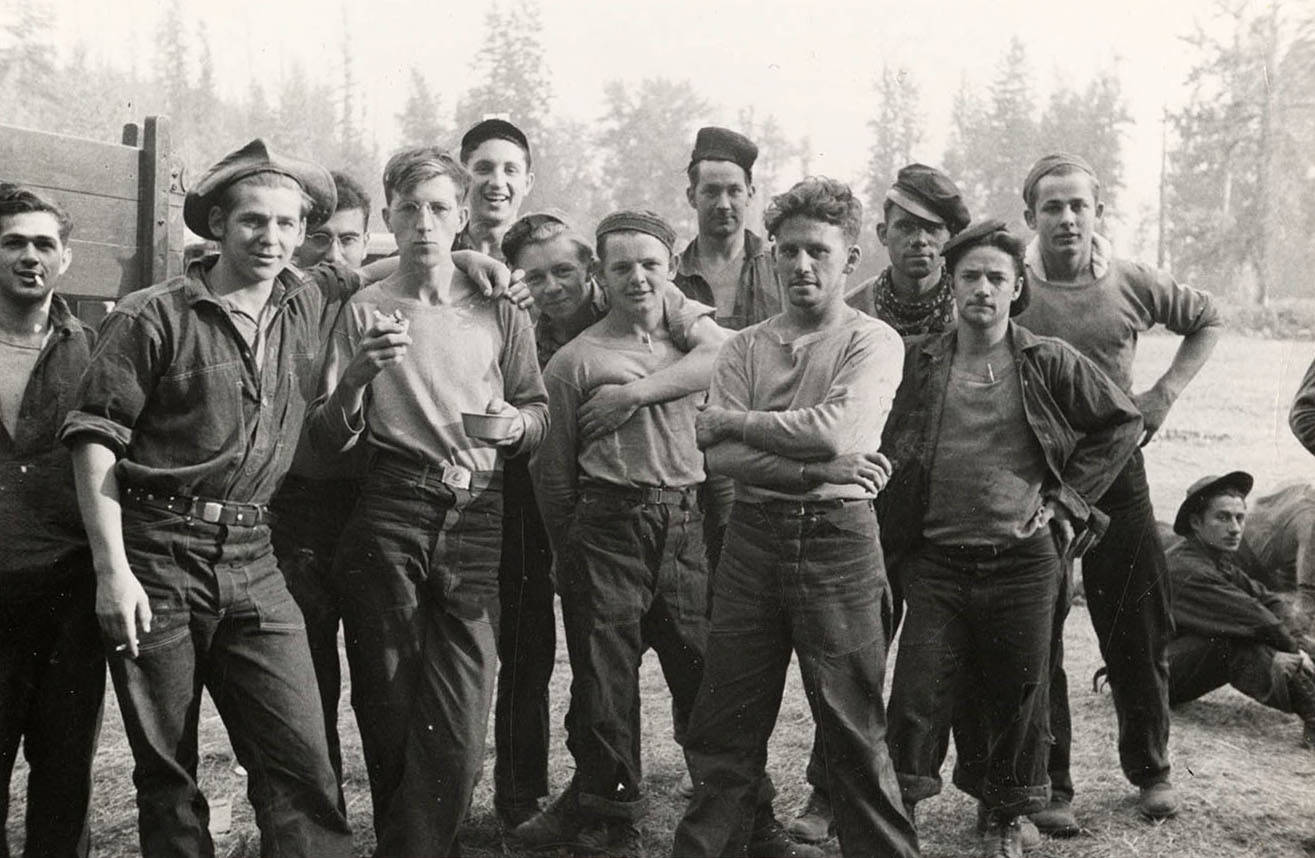
Jeans also spread slowly east as they were adopted by more and more factory and construction workers.  Hundreds of thousands of men first encountered them in Civilian Conservation Corps (CCC) camps during the Great Depression.  During World War II the Army issued loose fitting dungarees as fatigues for stateside duty.  Navy enlisted men eschewed traditional white bell bottoms for a tighter fitting style of jeans for everyday work and battle wear aboard ship.  And women flocking to the defense plants got their own jeans—usually buttoning up the side instead of the front.

CCC Fire Crew | Civilian Conservation Corps in Idaho Collection

                     An Idaho CCC fire fighting crew in blue dungarees.

After the war both sexes took to wearing jeans as weekend wear or for chores like gardening.  When James Dean wore a pair in Rebel Without a Cause, they became the instant uniform of rebellious youth.  Marilyn Monroe did the same thing for tight fitting, shape enhancing jeans for women in The River of No Return.


                                                It turned out that James Dean's jeans made a more enduring fashion statement than his red jacket in Rebel Without a Cause.

In 1973 Levis revolutionized the jeans business by introducing their 501 Jeans which were preshrunk.  It was now possible to buy jeans close to the size you could actually wear—being made of cotton there was still some, although much less, shrinkage.  That also meant you could buy jeans the right length.  Good bye rolled up pant legs.  Other manufactures followed.  Jeans also generally replaced the traditional fly buttons with heavy duty copper zippers.

The first pre-washed jeans and decorated jeans were introduced by retailers in New York City in the mid ‘60s inevitably leading to the era of designer jeans.

1982 #JordacheJeans // Jordache.com

                                                        My jaw dropped at the price of Jordache jeans with embroidered pocket that daughter Carolynne "had to have" in the '80s.

Today, even though their peak popularity in the 1980’s has passed, jeans are still probably the most common leisure and work wear in the United States.  Most people own three or more pair at any time.  And the look has been just as popular in France where the fabric originated and where nearly as many jeans are now sold annually as in the United States.

Kathy and the Old Man in sport coat, jeans, and a new dress hat rocked New Years Eve at Tree of Life in 2025


Saturday, February 21, 2026

Father and Son Latimers Each Illuminated History


                                 George Latimer as a fugitive slave in 1842,

Lewis Howard Latimer was born in Boston on December 4, 1848.  How that came to be is an epic story in its own right. 

His father, George W. Latimer, the son of a White man and an enslaved mother, and his wife Rebecca fled from slavery in Virginia by ship.  Traveling north via Baltimore and Philadelphia with prices on their heads and pursued by slave catchers, the young couple arrived in Boston on October 8, 1842.  By mischance Latimer was spotted by a Virginian who recognized him as the slave clerk in James Grays Norfolk shop.  He was immediately arrested under the Fugitive Slave Act of 1793 to be held until his master could claim him. 

The case aroused uproar among the growing number of abolitionists in the city.  In fact, this became the first time they were roused to public action to protect and free an escaped slave—a landmark in the evolution of the movement.  One attempt was made to storm the jail to free the prisoner.  Later, when an agent for Gary arrived in town, hundreds surrounded the jail to prevent him from being removed.  Historically significant lawsuits were launched in Latimer’s defense.  Tensions rose between the abolitionists and pro-slavery forces in the city including warring pamphlets and publications.  The Latimer and North Star Journal was a newspaper issued several times a week edited by Henry Ingersoll BowditchWilliam F. Channing, and Frederick Cabot.  Public meetings were held, including one at Faneuil Hall, where attendees not only vowed resistance to slave-catching but also voted for disunion if Federal enforcement of the Fugitive Slave Act continued. 

Latimer Committee circulated two petitions, the Great Massachusetts Petition and the Great Petition to Congress, about the case.  The former demanded a law banning the involvement of state officials or public property in the detention or arrest of suspected fugitives and was delivered to the State Assembly containing 64,526 signatures and weighing 150 pounds.     

Representative John Quincy Adams laid the Federal petition before Congress where it was immediately tabled and condemned setting off years of conflict between the former President and the Southerners who controlled the House of Representatives. 

Eventually, in 1843 Massachusetts adopted the Personal Liberty Act, or Latimer Law based on the demands of the petitions.  The new Federal Fugitive Slave Act of 1850, among other things, voided the Massachusetts law and similar statutes adopted by other Northern states and compelled local authorities to assist slave catchers. 

Meanwhile, the Latimer Committee raised $400 to finally purchase George’s freedom from Gray.  The Committee gave rise to the organization of the New England Freedom Association and encouraged collective action in the Black community of Massachusetts. 

Upon gaining his freedom George Latimer became an active abolitionist himself.  He prospered as a paper hanger and together with his wife raised four children, the youngest of them Lewis.  In gratitude for the support of the abolitionists who helped secure their freedom, the family joined and remained active members of a Unitarian congregation from which many supporters had come. 


Although the United States Navy became rigidly segregated in the 20th Century, during the Civil War Black sailors like this young recruit served along side Whites on integrated ships.

Lewis, like the other Latimer children, received a good education and literally grew up in the abolitionist movement.  Naturally, when the Civil War broke out, he was eager to serve but frustrated by his youth.  Finally on September 16, 1863, just days after his 15th birthday, he lied about his age—not that authorities were all that concerned—and enlisted in the Navy.  He served as a Landsman, then the lowest enlisted rank performing common labor aboard the USS Massasoit, a side wheel steam gunboat.  He was on board for anti-raider patrol along the New England coast and then blockade and picket duty of Virginia ports and on the James River.  In January of 1865, the Massasoit engaged in a dual with shore batteries at Howlett’s House Latimer was honorably discharged in July 1865. 

Returning to Boston the 17-year-old, perhaps via his father’s contacts in the abolitionist movement, was able to secure employment as an office boy with the patent law firm of Crosby Halstead & Gould for $3.00 per week.  While sweeping floors, emptying trash cans, and running errands, Latimer carefully observed the office’s draftsmen preparing patent applications.  He bought his own drafting tools and began practicing at home.  Within a few years he was promoted to draftsman and by 1872 was head draftsman pulling down a respectable $20 a week.  That was still, however, less than the White men he supervised were paid. 

On the strength of such prosperity Latimer was able to marry Mary Wilson Lewis of Providence, Rhode Island the next year.  The couple had two daughtersEmma Jeanette in 1883 and Louise Rebecca in 1890. 


                                            The sketch from lewis Latimer's first patent for a railway toilet system.  It would not be his last.

Working as a draftsman sparked Latimer’s own interest in invention.  In 1874 he and Charles WBrown co-patented the Water Closet for Railroad Cars, an improved toilet system for passenger cars. 

It was a remarkable achievement, and the young man was getting noticed for his skills.  One who took note was a teacher of the deaf, Alexander Graham Bell.  In 1876 Bell built and used telephone device in his laboratory.  He knew that others were doing similar work and a race to be first to file a patent was on.  Bell contacted Latimer and the two of them worked together furiously at night after spending their days at their regular employment, to prepare the application which was filed just four hours before Bell’s competition filed.  Latimer testified in the complicated legal challenges to Bell’s patent by his competitors. 

After 11 years with Crosby Halstead & Gould, Latimer was ready to strike out on his own.  In 1879 he re-settled his family, including his extended clan of siblings to Bridgeport, Connecticut, then a leading industrial center known for its technological innovation and where the mayor was showman, liberal reformer, and Universalist P.T. Barnum.  Latimer was hired as assistant manager and draftsman by Hiram Maxim, a rival of Thomas AEdison for his U.SElectric Lighting Company. 

Although Edison invented and demonstrated his incandescent light bulb, it was still not practical for extended use because the paper filament he used would burn out within hours.  If you watched the bio-flick Edison, The Man with Spencer Tracy you may think that the great man got the idea to char bamboo fiber to create a carbon filament from gazing at his fraying fishing rod.  That would be a mistake. 


                                            Lewis Latimer, light bulb pioneer in 1882.

In 1881 Latimer working for the Maxim company, won the patent for the Process of Manufacturing Carbons that made the light bulb practical.  Edison was irked but recognized Latimer’s talent.  In 1884 he hired Latimer away for his Edison Electric Light Company in New York City as a draftsman and an expert witness in patent litigation on electric lights.  With Edison, he became a key member of the team working on development of electric lighting.  He made further improvements to the filament and invented or made significant contributions to other essential improvements—the threaded socket; the oven, chemicals, and glassblowing equipment for the globe; and a new switch.  In the field, he was trusted by Edison to oversee installation of public lighting systems in New York, PhiladelphiaMontreal, and London. 


Latimer vastly improved Thomas Edison's incandescent light.  He improved the method and tools to make carbon filaments and the switch seen here.   Most importantly was his development of the screw base which meant bulbs could easily and universally be replaced without having to be hard wired into circuits.

Of course, Edison took credit for these innovations.  But he valued Latimer and paid him well, including stock in what became General Electric.  In 1918 he was the only African American selected as one of the 28 charter members of Edisons Pioneers. 

Latimer continued to tinker on his own and filed more patents including one for a locking coat and hat rack to combat the chronic theft from restaurants, barber shops, and other establishments.  He also patented an apparatus for cooling and disinfecting, an early forerunner of air conditioning. 

By the turn of the 20th Century, he was if not a truly wealthy man, he was a very comfortable one.  Along with other leading Black intellectuals at the time, he insisted on full equality of opportunity for his race.  He built a large, elegant house in developing Flushing Queens, an all-White neighborhood.  In 1908 he became a founding member of what is now the Unitarian Universalist Congregation of Queens. 


                                                      Latimer inscribed this photo to his wife in 1919 at age 70.

He was a man of wide-ranging interests.  He played violin and flute, occasionally hosting house concerts with his daughters, He wrote and published a book of poetry and wrote and produced a play.  In his 1890 book Incandescent Electric Lighting: A Practical Description of the Edison System Latimer waxed poetic about the achievement, “Like the light of the sun, it beautifies all things on which it shines, and is no less welcome in the palace than in the humblest home.” 

Latimer died on December 11, 1928 at the age of 80 mourned in the small circle of his fellow electrical pioneers, in his community, and in his congregation.  The general public scarcely knew of his existence. 


The Lewis Latimer home and museum in Flushing, New York City.

His granddaughter, Winifred Latimer Norman, a member of Fourth Universalist Society in New York, became the custodian of his legacy and worked tirelessly to bring his accomplishments to light.  She saw her childhood home moved to a Flushing park where it stands today as a museum maintained by the National Park Service.  An apartment complex and a public school in his old neighborhood are named for him.  At his old congregation, his portrait hangs in place of honor as a founder.  The granddaughter died on February 6, 2014, at the age of 100.