Showing posts with label public works. Show all posts

Friday, November 8, 2024

The New Deal Sneak Preview to the WPA Was a Hit

This symbol of the Civil Works Administration seven month pilot program was placed on, many of the brick and mortar public works projects built.
 
Note--This Blog resumes regular service. Pati et vincere anglicus.

On November 8, 1933 President Franklin Delano Roosevelt announced plans to create the new Civil Works Administration which, he said, would provide up to 4 million jobs for the unemployed while doing important work building roads, bridges, sewer lines, and other infrastructure.  In a 5 month run over the winter of 1933-34 over a billion dollars was spent putting people to work.

The basic idea was improved and expanded upon as the Works Progress Administration (WPA) funded by Congress in the Emergency Relief Appropriation Act of 1935.  The WPA was on its way to becoming the single biggest program of the New Deal under the personal supervision of FDR’s most trusted aide, Harry Hopkins.


 By 1933 unemployment was staggering--approaching a third of the work force in some cities and even higher in small, one industry towns.  Here men are lined up in a bread line that wraps around a block. Agitation like the Bonus March by unemployed veterans in 1932 and a return march the next year and raucous demonstrations of the unemployed led by the Communist Party, IWW Unemployed Workers Unions, and anarchists were scaring the crap out of business interests who began to fear revolution.  The Roosevelt Administrations public work employment projects were a safety valve against such an explosion.

Unlike the companion Civilian Conservation Corps, which was designed for younger workers, many of them single, to get them out of the cities where they might otherwise become idling malcontents and easy prey to Reds and agitators, the WPA was aimed squarely at economic heads of households to provide employment where they lived.  This meant that the overwhelming majority of enrollees were men.  Where women were enrolled, their husbands were typically absent, disabled, elderly, or had been unable to find work in at least 5 years.

To counter concerns by the labor movement that public employment would undercut union wages, pay was figured on an adjustable scale dependent on whether the area was urban or rural, local cost of living, and prevailing wages.  To counter employer fears that workers would never leave government jobs when private employment picked up, workers were limited to 30 hours per week.  In the work-starved Depression years, a WPA job meant a livable, but not generous support for families.

After some early stumbles, Blacks, Native Americans, and other minorities were represented at or above their percentage of the workforce.  In the South, however, work gangs were segregated, more advanced jobs limited or forbidden to Blacks, and wages unequal.  


The originally conceived public works projects changed the face of America transforming both the urban environment and a road system that at the beginning of the Depression was still built for the horse and wagon.  By June of 1941 the WPA reported that over $4 billion was spent on highway, road, and street projects; more than $1 billion on public buildings; and more than $1 billion on publicly owned or operated utilities.

But the range of work undertaken was astonishing.  Women were employed in sewing projects that produced uniforms for the CCC and military.  There were programs to distribute surplus commodities and provide school lunches.  A popular program built libraries and provided library services, including bookmobiles to under served rural and urban areas.

One of the most controversial aspects of the WPA was its programs to provide work for the white collar unemployed, as well as laborers.  WPA projects employed engineers, draftsmen, accountants and bookkeepers, lawyers, and supervisors as needed.  Teachers were employed in pilot education projects and to train workers in job skills.  Most controversial were the programs to provide work for writers, visual, and dramatic artists.  

A shelf of WPA State Guides.  Among the noted writers who were employed by the Federal Writers' Project were Conrad Akin, Nelson Algren, Saul Bellow, John Cheever, Ralph Ellison, Zora Neale Hurston, Kenneth Rexroth, Studs Terkel, Eudora Welty, Dorothy West, Richard Wright, and  Frank Yarby. 
 
The Federal Writers Project (FWP) employed thousands of writers, including many of minority and working class origin, on a wide range of projects, the most famous of which were The State Guidebooks.  These books were assembled for each state and territory and included comprehensive reviews of the historygeographyeconomic development, and ethnography of each state.  The books were printed in uniform editions by the states.  Today they are considered invaluable resources for any researcher.
 

Many WPA murals decorating public buildings celebrated local history, industry, and workers.  Mail Transportation by Fletcher Marin decorated the San Pedro, California Post Office.

Likewise, the Federal Art Project (FAP) employed artists to produce more than 200,000 separate works including posters, murals, and paintings.  The art, particularly the murals, installed in public buildings, schools, libraries, train stations, and elsewhere helped transform public space.  Many works are still considered classic treasures.  Others have been destroyed by demolition of the building they were in or were mutilated by renovation and being painted over.  Today WPA art is being re-discovered, treasured, and restored in many places where it has been found.

Artists and writers naturally comment on the world around them.  Although the majority of work by both projects was apolitical, many efforts vocally supported the labor movement, protested racial injustice, and advocated for the rights of women.  These voices were bitterly denounced by conservatives who waged a relentless, but unsuccessful campaign to defund these WPA agencies.

Conservatives also decried many of the public works projects as unnecessary make work and accused WPA workers of shovel leaning and other laziness.
 
WPA projects like this approach to the Golden Gate Bridge in San Francisco under construction  transformed the nation.

Despite these criticisms by the time that the WPA was ended in 1943 amid the essentially full employment caused by World War II, it had spent a staggering for the time $11 billion.  It was the largest single employer in the country.  In the peak year of 1938, it employed 3.3 million people—nearly every person eligible under the programs guide lines. It has been called the most successful of all New Deal programs not only for putting people back to work, but for the transformative legacy of its public works projects.

Tuesday, November 8, 2022

The New Deal Prequel to the WPA Was a Hit

This symbol of the Civil Works Administration seven month pilot program was placed on, many of the brick and mortar public works projects built.

On November 8, 1933 President Franklin Delano Roosevelt announced plans to create the new Civil Works Administration which, he said, would provide up to 4 million jobs for the unemployed while doing important work building roads, bridges, sewer lines, and other infrastructure.  In a 5 month run over the winter of 1933-34 over a billion dollars was spent putting people to work.

The basic idea was improved and expanded upon as the Works Progress Administration (WPA) funded by Congress in the Emergency Relief Appropriation Act of 1935.  The WPA was on its way to becoming the single biggest program of the New Deal under the personal supervision of FDR’s most trusted aide, Harry Hopkins.

By 1933 unemployment was staggering--approaching a third of the work force in some cities and even higher in small, one industry towns.  Here men are lined up in a bread line that wraps around a block. Agitation like the Bonus March by unemployed veterans in 1932 and a return march the next year and raucous demonstrations of the unemployed led by the Communist Party, IWW Unemployed Workers Unions, and anarchists were scaring the crap out of business interests who began to fear revolution.  The Roosevelt Administrations public work employment projects were a safety valve against such an explosion.

Unlike the companion Civilian Conservation Corps, which was designed for younger workers, many of them single, to get them out of the cities where they might otherwise become idling malcontents and easy prey to Reds and agitators, the WPA was aimed squarely at economic heads of households to provide employment where they lived.  This meant that the overwhelming majority of enrollees were men.  Where women were enrolled, their husbands were typically absent, disabled, elderly, or had been unable to find work in at least 5 years.

To counter concerns by the labor movement that public employment would undercut union wages, pay was figured on an adjustable scale dependent on whether the area was urban or rural, local cost of living, and prevailing wages.  To counter employer fears that workers would never leave government jobs when private employment picked up, workers were limited to 30 hours per week.  In the work-starved Depression years, a WPA job meant a livable, but not generous support for families.

After some early stumbles, Blacks, Native Americans, and other minorities were represented at or above their percentage of the workforce.  In the South, however, work gangs were segregated, more advanced jobs limited or forbidden to Blacks, and wages unequal

The originally conceived public works projects changed the face of America transforming both the urban environment and a road system that at the beginning of the Depression was still built for the horse and wagon.  By June of 1941 the WPA reported that over $4 billion was spent on highway, road, and street projects; more than $1 billion on public buildings; and more than $1 billion on publicly owned or operated utilities.

But the range of work undertaken was astonishing.  Women were employed in sewing projects that produced uniforms for the CCC and military.  There were programs to distribute surplus commodities and provide school lunches.  A popular program built libraries and provided library services, including bookmobiles to underserved rural and urban areas.

One of the most controversial aspects of the WPA was its programs to provide work for the white collar unemployed, as well as laborers.  WPA projects employed engineers, draftsmen, accountants and bookkeepers, lawyers, and supervisors as needed.  Teachers were employed in pilot education projects and to train workers in job skills.  Most controversial were the programs to provide work for writers, visual, and dramatic artists

A shelf of WPA State Guides.  Among the noted writers who were employed by the Federal Writers' Project were Conrad Akin, Nelson Algren, Saul Bellow, John Cheever, Ralph Ellison, Zora Neale Hurston, Kenneth Rexroth, Studs Terkel, Eudora Welty, Dorothy West, Richard Wright, and  Frank Yarby. 

The Federal Writers Project (FWP) employed thousands of writers, including many of minority and working class origin, on a wide range of projects, the most famous of which were The State Guidebooks.  These books were assembled for each state and territory and included comprehensive reviews of the historygeographyeconomic development, and ethnography of each state.  The books were printed in uniform editions by the states.  Today they are considered invaluable recourses for any researcher.

Many WPA murals decorating public buildings celebrated local history, industry, and workers.  Mail Transportation by Fletcher Marin decorated the San Pedro, California Post Office.

Likewise, the Federal Art Project (FAP) employed artists to produce more than 200,000 separate works including posters, murals, and paintings.  The art, particularly the murals, installed in public buildings, schools, libraries, train stations, and elsewhere helped transform public space.  Many works are still considered classic treasures.  Others have been destroyed by demolition of the building they were in or were mutilated by renovation and being painted over.  Today WPA art is being re-discovered, treasured, and restored in many places where it has been found.

Artists and writers naturally comment on the world around them.  Although the majority of work by both projects was apolitical, many efforts vocally supported the labor movement, protested racial injustice, and advocated for the rights of women.  These voices were bitterly denounced by conservatives who waged a relentless, but unsuccessful campaign to defund these WPA agencies.

Conservatives also decried many of the public works projects as unnecessary make work and accused WPA workers of shovel leaning and other laziness.

WPA projects like this approach to the Golden Gate Bridge in San Francisco under construction  transformed the nation.

Despite these criticisms by the time that the WPA was ended in 1943 amid the essentially full employment caused by World War II, it had spent a staggering for the time $11 billion.  It was the largest single employer in the country.  In the peak year of 1938, it employed 3.3 million people—nearly every person eligible under the programs guide lines. It has been called the most successful of all New Deal programs not only for putting people back to work, but for the transformative legacy of its public works projects.


Friday, March 25, 2016

Coxey’s Army—Stepping off for Washington

Members of Coxey's Army Assemble in Ohio.


On March 25, 1894, an Easter Sunday not entirely by accident, the Commonweal in Christ set off from a farm near Massillon, Ohio aiming to reach the capital of Washington, D.C. by May First.  The marchers came to be known as Coxey’s Army after their leader, Jacob Coxey.
The country was in the midst of the worst of the great economic panics that punctuated Nineteenth Century.  The Panic of 1893 would stretch on for four, painful years.  Unemployment reached an estimated 20% across much of America.  The collapse of commodity prices wiped out huge number of family farms, many of which had been successful for generations even through previous downturns.  Small business failed and predatory robber barons were snapping up struggling firms to build the great trusts that would dominate the economy for years.  There was no safety net and beyond churches and ethnic benevolent societies not even an extensive network of charities to pick up the slack.  
Jacob Coxey.
Yesterday’s worker was today’s homeless bum and menace to society.  Coxey, a middling Ohio businessman who dabbled in mystical Christianity, thought he saw a way out.  He noted the terrible conditions of roads in his home state and across the country.  Why not put the unemployed to work building modern roads that would expedite commerce?  He envisioned paying for a massive national public works program with $500 million in non-interest bearing government bonds.  It was, he believed, not only sound economics, but “The Christian thing to do.” 
Coxey lobbied Congress to no avail.  Government intervention in the economy on such a scale was unheard of and supported by neither Republicans nor Democrats.  The newly emerging Populists showed interest, but had no power.  So Coxey decided to bring the unemployed to Washington to petition Congress. 
Word of Coxey’s plan spread and attracted wide attention.  Many came to Ohio to join him.  Many others planned to join in on the line of march.  Western contingents—known as Kelley’s Army—made up largely of rugged lumberjacks, railroad construction workers, and hard rock miners, set out from Seattle, Portland, San Diego, and other points.  To speed their way east they traveled by freight trainriding the rods.  Although the dreamy Coxey was the nominal leader, actual day-to-day command of the main body fell to Carl Browne, who was said to believe himself to be the reincarnation of Christ.  Browne was an experienced huckster and pitchman who decked himself out as buckskinned pioneer and was a charismatic orator for the free coinage of silver.  At his right hand was a mysterious fellow who seemed to have some sort of military experience who was dubbed simply The Great Unknown.  
Carl Browne in day-to-day Command of the Army.
Despite the eccentric leadership, the Army was quite well organized.  Made up largely of Civil War veterans, Grand Army men, they organized themselves into military style battalions, set up and took down camps with precision, and generally maintained discipline on what was often an arduous march in harsh conditions.
Not so the more anarchic western contingent.  One group commandeered a train in Montana and was chased for hundreds of miles before being stopped and the leaders arrested.  Other bands straggled.  By the time they reached Iowa the railroads had organized enough force to keep them off their trains.  Some tried to continue by river.  Few, if any ever made it east to join the main army. 
The main body got considerable support from some locals as they passed through.  Because they were mainly native born Americans instead of the foreign rabble from the festering slums of the cities, they even gained some support among the press.  At least 44 reporters tagged along filing stories. 
In Pittsburg local authorities feared that immigrant workers would indeed join the Army so they harassed it on its march and arrested many for vagrancy.  As the Army finally neared its destination, Coxey mysteriously departed on un-named business.  The Unknown made a bid for leadership rallying the men and commandeering wagons and supplies from local farmers and businessmen.  Alarmed, Browne wired Coxey to return.  Although a vote of Commonwealth leaders supported the Unknown 158-4, Coxey calmly announced that he was personally casting 154 votes for Browne resulting in a tie that left Browne in day-to-day command.  The Unknown was expelled and revealed by Browne at a press conference to be a patent medicine salesman and occultist named A.P.B. Bozarro.  
Needless to say the Army was demoralized by the fracas. When the Army finally entered Washington as planned on May 1, President Grover Cleveland was ready for them.  Thousands of troops were mobilized and barracks up and down the East Coast were on alert, special trains waiting, to bring them to the city if necessary. Hundreds of armed guards surrounded the Treasury, thought to be a possible target for trouble because many marchers were passionately opposed to the Gold Standard.
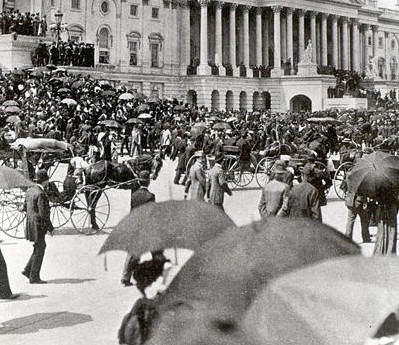
Crowds gathered at the Capitol to witness the long anticipated confrontation between Coxey and the authorities on May 1, 1894.
Yet about 20,000 local folks turned up out of curiosity to see just what would happen.  The Army marched into the city in orderly battalions, quietly carrying banners and signs.  The main body was stopped by authorities before they arrived at the Capital. Coxey and other leaders slipped through the police lines and when he attempted to mount the stairs to give a speech, he was blocked by police.  Browne struggled with officers and both men were arrested.
And then…Coxey’s Army simply melted away.  It was an anti-climax to an epic story.  Coxey and Browne were charged with walking on the grass of the Capitol.  
Some of the men lingered at their bivouac on the outskirts of the city for two weeks until police ordered them to go home.  Some business leaders raised money for railway tickets out of town for the indigent.  The camp broke up without resistance and the last vestiges of the great protest was over. 
The legacy of the event, however, was great.  The causes of public works to combat unemployment and an end to the Gold Standard were finally realized by the New Deal.  This first organized national march on the Capital inspired many others.  Within decades everyone from Suffragists to Ku Klux Klansmen were marching.  In the depths of another Depression the Bonus Marchers would receive even rougher treatment at the hands of the Army under the command of General Douglas MacArthur.  Dr. Martin Luther King, A. Phillip Randolph, Bayard Rustin, and others organized and led the 1963 March on Washington for Jobs and Freedom where King gave his famous I Have a Dream speech before a quarter of a million marchers on the National Mall and a live national television audience.
In recent years huge mass demonstrations in Washington, often involving hundreds of thousands of marchers against the wars in Iraq and Afghanistan, for and against abortion rights, for national health care reform, immigrant rights, and marriage equality have become so routine that they scarcely rate a mention in the press or a moment of national TV coverage.