Showing posts with label shoemakers. Show all posts

Saturday, October 18, 2014

Shoemakers and Coopers Lead the Way—Colonial Craftsmen Get Organized

Master shoemakers and coopers met in public houses like this to discuss their organizations.


According to some sources the first labor unions in the English Colonies of North America were organized in Boston on this date in 1648.  Close but no cigar.  In fact it is wrong on at least a couple of different accounts.  
First, it was not the date that shoemakers and coopers, first organized.  That had happened earlier.  It was the first time any organizations of craftsmen were legally recognized with an official Charter to allow them to operate.
Second, these organizations were not, in the modern sense trade unions, which consist of employees organized to bargain with their employers for wages, benefits, and over conditions on the job like work rules and seniority.
These organizations mimicked the medieval guilds, companies of master craftsmen organized to protect the craft, set prices, and provide fraternal aid and benefits to their members.  Guilds had played a powerful roll in transitioning from a feudal system to the emergence of cities, mercantile trade, and the burger class as a powerful new political force.  They were organizations of master craftsmen, who in turn were the employers of journeymen and apprentices. 
Since its founding in 1630 as the capital and hub of the new colony of Massachusetts Bay by that “company of saints,” the Puritans, civic authorities had tried to suppress class distinction.  But after only 18 years Boston was a rapidly growing port city and the trade center for an expanding arch of settlements stretching along the coast and reaching inland by dozens of miles.  Craftsmen had naturally emigrated from England and set up shops to make and sell goods that did not have to be imported at enormous costs across the Atlantic.  These crafts included those related to ship building and supplies; smiths of various types; carpenters, masons, thatchers, shingle makers, and other construction trades; and those who provided needed personal items like tailors, hatters, drapers, and shoemakers.

Colonial shoemaker and apprentice.
These craftsmen were sometimes relatively wealthy, but universally recognized as below the status of gentlemen or free holding farmers.  They yearned for the respect and mutual support that they had enjoyed in the mother country as members of guilds.  And in some cases there were now enough shops that competition was driving down prices.  They wanted to fix prices to preserve income, as well as to prevent others, not properly steeped in the traditions of the crafts and who have not completed training as apprentices and experience as journeymen from entering into competition.
The Puritan fathers on the General Court, the colony’s governing body, were highly suspicious.
The movement to gain official sanction with charters was lead by the shoemakers and the coopers.  Of all of the trades, shoemakers probably had the lowest status because they did not require much capital to open a shop.  They had generally small shops where the craftsman did most or all of the work or employing only one or two journeymen and apprentices.  Coopers on the other hand, were essential for the colonies burgeoning trade.  So many things, solids as well as liquids, were shipped in barrels in those days—grain from the countryside and beer, the universal beverage of choice where potable water was scarce, for instance.  But perhaps most important—barrels made by coopers were essential for exporting what was becoming the number one export of the colony since local fur supplies had been depleted—salt cod.
What the shoemakers lacked in social standing they made up for in numbers—there were several shops in Boston and more in the surrounding villages—and a certain propensity to make themselves heard in Town meetings and elsewhere.  The coopers had economic clout.

By comparison a cooperage was a larger and more complex operation.

So it was to these two trades that the General Court granted the first charters to The Company of Shoemakers and The Company Coopers.  But they placed severe restrictions on the fledgling organizations, barring them from many of the privileges of English guilds. The Court approved the association solely “for the suppression of inferior workmanship.”  They were stripped of the power to cooperate to provide education and fraternal benefits to their members.  Most importantly, they were forbidden to act “contrary to the public interest” by fixing prices.
Despite the official limitations of the charters, once organized the companies informally and secretly compelled their members to adhere to agreed upon pricing.  Within decades they were doing so openly.
Shoemakers would continue to press for more effective organization in other colonies and into the era of post Revolutionary independences.  A court suppressed an attempt by Philadelphia shoemakers to organize to fix prices and set wages for journeymen and apprentices in 1805 as late as 1805.
That was about the same time those journeymen and apprentices began to organize separately from the associations of the master craftsmen, their employers.  These were the first proto-unions.  In 1827 to protest debtor’s prison sentences in a time of financial panic, Philadelphia workers from several trades came together to launch the short lived Mechanics’ Union of Trade Association.  Although crushed within two years, they are generally viewed at the beginning of a true trade union movement in the United States. 
 

Friday, May 25, 2012

Philadelphia Court Trampled One of the First Unions in America

A corner in an early 19th Century shoemaker's shop.

On May 25, 1805 the leaders of a local union of shoemakers were arrested in Philadelphia for leading a strike, one of the first such organized work stoppages in American history.  Local employers brought charges against them for criminal conspiracy to violate English Common Law that banned schemes to force wage increases.  The strike was broken.

In the post-Revolutionary period some master artisans and craftsmen, then often referred to as a class as mechanics, were transitioning from small shops employing a handful or less of apprentices and journeymen to larger scale production.  Their shops were becoming factories and they were becoming, at least on a modest scale, capitalists.

This was accelerated in the years after the Constitution was adopted and stable national government and peace helped bring about some boom years before the turn of the 19th Century.  Shoe making crafts, an established trade with ample local raw materials, was one of the first to industrialize.

Philadelphia, still the infant nation’s largest and most important city despite no longer being the Capital, was the center of some of the earliest efforts by workers to come to grips with their new situation.  According to History of Trade Unionism in the United States by Perlman and Selig “The earliest genuine labor strike in America occurred, as far as known, in 1786, when the Philadelphia printers ‘turned out’ for a minimum wage of six dollars a week. The second strike on record was in 1791 by Philadelphia house carpenters for the ten-hour day.

The response was the creation of some of the first recognizable craft unions, as opposed to guilds of master mechanics or beneficial societies. 

In 1796 local shoemakers organized the Federal Society of Journeymen Cordwainers.  Cordwainer is just another name for shoemaker, derived from the Cordovan leather commonly used in quality gentlemen’s footwear. The organization staged a 10 week, successful strike in 1799 for higher wages.  It was the first strike organized and sectioned by a union.  At least one more successful strike followed.

Emboldened, the union struck again in 1805.  This time, however, employers enlisted support from the wider business community which was becoming alarmed with the rise of unionism.  The strike was marked by street battles between workers and would-be replacements.  But because they were skilled craftsmen, replacements were not easy to come by.  The union figured to once again outlast their bosses to force a settlement.

But with the support of the business community, leaders were shocked to be arrested and charged.  The strike collapsed.  But the worst still lay ahead.

Both the union itself and eight officers were charged.  Employers paid for the prosecution in the Mayor’s Court.  The actual trial did not get underway until 1806 months after the strike was over.

The case, known as Commonwealth v. Pullis, was heard over three days.  The union and all of the individual defendants were convicted of “a combination [conspiracy] to raise their wages.”  The Federation of Cordwainers was bankrupted and forced to disband.

The individual officers were each fined $8.  On modern historian has called this a “token fine.”  He is wrong.  That was more than a week’s wages and they also had to bear the cost of the prosecution and trial.  Although no record of those costs remains, it was probably considerable.  In addition all of the men were essentially blackballed from their trade.  They were personally ruined, each and every one of them.

The case became established precedent and was cited several times over the next decades in similar circumstances. 

Under the circumstances, the growth of craft unionism was largely stifled and did not begin to resume on a large scale until the 1830’s.  Strikes were not unheard of, but were often quick, spontaneous actions without organization or support.  Today we would call them wildcats.

It wasn’t until 1842 in decided another case involving shoemakers, that the precedent of Commonwealth v. Pullis would finally be overturned.

An 1839 strike against employers who hired non-union labor by the Boston Journeymen Bootmakers’ Society resulted in the similar arrest and conviction of union leaders on conspiracy charges.  But in the case of Commonwealth v. Hunt heard on appeal by the Massachusetts Supreme Judicial Court in 1842, the convictions were overturned.  The court ruled that “the act of unionization and recognition of that union through strike was legal unless the methods to coerce workers to strike were illegal.”

The case essentially legalized trade unions.  But employer and public opposition remained strong and time and again the rights of working people to organize would be trampled upon or won only at great sacrifice. 

Tuesday, October 18, 2011

Colonial Workers Get Organized—Shoemakers and Coopers Lead the Way

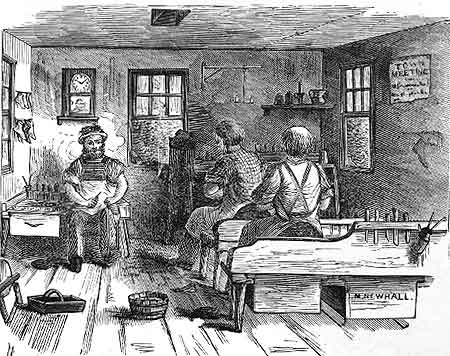
A typical colonial shoemakers shop--Not town meeting notice.
According to some sources the first labor unions in the English Colonies of North America were organized in Boston on this date in 1648.  Close but no cigar.  In fact it is wrong on at least a couple of different accounts.  

First, it was not the date that shoemakers and coopers, first organized.  That had happened earlier.  It was the first time any organizations of craftsmen were legally recognized with an official Charter to allow them to operate.

Second, these organizations were not, in the modern sense trade unions, which consist of employees organized to bargain with their employers for wages, benefits, and over conditions on the job like work rules and seniority.

These organizations mimicked the medieval guilds, “companies” of master craftsmen organized to “protect the craft”, set prices, and provide fraternal aid and benefits to their members.  Guilds had played a powerful roll in transitioning from a feudal system to the emergence of cities, mercantile trade, and the burger class as a powerful new political force.  They were organizations of master craftsmen, who in turn were often the employers of journeymen and apprentices. 

Since its founding in 1630 as the capital and hub of the new colony of Massachusetts Bay by that “company of saints,” the Puritans, civic authorities had tried to suppress class distinction.  But after only 18 years the city was a rapidly growing port city and the trade center for an expanding arch of settlements stretching along the coast and reaching inland by dozens of miles.  Craftsmen had naturally emigrated from England and set up shops to make and sell goods that did not have to be imported at enormous costs across the Atlantic.  These crafts included those related to ship building and supplies; smiths of various types; carpenters, masons, thatchers, shingle makers, and other in construction trades; and those provided needed personal items like tailors, hatters, drapers, and shoemakers.

These craftsmen, sometimes relatively wealthy, but universally recognized as below the status of gentlemen or free holding farmers, yearned for the respect and mutual support they had enjoyed in the mother country as members of guilds.  And in some cases there were now enough shops that competition was driving down prices.  They wanted to fix prices to preserve income, as well as to prevent others, not properly steeped in the traditions of the crafts and who have not completed training as apprentices and experience as journeymen.

The Puritan fathers on the General Court, the colony’s governing body, were highly suspicious.

The movement to gain official sanction with charters was lead by the shoemakers and the coopers.  Of all of the trades, shoemakers probably had the lowest status because they did not require much capital to open a shop.  They were generally small shops where the craftsman did most or all of the work or employing only one or two journeyman and maybe an apprentice.  Coopers on the other hand, were essential for the colonies burgeoning trade.  So many things, solids as well as liquids, were shipped in barrels in those days—grain from the countryside and beer, the universal beverage of choice where potable water was scarce, for instance.  But perhaps most important—barrel made by coopers were essential for exporting what was becoming the number one export of the colony since local fur supplies had been depleted—salt cod.

What the shoemakers lacked in social standing they made up for in numbers—there were several shops in Boston and more in the surrounding villages—and a certain propensity to make themselves heard in Town meetings and elsewhere.  The coopers had economic clout.

So it was two these two trades that the General Court granted the first charters to The Company of Shoemakers and The Company Coopers.  But they placed severe restrictions on the fledgling organization, barring them from many of the privileges of English guilds. The Court approved the association solely “for the suppression of inferior workmanship.”  They were stripped of the power to cooperate to provide education and fraternal benefits to their members.  Most importantly, they were forbidden to act “contrary to the public interest” by fixing prices.

Despite the official limitations of the charters, once organized the “companies” informally and secretly compelled their members to adhere to agreed upon pricing.  Within decades they were doing so openly.

Shoemakers would continue to press for more effective organization.  Court suppresses an attempt by Philadelphia shoemakers to organize to fix prices and set wages for journeymen and apprentices in 1805.

About the same time those journeymen and apprentices began to organize trade unions separate from the associations of the master craftsmen, their employers.  These were the first proto-union.  In 1827 to protest debtor’s prison sentences in a time of financial panic, Philadelphia workers from several trades came together to launch the short lived Mechanics’ Union of Trade Association.  Although crushed within two years, they are generally viewed at the beginning of a true trade union movement in the United States.