Showing posts with label Philadelphia. Show all posts

Saturday, July 4, 2026

The Fourth of July Had Competition to be Independence Day


A scene that never happened--the signing of the Declaration of Independence.  There was no great signing ceremony on July 4th or any other day.  On August 2, 1776 the Delegates to the Continental Congress who were still in Philadelphia stopped by the Pennsylvania State House to add their signatures before they left town.  Those who were already gone added their signatures when they could--weeks, months, and in one case years later.

Note--Officially, the United States is celebrating it 250th birthday today.  Due to distractions, divergence, and disappointment the celebration is much more muted than the national hoopla fifty years ago for the Bicentennial.  But gloomy or not the commemoration might not be on the right date. 

As we all know today is Independence Day when Americans celebrate the adoption of a resolution by the Continental Congress formally severing ties between the England and her former colonies in 1776. Although we celebrate on July 4th, the date is just one of several that could have been chosen. 

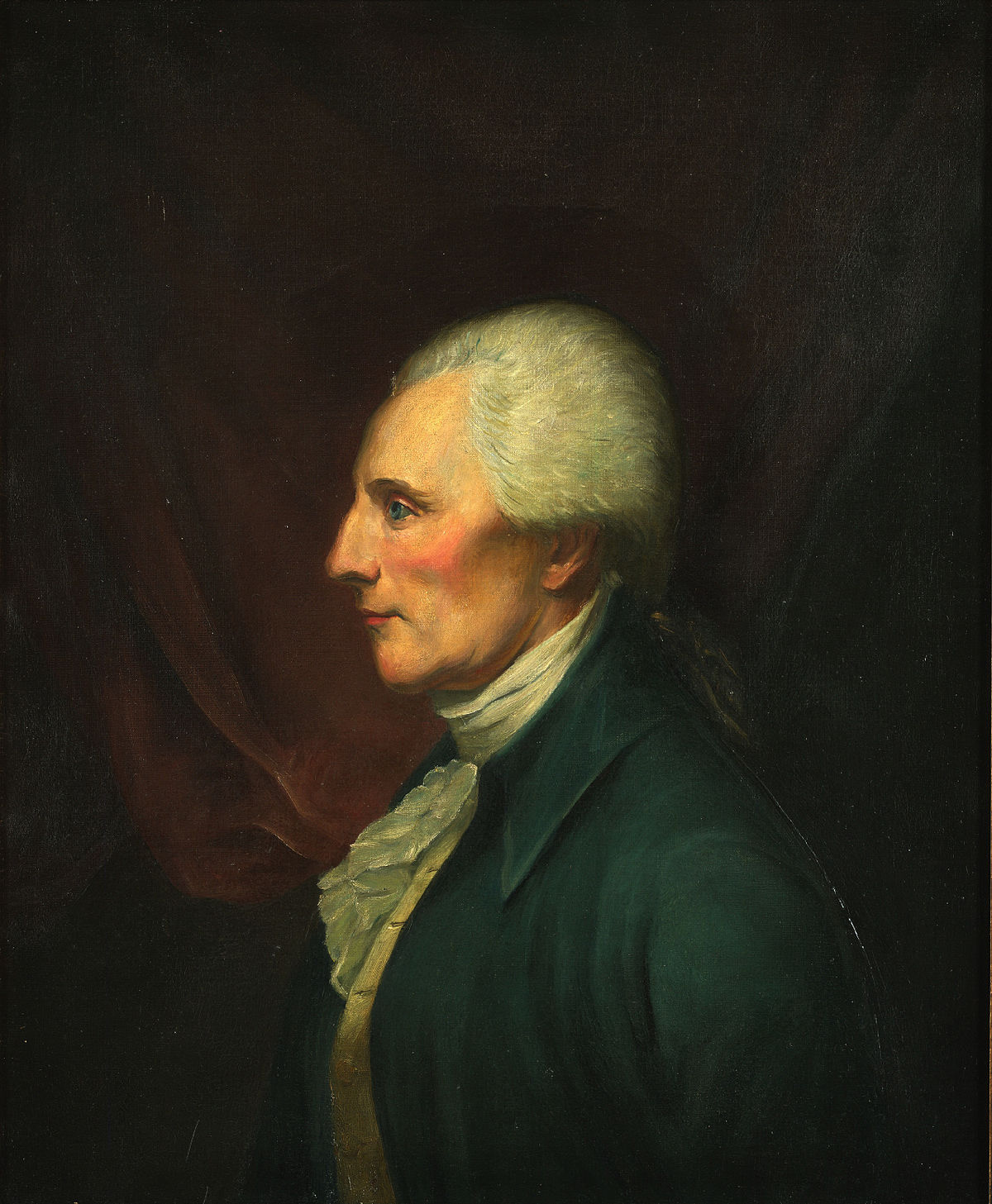
On May 15 Congress adopted a preamble for a resolution offered by Richard Henry Lee of Virginia calling for colonies without a “government sufficient to the exigencies of their affairs” to adopt new governments.  The preamble, written by John Adams, said that “it is necessary that the exercise of every kind of authority under the said crown should be totally suppressed.”  Although the four Middle Colonies voted against it, Adams wrote home that he considered this a virtual declaration of independence.  The same day the Virginia Convention adopted a resolution calling for a dissolving all allegiance to the Crown 


Virtually forgotten in popular accounts, Virginia delegate Richard Henry Lee offered the underlying resolution for Independence.  The familiar document was an explanation and justification of the act drafted by a special committee.  It was not the legal document accomplishing separation.  Lee's resolution and the votes for and against it were recorded in the official proceedings of Congress.

In keeping with his instructions on June 11 Lee offered a resolution that Congress declare independence, seek foreign alliances, and begin laying the groundwork for a new confederation:

Resolved, that these United Colonies are, and of right ought to be, free and independent States, that they are absolved from all allegiance to the British Crown, and that all political connection between them and the State of Great Britain is, and ought to be, totally dissolved.

As Lee’s resolution was being debated, Congress authorized a Committee of Five to draw up a document explaining the action, should it be passed.  The committee consisted of Adams; Benjamin Franklin of Pennsylvania, the delegate with the most international renown and prestige; Thomas Jefferson of Virginia, one of the youngest delegates; Robert R. Livingston of New York, and Roger Sherman of Connecticut.  


The famous committee charged with drafting a justification for Independence. Left to right:  Thomas Jefferson, Roger Sherman, Benjamin Franklin, Robert Livingston, and John Adams.  Jefferson wrote the first draft.  Franklin and Adams were actively involved in editing and fine tuning the document.  Sherman and Livingston are not known to have contributed to the wordage but were important politically to secure support from their states--especially Livingston whose New York delegation was deadlocked on Independence.

The committee delegated to Jefferson the job of writing a first draft.  He did so over several days.  The committee conferred and recommended some changes, which mortified Jefferson, and then he produced a draft incorporating the edits.  It remained, however, mostly Jefferson’s work. 

The language was sent to Congress on June 28.  The document was tabled until action on Lee’s resolution was completed. On July 1, sitting as a Committee of the Whole with each Colony having one vote, the resolution was approved with 9 yeas, two nays (Pennsylvania and South Carolina), and a no vote by New York, whose delegation lacked instructions, and Delaware whose two delegates were split.  


                    Ceasar Rodney rode hell-for-leather from Delaware to cast his deciding vote in that colony's delegation on June 2 passing Lee's resolution.

On July 2 South Carolina reconsidered and switched its vote to yes and the two most ardent opponents of independence in the Pennsylvania delegation, John Dickinson and Robert Morris, bowing to the inevitable, abstained in a caucus of the state’s delegates allowing the delegation to follow Franklin for independence.  Then, dramatically, Caesar Rodney arrived after an epic ride from Delaware to cast a vote breaking the tie in that delegation.  Only New York, then, had not voted for independence.  Adams regarded the July 2 vote as definitively the day of independence.  He wrote home to his wife Abigail:

The Second Day of July 1776, will be the most memorable Epocha, in the History of America. I am apt to believe that it will be celebrated, by succeeding Generations, as the great anniversary Festival. It ought to be commemorated, as the Day of Deliverance by solemn Acts of Devotion to God Almighty. It ought to be solemnized with Pomp and Parade, with Shews, Games, Sports, Guns, Bells, Bonfires and Illuminations from one End of this Continent to the other from this Time forward forever more. You will think me transported with Enthusiasm but I am not. I am well aware of the Toil and Blood and Treasure, that it will cost us to maintain this Declaration, and support and defend these States. Yet through all the Gloom I can see the Rays of ravishing Light and Glory. I can see that the End is more than worth all the Means. And that Posterity will tryumph in that Days Transaction, even altho We should rue it, which I trust in God We shall not.

Congress then took up the wording declaration from the Committee of Five. On July 3 after spirited debate Congress adopted most of Jefferson’s text except for a lengthy passage critical of the slave trade and some other relatively minor matters of language.  He was bitterly disappointed, but the deed was done.  Congress ordered official copies be made for each state and printed copies to be read publicly. These copies were dated July 4.  A calligrapher worked on a very fine original document which most delegates signed on August 2 and to which absent delegates appended their signatures weeks, maybe even months later.  There was no grand signing ceremony as enshrined in myth.  


The iconic document on display at the Library of Congress and reproduced in class rooms across the country is one of about three copies made by a calligrapher.  Like the printed copies it was dated July 4 although there was no action by Congress that day.  The Fourth was meant to be the date that the Declaration was to be read publicly for the first time but the broadsides were not ready from the printer.  The Philadelphia Evening Post ran it on July 6 and it was not until July 8 that Col. John Nixon of the Philadelphia Committee of Safety read it on the steps of the State House.   General George Washington personally read the document to his troops and local citizens in New York City on July 9.

Here are some dates in the associated with marking Independence Day and the Fourth of July:

1776—Philadelphia celebrated with toasts, 13-gun salutes, speeches, fireworks, and parades after the official reading on July 8.

1777—13 guns were fired once in the morning and once in the evening in Bristol, Rhode Island

1778George Washington marked the occasion with double rum ration for the troops. Benjamin Franklin and John Adams held a dinner for fellow Americans in Paris.

1779—The Fourth fell on a Sunday. To keep the Sabbath, observances in many places were held July 5.

1781Massachusetts became the first state legislature to recognize the day as an official occasion.

1791—The first recorded use of the name Independence Day occurred.

1826Former Presidents John Adams and Thomas Jefferson died within an hour of each other on the 50th anniversary of the dated copies of the Declaration

1831—Former President James Monroe died on the Fourth.

1870—Congress made the 4th of July an unpaid holiday for Federal employees.

1884—The Statue of Liberty was presented to the American People in Paris.

1941—Congress made Independence Day a paid Federal holiday.


Saturday, October 18, 2025

Colonial Shoemakers and Coopers Lead the Way to Early Labor Organizations


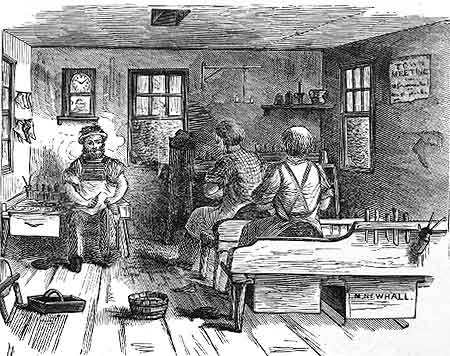
A typical Colonial shoe shop--a Master, journeymen, or possibly an apprentice.  Every shoe or boot made by hand with minimal tools and a small investment in leather.  Cobblers required much less capital and equipment than many other trades making it easier for craftsmen to set up shop. 

According to some sources the first labor unions in the English Colonies of North America were organized in Boston on this date in 1648.  Close but no cigar.  In fact, it is wrong on at least a couple of different counts.  

First, it was not the date that shoemakers and coopers first organized.  That had happened earlier.  It was the first time any organizations of craftsmen were legally recognized with an official Charter to allow them to operate.

Second, these organizations were not, in the modern sense, trade unions, which consist of employees organized to bargain with their employers for wages, benefits, and over conditions on the job like work rules and seniority.


                                                        Coats of Arms for some medieval German guilds featured tools of the craft.  Shoemakers top right. 

These organizations mimicked the medieval guilds, companies of master craftsmen organized to protect the craft, set prices, and provide fraternal aid and benefits to their members.  Guilds played a powerful roll in transitioning from a feudal system to the emergence of cities, mercantile trade, and the burgher class as a powerful new political force.  They were organizations of master craftsmen, who in turn were the employers of journeymen and apprentices. 

Since its founding in 1630 as the capital and hub of the new colony of Massachusetts Bay by that “company of saints,” the Puritans, civic authorities had tried to suppress class distinction.  But after only 18 years Boston was a rapidly growing port city and the trade center for an expanding arc of settlements stretching along the coast and reaching inland by dozens of miles.  Craftsmen had naturally emigrated from England and set up shops to make and sell goods that did not have to be imported at enormous cost across the Atlantic.  These crafts included those related to ship building and supplies; smithsmetal craftsmenof various types; carpenters, masons, thatchers, shingle weavers, and others in construction trades; and those who provided needed personal items like tailors, hatters, drapers, and shoemakers.

These craftsmen, sometimes relatively wealthy, but universally recognized as below the status of gentlemen or free holding farmers, yearned for the respect and mutual support they had enjoyed in the mother country as members of guilds.  And in some cases, there were now enough shops that competition was driving down prices.  They wanted to fix prices to preserve income, as well as to prevent others, not properly steeped in the traditions of the crafts and who had not completed training as apprentices and experience as journeymen from establishing themselves.

The Puritan fathers on the General Court, the colony’s governing body, were highly suspicious.


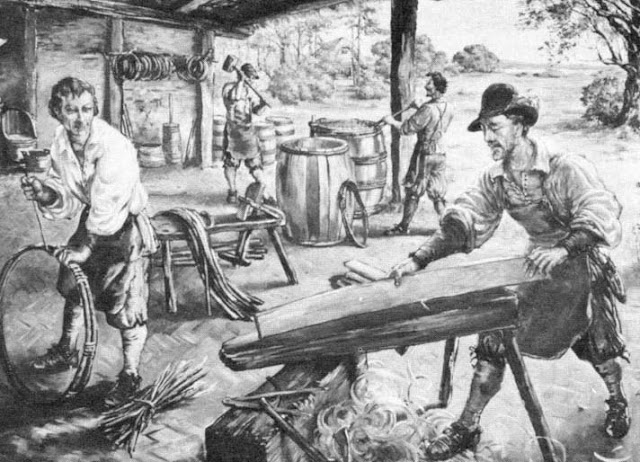
 An out-door Colonial cooperage.  Barrels were essential for trade and storage giving master coopers significant leverage.

The movement to gain official sanction with charters was led by the shoemakers and the coopers.  Of all of the trades, shoemakers probably had the lowest status because they did not require much capital to open a shop.  They were generally small shops where the craftsman did most or all of the work or employing only one or two journeymen and maybe an apprentice.  Coopers on the other hand, were essential for the colonies burgeoning trade.  So many things, solids as well as liquids, were shipped in barrels in those days—grain from the countryside and beer, the universal beverage of choice where potable water was scarce, for instance.  But perhaps most important—barrels made by coopers were essential for shipping what was becoming the number one export of the colony since local fur supplies were depleted—salt cod.

What the shoemakers lacked in social standing they made up for in numbers—there were several shops in Boston and more in the surrounding villages—and a certain propensity to make themselves heard in Town Meetings and elsewhere.  The coopers had economic clout.

So, it was two these two trades that the General Court granted the first charters to The Company of Shoemakers and The Company Coopers.  But they placed severe restrictions on the fledgling organizations, barring them from many of the privileges of English guilds. The Court approved the association solely “for the suppression of inferior workmanship.”  They were stripped of the power to cooperate to provide education and fraternal benefits to their members.  Most importantly, they were forbidden to act “contrary to the public interest” by fixing prices.

Despite the official limitations of the charters, once organized the companies informally and secretly compelled their members to adhere to agreed upon pricing.  Within decades they were doing so openly.

Shoemakers would continue to press for more effective organization.  Courts suppressed an attempt by Philadelphia shoemakers to organize to fix prices and set wages for journeymen and apprentices in 1805.


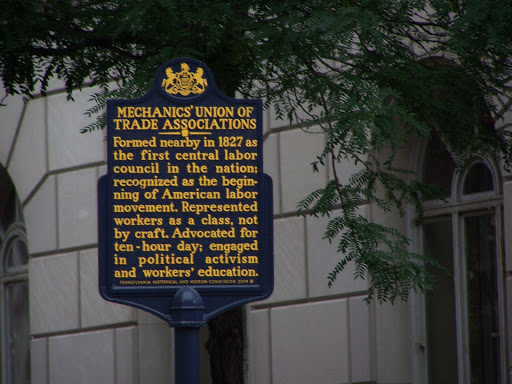
A Pennsylvania historical marker commemorating the establishment of the Mechanics' Union of Trade Associations--the first U.S. body of true trade unions.

About the same time those journeymen and apprentices began to organize trade organizations separate from the associations of the master craftsmen, their employers.  These were the first proto-unions.  In 1827 to protest debtors prison sentences in a time of financial panic, Philadelphia workers from several trades came together to launch the short-lived Mechanics’ Union of Trade Associations.  Although crushed within two years, they are generally viewed at the beginning of a true trade union movement in the United States 


Friday, September 19, 2025

Blacks Assembled for Themselves at the First National Negro Convention in 1830


An early Negro National Convention.

As ever, it was harddangerous and hard—to be Black in early 19th Century America for Freemen as well as for slaves.  Take the Northern state of Ohio, for instance.  It had entered the Union in 1803 under an 1802 constitution that abolished slavery.  Although technically a Free State, Ohio was culturally Southern having been settled predominantly by frontiersmen moving west from Virginia and the Carolina through Tennessee and Kentucky before, during, and after the American Revolution and the widespread Indian wars that followed.  This was especially true of Cincinnati, which rapidly became the busiest port on the Ohio River.

Farming in Ohio was not naturally suited to the plantation system which relied on large numbers of slave laborers, so the ban on slavery mostly affected those in domestic service or hired out by their masters as laborers, craftsmen, and river men.  It was not a huge economic loss to forgo them and in actuality most masters effectively kept their personal servants in virtual bondage for their lifetimes.  But the White citizens were fearful that as a free state Ohio would become a magnet for free Blacks and for escaped slaves who would compete for wages and land.  Thus in 1807 the state enacted strict Black laws.

Similar to laws passed in border and other Northern States like Illinois, the 1807 act was meant to discourage migration to the state by requiring Blacks to prove that they were not slaves and to find at least two people who would guarantee a surety of $500—a prohibitive fortune worth years of income to small farmers, craftsmen, or merchants who might employ them—for their good behavior. The laws also banned marriage to Whites and forbad gun-ownership in a region where hunting was an important source of food, regulated occupations, and imposed numerous petty restrictions.  Needless to say, the rights and privileges of citizenship were denied to any Blacks who could jump through all of the hoops.  

In the early years of the century, the Black laws did discourage migration.  But it never eliminated it.  As circumstances and economic realities changed enforcement became lax, then spotty, and finally rare.  Part of that was due to a major shift in the population.  The threat of Indian warfare finally ended after the War of 1812 and the British evacuation of Ft. Detroit and the end of sponsorship of hostile tribes and helped open up the mostly unsettled northern half of the State.  That accelerated greatly after the opening of the Erie Canal in 1825 made Lake Erie a major route to the West.  Most of the new settlers were decedents of the New England diaspora by way of New Hampshire, Vermont, and Up State New York.  These Yankees were in general anti-slavery and their influx was changing the political balance in the state.

But more importantly, the introduction of practical steamboats on the Ohio River created a boom in the trade on the river.  The larger steamboats required larger crews, especially deck hands and boiler stokers, as well as armies of dock laborers, warehouse men, and teamsters.  


A sketch of early steamboats and warehouses in bustling Cincinnati circa 1830 when Free Blacks were competing for jobs with White laborers. 

Cincinnati and other river ports had no choice but to use Free Black labor or be undercut by the slave labor used at Virginia and Kentucky river towns like Wheeling or Louisville.  By the late 1820 the Queen City had a large Free Black population.   White laborers became increasingly resentful of competition from Blacks which undercut wages.  Under pressure, Cincinnati began to try to apply the long dormant Black Laws on local Freemen.  When that was not effective in driving out the population major rioting against Blacks broke out in July and August of 1829.  After bloody rampages and the burning of Black neighborhoods, churches, schools, and businesses 1200 Blacks were driven from the city and many resettled in Canada.  Not only were casual laborers affected, but a small but growing elite of Black businessmen and skilled craftsmen was devastated.  Many appealed to other Black communities, especially well established centers like Philadelphia and Baltimore, for financial assistance for re-location schemes to Canada. 

Eventually a Baltimore Free Black leader and activist, Hezekiah Grice issued an appeal to major communities to a national meeting to plan assistance for a major Canadian resettlement.  He argued that the U.S. would never be safe for Blacks and noted that there were already communities of former slaves who were freed during the American Revolution by the British and evacuated to the North along with Tories after the war.  A small number of escaped slaves were trickling into British North America as well, a number that would grow exponentially with the regular establishment of the Underground Railroad.

Grice found an ally, host, and a venue in Philadelphia, home to the largest and most sophisticated population of Free Blacks in the U.S. thanks to the Quaker tradition of tolerance and relative proximity to slave states.  


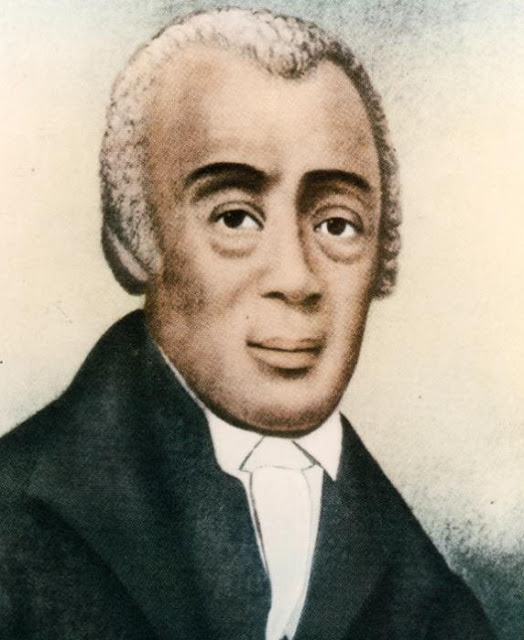
                                Bishop Richard Allen, pastor of Mother Bethel and founder of the African Methodist Episcopal Church.

Bishop Richard Allen was the most important Free Black leader of the first half of the 19th Century.  Born in 1760 as a slave to Benjamin Chew in Philadelphia, Allen and his family were sold to a Delaware plantation owner.  While in bondage he began to attend Methodist camp revivals and eventually became a lay preacher to his fellow slaves.  As a skilled carpenter Allen was able to purchase the freedom of himself and his family and rode circuit as a saddle bag preacher before relocating to his hometown.  There he was invited to preach for the Black community at St. Georges Methodist Church.  Eventually restrictions on his community, especially segregated seating in the balcony and numerous snubs from White congregants caused him and his people to leave the church and establish their own Methodist community.  After meeting in homes and rental properties, Allen purchased, moved, and physically rebuilt an old blacksmith shop as his first church—the first African-American congregation worshiping in its own building in the country.  Eventually he was regularly ordained as a Methodist minister and his Bethel Church—now revered as Mother Bethel—became the nucleolus of the African Methodist Episcopal Church, the first Black Protestant denomination.  Allen became its presiding Bishop.

But his influence went far beyond his fervent religious activity.  He realized early on that he was de facto the leader of his community.  His first step was to form the Free African Society in 1787 to support community and aid recently manumitted slaves. It offered financial assistance to families and educational services for children or adults seeking employment.   As part of the effort Allen began the first school for Black children and adult literacy and Bible classes at his church.  He also published a Freemen’s newspaper, and numerous pamphlets and tracts on religion, temperance, and Black issues.


The Bethel AME Church--Mother Bethel--in its second building in which the National Negro Convention met. 

Forty delegates, all Blacks from nine states attended the National Negro Convention at Mother Bethel from September 20-24, 1830.  Not surprisingly, Allen was elected to preside.  Debate focused on Grice’s Canadian resettlement proposal.

A minority were interested in the schemes of the American Colonization Society (ACS) to re-settle Blacks in Africa.  Supported by some well meaning religious folks, mostly Quakers and philanthropists it also drew support from “enlightened” Southern planters in the tradition of Thomas Jefferson who found slavery philosophically irreconcilable with liberty but were terrified by the prospect of freeing “savage and ignorant” slaves who would become violent and prey on White womanhood.  Convinced that Blacks and Whites could never live peacefully, shipping them back to their supposed homeland seemed the easiest solution.  Members of the convention recognized that for the virulent racism it represented.  Most of the established Freemen considered themselves culturally American and after generations had no connection at all to Africa.  Moreover the Colonization Society plan disregarded Africa’s ethnic and tribal divisions and the rights of native Africans to their own land.  By the end of the convention the Colonization Society plan would be flatly rejected.

But there was not total unanimity around the Canadian plan, although it was generally popular.  Canada offered a similar culture and climate and a common language—English—they already knew.  And with vast lands available for possible settlement, it seemed amenable and hospitable.  But many delegates were firm for striving for citizenship rights in American, which they considered home.

In the end, the delegates endorsed the Canadian plan and pledged to work towards it but also decided to advocate more broadly for Freemen in the United States and offer sympathetic support to those still in slavery.  In the U.S. Free Blacks would demonstrate their worthiness for citizenship by undertaking a program of moral up-lift, temperance, strong families, chastity, education, hard work, and building black businesses and institutions.  Although sympathetic to those still in slavery, they took pains to separate and elevate themselves as Freemen.  Their political program was not radical, their method gradual.  It spoke only in general terms of a possible total end to slavery and held out the hope of winning over more sympathetic Whites.


                                                        James Forten, leader of the American Moral Reform Society. 

Allen was elected President of a new organization, American Society for Free Persons of Color to follow up on Canadian colonization and other parts of the program.  A second, parallel organization was established to promote dignity, morality, and respectability in the Black community.  American Moral Reform Society, led by Philadelphia businessmen James Forten and William Whipper emphasized temperance and virtue.

Bishop Allen did not long survive the Convention.  He died on March 26, 1831 at the age of 71.  But his work was carried on by others.

The scheme for Canadian resettlement eventually fizzled for lack of resources to promote large scale emigration and the establishment of Black communities.  Many Blacks, who did re-locate, found their welcome far less hospitable than expected and concluded that there was not much difference between White men on either side of the border.  Work turned more to American reform and rights and with the rise of a vigorous, mostly White-led abolitionist movement and the establishment of the Underground Railroad.  By the 1850’s a much more radical generation represented by Fredrick Douglass transformed the movement.

The 1830 Convention was the first of many Black Convention held in the years before the Civil War.  Philadelphia was the most common site, but gatherings were also held in New York City, Baltimore, Pittsburgh, and Cincinnati.  National and state conventions were held almost yearly through 1864 and their proceeding reflected the growing changes and militancy in the Free Black movement.  New organizations were spawned and publications launched.

In 1859 a White newspaper observed, “Colored conventions are almost as frequent as church meetings.”

And it all began in Philadelphia.