Showing posts with label skeletons. Show all posts

Tuesday, October 31, 2017

Samhain to Halloween—The Crooked Path to Our Second Most Popular Holiday


NoteRevised and back by popular demand! 
Halloween traces its origin to the Celtic harvest festival Samhain.  It was one of the four festivals that fell between the Solstices and Equinoxes and which celebrated the natural turning of the seasons.  Samhain was particularly important because it was the gate in time to the death and starvation season of winter, as well a time to celebrate the recent harvest. 
This association with the death of winter also extended to the spirit world, which was considered to be closer to the mortal plane than at any other time of the year.  The Celtic priests—the Druids—marked the occasion with the lighting of bon fires and gifts of food and drink for the spirits of the dead.  Some consider it also analogous to a New Year’s Celebration launching a new cycle of the seasons.  It was popularly celebrated by the peasantry long after the Druids passed and well into the Christian era.
The Church symbolically casting out the Samhain celebrating Druids.  They succeeded in co-opting some customs, driving others underground or marginalizing them to isolated rural area
Too popular to squelch entirely, as with many pagan observances Catholic Church co-opted the custom as All Saints Day on November 1.   In rural regions especially Samhain customs continued to be observed on the evening before the Holy Day—which came to be known as All Hallows Eve, or Hallowe’en in Scots.
Immigrants from the British Isles brought some of their customs with them to the New World, but Halloween does not seem to have been widely celebrated colonial America.  The Puritans spent a lot of time trying to squelch other pagan customs like the May Pole dances associated with the spring Celtic festival of Bealtaine, but for all of their obsession with witchcraft, usually associated with those who continued to keep the old pagan traditions, there is no evidence of suppressing Samhain or Halloween.
In fact there is little mention of Halloween in American at the second half of the 19th Century.  By the 1880’s and ‘90’s greeting card companies were printing colorful post cards featuring images of witches, black cats, skeletons, and pumpkin Jack o’ Lanterns—all of the classic images associated with Halloween.  Period photos from around the turn of the 20th Century show both adults and children in costumes, most commonly some variation of witch or ghost themes.   

A popular lithographed Haloween greeting card.
A few scattered newspapers began reporting ritual begging on Halloween by masked youths accompanied by general hooliganism, threats, and acts of vandalism.  This was probably introduced by the wave of poor “country” Irish immigrants that began after the Potato Famine and continued through most of the rest of the century.  The ritual begging in costumes and general hooliganism more closely resembled rural Irish Wren Day—St. Stephen’s Day December 26—customs than those celebrated in either England or Scotland.
Rowdism by boys and young men was reported in big cities and small towns alike and often included setting small bonfires of junk in roadways; tipping or stealing out houses; pelting houses with eggs, rotten vegetables, or manure; letting horses and livestock loose from barns and pens; and sometime blocking chimneys so that houses would fill with smoke.  Sometime significant damage was done.  The Halloween scene in the classic MGM musical  Meet Me in St. Louis shows a rare screen glimpse at the rowdy shenanigans most Americans associated with the celebration.
As it spread, customs for observing the holiday varied regionally. Communities started to organize activities to keep the kids and hooligans off the streets, with mixed success.  Parties with games such as bobbing for apples and the telling of ghost stories were fairly common.  

Walt Disney's 1929 Silly Symphony, The Dancing Skeletons.
Animated films of the ‘20’s and ‘30’s such as Walt Disney’s 1929 Silly Symphony The Dancing Skeletons showed the popularity of the holiday and light-hearted images of death, witches, and black cats.  The Skeletons perhaps show a tip-o’-the-hat familiarity with the Mexican customs around The Day of the Dead which is celebrated on All Soul’s Day.
The custom of trick or treating seems to have spread slowly.  It combined the ritual begging with toned-down tricks that were a little less extreme than the wild rampages reported earlier.  What progress it was making was largely interrupted by the Depression years when families had little extra money to spend on treats and by the sugar rationing of World War II.
Trick or treating was still far from universal until after World War II when it became a topic of popular radio programs like the Jack Benny Show and Ozzie and Harriet. 
In 1947 the popular children’s magazine Jack and Jill published a story on the custom of Halloween begging and described it in detail, spreading the practice widely and with amazing uniformity.  By 1951 the practice was wide spread enough that a Philadelphia woman, Mary Emma Allison and the Reverend Clyde Allison decided to channel the energy to constructive purposes by introducing Trick or Treat for UNICEF to support the work of the United Nation’s international children’s relief.
1950's Trick-or-Treaters--the era of plastic masks and cheep store bought costumes.
By the mid 1950’s with the strong support of the candy companies and the introduction of cheap masks and pajama style costumes for children, the practice of trick or treating had become ubiquitous and had even taken on a feeling of a long standing practice.
What started with ghost stories and the like, soon spread to all types of horror, fueled by the growing popularity of increasingly violent Hollywood films.  Gore became and more and more common theme and showing horror films for the whole month of October in theaters and on TV was standard by the early 1970’s.

Halloween is increasingly the occation of adult revelry.
About the same time the first generations of trick or treaters grew up but continued to enjoy the dress-up and parties of Halloween.  It is, year by year, an increasingly popular adult holiday, incorporating many of the features of various world masquerade festivals with macabre twist.
Halloween is now the second most widely celebrated holiday in the United States and is an economic powerhouse, generating sales second only to Christmas.  Popular American media have spread the customs of trick or treating and celebrating gore around the world, often supplanting truly ancient celebrations of Halloween in the Celtic countries.
The resurgence of Christian Fundamentalism in the U.S. has led to a counter movement to strip the “Satanic” festival from public schools and the wider community.  Although they get it wrong—there was never any connection between Satanism and Halloween—the fundies, ironically, at least recognized a religious tradition hiding under the commercial hoopla. 
At the same time re-invented “traditional” paganism like Wicca, one of the most rapidly growing religious movements of the last twenty years, has striven to recapture the nearly lost significance of the holiday’s roots in Samhain.
Go thou, and celebrate as thou wouldst.  

Sunday, November 1, 2015

Día de los Muertos—Its Own Thing Not Mexican Halloween


Despite sharing some key common imageryskulls and skeletons—and some cultural and religious DNA, Día de los Muertos, the two day festival from Mexico, is not just a Latino Halloween.  The two observations reflect two entirely different views of death—one reflecting terror and horror and the other welcoming acceptance.  That’s the shorthand for it anyway.  In reality it is, of course, more complicated.  The Mexican holiday owes its unique vitality to the merging and mutual corruption of two cultures so alien to each other that at first the seemed totally incompatible.
The Aztecs were the new kids on the block.  Just the most recent in a chain of high civilizations that had risen and fallen in Mesoamerica over a period of 4,000 years—the Olmec, Maya, and Toltec to name a few.  There were serious ethnic, cultural, and religious differences between these groups, but archeological evidence shows that they shared a view of the afterlife—a cyclical pattern of life and death that was continuous and in which the spirits of the dead were a protective presence to the living and under the right circumstances the living and the could communicate.  Death was not seen as something grim, but as a natural step in continuing existence. 
This belief manifested itself in many ways, including some that to European eyes seemed barbaric and brutal beyond imagination, especially the mass human sacrifices as practiced by the Aztec.  But, at least theoretically, those sacrificed were expected to undergo the knife in a state of religious ecstasy as they transitioned to the next life for the good of their people.  Of course in practice, the Aztecs often used hundreds of their captured enemies for the rituals and they may not have been so sanguine to their fates.

But beyond the sacrifices, these beliefs meant that ordinary people could commune, even celebrate, with their lost loved ones.  The Aztecs expressed it in a month long festival honoring the goddess Mictecacihuatl, Queen of the Underworld, or Lady of the Dead. During the festival they first honored los angelitos, the deceased children and then those who passed away as adults. The Mictecacihuatl festival was held during the late summer period of the corn harvests, a natural time of bounty and celebration.
Enter the Spanish, their soldiers and priests who conquered the mighty Aztec—with the significant assistance of other civilized vassal peoples who were tired of giving up their corn and sacrifants to the mighty rulers of Tenochtitlan—who had very different ideas.  The first order of the day, going hand-in-hand in making the conquered people slaves, was destroying all vestiges of the old religion and imposing Catholicism on them.  After all, saving the souls of the savages whether they liked it or not was a central mission of the Conquest.
The Church, of course, had a lot of experience in this sort of thing.  Hundreds of years earlier it had encountered, squelched, and absorbed the pagan Celtic and Germanic peoples.  The Church had learned to adapt local customs that could not be obliterated and cloak them as Christian traditions and turning old gods into venerated saints.
The transformation of the popular Celtic festival of Samhain, for instance, had been transformed into All Saints and All Souls Days.  Similarly in Mexico they re-purposed the Mictecacihuatl festival and squeezed it down from a month to the same two days coinciding with the end of the European harvest season on November 1 and 2.  Indio peons were expected to attend Masses to honor their dead—a least those who had died good Catholics.  And this the people dutifully did.  Indeed at first they had no choice, but eventually they internalized the changes and accepted them.

A large ofrenda--an altar for the dead.


While the people accepted the Masses, they brought their own interpretations to them, and they continued to hold onto folk traditions that stretched back to Pre-Columbian times.  Over generations those traditions blossomed into Día de los Muertos as we know it today—spilled out of the churches and into homes where ofrendas, welcoming altars to the dead, are gaily decorated with skeletons, skulls, Flor de Muertoorange marigolds, candles, religious icons, photos and memorabilia of the dead and groan with gifts of sweets, favorite foods, and alcohol.  These altars welcome the spirits of the visiting dead.
Then in many places families return the favor by visiting the cemeteries and picnicking on the graves of loved ones.  In some areas of Northern Mexico the family might camp out there from the evening of All Saints Day, November 1.  There are many regional variations involving parades and special celebrations in the homes where someone has died within the year which are opened to all visitors who are fed with homemade tamales and other treats.

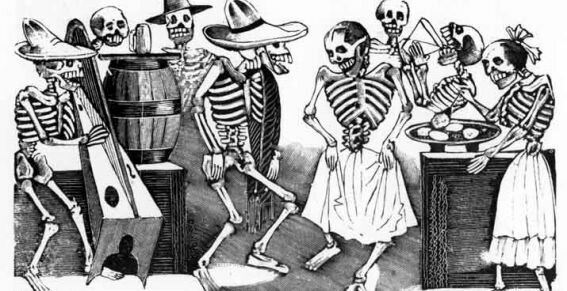
José Guadalupe Posada helped popularize the gay skeletons that are an important part of the Day of the Dead.
The frequent use of skeletons and skulls is meant as a reminder that we are all mortal and will someday join the dead.  The popular 19th Century artist José Guadalupe Posada who depicted calacas—skeletons—cavorting gaily is credited with popularizing that sort of imagery which is continually re-interpreted by folk and fine artists. Particularly popular is the image of Catrina, the lanky, skeletal female figure bedecked in sumptuous clothing and giant ornate hats, who serves as a reminder that death is a fate that even the rich can’t avoid.  Catrina is also seen as an embodiment of old Aztec goddess Mictecacihuatl.
Other countries of Latin heritage have significant All Saints and All Souls celebrations, but outside of Mexico and adjacent countries with significant Mexican populations or cultural influence, none celebrate Día de los Muertos in this unique way.
The United States, with a large and growing population of Mexican descent or origin, is one place where the festival is widely celebrated, particularly in the Southwest and border regions.  But with large population moving north into the old industrial cities of the Midwest and northeast and into rural and small town communities, the custom has spread, adapting to new circumstances.  

In San Francisco Anglo made up as skeletons now join in a  Día de los Muertos parade and street revelry.

Anglo children are introduced to the Festival, stripped of religious significance, as part of their cultural awareness curriculum now in many schools.  Street festivals featuring revelers painted to look like skeletons are popular in cities like San Francisco and draw many non-Mexicans.
The spirituality of Día de los Muertos and its unique view of death and the relationships between the living and the dead appeals to many in this country looking for new religious experiences.  Many non-Catholic churches now have Day of the Dead services or host family gatherings.  It is now commonly observed in many Unitarian Universalist congregations which strive to navigate he tricky ground between respect and cultural misappropriation.  My church, the Tree of Life Unitarian Universalist Congregation in McHenry, Illinois has had regular Day of the Dead services for well over a decade and again today will invite members and friends to bring a photo or token of a loved one to be placed on our own ofrenda.