|
| Three hills on the Shuqmut Peninsula in a bay--Beacon Hill center--an illustration circa 1850. |
Today,
by serendipitous coincidence of the calendar, I tell the story of the founding
and early years of the capital of the Puritan culture from which she
sprang—Boston.
They used to call it, without a trace of irony, the Hub of the Universe. But it was still a wilderness when the City of
Boston was established on September 18, 1630.
The dissenting Separatists we call Pilgrims
had founded their struggling colony
at Plymouth just ten years
earlier. Since then a thin scattering of settlements had been
established along the harsh shores.
One of those settlements was Charlestown, located on a small peninsula between the Charles and Mystic Rivers on the northern
shores of a narrow passage
leading to a fine natural harbor. Thomas and Jane
Walford were the first English settlers of Mishawaum in 1625. The area became part of the Massachusetts Bay Colony, which was
given a charter in 1628.
Walford, who prospered trading furs
with native tribes, welcomed
newcomers dispatched by Massachusetts Bay Governor
John Endicott led by William, Richard, and Ralph Sprague. Together they laid out and established Charlestown. For his troubles the loyal Anglican Walford
would be banished from the colony
within three years by ruling Puritans.
To the south the Shawmut Peninsula,
connected to the mainland by a narrow isthmus, became the home of a
lone settler, William Blackstone (sometimes
rendered Blaxton.) He was a dissenting
Anglican priest who had traveled to the New World in 1623 as part of the abortive Robert Gorges expedition. When that group returned to England in 1625,
Blackstone established a farm at the
base of what would become Beacon Hill which
was watered by a fine sweet water spring. His house stood on what is today Boston Common. In 1628 the Puritan settlers in
Charlestown bought some of his land
for possible future settlement.
 |
| Governor John Winthrop was the key figure in establishing Boston as the capital of a little theocratic colony and also conducted some land hustles and estate milking that lined his own pocket. The Puritans were good a combining lofty religiosity with the gleaming eye for the main chance. |
The same year the Puritan settlements gathered together and signed the Cambridge Agreement establishing
Massachusetts Bay as a self-governing
colony answerable only to the King
under a new Royal Charter. John Winthrop became Royal Governor. In practice the colony would become a virtual theocracy dominated by Puritan
clergy.
The Puritans, unlike the Pilgrim separatists, theoretically only wanted to reform or “purify” the official Anglican
Church stripping it of all vestiges
of Catholic ritual mystery following the tenants of John Calvin. Although
seeking religious freedom for themselves, they were determined to keep their settlements free of any other religious
practice.
Winthrop described the dream of building a New Jerusalem, the City on the Hill based on moral rectitude that would become a beacon of hope to the world. Thus for
good and ill the seeds of American exceptionalism were laid.
Sent back to England to recruit more
settlers, Winthrop returned in the summer of 1630 with the first of several
ships, known as the Winthrop Fleet carrying more than 700 Puritan
settlers—Anne Bradstreet among
them—along with plenty of livestock,
farm and household equipment. They
first landed at Salem, but the struggling village there did not have adequate food supplies. The Bay Colony Capital of Charlestown, where tides pushed brackish saltwater far up
the two rivers, was also critically
short of water.
Blackstone offered to share his spring water on the Shawmut Peninsula. Two small settlements were founded, Trimountaine and Shawmut. Winthrop quickly decided to make this the center of the
new colony. On September 9 Triountaine
officially changed its name to Boston, followed by Shawmut on September
16. The following day Winthrop announced
the founding of the City of Boston
encompassing both settlements and most of the peninsula.
For his courtesy, Blackstone was
“generously” given 50 acres of his own
land and was told he was a member of the quickly established First
Church of Boston. But the original
settler soon ran afoul of Puritan law
because of suspicion that as an ordained Anglican he was plotting to establish an orthodox church. A court
ordered his house burnt.
In 1635 Blackstone sold his land back to the colony and moved 35 miles
south to a bluff overlooking the Pawtuck
River, which eventually would be renamed for him. That made him the first English settler in
what became Rhode Island predating Roger Williams by a year. Despite different
theologies he shared Williams’s vision
of religious tolerance and the two men cooperated. Blackstone went on to become New England’s pioneering Anglican clergyman.
When Winthrop sailed from England with his fleet, he was accompanied by one very rich man, a long time friend, Isaac Johnson. Johnson was
the son of the 5th Earl of Lincoln and
was worth an astonishing £75,000. Johnson died
on the voyage and his widow soon
after landing. Winthrop entered the estate into probate and
kept it there for 30 years with shrewd
legal maneuvering, getting rich from
fees as the executor.
When Johnson’s brother arrived in Boston in 1635 to claim the estate,
Winthrop saw that he was denied. None the less the brother stayed in Boston to
press his claim. Winthrop had his wife arrested on a charge of adultery and sentenced to death. She
literally had a rope around her neck before
the governor relented. The brother
got the message and quit his claim allowing Winthrop to continue to milk the estate.
I tell that story to illustrate that although
wrapping itself up in moral righteousness, there was also an open and frank drive to accumulate wealth
that became incorporated in Puritan
philosophy. The many settlers were also,
like Winthrop and the Johnsons, drawn on the whole from a much higher stratum of society than other
colonists. They were highly literate and included several professionals—clergy, lawyers, and physicians.
 | |
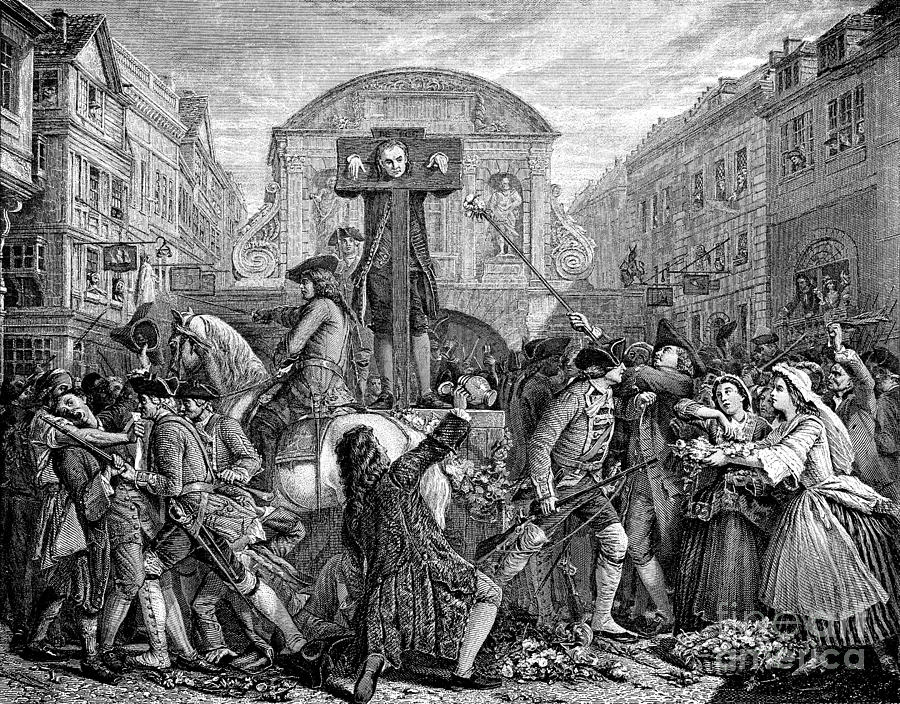
| The stocks and pillory are inseparable from our image of early Boston, as in this depiction of the Town Square in the 1640's, for good reason. Probably no place on earth regulated by law so much of every detail of everyday life and enforced it by vigorous prosecution before a theocratic court. It was ridiculously easy to run a fowl of the law and outside of the elite an astounding percentage of Bostonians were put on display over the course of their lives. |
They quickly established a court
system and relied on it to both settle
disputes and to impose tight control
over the daily life of the people.
Few places on earth found every
detail of daily life so prescribed by law as Massachusetts Bay, from set prices on almost everything to appointed
hours for meals, sleep, and prayer.
Any of hundreds of violations
could land the malefactor in court and
subject to fine—or the stocks.
The simplest disputes among
neighbors quickly turned into law
suits and counter law suits.
The Puritan emphasis on reading the
Bible and literacy demanded education. Boston
Latin became the first school in
the colonies in 1635 and Harvard College
was established to churn out more ministers and lawyers the following year.
While most colonial settlements were essentially agricultural villages or fishing
ports, Boston soon was using the advantages
of its fine deep water harbor sheltered from the fierce storms of the Atlantic to become a trading hub. Within
a generation its ships were trading
with the world and the growing city was relying on a network of villages across Boston Neck to provide food stuffs.

When King Philip's War with native
tribes erupted in 1665, Boston’s easily defensible position became
the fall back for the whole region as tribes scoured the countryside.
Of course as a bustling port,
the population soon grew to include many
non-Puritans. By the dawn of the 18th Century the city was becoming more
cosmopolitan and less of a day to
day theocracy.
Still, the values of Puritanism made Boston easily the most prosperous city in the growing British Empire with the highest rates of literacy and per-capita income and the largest city in the Colonies by the 1760’s. And it made it ripe for rebellion when time
honored privileges of self-governance
where challenged by the Crown.
By the early 19th Century Puritanism
would shed Calvinism and emerge like a butterfly from a cocoon transformed into something quite
different—a whole new form of liberal Christianity called Unitarianism. And in the first half of that new century literate Boston would cradle an
astonishing literary and philosophic renaissance that would
help transform a nation. But those, of course, other stories.