Showing posts with label western expansion. Show all posts

Sunday, July 26, 2020

Native People and Culture Through White Eyes—The Art of George Catlin

George Catlin captured Native American culture just before it was wiped away like this council of Northern Plains Indians and tepee village.  Amazing detail in costume, decoration on the tepee, cultural symbols such as the central tribal staff and bundles, smoking, and the scalps hanging from the tripod.  

When George Catlin was born on a farm near Wilkes-Barre in Luzerne County, Pennsylvania on July 26, 1796 the area was only a couple of generations removed from being on the frontier.  During the American Revolution it had been subject to raids by native tribes allied with the British.  His own mother had been taken hostage on such foray and she was held for a while in captivity.  Like many female captives she was apparently well treated and grew sympathetic to the tribe that held her until she was ransomed.  Her tales of that experience and the yarns of old timers set fire to the imagination of the  young boy with an artistic bent.
As he roamed the woods, streams, and fields hunting and fishing he began to search for and collect arrowheads and other artifacts of the now vanished tribes that once roamed the same ground.  While visiting Philadelphia with his father he witnessed the colorful array of a large delegation of trans-Mississippi chiefs and warriors on their way to a meeting with President Thomas Jefferson in Washington.  After reading accounts of the Western explorations of Lewis and Clark, who he grew to idolize, young George became determined to somehow go West and see the tribes for himself.
Meanwhile he set himself on becoming an artist.  The Peales of Philadelphia, the family of the foremost painters of the young Republic, took an interest in the talented lad and mentored him. Charles Wilson Peale also shared his enthusiasm for Native culture and his collection of artifacts brought back by Lewis and Clark. 

Catlin--early work,  a lithograph of Buffalo Harbor.
Peale recognized the young artist’s sharp eye for detail and meticulous draftsmanship.  After Catlin began to specialize in quality engravings, Peale recommended him for a prestigious project—a documentary volume on the route of the Erie Canal, other New York water ways, the Niagara escarpment, and the fledgling city of Buffalo.  Several of his plates were included in the first American book to include lithography, Cadwallader D. Colden’s Memoir, Prepared at the Request of a Committee of the Common Council of the City of New York, and Presented to the Mayor of the City, at the Celebration of the Completion of the New York Canals, published in 1825.
Three years later while traveling in Upstate New York and preparing more of the landscape prints for which he was becoming know, Catlin met Clara Bartlett Gregory in Albany and married her the same year.  She was evidently devoted to her husband and became the mother to four of his children despite his frequent long absences. 
The first of those absences came with a dream opportunity—to accompany his hero General William Clark, Superintendent of Indian Affairs in the new Bureau of Indian Affairs in the War Department, as the official artist on a diplomatic mission up the Mississippi River into Native American territory in 1830.  On that trip into what is now Minnesota Catlin for the first time encountered tribes with little previous contact with Europeans other than trading in furs.  He began making the detailed sketches or cartoons which he would use later in his studio to execute oil paintings.  He had found his life calling.

From the first trip with William Clark--Blood chief Buffalo Bull's Back Fat.
Catlin and his family would base themselves in St. Louis for the next six years and he would make a total of five extended expeditions during which time he would visit and document more than 50 tribes just before their way of life would vanish forever and their cultures became corrupted where they were not destroyed.  On one of these trips the dutiful Clara accompanied him at least part way.
His most important and productive trip came in 1832 when ascended the Missouri River more than 1850 miles to the Fort Union Trading Post near what is now the North Dakota-Montana border.  He spent weeks among 18 tribes including the Pawnee, Omaha, and Ponca in the south and the Mandan, Hidatsa, Cheyenne, Crow, Assiniboine, and Blackfeet to the north.  He sketched portraits, costume studies, village life, hunting scenes, and rituals.  He captured the powerful Mandan, the most significant of the northern plains tribes and Lewis’ and Clark’s hosts during their first winter just before they were virtually wiped out by a small pox epidemic caused by infected blankets traded to them.  That included a depiction of the sun dance in which warriors would hang from the ceremonial lodge poles with thongs attached to skewers piercing their chest muscles while they had visions.  

Mandan Sun Dance Lodge.

Catlin returned to the East with his wife in 1838 and completed hundreds of paintings which he assembled into the Indian Gallery which he took on a tour of principle cities.  The paintings were displayed in the salon style of the day occupying walls floor to ceiling.  The artist would also lecture on his adventures and on tribal customs and display objects from his extensive artifact collection.  The main source of revenue was the sale of a detailed and illustrated catalogue from which visitors could identify each painting from the number attached to it and read details about the subject.
Despite strong notices in the press the tour, which was Catlin’s only source of income, struggled from the expense of the tour, rental cost exhibit space, and most of all the high cost of the catalogue which most viewers could not afford to purchase. Although he had numerous offers to buy individual works, Catlin was desperate to keep the collection together and to finance subsequent trips to the Arkansas, Red, and Mississippi Rivers; and to Florida and the Great Lakes region.  Eventually he had more than 500 paintings in the Indian Gallery.

George Catlin by William Fisk.  The artist often wore the shirts and other clothing from his collection of Native outfits and artifacts.

In 1839 he had better luck taking the Indian Gallery on a tour of European capitals where it was a sensation.  The pictures struck a chord with a population already enamored with the Romantic vision of the Noble Savage as an innocent creature of Nature and primed by the popularity of James Fennimore Cooper’s Leather Stocking Tales and other American books.  A French critic gushed, “He has brought back alive the proud and free characters of these chiefs, both their nobility and manliness.”
The European triumph proved to be only a temporary respite from financial desperation, however.
To avoid selling the work piecemeal and to support his family Catlin tried repeatedly to sell the collection intact to Congress.  That then notoriously parsimonious body refused every plea to preserve the collection as an irreplaceable national treasure. 

One of the most famous images--Chief Four Bears of the Mandan in all of his magnificence.
He derived some income from the publication of a series of books beginning with Manners, Customs, and Condition of the North American Indians, in two volumes, with approximately 300 engravings, the source of the images the contemporary American public is most familiar with in 1841.  Three years later he published Catlin’s North American Indian Portfolio with 25 plates suitable for framing
Through the 1840’s Catlin was based largely in Europe where wealthy patrons could afford his expensive books and plates.  But tragedy struck in 1845 in Paris when his wife Clara and youngest son died of some infectious disease.  On his return to the states Catlin unsuccessfully published a collection of pictures from those years, Eight Years’ Travels and Residence in Europe.  What interest the American buying public had in Catlin was limited to his work as an Indian iconographer.  Unfortunately they were still not interested enough in that either to support him.

Clara Catlin circa 1840 by George Linen
In 1852 in order to fend off clamoring creditors and finance further explorations and work Catlin sold the now 607 paintings in the Indian Gallery to industrialist Joseph Harrison who promised not to break the collection up and to hold it in trust until Catlin could re-purchase it.  He stored the collection in one of his Philadelphia factories where they were removed from public view for years.   Unfortunately the artist could never redeem his work.
Instead he began to painstakingly duplicate as many of the paintings as possible using his original cartoon sketches, notes, and his own memory. Over 20 years he re-created more than 400 of them.  These paintings, known as the Cartoon Collection are not as highly prized today as the originals but do sometimes turn up for private sale.

Dramatic action in Attacking the Grizzly

Catlin also continued to travel and do new work when possible.  He toured the American South West, Central and South America as well as returning to the Great Plains where he captured the Sioux, Cheyenne, and the Arapaho and the environs of Fort Laramie as the Oregon Trail encroached on tribal lands.  All of this was documented in Last Rambles amongst the Indians of the Rocky Mountains and the Andes published in 1868.  Work on the Southwest tribes was issued separately.  A final posthumous volume, My Life among the Indians issued his unpublished material in 1908 edited by N. G. Humphreys.
During the final years of his life, Catlin was evidently progressively more eccentric.  While working in Brazil wrote and published Shut Your Mouth a lengthy essay suggesting that people who are slack jawed, mouth breathers or just talk too much are apt suffer to any number of physical ailments.  His prescription to “keep your mouth shut” somehow went through eight editions showing that American taste runs more to crack-pot quackery than anthropological art.
In 1872, sick and broke the first Secretary of the Smithsonian Institution invited Catlin to make use of studio space in the museum Castle in Washington.  It was there that the artist did his final work before dying in Jersey City, New Jersey on December 23, 1872 at the age of 76.

 Chief Osceola, bane of he U.S. Army Regular Dragoons in the Florida Seminole Wars.
The Smithsonian did end up with Catlin’s original Indian Gallery in 1879 when Joseph Harrison’s widow donated the whole collection to the museum.  The Gallery is now a centerpiece of the Smithsonian American Art Museum.
Other significant collections of Catlin’s vast output and associated material include the Department of Anthropology at the Smithsonian’s National Museum of Natural History, 700 sketches at the American Museum of Natural History in New York City;  artifacts in the University of Pennsylvania Museum of Archaeology and Anthropology collections; and  239 of illustrations of  North and South American Indians and other illustrative and manuscript material in the Huntington Library in San Marino, California.
Of course no illustrated history of the American West, or study of Native Americans in books, articles, or TV documentaries is complete without illustrations from the prolific George Catlin.

Wednesday, October 26, 2016

A Mule Named Sal and an Inland Empire


I’ve got an old mule and her name is Sal
Fifteen years on the Erie Canal
She’s a good old worker and a good old pal
Fifteen years on the Erie Canal
We’ve hauled some barges in our day
Filled with lumber, coal, and hay
And every inch of the way we know
From Albany to Buffalo

Chorus:
Low bridge, everybody down
Low bridge for we’re coming to a town
And you’ll always know your neighbor
And you’ll always know your pal
If you’ve ever navigated on the Erie Canal.

—Thomas  S. Allen,  1905.  Original lyrics written to commemorate the construction of the Erie Canal.
The Erie Canal opened October 26, 1825.  Few innovations in American history had such immediate and far reaching consequences as the public works project once derided as Clinton’s Folly.
A canal linking Lake Erie with the Hudson River at the New York capital of Albany was first proposed by Thomas Eddy, a business man with interests in a failing canal digging company and sponsored in the New York State Assembly by Jonas Platt, leader of the Federalists in the Senate.  To gain bi-partisan support for the ambitious project, Platt proposed a commission carefully balanced between leading figures in both his party and the Democratic-Republicans. 
On March 13, 1810 the Erie Canal Commission was created with the assignment to do preliminary studies of feasibility, explore possible routes, and come up with plans to finance what would be by far the biggest engineering project yet undertaken in North America.  Gouverneur Morris, a distinguished former Federalist Senator and one of the principle authors of the Constitution, was named as President.   The other commissioners were Federalists Eddy, Stephen Van Rensselaer, and William North plus Democratic Republicans DeWitt Clinton, Simeon DeWitt, and Peter Buell Porter.
DeWitt Clinton's single minded devotion to the construction of the Erie Canal over 15 years of political intrigue and controversy ended in triumph for him and the opening of the American interior to rapid settlement and development.  Portrait by George Caitlin.

The driving force on the Commission quickly became Clinton with strong support, despite their different political connections of Van Rensselaer, the heir of the greatest of the Patroon dynasties of semi-feudal land owners in Up State.  The Commissioners quickly went to work and several of them explored the route as far as possible by water and on an arduous cross country trek via unimproved roads and trails.  Clinton kept a detailed diary of his adventures on this trip. 
The following March the Commission issued a report that dismissed competing proposals for a possible canal to Lake Ontario and proposed that a totally man made channel be dug straight west from Albany to Lake Erie at Buffalo.  Morris dissented proposing instead a physically impossible scheme to deepen existing rivers and have Lake Erie “empty into them to fill them.”  Little wonder that his leadership on the Commission was by-passed.  Perhaps most importantly, the commission acknowledged that the project was too big to be financed by private capital and recommended public financing by the State.
In April 1811 the Legislature responded by authorizing the Commission to take all the necessary steps to finance the entire project and granted $15,000 to begin its work.  It also added Robert Fulton and Robert Livingston to the body.  Fulton had launched a commercially viable steamboat service between New York City and Albany with Livingston, a member of a powerful political family, as his partner in 1807 which had spurred interest in a western canal.  Both men were Democratic-Republicans, giving Clinton extra clout in addition to lending their enormous prestige to the project.  Fulton would actively work with Clinton on engineering aspects of the project until his death in 1815.
The War of 1812 ground progress to a halt.  Van Rensselaer was appointed General in command of the New York Militia.  The frontier with Canada around Buffalo became a major theater of operations in the war and was a jumping off point for attempted invasions by both sides.  The lack of reliable transportation to bring artillery, arms, powder, and supplies to the front crippled American efforts and provided a national defense justification for a canal. 
Meanwhile Clinton, then serving as Mayor of New York City and Lt. Governor, was reluctantly drafted by a dissident Democratic-Republican rump and backed by the Federalists to run for President against James Madison in 1812.  It was a close fought election and Clinton took 47% of the popular vote while losing by a wide margin in the Electoral College.  The run strained his relations with loyal Democratic-Republicans, notably the powerful Livngstons.
At the conclusion of the war, Clinton revived interest in the project by holding a large public meeting in the New York City.  He promised residents that the project would bring about a boom:
The city will, in the course of time, become the granary of the world, the emporium of commerce, the seat of manufactures, the focus of great moneyed operations.  And before the revolution of a century, the whole island of Manhattan, covered with inhabitants and replenished with a dense population, will constitute one vast city.
In 1816 the Legislature reformed the Commission with explicit authorization to supervise acquisition of land and the actual construction of the project. Clinton was named the new President and Van Rensselaer, who now abandoned the dying Federalists to become a Clintonian Republican, were held over.  Joseph Ellicott, an agent for the powerful Holland Land Company which donated 10,000 acres of land to the project; Myron Holley, a state Assemblyman and political ally; and Samuel Young,  who had written the influential book A Treatise on Internal Navigation: A Comprehensive Study of Canals in Great Britain and Holland. 
In 1816 outgoing President James Madison vetoed a bill that would have contributed Federal funds to the construction.  Madison supported using Federal funds for internal improvements but doubted that barring an authorizing amendment to the Constitution that the government had the authority.  But there must have been satisfaction to slapping back at Clinton.
1817 proved to be a big, break-out year for the canal. Clinton became the beneficiary when Daniel D. Tompkins was elected as James Monroe’s Vice President.  Despite the bitter opposition of the growing Tammany organization in New York City, Clinton was easily elected to serve out Tompkins’s term as Governor.  With his support in April Legislature created a Canal Fund which was authorized to spend $7 million for construction of a canal 363 miles long, 40 feet wide, and four feet deep. Commissioners of the Canal Fund was made up of the state Constitutional officers.
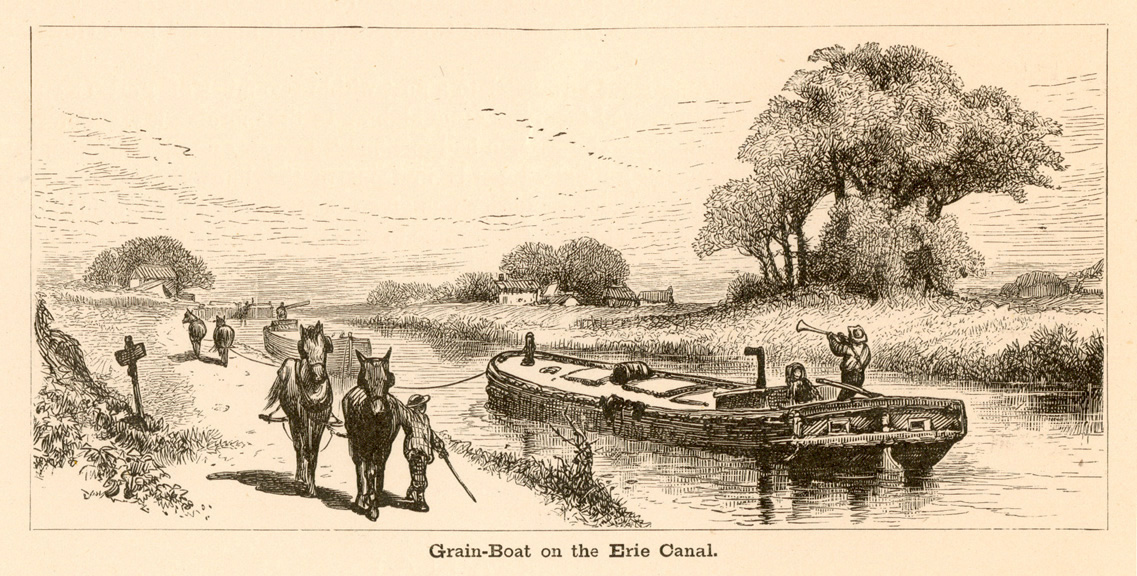
Construction began on July 4 at Rome.  The first 15 miles to Utica took two years to build due to the difficulty in felling trees through the virgin forest, excavating and removing earth by hand.  An innovative stump puller was used, but at best three man crews with mules could only build a mile of canal and adjacent tow path in a year of arduous labor. 
Also holding up construction was the fact that in the entire United States there was not one trained civil engineer.  The surveyors who had laid out the route, James Geddes and Benjamin Wright were in over-all charge of construction and learned by doing.  They were aided by Canvass White, a 27-year-old amateur engineer who traveled to England at his own expense to study canal construction there and Nathan Roberts, a mathematics teacher.  Despite this they laid out an impressive record of achievement, carrying the “Canal up the Niagara escarpment at Lockport, maneuvered it onto a towering embankment to cross over Irondequoit Creek, spanned the Genesee River on an awesome aqueduct, and carved a route for it out of the solid rock between Little Falls and Schenectady...” according to Canal historian Peter L. Bernstein
The route of the original canal.
The eventual arrival of thousands of Scotch-Irish laborers greatly speeded construction.  These navies, although Ulster Presbyterians, were the first of a wave of hundreds of thousand Irish laborers who dug the canals and built the turnpikes and railroads of their new country.  Conditions were brutal.  Over a thousand men died of swamp fever at Montezuma Marsh, the outlet of Cayuga Lake west of Syracuse.  Work there ground to a halt until winter when the marsh froze over.  But work in the frigid weather by men without adequate coats was almost as lethal.  Soon Catholic Irishmen were replacing the Ulstermen.  In 1825 Father John Raho wrote to his bishop that “so many die that there is hardly any time to give Extreme Unction to everybody. We run night and day to assist the sick.”
Despite the hardships, year after year the work pressed on.  The middle section from Utica to Salina (now Syracuse) was completed in 1820 and traffic on that section started up immediately. The eastern section, 250 miles from Brockport to Albany, opened on 1823 to great fanfare as did another 64 mile section from Watervliet on the Hudson to Lake Champlain.  
The back breaking labor to build the canal was largely provided first by Scotch-Irish Ulstermen then by immigrant Irish Catholic navies.  Hundreds died of disease, accidents, and exposure in the harsh environment.
Next, climbing the Niagara Escarpment up though an 80 foot wall of hard limestone was the great challenge.  Generally following the course of a “wild” stream pouring over the cliff, a series of five locks were carved out so that barges could be lifted to the level of Lake Erie.  This is the only section where wide-spread use of blasting powder occurred, predictably with fatal consequences for many workers. 
On the west end the village of Buffalo they dredged a channel of Buffalo Creek to make it navigable and built a port facility on Lake Erie.  That secured the village as the terminus of the canal over neighboring, and much less enterprising, Black Rock on the Niagara River.  In doing so Buffalo secured a future as an industrial powerhouse and the economic center of the region.
Despite the apparent success of his great project, Clinton was in political trouble.  Tammany politicians in New York City allied themselves with the Albany Regency, a masterfully assembled Up State political machine created by Martin Van Buren.  Together they became known as the Bucktails faction of the Democratic Republican Party and declared war on Clinton and his supporters.  Gaining control of a state Constitutional Convention in 1821, the Bucktails shortened the term of governor to two years and moved the term from a July 1 start to a January 1, thus shaving a year off of Clinton’s term.  They also passed a 2 million dollar appropriation for the canal attached to a measure that stacked the Canal Board with Clinton’s political appointments.  The governor was forced to sign the measure or jeopardize funding of his pet project. In 1822 Clinton, despite huge personal popularity, was denied re-nomination by the Democratic-Republicans and he was out of office at the end of the year.  In 1824 the Legislature ousted him as President and a member of the Canal Commission.
The last act proved a step too far for his opponents.  With the Canal nearing completion, voter indignation over Clinton’s shabby treatment propelled him back into the Governor’s chair that fall.
It was with understandable glee that Governor Clinton got to preside over the ceremonies opening the canal in October 1825.  He sailed on the packet barge Seneca Chief along the Canal from Buffalo to Albany then transferred to a steam packet for the trip down the Hudson to New York City.  He poured two casks of Lake Erie water into the harbor in the City making a symbolic Marriage of the Waters to officially open the whole waterway system.
Clinton pouring water from Lake Erie into the harbor at New York City officially opening the Erie Canal system.


The economic and social effects of the Canal quickly surpassed the most optimistic predictions.  The vast resources of the Great Lakes basin were immediately accessible in the east as they had never been before when the Allegany and Appalachian Mountains presented a substantial barrier to commerce.  Freight rates from Buffalo to New York went from $100 per ton by road to $10 per ton by Canal. In 1829 3,640 bushels wheat were transported down the Canal.  By 1837 this had increased to 500,000 bushels and four years later it reached one million. In nine years short years Canal tolls more than recouped the entire cost of construction.  
Equally, if not more important, the Erie Canal became the great highway to the West for hundreds of thousands of settlers who were eager to claim land and begin to ship their crops east for good hard cash money.  Previously growth of the trans-Appalachian West was limited to the heartiest pioneers who had to stay close to the great river systems to ship their produce to market via the long trip down to New Orleans.  The younger sons of New England and New York farmers, craving land and with the resources to buy it flooded the Old Northwest transforming Ohio, Indiana, Michigan, Illinois, Wisconsin, and even distant Minnesota from frontier wilderness to prosperous, populous states by 1850.
Not only did the mostly farming settlers find easy access to market, others began to ship the endless lumber of the Great North Woods, iron ore to feed the smelters and furnaces of an industrializing nation, and other resources.  Within 15 years New York City had fulfilled Clinton’s dazzling prediction.  It had leapfrogged its competitors, Boston, Baltimore, and New Orleans and was handling more freight than all of those cities combined.  The Canal also spurred development in towns and cities along the route from Buffalo on down the Hudson.  Many cities developed industries that fed manufactured goods into the interior.  New York State communities along the path of the canal, the lateral canals built to feed it from the more remote interior of the state, and the Hudson River became boom towns.
The Canal was deepened and widened twice in the 19th Century to accommodate larger barges and greater traffic.  Between 1905 and 1918, engineers decided to abandon much of the original man-made channel and use new techniques to “Canalize” the rivers that the canal had been constructed to avoid—the Mohawk, Oswego, Seneca, and Clyde plus Oneida Lake.  A uniform channel was dredged; dams were built to create long, navigable pools, and locks were built adjacent to the dams to allow the barges to pass from one pool to the next.  When it opened in 1918, the whole system was renamed the New York State Barge Canal.
The widened and deepened second reconstruction of the Erie Canal allowed much heavier barges.  Near Shenetady in 1913.

The system remained an economic engine for New York State until the St. Lawrence Seaway was completed in 1959.  Traffic then dropped to a trickle.  In recent years the system has experienced a renaissance as recreational corridor.  Abandon stretches of the original canal have been preserved in many places, including a 36 mile stretch in the Old Erie Canal State Historic Park from the town of DeWitt near Syracuse to Rome.