Tuesday, September 25, 2012

Why Mitt’s Great Grandpa Skipped to Mexico—The War on Mormons

Mormon men, including Church Elders, held in Federal Prison for Polygamy.


Mitt Romney’s Mormon heritage has been an issue bubbling just below the surface since his announcement that he was running for president.  As he slogged through the primaries while desperate Tea Baggers, assorted religious zealots and Ayn Rand fan boys desperately ran through one any-body-but-Mitt possibility one after the other, the word was out that the crucial Evangelical block would not support a member of the anti-Christian cult.
Since clinching the nomination, some Democrats have delighted in mocking the more bizarre aspects of Mormonism from after death baptism of Jews to funny secret underwear.  Lately immigration and marriage equality activists have brought up the flight of his great grandfather and father to Mexico to avoid prosecution as polygamists and to continue to enjoy their plural marriages.  Even his dad, George Romney was born there before fleeing back to the United States during the Mexican Revolution. 
But few American who did not grow up Mormon themselves or who did not live in Utah or one of the other Western states with major Mormon population have any idea about the back story to that episode.  Even fewer realize the political implications that are felt to this day.
The story below explains why the secretive leadership of the Church of the Latter Day Saints has always cultivated political influence and tried to secure the election of Mormons to high office from both political parties.  It explains the almost desperate drive to expand membership, particularly in Western states, so as to become so large and powerful that no governmental suppression could ever touch them again.  And it explains the secret desire to place one of their own at last in the very center of power.  Mitt Romney might be a stiff sock puppet, careless elitist snob, and willing tool of an oligarchy of powerful rich men to others.  But to Mormon leaders, he is literally a savior.

On September 25, 1890 Wilford Woodruff, President and Prophet of the Church of Jesus Christ of Latter Day Saints came down to his office looking haggard.  He had not slept much the night before, he told his secretary.  He had been in consultation with God and in the night God had given him a vision of the fate of the church and its people if the practice of polygamy did not end—the Temples would be sized and violated, the President and the Apostles would be imprisoned, and the possessions of all of the people confiscated.  With this revelation in hand, Woodruff went to the Apostles—a council of Twelve senior members—who approved a Manifesto renouncing plural marriage.  On October 1 the Manifesto was made known to the national press.  It was confirmed, at the insistence of the Federal Government at a Church General Conference on October 4.

Although Woodruff insisted he was acting only in accordance with instructions from God and not out of any worldly political considerations, it looked too much of the nation like the Mormons were caving to decades of escalating pressure against them by the Federal government.

Plural marriage, the preferred Mormon term for polygamy, was not part original Mormon practice as reveled to the Prophet Joseph Smith.  It seems to have been introduced through proselytizing and the absorption of a small polygamous sect in rural Maine.  In 1843 Smith received a private revelation approving of plural marriage, at least for himself and the Apostles.  The justification was the need to “rise up the seed of a new priesthood”—rapidly grow the society. 

Smith and the Church continued to publicly condemn polygamy and deny participation in it, but it became an open secret in the Illinois settlement of Nauvoo, where the first Temple was built.  Much of the public antipathy to the Mormons grew out of the suspicion that polygamy was sanctioned or practiced and it helped lead to Smith’s assassination and the Mormon exodus from Nauvoo.

Polygamy was not publicly proclaimed until 1852, five years after the Mormons arrived in Utah, and eight years after Smith’s death. Smith’s successor Brigham Young, who had led his people half way across the continent to their promised land, was an open polygamist.

The practice scandalized those back east and political pressure began to build to suppress the practice.  President James Buchannan dispatched the Army to Utah Territory in 1857, beginning the so-called Mormon or Utah War.  The church had over-played its hand in persecuting non-Mormons in the territory when a Mormon militia attacked and massacred an immigrant wagon train from Missouri at remote Mountain Meadows because some of its leaders were thought to have participated in past persecution of them.  The Army eventually occupied Salt Lake City.  Brigham Young was stripped of his post as Territorial Governor and was replaced by an eastern Gentile. Young delivered up elder John D. Lee as the responsible person for the massacre and continued to run a parallel, shadow government.

The infant Republican Party made the suppression of polygamy an important part of their platform.  When Abraham Lincoln came to the Presidency, however, he needed the support of Young and Mormon power in Utah to keep open the overland route to California and as a bulwark against Confederate ambitions in New Mexico.   When the Republican Congress passed the Morrill Anti-Bigamy Act which outlawed polygamy in States and Territories in 1862, Lincoln privately assured Young that he would not attempt to enforce it if the Mormon’s continued support of the Union cause.  A temporary truce of sorts over the issue was in force.

Then in 1874 Congress passed the Poland Act which facilitated charging individuals with violations of the polygamy ban.  As a show of force prominent Mormon leaders, including Brigham Young’s personal secretary, were arrested and prosecuted for plural marriage.  The Mormons reacted with defiance.  In the 1876 the doctrine authorizing plural marriage was officially published in a revised version of the Church’s Doctrine and Covenants for the first time.  

The Edmunds Act of 1882 made “cohabitating with more than one woman” a crime. Those who believed in polygamy could not try polygamists either as a judge or juror and polygamists and their spouses were banned from holding any office in any territorial voting.   With the majority of Utah’s residents thus excluded from voting anti-Mormons filled the Territorial legislature and took control of the educational system.

By the mid-80’s authorities, led by Federal Marshalls, began what the Mormons call “The Great Raid.”  Communities across Utah and adjacent southern Idaho were visited, homes raided at night, and children separated from their parents and questioned about their parents.  Hundreds, probably thousands of men and their families fled to Mexico or Canada including Romney’s ancestors.

The aim to actually destroy the church was made clearer in yet another piece of legislation, Edmunds-Tucker Act of 1887.  The Territorial Militia, composed mostly of Mormons was abolished and ordered to disarm. Fornication and adultery became Federal crimes meaning that polygamists could be charged with multiple offences.  Children born to polygamist fathers could not inherit from them.

Most ominously, the legislation disincorporated the Church, confiscated its properties, and even threatened seizure of its Temples without which believing Mormons could not uphold the requirements of the faith.  The Mormons were in disarray and despair.  In Utah alone there had been more than 2000 prosecutions for polygamy, adultery, and fornication.  Many men were convicted on multiple counts for each year married to each wife and were essentially held in prison indefinitely.  Courts held the ban against cohabitation even extended to women in separate households if they were financially supported in any way, instantly impoverishing thousands of women.  Much of the church leadership was in hiding and many had active warrants out against them.  President and Prophet John Taylor died while in hiding.

Taylor’s successor Woodruff was desperately seeking a solution.  In 1887 and 1888 he had asked the Quorum of Apostles if the Church should abandon polygamy.  In both cases Woodruff was told that they could not bend to temporal law in violation of “revealed truth.” Only the revealed word of the Lord could end the practice.

In 1890 the Supreme Court upheld the Edmunds-Tucker Act and legal action to seize church properties, including the Temples, was begun.  Additional legislation was introduced in Congress that would bar all Mormons from holding office or voting whether they practiced plural marriage or not.

It was in this context that God apparently finally spoke to the President.

Even though the Manifesto as approved by the General Convention allowed previously married men to keep their wives and families and skirted the issue of sanctions for violating the ban, it was enough to relieve pressure on the Mormons.  Raids and prosecutions fell off sharply and movement on the suit to seize church property was halted. 

In 1893 Church property was returned and in 1894 Democratic President Grover Cleveland issued a general amnesty and the Church replied by the dissolving the Mormon dominated People’s Party.  Although Mormons generally tended to support Democrats because their persecution was spearheaded by the GOP, Church leaders split affiliation with the two parties to assure support for both for the final push to the long cherished dream of statehood.

In 1896 Utah was finally admitted to the Union and the Church issued another Manifesto, this one supporting the separation of Church and State.

But the controversy was not entirely over.  Senate Republicans blocked seating Senator elect Reed Smoot because polygamy had not been eradicated in Utah.  Indeed, some plural marriages continued to be sanctioned in Utah by some members of the Apostles.  New President Joseph F. Smith, a great-nephew of founder, issued a Second Manifesto on Polygamy which explicitly excommunicating those practicing polygamy.

To this day Church leaders flatly declare that no “recognized members of the church,” practice plural marriage.  Yet it persists, largely in remote and rural areas.  A tiny Fundamentalist Church of Jesus Christ of Latter Day Saints and other break away groups have been organized and continue to endorse the practice.  Prosecutions are once again on the rise in Utah.

Meanwhile the Mormons have carefully burnished a public image of fostering an idealized, if paternalistic, family life featuring clean living, close relationships, and fervent support for traditional values.  On social issues, particularly abortion and marriage equality, they have sought to make common ground with the Evangelical Religious Right, and conservative Catholics.

Can the Saints ever shake the stained heritage of polygamy?  Can they find safety and security from persecution as part of a broader Conservative movement?  Can they put their own man in the White House?  Stand by for the results.


Monday, September 24, 2012

This Would be the Day for “That Would be the Day”

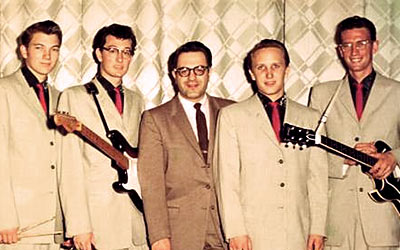
The original Crickets lineup, Joe Mauldin, Buddy Holly, D.J and concert host Lou Barile, Jerry Allison, and Niki Sullivan,


The history of Rock and Roll is replete with firsts that really weren’t.  Almost anyone will tell you that the first rock and roll song was Rock Around the Clock by Bill Haley and the Comets recorded in 1954 and which shot to the top of the charts the next year.  Wrong.  It can only claim to be the first number one hit and/or the first big hit by White artists covering a Black style.
Some musicologists claim that songs with key rock and roll elements were recorded by Black blues artists as early as 1939.  But it took ten years and several technological and economic changes—the introduction of the 45 rpm single and the collapse of the viability of large touring big bands among them—for Black artists to break out with a new sound on the Rhythm and Blues charts.  Two 1949 contenders were Goree Carter’s guitar driven Rock Awhile and Jimmy Preston’s Rock the Joint with a driving, blaring saxophone lead.  In fact Rock the Joint was covered three years later by Bill Haley and his earlier band The Saddlemen becoming a minor hit.
Another Black contender for first rock and roll record is Rocket 88 by Jackie Brenston and his Delta CatsIke Turner and The Kings of Rhythm under contract to another label working under a pseudonym—recorded by Sam Phillips at Sun Records in Memphis March of 1951.
By the mid-Fifties, rock and roll was an emerging genre and picking up steam, but pop charts were still dominated by crooners, close harmony vocal groups—the doo wop sound would emerge from the street corners out of this genre—and even the surviving big bands.  It took Elvis Presley to send it into the stratosphere.  Presley was the super-nova of a group of Sun Records stars who would infuse Delta blues and Gospel sounds into a tight, stripped down country sound.  Presley’s first regional hit, That’s All Right Momma was recorded within months of Rock Around the Clock.  Carl Perkins, Jerry Lee Lewis, and Johnny Cash, all recording at Sun along with Presley would define what became known as Rock-a-billy.
In 1955 Black blues based performers would drive the beat even harder and introduce a new guitar sound—Bo Diddley, Chuck Berry, and Little Richard.  And white acts were hard on their heels cleaning up lyrics and sanding off raw edges to make their sound acceptable to white teenagers—and their parents.
By 1957 rock and roll was a cultural steamroller.  So why at this late date does a record by some kids from Lubbock, Texas barely out of their teens which went to No. 1 on September 24, 2012, rate as seminal in rock history? 
Because the band, The Crickets, their lead singer and creative dynamo, Buddy Holly, and a smart record label assembled at last all of the elements that would tie together the disparate roots of rock and propel it into a new era.  That was the day that That’ll be the Day made it to the top.
The Cricket’s line-up—lead, rhythm, and electric bass guitar and drums—stripped away saxes, horns, stride or boogie-woogie piano, organ, and even the country fiddles and accordions that were part of earlier combos.  This quartet arrangement soon became standard, capable of delivering a beat heavy, driving sound.  The band could sing together in harmony or put Holly out front.  They could take the themes of teen age love, the stripped down substitute for the raw sex of early black rock, and run with them in new and creative directions.  Perhaps most important, they were the first white act to consistently write and record their own material instead of either adapting it from Black artists or using the talents of professional songwriters like those in the famous Brill Building.  Within a few years bands, as opposed to solo performers, would dominate rock music and they would be expected to produce their own songs.
They were immediately influential.  Within a year other acts were copying their formula.  In the early ‘60’s John Lennon and Paul McCartney would acknowledge their debt by naming their band the Beatles, a tip-o’-the-hat to the Crickets.
Influenced by the Memphis rock-a-billies, Holly and high school pals were experimenting and making demos as early as 1954.  Holly signed with Decca Records in 1956 and recorded several sides under his own name with the backing of Sonny Curtis, Jerry Allison and Don Guess in Nashville.  These records were straight forward rock-a-billy and were only moderately regionally successful.  One of those sides was a version of That’ll be the Day.
Holly was inspired to write the song after a trip to the local movie palace in Lubbock with his pals where they saw The Searchers.  The words were something of a catch phrase for John Wayne’s obsessed character.
In February 1957 producer Norman Petty brought Holly and his band, now consisting of drummer Jerry Allison, bassist Joe B. Mauldin, and rhythm guitarist Niki Sullivan to Clovis, New Mexico for a new recordings session for the Brunswick label.  Because Holly was under contract as a solo to Decca, Petty decided to release the resulting recordings under a band name.  After a brief consultation among the members, they settled on The Crickets after first toying with some “bird” names. 
That’ll Be the Day was released in May with Holly’s name visible only in the fine print as a composer under the name of The Crickets, as would all of the subsequent successful releases from that session.  It began its slow rise to the top.  As it did so, Decca discovered that their artist was one of the Crickets.  They were not overly alarmed, however, because Brunswick was a subsidy.  They signed a new deal with Holly.  The material recorded in Nashville would be released under his own name on Decca.  Anything recorded with the band would be released as the Crickets.  Subsequent solo efforts by Holly would go out on yet another subsidy label, Coral.
As That’ll Be the Day was nearing the peak of its climb, Decca released the Nashville version under Holly’s name on September 7 as a B side to Rock Around With Ollie Vee.  It was not a hit, but made it to Holly’s solo LP.