Showing posts with label exile. Show all posts

Saturday, October 9, 2021

The Banishment of the Contrarian —Roger Williams

No authenticated portrait of the quintessential religious dissenter and maverick  Roger Williams but an oil painting that was used for this engraved illustration that was supposedly made in 1644 during a trip back to England was circulated from the min 19th Century and other images derived from it.  Art historians have determinized that it was painted more than a century later and may actually have been adapted from a poor likeness of Benjamin Franklin.  Some of the derivatives took the faint darkening on the subject's upper lip and just below his lower lip and showed a moustache and   "soul patch." 

On October 9, 1635 the General Court of Massachusetts ordered Roger Williams, who they considered an obnoxious religious and political crank, into exile from the colony.  Specifically, the 32 year old was convicted of both heresy and sedition for spreading, “diverse, new, and dangerous opinions.”

Williams was born in 1603 to a conventional Anglican family.  His father was a prosperous master tailor and merchant in Smithfield, London.  A bright, inquisitive, and pious boy, Williams had a personal religious conversion experience which began his long journey as a dissenter.  His father disapproved but allowed his wayward son to continue his education, including an apprenticeship with the great legal scholar and jurist Sir Edward Coke.  He attended Charterhouse, a prestigious public school before enrolling at Pembroke College, Cambridge from which he graduated in 1627.  He excelled at classicalHebrew, Greek, and Latin—and modernDutch and Frenchlanguages.

While at Cambridge Williams became a Puritan—an advocate of purifying the Church of England by stripping away the remaining trappings of Catholicism including the Mass, use of Latin in liturgy, and idolatry in the form of statues of saints and icons.  He took Holy Orders as an Anglican priest, but his chances at advancement were blocked by the firmly High Church hierarchy.  He took a position as a private chaplain to Sir William Macham, a leading Puritan lord.  As such he was privy to plans to seed a Puritan colony in the New World.  Newly married, he passed on his opportunity to go in the first ships sent to found what would become Massachusetts in 1630.  But he was soon so disgusted with church leadership that he determined to join the migration.  He also privately abandoned any hope of reforming the corrupt church and became a Separatist.

Williams and his wife Mary set sail for New England in December on the Lyden and arrived in Boston in February 1731.  He found himself not only welcome but honored.  He was offered as a position as Teacher—sort of an associate pastor—of the Boston congregation.  He declined the position and openly declared himself as a Separatist.  He also insisted that civil magistrates should have no authority over religious maters and that individuals were free to develop and express their own religious convictions.  These positions shocked and appalled the Puritan worthies who demanded complete conformity to their beliefs in matters both civil and religious.

The church in Salem was then tending toward Separatism and invited Williams to become Teacher there.  Outraged leaders in Boston threatened the Salem church, which rescinded the invitation.  By August 1631 he had left Massachusetts for a friendly welcome among the Separatists of Plymouth.  Although not given an official position, he assisted the local minister and occasionally preachedGovernor William Bradshaw found his preaching, “entirely amicable” to the local church.

But Williams was never one to go long without examining his conscience and in holding the church to the exceedingly high standards he demanded.  He began to doubt that the Plymouth church was sufficiently separated from Anglicanism.  And his growing and admiring contact with native inhabitants led him to question the legitimacy of Royal Charters that granted land that the King did not own.  Instead, he maintained that land need be purchased from its rightful owners, the native tribes.  In December 1632 Williams wrote a lengthy tract on these subjects which he circulated to churches in both Plymouth and Massachusetts colonies.

By this time Bradford noted that Williams had fallen “into some strange opinions which caused some controversy between the church and him.”  In 1633 he had worn out his welcome and was back in Salem, which now seemed more inclined to support him.  Upon learning of his return, the Massachusetts General Court summoned him to Boston.  Williams apparently agreed to make some concessions and all known copies of his critical tract were burned.  Allowed to return to Salem, he became acting pastor when his sponsor, Rev. Samuel Skelton died.

Soon Williams had returned to his criticisms of both civil authority over religious matters and of the legitimacy of colonial charters.  He was called before the General Court again in March of 1635 and in April he so vigorously opposed a new oath of allegiance to the colonial government that it became impossible for the magistrates to enforce it.

Unable to rein in Williams, the General Court turned on the Town of Salem.  It refused a routine petition to annex adjacent land on the Marblehead Neck and took other actions against Salem’s interest.  In July the Court formally demanded that Williams be removed from the pulpit of the Salem Church.  The Salem Church asserted that the order was a violation of congregational polity and independence and circulated a protest letter to other churches.  The General Court ordered that the letter not be read in the other churches and refused to seat delegates from the town of Salem until the Church was in compliance.

As pressure grew on the Church, Williams demanded that it formally separate itself from the Standing Order.  His support within the Church then collapsed. Williams withdrew as minister and began meeting privately with a few followers in his home.

Without the protection of the Salem church or Town, the General Court went ahead with its sedition and heresy trial in October.  When the conviction was handed down, Williams was confined to his bed by illness.  He was given a reprieve from banishment until spring on condition that he remain quiet.  Typically, Williams would not shut up.  The Sheriff was sent to seize him in January 1636 but found Williams gone. 

Williams rest on his winter flight from Massachusetts in 1636 in a 19th Century illustration. 

Rather than be taken into custody and dumped, most likely, in hostile Indian country, Williams fled on foot through the deep mid-winter snows.  He marched 105 miles from Salem to find refuge at the head of Narragansett Bay, where he was welcomed by his friend Massasoit, sachem of the Wampanoags.  That spring he was joined by his most loyal followers from Salem and began to settle on land he purchased from the Wampangoags.  Learning that his claim was within the boundaries of the Plymouth Colony, however, Williams and his people crossed Seekonk River to territory beyond any charter and purchased land from Canonicus and Miantonomi, chief sachems of the Narragansetts.  Williams named his new settlement Providence.

Williams declared his settlement a haven for those of distressed of conscience.  It was soon attracting dissidents and exiles from both Massachusetts and Plymouth colonies. The settlement was governed by a majority vote of the heads of households, and newcomers could be admitted to full citizenship by a majority vote.

The Landing of Roger Williams in 1636 painted in1857 by Alonzo Chappel depicts Williams crossing the Seekonk River to meet with Native peoples to purchase their land.

In August of 1637 electors drew up a town agreement, which limited the government to civil matters.  In 1640 another agreement declared their determination “still to hold forth liberty of conscience.” Williams had founded the first place in modern history where citizenship and religion were separated, and where there was religious liberty and separation of church and state.  In fact, Williams advocated what he called a “wall of separation” between church and state—a term Thomas Jefferson would borrow over a 140 years latter in his famous Letter to the Danville Baptists.

Meanwhile, a second wave of exiles arrived on the Narragansett Bay.  In 1837 the Massachusetts Court moved against the followers of Anne Hutchins.  Williams invited them to settle near him and arranged for them to purchase land on Aquidneck Island.  They named their settlement Portsmouth and the island Rhode Island.  Their elected leader, William Coddington quickly turned out to be a civil and religious tyrant and was ousted.  He formed a second town, Newport.  Eventually these two settlements reunited with separate local administrations.

Meanwhile the Pequot War had broken out and much of Massachusetts was in flames.  Leaders there were forced to do what they loathed most—turn to Roger Williams for help.  And help he did.  Not only did his extensive contacts among all of the tribes—he was making his living by this time trading with the natives for furs—provide vital intelligence, but he also persuaded his friends the Narragansetts not to join the uprising and to become allies of the settlers.  The assistance of the Narragansetts became critical to the final victory in that ugly war.

Williams, his colony and his native allies became regional powers. In the next three decades Massachusetts, Connecticut, and Plymouth exerted pressure to destroy both Rhode Island and the Narragansetts.  In 1643 those colonies joined in an alliance excluding the towns around Narragansett Bay and hostile to them—the United Colonies.  To prevent the alliance from overwhelming them, Williams went to England to secure a Charter of his own.  He arrived just as his breakthrough dictionary of Native American words was published and creating a sensation among the English intellectual elite.  Through their influence he was able to get his charter for Providence Plantations over the vehement objection of Massachusetts agents.

                       Roger Williams's banned book.

While in England, however, Williams could not refrain from stirring the pot.  In July of 1643 he published his most famous book, The Bloudy Tenent of Persecution for Cause of Conscience, a scathing indictment of religious intolerance and plea for separation of church and state.  The book caused an uproar and cost him the support of many former friends.  The Public Hangman was ordered to confiscate and burn copies.  Luckily Williams was on board ship home with his charter in his pocket or he might have been arrested and even executed.

Back home it took Williams until 1643 to bring the two towns of Rhode Island—by then prosperous seaports with larger populations than Providence—into a single government under his Charter.  Coddington, in fact, plotted to usurp Williams.  He sailed to England and in an astonishing bit of power politics returned in 1751with a document naming him governor for life over Rhode Island.  Providence and its allied town of Warwick sent Williams back to England to reverse the decision joined John Clarke representing Coddington’s numerous critics from Portsmouth and Newport.  Williams had to sell his trading post, the only source of income for his family, which now included six children, to pay for his crossing.  The two somehow succeeded in overturning Coddington’s patent.

Williams returned to America in 1654 and was immediately elected the President of the colony. He subsequently served in many offices in the town and colonial governments, and in his 70s he was elected captain of the militia in Providence during King Philip’s War in 1676.

Clark stayed in England and in 1664 obtained a new charter under the name Rhode Island that covered all of the towns on the mainland and on the island.  The colony remained a haven for all sorts of religious minorities—Baptists, Quakers, even Jews and Catholics.

Williams is usually described as a Baptist.  And indeed by 1638 had come to adopt the key Baptist tenant of believer’s baptism or credobaptism as opposed to the Puritan and Separatist practice of infant baptism.  He had been exposed to the writing of English General Baptists but arrived at the conclusion on his own.  He was baptized by Ezekiel Holliman in late 1638 and founded the First Baptist Church in America in Providence.  A few years later John Clarke formed a second church in Newport.  Following the traditions of their founders, Baptists in America became the leading advocates of church and state separation.

Yet the restless Williams did not himself remain a Baptist long, although he remained sympathetic to them.  He concluded that the corruption of the early church when it was co-opted by the Roman Empire under the Empower Constantine had broken the sacred covenant between God and the Church.  A new church, he now believed, could not be established without a special new divine commission.  He declared, “There is no regularly constituted church of Christ on earth, nor any person qualified to administer any church ordinances; nor can there be until new apostles are sent by the Great Head of the Church for whose coming I am seeking.”

Williams spent the rest of his days praying privately with friends awaiting that great day.  Despite his honors in the colony, he founded and his many achievements, Williams died in relative poverty and obscurity some time in early 1683.  He was buried in an unmarked grave on his property. 

Williams's WPA built grave site and monument.  You can be sure that this hater of idols and icons and the man who first advocated for "separation of Church and State" would not have approved.

Within 50 years his house had collapsed, and his grave was lost.  In 1860, Zachariah Allen sought to locate his remains but found only an apple tree root in the grave he believed to be that of Williams.  The root has been preserved as a relic by the Rhode Island Historical Society.  Dirt from the supposed grave was named “the Dust of Roger Williams” and preserved in an urn that was finally interred in a monument erected by the Works Project Administration (WPA) in Providence’s Prospect Terrace Park in 1937.  You can be sure that he would have protested. 

Saturday, November 17, 2018

Religious Liberalism Flowered in Poland but Driven into Exile

Krakow--Cracovia--in the late 16th Century during the rule of Magnate John Saieninius.

On November 17, 1599 the Polish magnate John Saieninius, the ruler of Krakow, after listening carefully to a debate between an orthodox Calvinist and a member of the non-Trinitarian Polish Brethren abandoned his conventional Reformed Church affiliation and converted to proto-unitarianism.  Afterword he, and later his son, extended their protection and financial support to the struggling school and seminary at nearby Rakow and its press, which was soon flooding Europe with elegantly written arguments for unitarianism in Latin, still the universal language of the learned.
Only the most devoted students of the development of the Radical Reformation and the origins of unitarianism are even dimly aware of these developments.  Most of us know the Poland of today as the most intensively Catholic nation in Europe and a bastion of conservatism within the Church.  But Poland in the 16th Century was a very different place.  Heavily forested in the south and marked by sweeping plains and steppes in the north, it was vastly under populated due to a history of being an invasion corridor for armies on the way to someplace else.  It was also on the fringe of the Catholic world, far from the firm grip of Rome.  As the religious wars of the Reformation and Counter-Reformation periods wracked much of Western Europe, Poland basked in benign neglect.
The mid-16th Century was a period of rare general peace in Poland.  Never succumbing to the siren call of absolute monarchy that was turning much of Europe into a blood bath, Polish kings, who held little authority, were not even hereditary, they were elected with a rule of unanimity by the nobility.  When the nobles could not agree on a candidate, well there might just not be a king for a while.  The feudal nobles, on the other hand, exerted enormous power over their lands.  Given their relative isolation, it is somewhat surprising that many of them were among the most educated of their class in Europe, eagerly importing both books and personal tutors from the west.  Many of them were very open to new ideas, and were safe to explore them without either a powerful Church or king looking over their shoulders.
 The same magnates were also eager to bring new settlers into their lands to make them productive—and valuable sources of taxation.  Thus Poles welcomed refugees and persecuted minorities from far and wide and were willing to wink at their heresies and heterodoxies.  Which is why Jews, mercilessly persecuted almost everywhere else were given refuge to establish their rich shtetl culture there. 
Also welcomed were members of the Brethren, a pietistic sect growing out of Lutheranism that emphasized personal spiritual life, the “priesthood of all believers,” individual study and interpretation of scripture, living a life reflecting Christ-like simplicity and charity, believers’ baptism, rationality in religious debate, and tolerance of religious differences.  They also tended to be pacifistic and tried to stay out of the religious wars tearing apart Germany and the Netherlands from which many of them came.  The Brethren were equally unpopular with Lutherans and Catholics, and persecuted by both.  Many fled to Poland and were welcomed because of their reputation as thrifty hard workers.  
King Sigsmund II Augustus fostered a perion of religious toleration and freedom in Poland.
 Some of those Brethren were followers of Obbe Phillips and Menno Simons, Dutch preachers who denied the Trinity.  Rudolph Martin was particularly active in spreading this doctrine and as early as 1549 was preaching it in Krakow and finding an appreciative audience not only among the immigrants, but among the local aristocracy.  Soon other Brethren from Switzerland, Germany, Moravia, and the Hapsburg territories made their way to Poland as persecution became ever more severe while King Sigismund II Augustus had a policy of tolerance of a non-Trinitarian view of Christ, believers’ baptism and freedom of Biblical study.  Martin’s teaching spread widely among them, and among receptive nobles.
At the same time more conventional Lutherans and Calvinists were making inroads themselves and the Catholic Church seemed both in disarray and retreat.  Determined to win back Poland, the Jesuits came in 1564, just as the Polish Brethren were beginning to flower as a mature movement, and for fifty years worked surreptitiously to end toleration and re-impose Roman Catholicism.
In 1558 a Synod was held at Princzow that helped organize, however loosely, the Brethren as a distinct religious movement.  That synod was addressed by Blandrata an Italian dissenter from the Piedmont who was at the time one of the leading anti-Trinitarians.  Other prominent western dissenters came either seeking refuge or viewing Poland as fertile ground.

Italian radical theologian Fausto Sozzini--Faustus Socinus--became the spritiual leader of the Polish Bretheren despite never joining the sect because he refused Baptism.
None were more important than Fausto Sozzini, known best by his Latin name Faustus Socinus. Another Italian, he was on the run from the Inquisition when he arrived in Poland via Rumania where he had established warm relations with another group of Brethren. Despite agreeing with the Brethren on almost all major theological points, Socinus refused baptism and was thus never able to either join the sect or wield any official position. But he soon became the trusted advisor to Brethren leaders who appreciated his deep scholarship and integrity. Over the years he became the unofficial chief theologian of the Polish Brethren and moved them from crude anti-Trinitarianism toward positive unitarianism. Later the Jesuits and other enemies would brand the Brethren as Socinians, a label that they rejected as they also objected to being called Anabaptists.
In 1569 Rakow was established as a Brethren community just north east of Krakow.  It quickly became the spiritual and intellectual hub of the spreading community.  Cooperative farms and orchards supported a small school and eventually a print shop.  Within a few years the shop was producing books and tracts on Brethren theology and other topics in Latin.  Intended for instruction locally, the books were of such high quality that they soon began circulating in pietistic and Reform circles throughout Europe. 
When Rakow came under the sponsorship of the Saieninius family at the turn of the century, the school was able to expand into a full college, famous throughout Europe for the quality of its instruction and attracting scholars and students not just from the local Brethren but from many of the “best families in Europe.”  More than 1000 students regularly studied there.  

An early edition of the Racovian Catechism in Latin and Pollish.  Ciruclated throughout Western Europe despite supression, the book spread unitarian ideas widely.
The press got even busier.  Around 1605 the Racovian Catechism was drawn up by three noted Brethren scholars, Smaltzy, Moscorovy, and Volkel.  This famous book went through many editions, it declared that the “Brethren in Poland and Lithuania…confess One God the Father.”  It was the clearest and frankest exposition of biblically based unitarianism yet made.  The work was especially compelling for its calmness of reasoning and its refrain from attacking the theological views of opponents, unlike the openly contemptuous sarcasm that the martyred Michel Servetus had heaped on opponents in his earlier writing.  The quality of the book made it especially dangerous and it was banned in many places by Catholics, Lutherans, and Calvinists alike.  Mere position of the book was made an offense subject to burning at the stake for heresy by decree of that Defender of the Faith King Henry VII of England.
Despite the growing storms of opposition abroad, the early 17th Century was the glory days of the Polish Brethren.  Many of the nobles and gentry who converted to the faith made a display of living as did Christ by abolishing serfdom on their estates, establishing farming communes, and renouncing the privileges of rank to be part of the Christian community.  Needless to say, this trend alarmed other nobles, even other Reform members.  They threw their lot in with the on-going Jesuit plan to crush the Brethren.
By the 1620’s the Jesuits were appealing to the still largely Catholic class of serfs to turn against the Brethren, whose cooperative communities and orderly farms were far more prosperous than the tiny plots they were allowed to farm for their own families.   Although Poles of all classes had joined the Brethren, many of them were still either immigrants or the descendants of immigrants and many of their leaders had German, rather than Polish names.  The classic politics of resentment and tribalism worked well.  Peasants began to riot against the Brethren and attack their churches and schools.
Soon where local magnates were Catholic, prosecution of members of the Brethren on various charges minor and major was stepped up.  As early as 1611 John Tyscoviski of Bielsko was charged with refusing to swear by a triune God in court and was tortured and put to death in Warsaw.  He was just the first.  Brethren and other “heretics” isolated in majority Catholic areas were at first the targets while those on lands protected by local magnates and nobles were safer. 

Stannislaw Lubienicki, a philospher, historian, and astronomer widely admired in Western Europe was an example of the high scholarship fostered at the College in Rakow.
 An indiscretion by riotous students at the College in Rakow in 1638 gave Catholic authorities the long sought after excuse to close the school for good, scatter its students, and end it pesky publishing.
The next year 1639 Katherine Weigel (often called Catherine Vogel in the West), an 80 year old Catholic convert to Judaism was burned at the stake after being imprisoned for ten years for denying the Trinity.  Although she was a Judenizer, rather than a member of the Brethren, her death in the capital of the Brethren heartland, was a pointed warning of what was to come.
By the 1650’s Poland reverted to one of its periodic episodes of chaos.  Austrians and Romanians were attacking in the south and Polish nobles battled invading Tartars and Cossacks in the north and east.  Much of the later fighting took place around Krakow.  The peaceful Brethren tried to remain neutral, while Jesuit agents bribed the Cossacks to attack and burn Brethren estates, churches, and communes. 

King John II Casmir was driven out by the Swedes but rallied an army that expelled the northern invaders.  He accused the Brethren of colaborating with the enemy despite their pacifist neutrality and got the Polish Diet exile them.
 When the Swedes conquered Poland driving out King John II Casmir, the Brethren, like the Calvinists and Catholics, were required to swear loyalty to the Swedish King.  When Casmir later rallied his forces and expelled the Swedes, the Brethren never formally renounced their oath of loyalty although they had offered the Swedes no support and as was their custom tried to maintain peaceful neutrality.  The Jesuits whipped up a storm, accusing the Brethren of being agents of a foreign enemy.
 As a result in 1658 the Polish Diet proclaimed:
The toleration granted to dissenters from the church does not legally extend to the unitarians whom they call anabaptists, this being a new heresy. Therefore all who within such a limited time will not embrace the Roman Catholic religion shall be banished out of Poland; allowing, however, two years to sell their estates, whether real or personal.
Even before the two years were up, authorities ignored widespread riots against the community and seizures of their property.
In 1660, right on schedule the expulsion began with ruthless efficiency.  The Brethren were scattered to uncertain fates in Prussia, Silesia, Moravia, and Russia. Some were welcomed into existing, by non-unitarian Brethren groups, others were persecuted by local authorities and driven underground.  A few hundred managed to get to Transylvania to join Unitarians already there. Many migrated to the Netherlands, a few even reached England. In this they were helped by members of the congregations founded through the influence of John Biddle.
The Polish Brethren passed into history.  Their influence did not.  In exile they continued to publish and circulate clandestine copies of the Racovian Catechism into the next century.  Those books were passed hand to hand and treasured.  They came into the hands of the English Dissenters who became Unitarian and who were called Socinians by their enemies.
The triumphant Catholics of Poland soon turned their attention to the Lutherans and Calvinists and they, too, were crushed.  As Poland was repeatedly invaded, divided, and re-divided over the next centuries, Catholicism became the unifying banner of Polish nationalism.  To this day, you will find no monuments or markers commemorating the once vibrant flowering of Polish religious tolerance.

Monday, September 12, 2016

Elizabeth and Robert—The Great Elopement

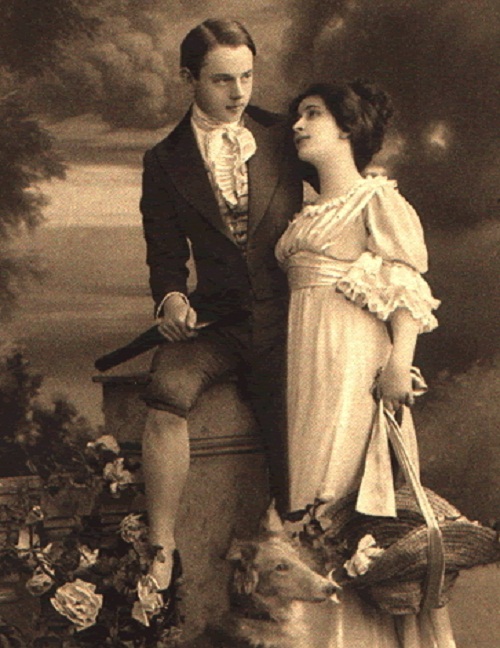
A late 19th Century photo postcard idealization of the elopement of Elizabeth Barrett and Robert Browning.  Note her beloved and loyal dog.


It may have been the most famous—and wildly romanticelopement since Romeo and Juliette.  The bride was a lovely but disabled spinster who happened to be perhaps the most famous living English poet at the time.  Her dashing beau was six years younger, of an inferior social class and just establishing himself as a poet of note in his own right.  They courted in secret—he contrived to visit her in the sick room to which she was mostly confined—and on September 12, 1846 ran off to be wed at St. Marylebone Parish Church in London then fled to sunny Italy in imitation of two of their mutual heroes—Percy Bysshe Shelley and Mary Wollstonecraft Shelley.  Her father disowned her.  Her beloved brothers shunned her.  But the couple lived happily and productively—each writing some of the best verse of their lives—until her frail health gave out at age 55.
Such is the tale of Elizabeth Barrett and Robert Browning who celebrated their love in poetry—she in Sonnets from the Portuguese which included Number 43 beginning with the lines “How do I love thee?  Let me count the ways” and he in the poem One Word More with which he concluded his collection Men and Women. 
The story also inspired literary work. Virginia Woolf’s Flush: A Dog’s Life saw the story through the eyes of Elizabeth’s beloved spaniel. The hugely successful play The Barretts of Wimpole Street by Rudolf Besier became the signature vehicle for American actress Catherine Cornell and was made into a popular MGM film starring Norma Shearer, Fredric March, and Charles Laughton.  

Fredric March, Charles Laughton, and Norma Shearer in MGM's 1934 production of The Barretts of Wimpole Street.

Elizabeth was born on March 6, 1806, the eldest of twelve children, to a family that had made an enormous fortune in Jamaica in sugar, mercantile trade, manufacture, and slaves over the previous 150 years.  She personally believed that she had some Black ancestry although none was ever documented.  She was raised at Hope End near Malvern Hills in Ledbury, Herefordshire, the country estate of her father, Edward Barrett Moulton Barrett.  She was educated at home and benefited by sharing a tutor with her oldest brother, giving her access to education beyond most girls.  She was extremely precocious reading novels at six and learning Greek to read The Iliad shortly after.
Her love of all things Greek led her, at age ten, to write her own epic in the style of Homer, The Battle of Marathon which so delighted her father that he had 50 copies privately printed.  She became a prolific, even compulsive, poet and her mother carefully preserved all of her work in scrapbooks which are said to represent the largest collection of juvenilia of any English writer. 
Elizabeth’s interests as a child were wide.   She took religion seriously both as a matter of faith and philosophic speculation.  Her family were devout Dissenters and reading of sermons and tracts exposed her to the most liberal opinion in England.  In her early teens she had absorbed Mary Wostoncraft’s Vindication of the Rights of Women.  She was entranced by Lord Byron and the Greek Revolution which inspired her first published poems,  Stanzas Excited by Reflections on the Present State of Greece in The New Monthly Magazine and Thoughts Awakened by Contemplating a Piece of the Palm which Grows on the Summit of the Acropolis at Athens in 1821.
But about this time her happy adolescence was dealt a severe blow—she came down with a serious illness inflicting excruciating pain in her brain and spine and sometimes rendering her incapable of walking.  Two of her sisters had the same condition, but ultimately recovered.  Elizabeth would regain some strength but be a semi-invalid the rest of her life.
The exact cause of this condition has never been diagnosed with certainty.  Speculation has run wild.  Polio was suspected.  In the early 20th Century it became fashionable to dismiss her ailment as female hysteria, a form of hypochondria said to affect creative women with “over active imaginations.”  But those who knew or observed her had no doubt her suffering was real.
 She began to rely on laudanum for the pain and later graduated to morphine making her a life-long addict.  Some believe reveries from the drug contributed to the vivid imagination she employed in her maturing poetry.  On the other hand, dependency contributed to her general weakness and after she developed a separate respiratory ailment—likely tuberculosis—in her twenties would have made that condition worse.
Still, she was an extremely attractive young woman as recorded in portraits made of her at the time and descriptions of family and friends.  She was small and delicate with large, expressive brown eyes and a dazzling smile readily offered.  She wore her nearly black hair in long ringlets divided by a center part which framed her heart shaped face.  She maintained that hair style through her life, long after it had gone out of style.
When she was 22 she lost her devoted mother.  An aunt moved in to supervise the children, including the now adult Elizabeth.  Where her mother had encouraged her literary career, the aunt found it unseemly.  They clashed.  The family left beloved Hope End and moved three times in the next few years before settling in a London town house, first in Gloucester Place and ultimately to that famous address, 50 Wimpole Street.
Young Elizabeth Barrett, celebrated poetess.
Elizabeth’s condition relieved her of the domestic duties expected of her sisters, as well as the sometimes demanding social obligations of a wealthy young woman.  She spent much time in her room devoting herself to wide ranging reading and study, voluminous correspondence, and, above all, writing.  But she was hardly a recluse.  She could, and did leave the house, and regularly received visitors, including many admirers of her growing literary reputation.  She was witty and charming between bouts of serious illness.
In fact in London she was able to meet—and impress—a wide circle of the English literary establishment, introduced by her cousin and close friend John Kenyan, including William Wordsworth, Mary Russell Mitford, Samuel Taylor Coleridge, Alfred Lord Tennyson and Thomas Carlyle.
Through the 1830’s and early ‘40’s Barrett’s literary output was astonishing. Much of her work was social commentary.  Unlike other popular female poets of the era, she had little patience for art-for-art’s-sake poetry.  She meant to instruct and uplift, not merely to decorate.  In the early 1830’s she became a passionate abolitionist and her popular poems like The Runaway Slave at Pilgrim’s Point and A Curse for a Nation were said to have helped swing public opinion behind the Emancipation Act of 1833 which abolished slavery in the colonies. 
But this activity put a strain on her relations with the father she adored, whose income relied on slavery.  And indeed after emancipation, the family’s fortunes waned dramatically.  Her father was forced to sell his country estates.  While the family was never reduced to poverty, their circumstances were reduced—and the income from Elizabeth’s literary output was surely welcome.
Later in the decade she turned her attention to child labor in The Cry of the Children published in 1842 and actively—by pen—campaigned in support of the Ten Hour Bill advanced by Lord Shaftsbury.  In addition to her original verse Barrett also contributed translations and essays to popular magazines.
The Seraphim and Other Poems in 1838 was her first mature collection of poetry followed by Poems in 1844.  She was one of the most popular, and widely respected poets in England, and the American edition of Poems re-titled A Drama of Exile, and other Poems was just as popular and influenced Edgar Allan Poe and Emily Dickinson whose life in some ways echoed hers.
It was that 1844 edition of Poems that led Robert Browning to write a fateful fan letter.

Robert Browning--a younger suitor with insufficient social standing.

Browning was born less extravagant circumstances than his beloved on May 7, 1812 in London, but it was hardly poverty.  His father, also named Robert had a sinecure at the Bank of England that paid £155 a year—a very comfortable middle class income.  Other than class Robert and Elizabeth shared remarkably similar backgrounds and upbringings.
His father was also a scion of a land and slave holding colonial Caribbean family with holdings in St. Kitts, but youthful experience on the plantation left him revolted with slavery.  He became an abolitionist, which cost him his inheritance on his father’s side.  There was also rumored to be slave ancestry in the family.  Robert’s mother was the daughter of a German ship owner and a Scottish mother who brought a modest income of her own to the family and was a devout Dissenter. 
The elder Browning was a bibliophile who filled his home with a library of over 1000 volumes.  When his son rebelled at the tedium of school, the library became his education.  He was literary almost by osmosis.  At age 12 he completed a manuscript of poetry which he angrily destroyed when he could find no publisher for it.  He was soon fluent in Greek, Latin, French, and Italian.   He entranced by the Romantics, especially Shelley in imitation of whom he dramatically renounced his mother’s fervent Protestantism for a noble atheism.
Barred from Oxford or Cambridge by his family’s non-conformist religion, Browning entered University College London at age 16 to study Greek.  He left after one year and refused all entreaties by his father to pursue some remunerative career.  He declared his intention to dedicate himself to literature.  His noble sacrifice to this end was to remain in his father’s household until he was 32 and eloped with Barrett.  His indulgent father accepted the situation and even underwrote some of his largely unsuccessful publications.
In 1833 he privately published—on the largess of his aunt and father—Pauline, a fragment of a confession, a long poem in appreciation and imitation of Shelley.  The book attracted a few positive reviews but sold almost no copies.  Only anonymity spared the author deep public humiliation.  Years later, in 1850, Dante Gabriel Rossetti stumbled on the work in the British Museum and connected it the by then established Browning.  The author heavily revised the poems for inclusion in his later collection.
He fared better with Paracelsus published in 1835 after a brief visit to St. Petersburg as the companion to a French/Russian aristocrat and diplomat.  The poems were cast as monologues of a 16th Century alchemist and sage and were meditations on an intellectual trying to find his role in society.  The esoteric subject matter did not sell well with the general public, but found an appreciative audience among the London literati including Wordsworth, Charles Dickens, John Stuart Mill, and Tennyson.  At least it gained him admittance to the fringes of literary society.
After turning his hand unsuccessfully to play writing, Browning went to Italy for the first time in 1835 where he found the inspiration for his ambitious  Sordello, a long poem in heroic couplets, the imaginary biography of the Mantuan bard spoken of by Dante in the Divine Comedy.  The book was both dense and obscure. Tennyson complained he could only understand the first and last lines.  The effort was ridiculed in the literary press, and an abject failure that nearly sank Browning’s reputation.
From 1841 to ’44 Browning slowly recovered his reputation with the modest publication of a series of eight pamphlets—we would call them chap books today—assembling work that had been published in various journals as well at the texts of his plays.  The plays impressed no one, but the poems which he styled dramatic lyrics, drew admiration.
Such was the modest state of Browning’s career and reputation when he eloped with the far more celebrated Barrett. 
The couple first resided in Pisa where they weathered the anticipated storm created by their scandalous elopement.  Of course they expected her father’s reaction.  He disinherited his daughter, as they knew he would.  But he went further, severing all connection to what had once been a close and loving relationship.  When the press painted Browning as a cad, seducer, and fortune hunter, even Elizabeth’s beloved and once supportive brother turned against her.  None would ever deign to receive or acknowledge her husband.
Italy in those days was something of a paradise for exiled Brits.  The climate was salubrious, the people warm and friendly, the food a delight and adventure to English palates raised on boiled beef, and the expenses low.  The couple and the nurse Elizabeth had brought with her were able to live simply but comfortably on her independent income derived from her mother’s estate and her earnings as a writer.  Better yet, the sunshine and fresh air—not to mention happiness—improved Elizabeth’s heath.
The following year the couple settled into apartments in Florence, which they would make their home the rest of their time together.  Both were writing productively—Elizabeth completing the love poems that became known as Sonnets from the Portuguese.  The title had a double meaning—the sonnets were composed in a somewhat unusual Portuguese style and Browning had made a pet name of calling her My Portuguese for her dark hair and eye beauty.  Barrett was contributing poems to London journals, the notoriety of the elopement probably helping to gain interest in more popular publications.  Yet the critical reception of these pieces was wildly divided.

Elizabeth Barrett Browning with her son in 1860.  One of her last pictures.

After suffering miscarriages Elizabeth, now 43 years old, successfully gave birth to a son, Robert Wiedeman Barrett Browning, whom they called Pen.  Their joy was unbounding and the boy doted on.
Meanwhile Elizabeth was preparing a new edition of her Poems.  Robert insisted that she include Sonnets from the Portuguese which she had considered private.  When the new edition was published in 1850 it created a sensation.  Whatever fame and admiration Elizabeth had enjoyed previously, it was now magnified.  And so was the public view of the story of her and Robert’s elopement—it was transformed almost immediately to the stuff of high romance.  Victorian audiences were thrilled.
When Wordsworth died that year so high was her star that she was seriously in the running with Tennyson to be named successor as national Poet Lauriat.
While in Florence the couple regularly socialized with the large English expatriate community there and entertained a stream of distinguished visitors from Britain and the United States which included William Makepeace Thackeray, sculptor Harriet Hosmer, Harriet Beecher Stowe, Margaret Fuller, and the female French novelist George Sand. 
In 1855 Browning finally had a breakthrough in his own career with the publication of the two-volume Men and Women, a collection of dramatic monologues in verse, the form for which he would become best known.
Elizabeth was even more active.  She produced Casa Guidi Windows in 1851 and her 1857 epic novel in verse, Aurora Leigh which was considered by many critics the greatest long form poem of the Victorian era.
Elizabeth also took note of social developments in England, and as she had done with abolitionism and child labor, composed poetic commentaries including Two Poems: A Plea for the Ragged Schools of London and The Twins.
Meanwhile Elizabeth became passionately involved in Italian politics, casting her lot with Giuseppe Garibaldi, his Red Shirts and their ambition to drive foreign influence out of Italy and create a unified kingdom.  She composed a short book of poems, Poems before Congress in support of the cause.  Back home in England these created an uproar in the Tory press, which denounced her as a fanatic.
In 1860 Elizabeth’s health began to collapse.  After winter in warmer Rome, the couple returned to Florence.  There on June 21, 1861 she died in her husband’s arms “smilingly, happily, and with a face like a girl’s. … Her last word was … ‘Beautiful.’”  So beloved was she in her adopted homes that shops closed down for her funeral.  She was buried in the famed Protestant English Cemetery of Florence, last resting place of several notables.
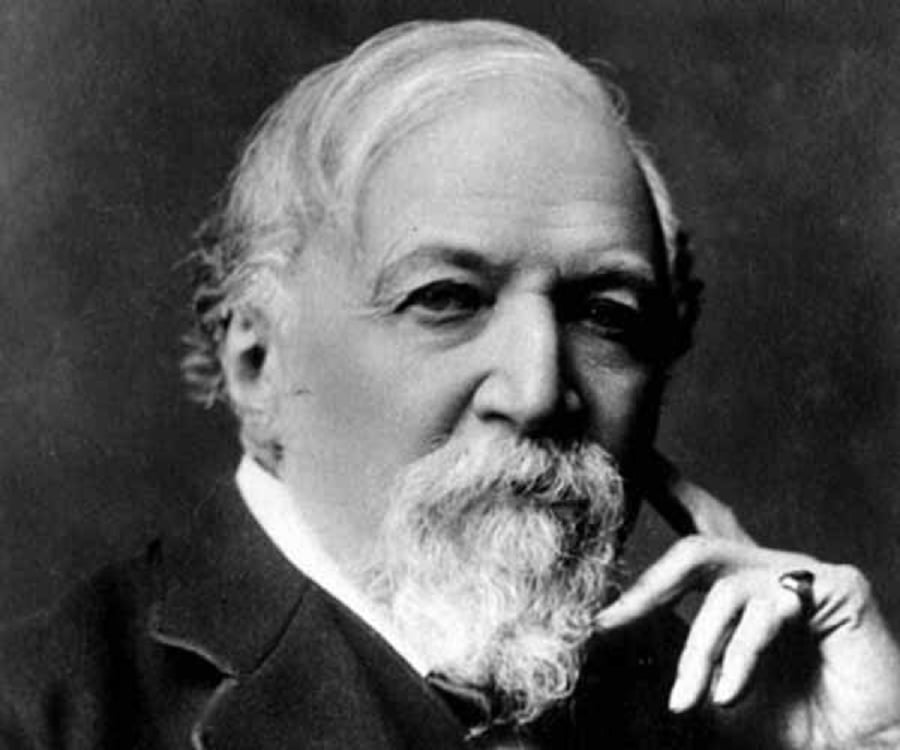
Robert Browning--at long last a literary lion in his own right.
Grief stricken Browning and his son returned to London, although he frequently visited Italy.  He edited and supervised a posthumous collection Last Poems published in 1862.
In subsequent years Browning’s own reputation as a poet soared with the long blank-verse poem The Ring and the Book based on a Roman murder-case from 1690s. Later works included Balaustion’s Adventure, Red Cotton Night-Cap Country, Parleyings with Certain People of Importance in Their Day and Asolando, coincidentally published on the day of his death.  Perhaps his best loved individual poem was his re-telling of The Pied Piper of Hamlin.
Browning died full of honors, at last one of the most admired English, poets on December 12, 1889 at his son’s home in Venice.  He was laid to rest in Poets’ Corner in Westminster Abbey next to Tennyson.