Tuesday, October 28, 2025

Edith Head Collected Oscars Like Nobody Else


Never one to hide her light under a bushel, Edith Head frequently allowed herself to be photographed with her Oscar Collection. 

Quick quiz.  What woman won more Academy Awards than any other?  Meryl Streep your say?  Wrong.  Katherine Hepburn.  Nope.  Sally Field.  Don’t be ridiculous.  The woman with eight, count ‘em eight Oscars was not an actress at all but a diminutive woman turned out for decades in enormous round glasses, black Moe Howard bangs, tasteful two piece suites, and a take-no-prisoners attitude.

Who else but costume designer to the stars, Edith Head.

Edith Claire Posener was born on October 28, 1897—although she would later claim 1902, a date which still shows up in articles based on her Hollywood press clippings—in San Bernardino, California.  It was not a place she called home.  Indeed she never had a real hometown.  Her father, Max Posener, was a Russian Jewish emigrant and her mother, Anna E. Levy, was born in St. Louis, Missouri, the daughter of German/Austrian Jews.  In the pecking order of Jewish society in America, they were mismatched.  It is likely Anna’s parents disapproved of the match and the couple eloped, or simply ran away since there is no evidence they ever married.

Max disappeared when Edith was small after a haberdashery he managed to open in San Bernardino failed.  A year later, in 1905 Anna married Frank Spare, a young Catholic engineer.  They were soon passing Edith off as their mutual daughter and she was raised a Catholic.   Her stepfather’s profession made the family virtual nomads has he found work in mining camps around the West.  The family stayed longer in Searchlight, Nevada than most towns.

Frank did earn a nice living an indulged his daughter in a first rate education.  Edith graduated with a B.A. and honors in French from the University of California at Berkley in 1919 and earned her Master’s in Romance Languages from Stanford a year later.

Then she was on her own in the world.  She started as a French teacher, first in a parochial school in La Jolla and then at the Hollywood School for Girls, a prestigious finishing school catering to the daughters of the booming movie business. In order to qualify for higher pay, she volunteered to teach art as well as French despite having no lessons in the subject since high school. 

Edith’s drawing skills were extremely limited so she enrolled for night classes at the Chouinard Art College.  While there she met Charles Head, the brother of a classmate.  They were married in the summer of 1923.  It was not a particularly happy marriage and the couple separated after a few years.  They did not divorce, however until 1934, presumably because of Edith’s Catholicism.  They had no children, but she gained the name she used throughout her professional life.

In 1924, bored with the life of a housewife in search of a good income, Edith naturally turned to the main local industry for work.  Despite absolutely no experience in fashion or design and still limited in drafting skills, she applied to Paramount Pictures for work as a costume sketch artist under the direction of studio designers.  To get the job she submitted a portfolio "borrowed" from another student.  Not the last time she would finesse her career by cutting corners here and there.


                                                            A rare shot of a young Edith Head sans glasses from her early days at Paramount.

Head, however, was a quick study.  Her drawing improved, and she began making suggestions.  Within a year she was designing for her first picture, The Wanderer, a Raoul Walsh film starring German actress Greta Nissen and Wallace Berry.  She soon became a Walsh favorite, the first of several directors who championed her career.

She toiled in the shadows of Paramount’s head designers, first Howard Greer, then Travis Banton both of who, as was the custom, would often claim her work as their own for screen credits.  It was a “tradition” Head continued after she got the top job long after it was both out of fashion and professionally frowned on, for which she would get a lot of criticism from fellow designers.

But within the studio, Heads work was championed not only by directors, but by leading ladies who appreciated her habit of consulting with them on her design to accommodate  when possible their taste and to accentuate their best features.  Most designers took a take-it-or-leave it attitude with actresses except for the handful of stars with real clout within the studio system.

Although she had enjoyed some studio publicity over the years, Head did not attract wide spread public attention until she put Dorothy Lamour in that famous sarong in 1937’s John Ford epic The Hurricane.  The dress made Lamour a star—Head kept her in versions of it in the subsequent Bring Crosby/Bob Hope road pictures—and Edith a celebrity. 

Dorothy Lamour's sarong was a break-out look.

She would keep an iron grip on the job for 29 more years.

Paramount was toward the rear of the pack of Hollywood Major Studios, much smaller than the relentless factory at MGM which produced as many as 200 pictures a year at its peak, or Warner Bros.  home of gritty urban dramas, women’s movies, and prestige bio-flicks.  In either of those she would have had to compete with rafts of designers to get the top assignments.  Paramount, on the other hand, made 20 or 30 features a year with a relatively thin stable of stars.  Head got her hand on any project she desired, and had time to frequently go on loan to other studios at the bequest of stars or directors she had cultivated.  By the 1940’s “Costumes by Edith Head” seemed a ubiquitous credit.

In that decade she left her impression on many stars and memorable films including Paulette Goddard in Cat and the Canary; Veronica Lake in Sullivan’s Travels and I Married a Witch; Barbara Stanwyck in The Lady Eve, Ball of Fire, and Double Indemnity; Ginger Rodgers in Lady in the Dark; Ingrid Bergman in Notorious, Loretta Young in The Farmer’s Daughter; and Bette Davis in June Bride.

Head’s star was rising, but she was not about to let studio publicity departments bury her contributions while hyping stars.  She made herself available for interviews to key entertainment reporters and kept gossip columnists in her debt by occasionally feeding them juicy—but never career damaging—studio gossip and usually flattering bits on the stars she cultivated.  She contributed fashion articles to magazines and staged costume shows for newsreels.  She even got Paramount to film a short documentary on her and her department.

Not that she was without critics, particularly among her fellow designers and those who toiled in studio wardrobe departments.  She had been an outspoken opponent of unionization by costume designers.  Always obsequious to authority, especially studio bosses, producers, and name directors, she could be a tyrant and taskmistress over the employees under her, quick to shift blame for failures and to claim credit for their work.  She defended the later by saying that their designs were always only executed at her guidance, direction, and inspiration. 

Others were critical of her style, particularly in modern dress pictures calling her the Shirtwaist Queen for her frequent use of that basic style.  But shirtwaists are flattering on most women’s bodies.  Moreover studio bosses were explicit that designs be a timeless as possible, shunning passing fashion trends, so that pictures could easily be re-released, a big money maker.  The result was a classic clean but elegant Edith Head style.

 
                                       Head's design for Bette Davis's cocktail party gown in All About Eve was among her most celebrated work.

In 1949 the Academy of Motion Picture Arts and Sciences added the costume design to its annual Oscar Awards.  Beginning that year with The Emperor Waltz, a Bing Crosby musical co-starring Joan Fontaine, Head would be nominated for the next 19 consecutive years—sometimes  for multiple pictures in a year—and five more times after that with a total of 35 nominations.  Her eight trips home with the trophy were for The Heiress with Julie Harris, 1950; Samson and Delilah with Heddy Lamarr (color), 1951; All About Eve with Bette Davis and Anne Baxter (black and white), 1951; A Place in the Sun with Elizabeth Taylor and Shelly Winters, 1952; Roman Holiday with Audrey Hepburn, 1954; Sabrina, again with Hepburn, 1954; The Facts of Life with Lucile Ball, 1960; and The Sting in 1974.

Of those films, the award for Sabrina was the most controversial.  For the key sequences when Hepburn as the chauffeur’s daughter blossoms into a Paris model, the star personally picked sketches by designer Hubert de Givenchy.  The outfits were constructed in Head’s wardrobe department and she did design most of the American clothes.  She refused to give de Givenchy screen credit with her for design.   Although the award was obviously mostly for his contributions, Head accepted it anyway.

Head was now a major celebrity in her own right.  There were not yet famous American fashion houses, and outside of New York society hardly anyone knew the name of a haute couture American designer.  Only the great Paris fashion houses were known to the public.  For many ordinary American women, the highly visible Head was high fashion, not just costume design.  Knock-off manufacturers kept Main Street dress shops across the country stocked with dresses and suits inspired by Head movies.

Even I, a pre-teen yahoo in Cheyenne, Wyoming knew who Edith Head was.  In those days we had a full hour for lunch at school and those who could, walked home to eat.  I did.  And everyday Mom had Art Linkletter’s House Party, a kind of stone age talk/variety program, on the TV.  Head made frequent, sometimes weekly, appearances on the show, on the show, often dishing out fashion advice to members of the audience.  At home, Mom paid strict attention.

She had now added Cecil B. DeMille, Billy Wilder, and Alfred Hitchcock to her list of director champions and a galaxy of stars including Hepburn, Taylor, Baxter, Grace Kelly, and Natalie Wood as her devoted fans. 

Among her other screen triumphs in the ‘50s and ‘60s were Sunset Boulevard with Gloria Swanson; Rear Window and It Takes a Thief with Kelly; White Christmas with Rosemary Clooney, Vera-Ellen, Crosby, and Danny Kaye; The Man Who Knew too Much with Doris Day; the DeMille epic Ten Commandments; Witness for the Prosecution with Marlene Dietrich; Separate Tables with Rita Hayworth; Vertigo with Kim Novak; and That Kind of Woman with Sophia Loren.

Starting in 1963 with Love With a Proper Stranger through The Last Married Couple in America in 1980 Head made seven films with Natalie Wood.

Her last film for Paramount was the gaudy melodrama The Oscar, for which she naturally received another nomination for the statuette in 1967.  Then Head left her longtime home at Paramount and jumped to Universal, a studio on the rise since its days as the home of classic monster movies.  She followed Alfred Hitchcock there, the director with whom she worked most often. 


Head surrounded by sketches reflecting her long career in 1967.

Age and increasingly fragile health slowed her up some, but she could still pull out some claims to glory.  There were five more Oscar nominations including nods for the musical Sweet Charity,  the costume epic The Man Who Would Be King, and the disaster movies Airport and Airport ’77.  After years of gaining glory for designing for beautiful Hollywood clothes horses, her final years were marked by films centering on men, including her final Oscar win, The Sting.

She designed for Rooster Cogburn with John Wayne and Katherine Hepburn.  She also did work that evoked earlier years of Hollywood glory and her own screen work—Gable and Lombard with James Brolin and Jill Clayburgh, W.C. Fields and Me with Rod Steiger and Valerie Perrine, and Steve Martin’s Dead Men Don’t Wear Plaid.  The latter, released in 1981, captured the look of ‘40’s film noir.  Released after her death, Martin dedicated the film to her.

Head’s husband since 1940, set designer Wiard Ihnen died in 1979 of prostate cancer.  The couple had no children.  Although Head continued to work until the end, her health was bad.  She suffered from myelofibrosis, an incurable bone marrow disease.  She died on October 24, 1981 four days shy of her 84th birthday.  She was buried unostentatiously under a simple bronze plaque in a Catholic section of Forest Lawn Memorial Gardens removed from the flashy graves and mausoleums of the stars she had decorated. 

Monday, October 27, 2025

A Dorky Cheyenne Boy Had aNutty Obsession With the Rough Rider


Theodore Roosevelt--boyhood idol turned obsession.

Brilliant. Bombastic. Explosively energetic.  Arrogant.  Innovative.  Ego maniacal.  Heroic.  Perpetually manic.  Self-inventing.  Those are some of the words and phrases the immediately spring to mind when contemplating the life of Theodore Roosevelt, the man who, among other things, reinvented the Presidency for the 20th Century.  The man who was born into a wealthy and influential old Knickerbocker Dutch family on October 27, 1858 continues to fascinate 106 years after his death in 1919 at the age of 60. 

In recent years he was the subject of widely hailed three volume biography by Edmund Morris and several other books examining various parts of his multi-faceted life, studied in Doris Kearns Goodwin’s close examination of the Progressive era in The Bully Pulpit, portrayed by Tom Berenger in the TV miniseries Rough Riders, and was one of the three main characters profiled in Ken Burns’ epic 5 night PBS documentary series The Roosevelts. And one of my favorite novelists and Facebook connections Jerome Charyn got inside T.R.’s head in The Perilous Adventures of the Cowboy King.


Jerome Charyn's The Cowboy King was a rip-roaring romp and a reminder of why idolized Theodore Roosevelt.  It even echoed the vibe of my Classic Illustrated comic book.

But 40 years after Roosevelt’s death, he also grabbed the idolizing attention of a 10 year old nerd from Cheyenne, Wyoming.  I was already in the grips of fascination with history as a bespectacled, bookish kid with no friends when I first encountered passing notice of him in my entirely inadequate elementary school social studies text.  From there I checked him out in the illustrated Presidential biography books that I had already collected.  And my folks rook me to the Black Hills where I saq Roosevelt’s visage squeezed in between Jefferson and Lincoln on Mount Rushmore.  So I knew he was a big deal.

But what turned Roosevelt from a passing interest into an obsession was a Classics Illustrated   comic book, The Roughrider.  It told the story of how young Theodore, the weakling asthmatic who was bullied and mocked for his myopia and thick glasses but who by dint of sheer grit and determination transformed himself into a Harvard boxer, South Dakota rancher, New York City Police Commissioner, war hero, and eventually President.  A particularly satisfying panel in the book depicted Roosevelt knocking out with one mighty blow a cowboy who mocked him as four eyes.  The boy Teddy seemed a lot like me, likewise the brunt of ridicule and abuse.  The adult hero held out promise that it did not always have to be that way.

It was a short step from hero worship to nutty obsession.  How so?  Let me count the ways.

Not Batman, Superman, or The Flash could compete with my comic book super hero..

The first thing was appearance.  The mustache stubbornly refused to rise from the fine blonde down on my upper  lip.  Halloween costume fakes were all jet black, lacked the distinctive inward curl around the sides of the mouth, and, well, looked like crap.  And I discovered that pince-nez glasses were not available at my local optician.  I was stuck with the clunky plastic faux tortoise shell frames fit for a middle aged accountant.  But I could get the hat right.

I started with a cheap gray felt hat I bought at a souvenir stand at Cheyenne Frontier Days.  It was supposed to be a Confederate hat and had a paper Stars and Bars Flag sticker on the front.  I was a loyal Union man and spent hours trying to get all vestiges of that peeled off.  The hat did have a satisfyingly military looking gold braid band with end tassels.  I pinned up one side with a brass US collar insignia from my Dad’s World War II uniform.  It made a satisfying reproduction of Col. Roosevelt’s famous Rough Rider campaign hat.

At first I decorated it with a long pheasant tail feather, but discarded that when I realized that no photo showed my beloved Teddy sporting such a plume.  I wore that increasingly battered hat every single day from the moment I got out of bed to the time I turned in at night—except when required to remove it at school or church—for almost three years until it practically disintegrated, and my head got too big.  Needless to say, I attracted a lot of gaping stares.  And the bullies were unimpressed by its martial appearance.

The hat was useful in the back yard fantasy games I played largely by myself.  None of the other neighborhood kids, least of all twin brother Tim who was running with a faster older crowd and already smoking cigarettes in their fort/club house, were interested in daily charges up San Juan Hill or whatever other adventures I could conjure.  My red and white Firestone coaster brake bicycle with the plastic streamers on the hand grips had to be my noble steed.

Alas, there are no extant photos of me in my Rough Rider hat, although I know that several were snapped on our old Kodak Brownie Box Camera.  My mom, likely out of shame and humiliation, left them out of her meticulously maintained photo albums and they can’t even be located in the unsorted shoe boxes of old photos. 

School was a place where my obsession played out with a bit of drama.  I started handing in my homework, busy work Ditto activity sheets, quizzes, and tests with the correct day of the month underneath my name but instead of 1959 listing the year as 1905, the year after Roosevelt’s election to a full term on his own. I picked the year because the old movies I watched on TV when I got home from school painted that era as sunny, pleasant, and free from looming nuclear annihilation—something that was constantly on our minds in Cheyenne where the Air Force was beginning to build the nation’s first ICBM missile base and which, the civic boast proclaimed, would be a top target for Commie obliteration.  The movies, mostly musicals and comedies like Meet Me in St. Louis or Life With Father were all made in the ‘30’s and ‘40s when many ticket buyers were of an age to recall those days with wistful nostalgia.  Most depicted the comfortable middle class in large homes with live-in servants.  It seemed to me that Teddy Roosevelt ruled over an ideal time to be alive.

The comfortable family life depicted in movies like Meet Me in St. Louis made me long to live in the days of Teddy Roosevelt's Presidency. After all, no Ruskie was apt to drop a nuke on this house..

So I decided that, come hell or high water, I would live then.  Neither my teachers, nor the Principal at Eastridge Elementary where I was routinely sent for an attitude adjustment, were amused by this quirk.  They demanded that I use the correct date and used every punishment in their arsenal to compel my acquiescence.  For a while I was given an F (actually a 5 because Cheyenne Public Schools were then using an odd numerical grading system) on every paper I turned in with the wrong year.  But I was a student reading at the level of a senior in high School and in subjects like social studies and science showed every evidence of complete mastery of the lessons.  Of course my spelling was atrocious, my hand writing cramped and nearly illegible, and I was too bored by arithmetic to bother with accurate computations and, it would be discovered much later, was mildly dyslexic compounding that problem.  Despite my wildly uneven academic performance, eventually it was decided that it was hopeless the hold the date thing against my grades.  Besides, if the teachers kept it up, I would be held back for another year and they would be stuck with me again.

So, they tried keeping me in for recess.  Hardly a punishment as it kept me from getting beat up on the playground.  While the others were outside running around and screaming, I was happily alone in the classroom partaking of my favorite activity—reading.  Keeping me after school was no skin off my nose either.  Things were not all that rosy at home where my Mom was battling mental health and rage issues and I was the #1 object of her wrath and dissatisfaction with the hand life had dealt her.  Of course, that also meant that when the school sent home notes complaining about my stubborn misdating, she took it as a purposeful disgrace to the family—the gravest of all possible offenses.  Then out would come the wire handle of the fly swatter, down would drop my jeans and underwear and my ass got whipped to hamburger.

None of it mattered.  I just kept entering that date, and dreaming of the time and place where nothing like that happened. 


Roosevelt made several visits to Wyoming including this 1902 Presidential visit to Yellowstone National Park.  A special full scale rodeo was once put on for him in Cheyenne at the Frontier Days grounds.  Several Wyoming cowboys had joined his Rough Riders and other were ready to sign up for the new volunteer cavalry unit that Woodrow Wilson would not let him raise for World War I.

The whole thing lasted almost three years until I entered Junior High School and just let it all slide for new dreams and obsessions, every bit as weird perhaps, but not as apt to draw notice. 

Then in a few more years I would discover the underside of 1905 and the Roosevelt utopia—the world of vicious capitalist exploitation of working people, their resistance and rebellion, of open class war, Jim Crow, lynchings, and of nasty little imperialist wars.

Saturday, October 25, 2025

There Was a Blunder in the Crimea—The Light Brigade at Balaklava


The Charge of the Light Brigade by Richard Caton Woodville, Jr. 

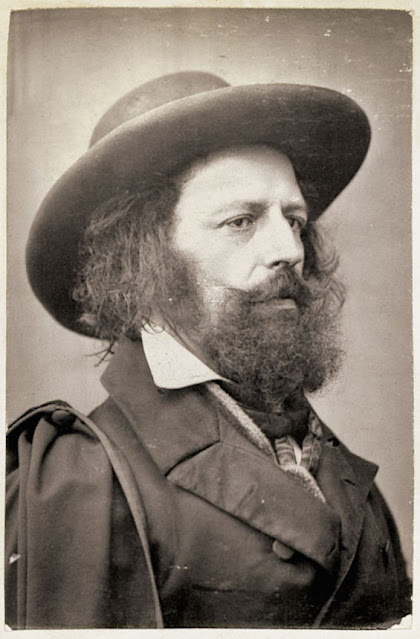
Alfred, Lord Tennyson, then the Poet Laureate of England got it exactly and succinctly right when he wrote “Not tho’ the soldier knew, someone had blunder’d... Charging an army, while all the world wonder’d.”  He dashed off what would become the recital piece of every English schoolboy within moments of laying down the Times with a correspondent’s account of a disastrous vainglorious charge by the British Light Cavalry into the teeth of Russian artillery that commanded a long, narrow valley from the heights on both sides as well as the head of the vale.  The poem, The Charge of the Light Brigade was rushed to press and published on December 9, 1854, less than six full weeks after the debacle of October 25 that year.


                                                     Alfred, Lord Tennyson's poem fixed the story of the Light Brigade in the public imagination. 

One could easily argue that not only was the charge itself an inexcusable blunder, but so was the whole Crimean War, of which it became the most celebrated moment of a wretched waste of lives and treasure.  For arcane motives involving international imperial rivalries particularly involving the Great Game of Russian dreams of a deep-water port on the Indian Ocean as the threat to British India and to support ambitions in Afghanistan, former enemies Britain and France came to the defense of the Ottoman Empire over Russians demands for protection of Orthodox minorities in the Balkans.

Both the new allies had large armies uniformed, armed, and drilled for a Napoleonic Era war of massed formations and open country maneuver.  Although the English had some experience with colonial warfare, both main armies were more than rusty after 35 years of European peace and the English were commanded by inexperienced and largely incompetent noblemen and wealthy gentry capable of buying commissions.

Moreover, the nature of modern warfare had changed and no one was less prepared than the Western powers.  Principle innovations were vastly improved heavy and field artillery mounted in unprecedented numbers, rifled muskets that increased the accuracy of infantry fire, and especially the use of railroads to supply and reinforce Russian forces through interior lines while the British and French had a long and unreliable sea connection.

After inconclusive early action in the Balkans, the British and French decided to attack the bastion Russian control of the Black Sea, Sevastopol on the Crimean Peninsula.  The Western armies were rushed to the theater with only summer campaign uniforms, inadequate tents and bedding, on short rations of barely edible bully beef. Moreover, many were weakened by sickness contracted on crowded troop transports and once ashore were stricken by dysentery and infectious diseases.

Despite this, the British and French had early success against the ill-trained Russians after landing unopposed on the Peninsula north of Sevastopol.  But the Russians quickly fortified the city and erected complex earthwork defenses which concentrated artillery fire against possible attack.  The war quickly settled into a siege and the allies were forced into miserable, water filled trenches opposite Russian defenses.  Staggering losses were soon felt from Russian artillery pounding but especially from disease, exposure, and malnutrition.  


A topographical map shows British held Balaclava and the valley between the Causeway Hills and the Fedukhin Heights into which the Light Brigade charged.  

To break the situation open, the British launched a flanking amphibious maneuver, landing a substantial force east of Sevastopol at Balaklava.  It should have been a masterful, war ending operation.  Instead, a large Russian Army began a counterattack on the English toehold beginning on October 23, 1853 which quickly routed Ottoman forces occupying outer defenses on the highlands around the port while capturing substantial Turkish artillery and turning it against the English.  Although the English rallied in their defensive interior trenches, the problem soon became how to re-capture or neutralize the former Ottoman guns.


Lord Lucan, commander of the Cavalry Division at Balakava, sent the Light Brigade up the Valley and kept the Heavy Brigade under his personal command in reserve.  He never committed the Heavy Brigade in support of the shattered Light Brigade.

The British cavalry, which had missed earlier fighting as it was delayed at sea had arrived.  It consisted of two divisions under the command of Lieutenant General George Bingham, 3rd Earl of Lucan, who was under the overall orders of Field Marshal FitzRoy Somerset, 9th Earl of Raglin. 

The Heavy Brigade was mounted on chargers, wore silver helmets and armored breast plates, and were armed with heavy cavalry sabers.  These men consisting of the 4th Royal Irish Dragoon Guards, the 5th Dragoon Guards, the 6th Inniskilling Dragoons, and the Scots Greys were intended as shock troops especially trained for frontal assaults of artillery positions and capable of overwhelming them.


Surviving officers and men of the 13th Light Dragoons at Balakava by James Fenton--one of the earliest war theater photographs.

The Light Brigade included the 4th and 13th Light Dragoons, 17th Lancers, and the 8th and 11th Hussars, under the command of Major General James Brudenell, 7th Earl of Cardigan.  Lucan and Cardigan were brothers-in-law but also bitter service rivals who personally detested each other.  This enmity would have fateful consequences.


Lord Cardigan in all of his splendor led the Light Brigade into the "jaws of Death."  He escaped most of the blame for the disaster and was hailed a hero.  He is also remembered for the name-sake buttoned sweaters he wore around camp.

Raglin recognized that the key to the upcoming campaign was re-capturing the Turkish guns, mostly heavy naval rifles, on the heights.  He intended for the fast-moving Light Brigade to sweep around Russian flanks and attack the guns before the Russians could evacuate them and hopefully send the gunners into a panicked flight in which they could be hacked to pieces.  It was exactly the kind of work the light cavalry was designed for.

Raglin’s written order to Lucan, drafted by Brigadier Richard Airey read “Lord Raglan wishes the cavalry to advance rapidly to the front, follow the enemy, and try to prevent the enemy carrying away the guns. Troop horse artillery may accompany. French cavalry is on your left. Immediate.”  This hasty and somewhat cryptic order was carried to Lucan by Raglan’s favorite, dashing young Captain Louis Edward Nolan.  Nolan was widely regarded as the most outstanding and capable young officer in the Cavalry with a great career and high command in his future. 

Nolan rode hard to find Lucan and excitedly handed the commander his orders.  Lucan was somewhat mystified by the orders and asked Nolan, “What guns does he mean?”  Nolan replied with a casual sweep of his hand, not just the hills, but the concentration of artillery at the head of the Valley.  Lucan assumed that he meant an assault on those guns was the primary objective.

Despite the fact that such a charge was the purpose of the Heavy Cavalry under Major General James Yorke Scarlett, Lucan believed the order was intended for Cardigan’s Light Brigade.

When Cardigan received his orders to attack up the valley “without delay” he recognized that his units would be riding into an unwinnable trap.  He assumed his brother-in-law had issued the order out of personal spite.  But to uphold his honor he decided to attack immediately without delaying for clarification of the orders from Raglan.


A panoramic and fairly accurate depiction of the Light Brigade charge up the valley into the Russian guns from a popular late 19th Century print.
 

With Cardigan in the van, the 669 men of Light Brigade set off at a trot up the long valley between Fedyukhin Heights and the Causeway Heights.  As a staff officer Nolan observed the maneuver and expected Cardigan to quickly split his forces to the left and right to attack the heights.  When instead they picked up the pace to a full charge, a horrified Nolan rode around the troops and across their entire front gesturing wildly and shouting “There’s been a mistake!” until he was shot out of the saddle and killed.

The Heavy Brigade, now under Lucan’s direct command, was held in reserve and was meant to follow the Light Brigade when it breached the guns at valley’s head.

The Russian forces commanded by Pavel Liprandi included approximately 20 battalions of infantry supported by over 50 artillery pieces deployed on both sides and at the opposite end of the valley.  Enfilading fire soon ripped the ranks of the troopers from the heights while the front was shredded by level fire heavy with grape.

Despite the heavy carnage, troopers reached the guns and sent the Russian artillerymen into flight.  But they were not able to hold on.  Lucan, observing the disaster, never launched his secondary attack with the Heavy Cavalry.  The Light Brigade was put to flight and the Russian crews returned to their guns to pour moved devastating volleys into their backs.

The Light Brigade suffered horrendous losses of officers and men—110 killed outright, 161 wounded, 60 captured and 335 horses killed in action, or were put down after because of their wounds.

The French light cavalry, the Chasseurs d’Afrique under Armand-Octave-Marie d’Allonville, did manage to clear the Fedyukhin Heights of two half batteries of guns, two infantry battalions, and Cossacks and provided cover for the remaining elements of the Light Brigade as they withdrew.  The French Marshal Pierre Bosquet, famously observed of the Light Brigade sacrifice, “It is magnificent, but it is not war, it is Madness!”

In the end the soon to be world famous battle had no immediate tactical or long-term strategic significance.  The disorganized Russians, who had been handed a gift beyond their expectations were unable to take advantage of it and dislodge the British from Balaklava.  The Siege of Sevastopol settled into a long, nightmarish endurance contest that was a preview of the trench warfare on the Western Front during World War I.

The yearlong siege of Sevastopol killed and wounded 170,000 men, on both sides not including the tens of thousands the British and French lost to disease and ended when the Russians pulled off a near-miraculous evacuation of their battered remaining forces over a pontoon bridge.  It signaled an ultimate Russian defeat but was delayed by some minor, face saving victories by the Tsar’s troops in the Balkans.   An Austrian ultimatum to Russia brought the parties to the negotiating table where the British and French were ready to grant none-to-terrible terms to end the whole bloody affair in March of 1856 with the Treaty of Paris.

No one got much out of the bloodbath except the Ottomans.  The famously ailing Sick Man of Europe was able to limp along as the edges of its Empire were nibbled away in rebellions and small local wars until their involvement in the Great War brought down the ancient Sultanate. 

When word of the disaster reached London in November, public reaction mirrored Tennyson’s, if not so elegantly expressed.  The troops were lauded—even idolized—as gallant heroes whose devotion to duty and country against impossible odds were inspiring and unquestionable.  The Army and government did everything in their power to encourage and spread this sentiment.  It was their armor against public outrage at the criminal incompetence that led to the slaughter.


                                                                London gets the news from Raglin's report to the Secretary of State for War. 

The first report of the battle was printed in the The London Gazette in an “Extraordinary Edition” on November 12 and contained the official dispatches of senior officers as addressed to the Secretary of State for War and the Colonies Henry Pelham-Clinton, 5th Duke of Newcastle.  Raglin put the blame almost completely on Lucan:

…from some misconception of the order to advance, the Lieutenant-General (Lucan) considered that he was bound to attack at all hazards, and he accordingly ordered Major-General the Earl of Cardigan to move forward with the Light Brigade.

Raglin essentially claimed that whatever the orders he received, Lucan on the ground should have exercised his discretion.

When he learned that the official reports had been publicly exposed, Lucan wrote a furious reply saying that Raglin had bound him strictly to absolute obedience to every order as issued.  The War Ministry blocked publication as a breach of public decorum and disrespect to a senior officer.  Lucan was recalled from duty and arrived in England in March 1854.  But word of his objections became public knowledge, if not the exact text of his defense. It was the beginning of round-after-round of finger pointing and blame shifting.

Meanwhile William Russell of the Times, the man who practically invented the roll of a professional war correspondent and would later notably cover major campaigns in the American Civil War, published his two lengthy accounts in December—the reports that inspired Tennyson’s poem.  None of the senior commanders escaped his blame except for Cardigan who dutifully and valiantly executed his fateful orders and did not receive the promised support of the Heavy Brigade.  Cardigan was able to return home a hero and was elevated over his superiors to Inspector General of the Cavalry.

When Lucan arrived in London in March he immediately launched what would today be called a public relations offensive.  He began with an exchange of letters the Times he reiterated his criticism of Raglin but also turned his sights on Captain Nolan for delivering a garbled message with unseemly, agitated excitement.  Nolan was the perfect target.  He may have been a promising officer, but he was a junior one without as yet a wide web of kin and supporters at the upper levels of the Army and government.  He was an Irishman with no aristocratic connections.  Best yet, he was dead and unable to mount a defense.

Lucan repeated his defense in a speech to a friendly House of Lords.  It worked like a charm.  Lucan escaped further investigation or any formal charges against him.  Although he never returned to active command, he was awarded the prestigious Order of the Bath that summer, made a full General in 1865 and a superannuated Field Marshal in 1887, the year before his death at age 88.


Lord Raglin, the one-armed old soldier in over-all command in the Crimea died of dysentery and depression before he could come home.

As for Raglin, he remained in command in the Crimea overseeing the fruitless stalemate.  A botched piecemeal allied assault on Sevastopol on June 18, 1855 was a complete failure.  The accounts of Florence Nightingale and others held him responsible for the wretched condition of his troops and their suffering.  His own health declined rapidly, accelerated by what is now recognized as clinical depression.  He died, like so many of his men, of dysentery, just ten days after his final blunder.  His body was returned to England to a solemn welcome and suitably grand funeral.

When the survivors of the Light Brigade finally arrived home with the rest of the battered Crimean army, their ranks further thinned by subsequent actions and mostly by disease and exposure, they were lionized.  There were a number of reunions over the years, most notably one in In October 1875 at the Alexandra Palace in London to celebrate its 21st anniversary of the battle.  It was the largest event of its kind.  The elderly Lucan, probably unsure of his welcome, declined to attend but dined the same night with some of his former officers.

In 1890 Rudyard Kipling wrote his own piece about the Light Brigade portraying an apocryphal visit to Tennyson by the “twenty last survivors” begging him to write a new poem to shame the British public into offering financial assistance to the elderly and neglected veterans.

Some observers credit the glory bestowed on the Light Brigade for the mindset of sacrificial devotion to duty the led a generation of young Britons to their doom in fruitless over-the-top bayonet charges into No Man’s Land in the teeth of German machine guns and artillery in the Great War.  And as in the Crimea, incompetent but aristocratic commanders usually escaped blame for the slaughter.

The American Civil War helped popularize Tennyson’s poem in this country as an ode to battlefield gallantry.  It was popular with troops on both sides, but especially cherished by the plumed knights of J.E.B. Stuart’s Confederate Cavalry.  In the post-war years it became nearly as popular a school recital piece here as it did in Britain.


The Warner Bros.1936 version of the tale was mostly romantic fantasy showcasing their photogenic popular leads, Errol Flynn and Olivia DeHavilland, 

Most Americans are only familiar with the battle through fragmentary memories of the poem or from the highly inaccurate 1936 Warner Bros. historical romance, The Charge of the Light Brigade starring Errol Flynn and Olivia de Havilland.  The movie portrayed the charge as revenge for a massacre of Lancers at the hands of a Russian influenced religious fanatic on the Northwest Frontier of India.  In the film Flynn and his Indian Army troops are miraculously posted to the Light Brigade and the villainous Surat Khan and his men are manning the Russian guns.  Flynn thus portrayed heroic figures in two of the most famous military disasters of the 19th Century including They Died With Their Boots On about George Armstrong Custer in 1941.


The death of Captain Nolan, David Hemming, in the 1968 British film. 

Tony Richardson’s 1968 British film, The Charge of the Light Brigade, a savage indictment of the stupidity of war and the British class system made at the height of the Vietnam War era, was epic in scale, but contained elements of bitter satire.  It got the facts of the debacle mostly straight.  Little seen in the U.S. it had a stellar cast of British film and theater notables including John Gielgud as Lord Raglin, Harry Andrews as Lord Lucan, Trevor Howard as Lord Cardigan, and Richardson’s wife, Vanessa Redgrave.  David Hemming played Captain Nolan as both a sympathetic naïve young man and a vainglorious twit, the perfect scapegoat for the disaster.  It was the most expensive British film at the time it was shot but was a box office failure when Richardson refused to screen the film for critics and went out of his way to insult and alienate them.  In retrospect the neglected film has been listed as one of the 100 Best War Films of All Time in a 2004 British public opinion poll.

It has been 57 years since that last film.  Many futile wars later, perhaps a new version is in order.   Too bad it would probably be too expensive to make and historical epics are out of fashion.