Showing posts with label . February Strike. Show all posts

Monday, October 2, 2017

The Parsley Massacre—A Dominican Genocide of Haitians

Rafael Trujillo of the Dominican Republic may have strutted on a smaller stage than others, but in his country as rutheless and brutal as the big names of 20th Centrury despotism and he had a "final solution" for his country's "Hatian problem."


If Americans recall Generalissimo Rafael Trujillo, the brutal and avaricious dictator of the Dominican Republic, at all it is for winding up dead in a bullet ridden Chevy in 1961, the victim of an abortive coup d’état arranged with the wink-and-not support of the Central Inelegance Agency (CIA.)  His death unleashed a decade of turbulence in the Caribbean nation which eventually “required” the intervention of American Marines yet again.
His death was just one bookend of a career as President and/or power-behind-the-throne for more than thirty years.  The other bookend was his rise to power as an officer in the Dominican Army, the protégée of Marines who occupied the country on behalf of United Fruit and other American interests through most of the 1920’s.
He was Army Chief of Staff in 1930 who allowed a revolution to topple a previous dictator, then quickly assumed power as President winning 99% of the vote in an election that a U.S. State Department official admiringly reported earned him more votes than there were voters.
Before he even donned the Presidential sash for the first time his soldiers and police were rounding up and quietly disposing of any possible opponents.  He ruled with an iron hand, directly or indirectly until peppered with rounds from CIA supplied M-1 carbines.
On one hand, Trujillo set off on a modernizing campaign that built highways to tie the nation more closely to the Capital Santo Domingo which he eventually modestly renamed Ciudad Trujillo as well as schools and hospitals.  He and his family also appropriated most of the nation’s cattle and dairy production as well as vast sugar cane plantations and other local economic powerhouses.
One key element of his nationalist policy was assuring the continued mastery of a White elite in the face of a nation that was largely Mestizo, with a rapidly growing Black population.  That population included not only a high birthrate for the decedents of Spanish slaves, but increasing numbers of Haitians spilling over a porous and contested border from the Creole French speaking western portion of the island of Hispaniola.
Relations between the two countries had always been difficult.  Haiti had invaded and occupied the Dominican Republic from 1822-44.  When Trujillo took power, the western provinces were poorly connected to the capital and to Dominican markets, naturally trading across the border to Haiti.  In the sparsely populated northwest as Haitians, lured by jobs in the sugar industry, had been taking up residence for decades.  Many now were second or third generation and while speaking Creole, were at least nominal Dominican citizens.
French Creole Haiti and the Dominican Republic--the former Spanish colony of Santo Domingo have uneasily shard the  island of Hispanola.  Tenssions came to a head in the so-called Parsley Massacre in 1937.
The border was poorly defined and both nations had outstanding territorial demands of the other. Trujillo was concerned that Haiti would use majority pockets of Haitian immigrants and their descendants to make further claims. In 1933 and 1935, Trujillo met the Haitian President Stenio Vincent to settle the border issue and in 1936, they reached and signed a settlement.
But that settlement did not include repatriation of Haitians in the Dominican Republic.  Trujillo had other plans for that.
For years his tightly controlled press had hyped any and all reports of crime committed by Haitians.  When there was not enough, he would manufacture it.  He particularly pointed out nearly non-existent rustling of cattle from the large herds of local ranchers—of which he and his family were the most important.  In the kinds of tactics Hitler would later use to justify the invasion of Poland, depredations were made up and highly publicized.
On October 2, 1937 the President publicly signaled a brutal new policy already underway in a speech given in the northwest provincial province capital of Dajabón.
For some months, I have traveled and traversed the border in every sense of the word. I have seen, investigated, and inquired about the needs of the population. To the Dominicans who were complaining of the depredations by Haitians living among them, thefts of cattle, provisions, fruits, etc., and were thus prevented from enjoying in peace the products of their labor, I have responded, “I will fix this.” And we have already begun to remedy the situation. Three hundred Haitians are now dead in Bánica. This remedy will continue.
Indeed five days of unimaginable horror and brutality that came to be known in English as the Parsley Massacre was underway.  In a well-organized campaign elements of the Army, police, and Trujillo’s security force, the dreaded Servicio de Inteligencia Militar (SIM), fanned out across the border region searching for Haitians.  They were not hard to find.
The story circulated that soldiers brought with them sprigs of parsleyperejil in Spanish.  Creole speaking Haitians were supposed to be unable to trill the r in the word.  Those who failed the test were executed on the spot, along with family members found with them.  Afro-Dominicans who passed the test were allegedly let go.  This tale, while popularized in the Anglo press, is largely mythical.  And in fact many Afro-Dominicans as well as Haitians were swept up in the blood bath.
Dominicans and Haitians have two different names for the five days of killing that followed.  Dominicans call it el cortethe cutting.  Haitians call it kouto-athe knife.
Murdered by the Army and Trujillo's personal security forces the rotting bodies of ethnic Hatians littered the ground.
Because many of the attackers were in civilian garb, surprised Haitians—many of them longtime residents and citizens—at first expected the Army to rescue them.   Instead they were shot, hacked to death by machetes, and bludgeoned with clubs and baseball bats.  Whole villages were surrounded and wiped out.  Those attempting to escape by fleeing across the Artibonite River to Haiti were intercepted on its banks and killed or drowned trying to reach safety on the other side.
In the five day killing spree, somewhere between 20,000 and 30,000 suspected Haitians were killed.  Murders continued on a more subdued level across the region for years.
The government of Haiti naturally protested the massacre.  But the black ruled nation was largely a pariah to neighboring Spanish speaking Caribbean and Latin American nations.  The U.S. State Department conducted an investigation and determined that, despite Trujillo’s claims that the killings were the work of outraged Dominicans and not the state, that the killing were indisputably the policy of the government and carried out by its forces. 
The Roosevelt administration toyed with the idea of another intervention to save the Haitians, but was effectively blocked by powerful Southern Democrats in the U.S. House and Senate who saw nothing wrong in killing Blacks.  Some were also the recipients of Trujillo’s gifts and largess.
Despite a moment or two of international embarrassment, Trujillo easily rode out the controversy.  He would subsequently kill an additional 30,000 suspected opponents of his regime in his long tenure.
In the end, the State Department accommodated him as the country’s economy prospered and so did the profits of American investors.  

When Trujillo became an embarssing niusance to the United States the CIA provided the encouragement and carbines for the attack that riddled the dictator's Chevy killing him and his entourage.
But by the ‘50’s Trujillo’s heavy handed meddling in the affairs of its neighbors including Haiti and Cuba began to concern American authorities.  After he tried to assassinate his biggest Latin American critic, Venezuelan President Rómulo Betancourt in an aerial bombing attack on his car, the U.S. had enough and the CIA began its intrigues with the potential Dominican junta.
After ten years of chaos and the intervention of the Marines, the CIA finally turned to a Truillo protégée, Joaquín Balaguer returning one of the late dictator’s puppet presidents to power as a bulwark against a Cuban style revolution.
For their part Haitians on both sides of the border remained mired in poverty, repression, and hopelessness.

Monday, March 31, 2014

New Film and New Latino Labor Battles Renew interest in César Chavez


Note: I have posted versions of this piece before, but a new bio-flic that opened in theaters around the country this past weekend has renewed interest in the founder of the United Farm Worker Union.  So have new battles involving Latino workers in the hospitality and dining industries, fast food, big box stores, and warehouse and distribution as well the drive for immigration reform and justice.  And there is a growing movement to create a national holiday in honor of César Chavez.
If a person is extremely fortunate in his life, he or she may have an opportunity to meet—and better yet support in some meaningful, if small way—his heroes.  I have been blest beyond measure by knowing and working closely some of the legendary figures of the Industrial Workers of the World (IWW).  I got to meet and march with Martin Luther King in Chicago.  And I got to meet César Chavez and help establish the grape and later the lettuce boycotts as the IWW’s representative on the Chicago Labor Support Committee for the UFW.

Chavez was born on March 31, 1927 in Yuma, Arizona to an established family with deep roots in the state.  His father owned a small grocery store and ranch, but lost the business and the family homestead in the Depression at least partly as a result of fraud.  Young César and his five siblings moved to California with their parents where they all entered the world of migrant farm laborers.  The family experienced long hours in the fields, harsh conditions in crowed and dirty migrant camps, and prejudice and hostility to “Greasers” by the communities in which they had to live or travel in.

Like all of the children, César often had to miss school to work in the fields or because the family was traveling.  Despite being an eager and bright student, he came from a family that spoke only Spanish at home and was often punished at school for the use of his native language.  He managed to graduate eighth grade, but then had work full time in the fields to help support his family.

In 1944 at the age of 17 he enlisted in the Navy for service in World War II.  He experienced intense discrimination, confinement to menial jobs with no possibility of advancement, and a rigid discipline.  He described his two years of service as the worst time of his life.

Back in California and working in the fields Chavez married his childhood sweetheart, Helen Favela in 1948.  The couple moved to San Jose, California which served as home base while both continued to work in the fields.  Eventually they had eight children. 

In San Jose Chavez met and was mentored by Father Donald McDonnell, with whom he often discussed the plight of farm workers and from whom he learned something of the history of labor struggles in the fields.  Father McDonnell introduced him to the ideas of St. Francis of Assisi, Gandhi, and nonviolence.  He also launched him on a life long program self-education through wide ranging reading.

Chavez continued to follow the crops until 1952 when he met Fred Ross, founder of the Community Service Organization (CSO), a community organization for the Hispanic community affiliated with Saul Alinsky’s Industrial Areas Foundation.  Ross recognized leadership skills in young Chavez and hired him as an organizer for the CSO.  Trained by Ross in Alinsky’s techniques, Chavez organized around police brutality issues and led voter registration drives.  He traveled through out California for the organization and became increasingly draw to struggles for worker’s rights.  He rose to become National Director of the CSO in 1958, a position he kept until 1962. 

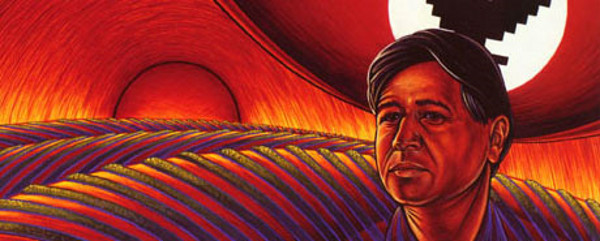
In 1962 Chavez left the CSO to concentrate on the plight of farm workers on the job.  That year with Delores Huerta and his brother Richard, Chavez founded the National Farm Workers Association (NFWA), a fledgling labor organization.  At his suggestion his brother Richard created the symbol of a stylized black Aztec eagle as the symbol of the new organization and created the bright red banner with the eagle highlighted in a white circle that soon became familiar in fields across the state.

Huerta and Chavez hoped to merge the tactics of non-violence used by Martin Luther King and the Civil Rights Movement with a renewal of long battles for union representation in the fields.  But in the early years, members were few and the organization struggled. 

Despite his deep ties to the Mexican-American migrant community, the organization did not really take of until 1965 he threw the support of the NFWA behind Filipino workers striking in Deleno, the same fields where his family had labored and where he met his wife.  He broadened the strike to other fields bringing out Chicano and other migrants.  Within a few months he led a historic march from Deleno to the state capitol in Sacramento to demand better wages and working conditions in the fields. The Deleno strike dragged on for five years, with picketers regularly attacked by grower hired thugs and harassed by local police and Sheriff Departments.  In the face of many provocations, Chavez always counseled his members in nonviolence. 

The national news media began picking up on the struggle, particularly after the U.S. Senate Committee on Labor’s Subcommittee on Migrant Labor came to California to hold hearings where member Robert F. Kennedy expressed strong support for the workers.  It was the beginning of a long relationship between Chavez and the Kennedy Prince.  

The NFWA merged with the Agricultural Organizing Committee, sponsored by the AFL-CIO to become the United Farm Workers Organizing Committee (UFWOC), which launched a nationwide boycott of table grapes to pressure the growers into concessions. 

As tensions in the fields grew, some rank and file members began advocating self defense against attacks by thugs and police and perhaps action against scabs in the fields.  In 1968 Chavez launched his first great fast, 25 days long to rally his people to nonviolence.  He attracted the attention and support of his hero Martin Luther King and Robert Kennedy returned to California to participate in the peace mass that broke the fast. 

In return UFW members worked hard for Kennedy in the California Presidential Primary that spring.  They, and Chavez, were devastated by his murder at the very moment of his victory.

In 1970 UFWOC stepped up its national grape boycott campaign, organizing local support committees around the country to picket markets selling “scab grapes.”   The boycott was effective.  In 1970 the most growers had enough.  Even the most recalcitrant Deleno growers filed into the dilapidated union hall to sign an agreement. 

The grape strike and boycott was no sooner won than California lettuce growers signed “sweet heart” contracts with the Teamster’s Union aimed at keeping the UFW out.  Chavez led some 10,000 farm workers out on strike in protest, prompting many growers to abandon the Teamsters and sign with the UFW.  A new nation-wide boycott of non-union and scab iceberg lettuce was launched.  Chavez was jailed for violating a court order against the boycott, where was visited by Coretta Scott King and Bobby Kennedy’s widow Ethel. 

When the original UFW contracts with table grape growers and vintner Ernest and Julio Gallo expired in 1972, growers rushed to sign with the rival Teamsters without any consultation with their workers.  Chavez led thousands out strike in protest while growers obtained injunctions against picketing.  Over 3500 strikers were arrested, hundreds beaten and at least two shot and killed.  Alarmed by the violence, Chavez halted the walk out but announced a second grape boycott.  Within a few months an astonishing 17 million Americans were boycotting scab grapes, lettuce and/or Gallo wines. 

California Governor Jerry Brown helped Chavez achieve his long cherished goal of a state agricultural labor relations law that guaranteed the right of farm workers to organize in 1975.  Despite this the balance of the ‘70’s and much of the ’80’s was a long running battle between the UFW, since 1972 an official independent affiliate of the AFL-CIO on one side, and growers, their Teamster allies, and Republican politicians on the other. 

There were many strikes and boycotts, long marches and hunger strikes.  Chavez and the union were under constant legal harassment by growers filing multi-million dollar law suits against them.  Through it all Chavez persevered and held fast to his cherished nonviolence.  In the mid eighties he turned his attention to the use of pesticides in the fields and the health effects on workers and—ultimately—consumers.  Yet another grape boycott was called to protest the use of poisons and in 1986 he went on his longest, and last fast, lasting 36 days to draw attention to the cause.

Chavez never fully recovered from the effects of that fast, although he continued his tireless work.  On April 18, 1992 at the age of 61 and worn out, he died in his sleep in the modest home of an Arizona migrant worker.  Forty Thousand mourners marched in his funeral. 

In September 1984 President Bill Clinton, posthumously awarded Chavez the Presidential Medal of Freedom.  More recently President Barack Obama proclaimed March 31 César Chavez Day and urged Americans to ?\”observe this day with appropriate service, community, and educational programs to honor César Chávez's enduring legacy.”  Today there are ongoing efforts to have his birthday declared a holiday in various states and by the Federal Government.

But César Chavez’s greatest legacy is the union he left behind and the millions he has inspired.  ¡Si, se puede!

Sunday, May 5, 2013

When Americans Raise a Glass to Mexico—Cinco de Mayo

A typically culturally sensitive American promotion of Cinco de Mayo celebrations..


Note:  This is the fourth consecutive year I have run essentially the same post with a little tinkering on the margins. And, damn it, I will continue to do it until your all get it right!

Today is, as every hearty partier will tell you, is Cinco de Mayo.  In the U.S. in recent years it has become kind of second St. Patrick’s Day decked out in sombreros and serapes instead of emerald green, toasted to with Coronas with lime and shots of tequila instead of Guinness and Jamison’s, and laid out with two for one taco deals instead of corn beef and cabbage plates.  It is celebrated without apparent irony even by those who write semi-literate screeds to the newspapers cursing those damned lazy, criminal immigrants. 

Mexican-American restaurant owners and importers of spirits and trinkets appreciate the business.  Grade schools have the kids make paper hats and sing Spanish songs for a one day lesson in Mexican culture.  And immigrant communities will hold fiestas and parades, glad that for one day of the year the rest of the country is paying attention to them in sort of a good way.  If you ask most of the revelers what they are celebrating, they will mumble something vague about Mexican Independence Day.
 
Of course they are wrong.  Independence Day is Diez y Seis de Septiembre (September 16th) celebrating the day in 1810 when Father Miguel Hidalgo read the Gritto de Hidalgo  beginning Mexico’s War of Independence from Spain.  

In Mexico Cinco de Mayo is a minor patriotic holiday observed mostly in the State of Puebla.  It celebrates the victory Mexican patriots over a large, modern and well equipped French army in the Battle of Puebla on May 5, 1862.  It was not even the final victory of the war against the French, who did not evacuate the country until 1866. 

In 1861 the President of Mexico, Benito Juarez, had been forced to default on Mexico’s heavy debt to European powers.  Britain, France and other powers all made threats to redeem their debts by force if necessary.  They were warned by the United States, which invoked the Monroe Doctrine, not to intervene in Mexico.  French Emperor Napoleon III recognized the U.S. would be too preoccupied with its own Civil War to take action and dispatched a large French Army to take control of the country.
 
After initial success the occupying French Army with its Mexican allies, numbering 8,000 men was met by 4,000 Mexican troops loyal to Juarez under the command of General Ignacio Zaragoza Seguín and soundly defeated.  It was an enormous moral boost for the Mexicans, but only delayed the French march on the capital of Mexico City.  

In 1864 a plebiscite conducted under French guns invited the Austrian Hapsburg prince Ferdinand Maximilian to sit as Emperor of Mexico with his wife Carlota as Empress.  Maximilian did have support of some Mexican conservatives, large land owners and the Catholic Church, but despite his liberal bent—he continued many of Juarez’s land reforms and even offered the former President the post of Prime Minister—Mexican patriots refused to recognize his rule or the French occupation that made it possible.
 
Juarez and his supporters engaged in a grizzly war of attrition against French forces.  With his army slowly being bled away and the costs of occupation far outstripping any profits from empire, Napoleon III began to withdraw his support.  When the American Civil War ended and American intervention with a new, modern, and battle hardened army became a distinct possibility, the French Emperor finally withdrew his troops.  

Maximilian, deluding himself that he was truly the popular Emperor of Mexico stayed behind with his loyal generals to fight it out with the Juaristas.  Carlota made a desperate trip to Europe in which she traveled from capital to capital begging for assistance for her husband.  When she failed, she suffered an emotional and mental breakdown.  One by one Maximilian’s loyal armies were defeated.  He was captured by republican troops after trying to make a break-out from the besieged city of Santiago de Querétaro on May 15, 1867.  The would-be Emperor was tried by court martial and executed by firing squad on June 19.  

But if you ask any reveler at the bar tonight about any of this, all you will probably get is a blank stare and, if you’re lucky, a Margarita.