Showing posts with label 1933. Show all posts

Wednesday, October 9, 2024

There Was a Bomb on Board a Boing 247—A Real Unsolved Mystery

The doomed United Air Lines Boeing 247, registration number NC13304 was photographed over Chicago's Century of Progress and Soldier Field just weeks before it went down.

It seemed like a routine flight for the relatively early days of regularly scheduled commercial airline operations.  In the late afternoon three crew members and four passengers climbed aboard one of United Air Lines most modern aircraft, a twin-engine Boeing 247, at Newark, New Jersey for a transcontinental flight to Oakland, California with several stops for fuel along the way.  Most of the passengers had Chicago as a destination.  Other fares would be picked up there.  After a stop in Cleveland, Ohio the plane was cruising at about thousand feet over Indiana around 9 pm October 10, 1933 when it was ripped apart by and explosion, falling in two pieces into cornfields near Chesterton and the Dunes of Porter County.  Everyone on board was killed.

The sleek new Boeing 247 was not a likely candidate for an accidental explosion.  The aircraft, which was introduced into fleet service in May and was the highly talked about centerpiece of the Boeing exhibition at Chicago’s Century of Progress, was the safest and most modern commercial plane in the air.  It was so far advanced that it immediately made the high wing Fokker and Ford Trimotors and Curtis Condor bi-planes then in service obsolete.  It was the first airliner with an as all-metal anodized aluminum construction, a fully cantilevered (low) wing, and retractable landing gear. Other advanced features included control surface trim tabs, an autopilot, deicing boots for the wings and tailplane, and even a climate controlled, air conditioned cabin for passenger comfort.  It’s airspeed was faster than the most modern Army Air Corps fighter, but its design allowed it to be set down gently at a mere 62 mph on a remarkably short runway for its size and weight.  The 247 was so revolutionary, it essentially was the prototype for all subsequent multi-engine passenger planes.

Witnesses on the ground in Indiana reported hearing an explosion shortly after 9 pm and saw the plane in flames at an altitude of about 1,000 feet.  A secondary explosion occurred after the main body of the aircraft plowed into the ground.  The tail section aft of the baggage compartment and lavatory was found mostly intact almost a mile away from the main wreckage indicating that the plane had broken up almost immediately after the initial explosion.


Rescuers arriving on the ground immediately noted suspicious conditions of the debris.  By the next morning Boeing 247, head of the Chicago office of the United States Bureau of Investigation, an already a famous gang buster whose regular appearances in the newspapers was stirring the ire of FBI Director J. Edgar Hoover, arrived on the seen with a team of agents to investigate the wreckage.  He found the toilet and baggage compartment smashed into fragments with metal shrapnel riddling the inside of the toilet door while the other side was free of the metal fragments.  Purvis later reported to the press that:

Our investigation convinced me that the tragedy resulted from an explosion somewhere in the region of the baggage compartment in the rear of the plane. Everything in front of the compartment was blown forward, everything behind blown backward, and things at the side outward…The gasoline tanks, instead of being blown out, were crushed in, showing there was no explosion in them.


Dapper Melvin Purvis, agent in charge of the Chicago office of the Bureau of Investigation gets off of anther Boing 247 shortly after he got Most Wanted gangsters Pretty Boy Floyd and John Dillinger in 1934. His knack for getting publicity for his high profile cases was irritating his boss, J. Edgar Hoover.

Dr. Carl Davis of the Porter County Coroners Office called on the Crime Detection Laboratory at Northwestern University to conduct forensic tests on the wreckage.  His report, based on the Lab conclusions was that the plane had been brought down by an explosive device, probably employing powerful nitroglycerine.  There seemed to be no doubt that the plane was sabotaged with a bomb.  The Coroners Jury ruled that the seven dead were homicide victims.

It was the first known case of what we would now call a terrorist bomb bringing down an airplane.

Figuring out who did it and why proved virtually impossible.  No note was found. Nor was there a claim of responsibility that would be common in aircraft bombings decades later.  Investigations turned up no known enemies of the passengers or crew.  There were no attempts to extort the airline or its parent company and plane manufacturer Boeing.  No one carried un-usual or extravagant insurance coverage.  In short, no motive could be established and without a motive, suspects were impossible to identify.

There was a brief stir of excitement when a witness recalled seeing one of the passengers board the plane in Newark with a package wrapped in brown paper.  Then the package was found intact amid the wreckage.  There was also a rifle on board but it was in the nearly destroyed baggage compartment and was the property of a passenger on the way to Chicago to compete in a shooting match at the North Shore Gun Club.  All of the passengers and crew were evidently in their seats when the mid-air explosion took place. 

The crime has never been solved.  


Stewardess Alice Schiber's home town Stevens Point, Wisconsin newspaper printed this diagram and illustration of the bombing based on Purvis's conclusions.     

Air crew victims included Pilot Harold R. Tarrant of Oak Park, Illinois, Co-pilot A.T. Rudy also of Oak Park, and 26 year-old nurse and stewardess Alice Schiber of Chicago’s North Side.  The unfortunate Miss Schiber had the distinction of being the first stewardess ever to die on a commercial flight.

Other than the fact that they could afford the hefty price of a plane ticket during the Depression nothing seemed unusual about the four passengers.  They were 28 year old Chicagoan Fred Schendorf, the manager of the apartment division of R. Cooper, Jr., Inc., a manufacturer of refrigerators; 25 year old Dorothy M. Dwyer of Arlington, Massachusetts; Emil Smith, age not noted, of Argyle Avenue in the Rogers Park neighborhood; and H. R. Burris of Columbus, Ohio, a United Airlines radio technician dead heading to a work assignment.

The bodies of Smith and Burris, believed to have been seated next to each other nearest the explosion, were thrown from the plane and found the next morning a half mile from the wreckage.

Pilots Tarrant and Rudy had both been married within the year and members of Tarrant’s family rushed to the grim scene of the still smoldering wreckage.  Stewardess Schiber had left her Stevens Point, Wisconsin home just two month earlier to take up the exciting career of an airline hostess.

The crash was the first with loss of life for the seven year old airline.

It could have been much worse.  Only 4 passengers occupied the ten available seats.  The plane was operating therefore at a loss. 


Monday, July 6, 2020

Hustling Chicago Gives Birth to the Baseball All Star Game

Nosebleed seats at Comiskey Park for the All Star Game went for just a buck plus tax, affordable to many ordinary stiffs even in a Depression year.
Note—Sadly there will not be a Major League Baseball All Star Game this summer.  Baseball fans are holding our breaths and crossing our fingers that the announced 60 game shortened season starting later this month and being played in empty ball parks will actually come off as the Coronavirus rages unabated across the county.  Perhaps it is selfish of us to cling to that glimmer of hope, but what can we do.  Well, we can recall the origin of the mid-summer tradition.
Give credit where credit was due.  It was all Arch Ward’s original idea.  He was the sports editor and principle baseball writer for the Chicago Tribune, the 800 lb. gorilla of Second City and Mid-Western newspapers.  Why not, he suggested, stage a mid-summer exhibition game featuring the biggest stars of the American and National Leagues to coincide with the Century of Progress—the World’s Fair on the Lake—in 1933. 
At first the two leagues, which had, at best, an uneasy relationship with each other were reluctant.  But the Depression was cutting into attendance at all but a handful of ballparks and Ward and his supporters soon convinced owners that the national attention could boost ticket sales.  It also helped that Ward was a crony of Tribune owner Col. Robert R. McCormick and a political powerhouse in the Republican Party and hyper-conservative circles on his own—views fervently shared by most owners.

Chicago Tribune reporter and promoter of the first All Star Game, Arch Ward even eventually got his own baseball card.
The concept of All-Star teams was not unknown.  Back in the earliest days of the National League Albert Spaulding toured nationally and even internationally with hand selected squads in the off-season.  Various star players were still assembling all-star teams—usually made up more of cronies than a full squad of actual stars—and barnstorming against local teams.  And the chance to see Big Leaguers in tank towns and back waters did bring out fans in droves.  Now a lot of those same small town fans would be flocking to the big city for the fair.
Otherwise there was scant play between the two leagues except in spring training where many teams saw each other in the Florida Grapefruit League.  Except, of course, for the goofy Cubs who trained in far off Catalina Island, California for no good reason except that the Wrigley family owned property there.   Sometimes in cities with teams in both leagues—Boston, New York, Philadelphia, St. Louis, and Chicago—inter-city exhibition games were scheduled, usually at the end of spring training or after the regular season was over.

More than 49,000 fans jammed Comiskey Park for the 1933 All Star Game.
In the days when players tended to spend all or most of their careers with one team, even the players were unfamiliar with each other unless they had played with or against each other in the minor leagues.
Players for the exhibition game, which was expected to be a once-in-a-life-time extravaganza, were selected in a system that somehow combined the choices of each league’s managers with a fan poll conducted not-too-scientifically or reliably by the Tribune and a handful of other newspapers.  The results were predictable.

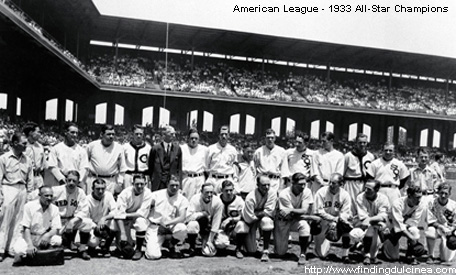
The power house of an American League team was dominated by the heart of the New York Yankee line-up. 
The American League team under Philadelphia manager Connie Mack was a heavy hitting power house long on home run hitters  and dominated by the princes of baseball—New York Yankees sluggers Babe Ruth, Lou Gehrig, and Ben Chapman in addition to hurler Lefty Gomez.  The starting squad also included two members of the White Sox—Jimmy Dykes and Al Simmons, both new to the team that year from a trade with the Philadelphia Athletics.
The National League, by contrast, still relied on small ball—slap hitting, singles, doubles, steals and aggressive base running, bunt and sacrifices, working the count for walks.  Pitching was aggressive, brush backs and intentional bean balls a part of the game.  The whole style of play was aggressive, rhubarbs with umpires and bench clearing brawls were common.  The team, while talented and suited for such play, did not feature the kind of legends-in-the-making on the American roster.  Veteran Giants manager John McGraw fielded a team that included Pepper Martin, Frankie Fritche, and Jimmie Wilson all of the league dominating St. Louis Cardinals along with starting pitcher Bill Hallahan.  The Cubs placed no players among the starters.  Their biggest star, catcher Gabby Harnett and short stop Woody English were reserves along with pitcher Lon Warneke.

The scrappy National League featured small ball specialists.
Since the game was to be played at the White Sox home of Comiskey Park, the umpires were from the American League.  And that made a difference, too, because umpiring styles were very different between the two leagues.  American umpires squatted behind enormous inflated chest protectors behind the plate.  That caused them to have a high strike zone friendly to sluggers.  Sluggers whaling away also reduced walks.  National League players were used to umpires with padded chest protectors worn discretely under their wool suit coats.  That enabled them to get down low behind the plate and their strike zone was low—from the knees to just above the belt, barely.  They called more balls working the count up and causing hurlers to throw more pitches.
With huge national advance publicity, fans flocked to standing-room-only Comiskey Park and milled around on the streets outside.  In downtown areas of major cities fans gathered to watch play-by-play coverage flashed on electronic scroll signs just as they did for World Series games.  Millions hunkered by their radios as the game was broadcast nationally by both the NBC and CBS radio networks.  Cameras from all of the major Newsreel companies ground away from the grandstand roof.  The press box was jammed to overflowing scores of sportswriters from every major and most minor cities plus national magazines.
As for the game itself, it was not quite the American League blowout almost everyone expected.

A White Sox bat boy greets Babe Ruth at home after his first ever All Star /Game home run.  The Babe even made a rare stellar defensive play later in the game.
In the bottom of the second the American League got on the board when pitcher Hallahan issued one-out walks to Jimmy Dykes and Joe Cronin. Two batters later, pitcher Lefty Gomez singled home Dykes for the first run. In the bottom of the third, after a walk to Charlie Gehringer, Babe Ruth famously hit the first home run in All-Star Game history, putting the AL up 3-0. Hallahan was chased from the game after walking Lou Gehrig immediately afterward, and was replaced by Cub Lon Warneke.  General Crowder replaced Gomez to start the fourth inning. In the sixth, Warneke hit a one-out triple and scored on a Pepper Martin groundout. Frankie Frisch followed with a home run to bring the NL to within a run, but after a Chuck Klein single, Crowder would escape the inning without giving up any more damage.
Cronin led off the bottom of the sixth with a single. After advancing on a bunt, he scored on an Earl Averill single to extend the lead to 4-2. Crowder would be replaced by Lefty Grove in the top of the seventh, while Warneke was replaced by Carl Hubbell in the bottom of the inning. The NL looked to have a chance in the top of the eighth. With Frisch on first with two outs, Chick Hafey lined a shot to right field that looked like it could be home run, but Ruth, in rare defensive acrobatics, reached over the wall to catch it, denying the NL a chance to tie the game. Grove retired the side in order in the ninth to secure the American League's victory.
All in all an exciting, if kind of old fashion, baseball game that left fans satisfied and wanting more.
And more they got.  The game became an annual event and, as predicted, raised interest in baseball and ticket sales across the country.

Wednesday, July 6, 2016

The Windy City First Put Baseball All Stars in the Spotlight


There will be even more interest than usual in the All Star Game July 12 in San Diego for Chicago fans.  The 87th Midsummer Classic next Tuesday at Petco Park will not only field a National League Team featuring the entire Cub infieldAnthony Rizzo, first base; Ben Zobrist, second base; Addison Russell, shortstop; and Kris Bryant, third base—plus hurlers Jake Arrieta and Jon Lester, but White Sox super ace Chris Sale is a shoe in as American League starting pitcher. 
Give credit where credit was due.  It was all Arch Ward’s original idea.  He was the sports editor and principle baseball writer for the Chicago Tribune, the 800 lb. gorilla of Second City and Mid-Western newspapers.  Why not, he suggested, stage a mid-summer exhibition game featuring the biggest stars of the American and National Leagues to coincide with the Century of Progress—the World’s Fair on the Lake—in 1933. 
At first the two leagues, which had, at best, an uneasy relationship with each other were reluctant.  But the Depression was cutting into attendance at all but a handful of ballparks and Ward and his supporters soon convinced owners that the national attention could boost ticket sales.  It also helped that Ward was a crony of Tribune owner Col. Robert R. McCormick and a political powerhouse in the Republican Party and hyper-conservative circles on his own—views fervently shared by most owners.
Chicago Tribune reporter and promoter of the first All Star Game, Arch Ward even eventually got his own baseball card.
The concept of All-Star teams was not unknown.  Back in the earliest days of the National League Albert Spaulding toured nationally and even internationally with hand selected squads in the off-season.  Various star players were still assembling all-star teams—usually made up more of cronies than a full squad of actual stars—and barnstorming against local teams.  And the chance to see Big Leaguers in tank towns and back waters did bring out fans in droves.  Now a lot of those same small town fans would be flocking to the big city for the fair.
Otherwise there was scant play between the two leagues except in spring training where many teams saw each other in the Florida Grapefruit League.  Except, of course, for the goofy Cubs who trained in far of Catalina Island, California for no good reason except that the Wrigley family owned property there.   Sometimes in cities with teams in both leagues—Boston, New York, Philadelphia, St. Louis, and Chicago—inter-city exhibition games were scheduled, usually at the end of spring training or after the regular season was over.
In the days when players tended to spend all or most of their careers with one team, even the players were unfamiliar with each other unless they had played with or against each other in the minor leagues.
Players for the exhibition game, which was expected to be a once-in-a-life-time extravaganza, were selected in a system that somehow combined the choices of each league’s managers with a fan poll conducted not-too-scientifically or reliably by the Tribune and a handful of other newspapers.  The results were predictable.

The power house of an American League team was dominated by the heart of the New York Yankee line-up.

The American League team under Philadelphia manager Connie Mack was a heavy hitting power house long on home run hitters  and dominated by the princes of baseball—New York Yankees sluggers Babe Ruth, Lou Gherig, and Ben Chapman in addition to hurler Lefty Gomez.  The starting squad also included two members of the White Sox—Jimmy Dykes and Al Simmons, both new to the team that year from a trade with the Philadelphia Athletics.
The National League, by contrast, still relied on small ball—slap hitting, singles, doubles, steals and aggressive base running, bunt and sacrifices, working the count for walks.  Pitching was aggressive, brush backs and intentional bean balls a part of the game.  The whole style of play was aggressive, rhubarbs with umpires and bench clearing brawls were common.  The team, while talented and suited for such play, did not feature the kind of legends-in-the-making on the American roster.  Veteran Giants manager John McGraw fielded a team that included Pepper Martin, Frankie Fritche, and Jimmie Wilson all of the league dominating St. Louis Cardinals along with starting pitcher Bill Hallahan.  The Cubs placed no players among the starters.  Their biggest star, catcher Gabby Harnett and short stop Woody English were reserves along with pitcher Lon Warneke.

The scrappy National League featured small ball specialists.
Since the game was to be played at the White Sox home of Comiskey Park, the umpires were from the American League.  And that made a difference, too, because umpiring styles were very different between the two leagues.  American umpires squatted behind enormous inflated chest protectors behind the plate.  That caused them to have a high strike zone friendly to sluggers.  Sluggers whaling away also reduced walks.  National League players were used to umpires with padded chest protectors worn discretely under their wool suit coats.  That enabled them to get down low behind the plate and their strike zone was low—from the knees to just above the belt, barely.  They called more balls working the count up and causing hurlers to throw more pitches.
With huge national advance publicity, fans flocked to standing-room-only Comiskey Park and milled around on the streets outside.  In downtown areas of major cities fans gathered to watch play-by-play coverage flashed on electronic scroll signs just as they did for World Series games.  Millions hunkered by their radios as the game was broadcast nationally by both the NBC and CBS radio networks.  Cameras from all of the major Newsreel companies ground away from the grandstand roof.  The press box was jammed to overflowing scores of sportswriters from every major and most minor cities plus national magazines.
As for the game itself, it was not quite the American League blow out almost everyone expected.

Babe Ruth trots home after hitting the first Al Star game homer.
In the bottom of the second the American League got on the board when pitcher Hallahan issued one-out walks to Jimmy Dykes and Joe Cronin. Two batters later, pitcher Lefty Gomez singled home Dykes for the first run. In the bottom of the third, after a walk to Charlie Gehringer, Babe Ruth famously hit the first home run in All-Star Game history, putting the AL up 3-0. Hallahan was chased from the game after walking Lou Gehrig immediately afterward, and was replaced by Cub Lon Warneke. General Crowder replaced Gomez to start the fourth inning. In the sixth, Warneke hit a one-out triple and scored on a Pepper Martin groundout. Frankie Frisch followed with a home run to bring the NL to within a run, but after a Chuck Klein single, Crowder would escape the inning without giving up any more damage.
Cronin led off the bottom of the sixth with a single. After advancing on a bunt, he scored on an Earl Averill single to extend the lead to 4-2. Crowder would be replaced by Lefty Grove in the top of the seventh, while Warneke was replaced by Carl Hubbell in the bottom of the inning. The NL looked to have a chance in the top of the eighth. With Frisch on first with two outs, Chick Hafey lined a shot to right field that looked like it could be home run, but Ruth, in rare defensive acrobatics, reached over the wall to catch it, denying the NL a chance to tie the game. Grove retired the side in order in the ninth to secure the American League's victory.
All in all an exciting, if kind of old fashion, baseball game that left fans satisfied and wanting more.
And more they got.  The game became an annual event and, as predicted, raised interest in baseball and ticket sales across the country.