Showing posts with label Baptist. Show all posts

Saturday, October 9, 2021

The Banishment of the Contrarian —Roger Williams

No authenticated portrait of the quintessential religious dissenter and maverick  Roger Williams but an oil painting that was used for this engraved illustration that was supposedly made in 1644 during a trip back to England was circulated from the min 19th Century and other images derived from it.  Art historians have determinized that it was painted more than a century later and may actually have been adapted from a poor likeness of Benjamin Franklin.  Some of the derivatives took the faint darkening on the subject's upper lip and just below his lower lip and showed a moustache and   "soul patch." 

On October 9, 1635 the General Court of Massachusetts ordered Roger Williams, who they considered an obnoxious religious and political crank, into exile from the colony.  Specifically, the 32 year old was convicted of both heresy and sedition for spreading, “diverse, new, and dangerous opinions.”

Williams was born in 1603 to a conventional Anglican family.  His father was a prosperous master tailor and merchant in Smithfield, London.  A bright, inquisitive, and pious boy, Williams had a personal religious conversion experience which began his long journey as a dissenter.  His father disapproved but allowed his wayward son to continue his education, including an apprenticeship with the great legal scholar and jurist Sir Edward Coke.  He attended Charterhouse, a prestigious public school before enrolling at Pembroke College, Cambridge from which he graduated in 1627.  He excelled at classicalHebrew, Greek, and Latin—and modernDutch and Frenchlanguages.

While at Cambridge Williams became a Puritan—an advocate of purifying the Church of England by stripping away the remaining trappings of Catholicism including the Mass, use of Latin in liturgy, and idolatry in the form of statues of saints and icons.  He took Holy Orders as an Anglican priest, but his chances at advancement were blocked by the firmly High Church hierarchy.  He took a position as a private chaplain to Sir William Macham, a leading Puritan lord.  As such he was privy to plans to seed a Puritan colony in the New World.  Newly married, he passed on his opportunity to go in the first ships sent to found what would become Massachusetts in 1630.  But he was soon so disgusted with church leadership that he determined to join the migration.  He also privately abandoned any hope of reforming the corrupt church and became a Separatist.

Williams and his wife Mary set sail for New England in December on the Lyden and arrived in Boston in February 1731.  He found himself not only welcome but honored.  He was offered as a position as Teacher—sort of an associate pastor—of the Boston congregation.  He declined the position and openly declared himself as a Separatist.  He also insisted that civil magistrates should have no authority over religious maters and that individuals were free to develop and express their own religious convictions.  These positions shocked and appalled the Puritan worthies who demanded complete conformity to their beliefs in matters both civil and religious.

The church in Salem was then tending toward Separatism and invited Williams to become Teacher there.  Outraged leaders in Boston threatened the Salem church, which rescinded the invitation.  By August 1631 he had left Massachusetts for a friendly welcome among the Separatists of Plymouth.  Although not given an official position, he assisted the local minister and occasionally preachedGovernor William Bradshaw found his preaching, “entirely amicable” to the local church.

But Williams was never one to go long without examining his conscience and in holding the church to the exceedingly high standards he demanded.  He began to doubt that the Plymouth church was sufficiently separated from Anglicanism.  And his growing and admiring contact with native inhabitants led him to question the legitimacy of Royal Charters that granted land that the King did not own.  Instead, he maintained that land need be purchased from its rightful owners, the native tribes.  In December 1632 Williams wrote a lengthy tract on these subjects which he circulated to churches in both Plymouth and Massachusetts colonies.

By this time Bradford noted that Williams had fallen “into some strange opinions which caused some controversy between the church and him.”  In 1633 he had worn out his welcome and was back in Salem, which now seemed more inclined to support him.  Upon learning of his return, the Massachusetts General Court summoned him to Boston.  Williams apparently agreed to make some concessions and all known copies of his critical tract were burned.  Allowed to return to Salem, he became acting pastor when his sponsor, Rev. Samuel Skelton died.

Soon Williams had returned to his criticisms of both civil authority over religious matters and of the legitimacy of colonial charters.  He was called before the General Court again in March of 1635 and in April he so vigorously opposed a new oath of allegiance to the colonial government that it became impossible for the magistrates to enforce it.

Unable to rein in Williams, the General Court turned on the Town of Salem.  It refused a routine petition to annex adjacent land on the Marblehead Neck and took other actions against Salem’s interest.  In July the Court formally demanded that Williams be removed from the pulpit of the Salem Church.  The Salem Church asserted that the order was a violation of congregational polity and independence and circulated a protest letter to other churches.  The General Court ordered that the letter not be read in the other churches and refused to seat delegates from the town of Salem until the Church was in compliance.

As pressure grew on the Church, Williams demanded that it formally separate itself from the Standing Order.  His support within the Church then collapsed. Williams withdrew as minister and began meeting privately with a few followers in his home.

Without the protection of the Salem church or Town, the General Court went ahead with its sedition and heresy trial in October.  When the conviction was handed down, Williams was confined to his bed by illness.  He was given a reprieve from banishment until spring on condition that he remain quiet.  Typically, Williams would not shut up.  The Sheriff was sent to seize him in January 1636 but found Williams gone. 

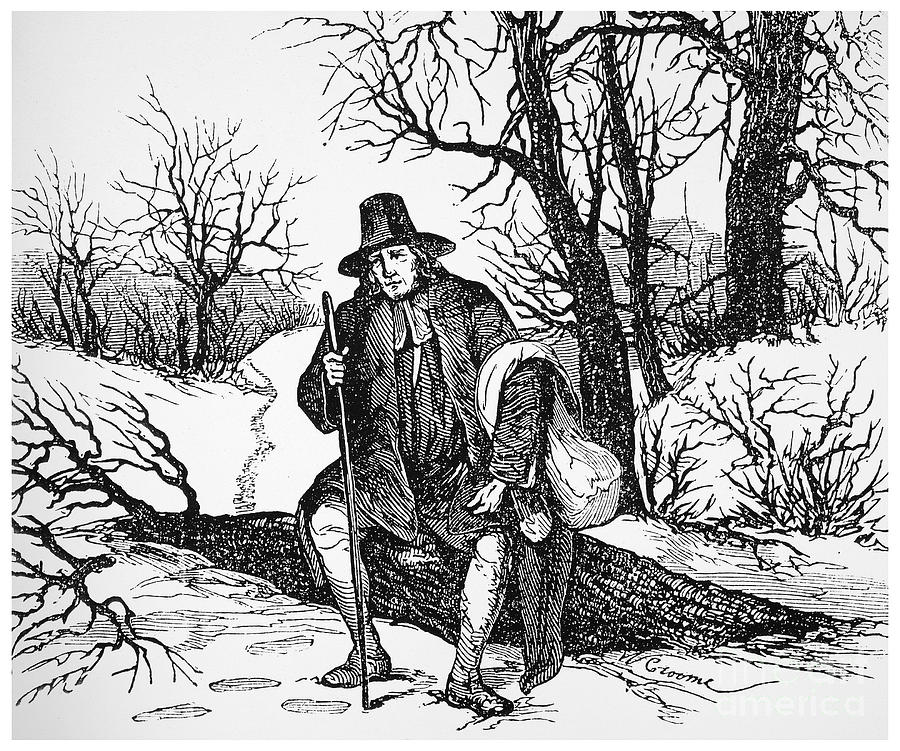
Williams rest on his winter flight from Massachusetts in 1636 in a 19th Century illustration. 

Rather than be taken into custody and dumped, most likely, in hostile Indian country, Williams fled on foot through the deep mid-winter snows.  He marched 105 miles from Salem to find refuge at the head of Narragansett Bay, where he was welcomed by his friend Massasoit, sachem of the Wampanoags.  That spring he was joined by his most loyal followers from Salem and began to settle on land he purchased from the Wampangoags.  Learning that his claim was within the boundaries of the Plymouth Colony, however, Williams and his people crossed Seekonk River to territory beyond any charter and purchased land from Canonicus and Miantonomi, chief sachems of the Narragansetts.  Williams named his new settlement Providence.

Williams declared his settlement a haven for those of distressed of conscience.  It was soon attracting dissidents and exiles from both Massachusetts and Plymouth colonies. The settlement was governed by a majority vote of the heads of households, and newcomers could be admitted to full citizenship by a majority vote.

The Landing of Roger Williams in 1636 painted in1857 by Alonzo Chappel depicts Williams crossing the Seekonk River to meet with Native peoples to purchase their land.

In August of 1637 electors drew up a town agreement, which limited the government to civil matters.  In 1640 another agreement declared their determination “still to hold forth liberty of conscience.” Williams had founded the first place in modern history where citizenship and religion were separated, and where there was religious liberty and separation of church and state.  In fact, Williams advocated what he called a “wall of separation” between church and state—a term Thomas Jefferson would borrow over a 140 years latter in his famous Letter to the Danville Baptists.

Meanwhile, a second wave of exiles arrived on the Narragansett Bay.  In 1837 the Massachusetts Court moved against the followers of Anne Hutchins.  Williams invited them to settle near him and arranged for them to purchase land on Aquidneck Island.  They named their settlement Portsmouth and the island Rhode Island.  Their elected leader, William Coddington quickly turned out to be a civil and religious tyrant and was ousted.  He formed a second town, Newport.  Eventually these two settlements reunited with separate local administrations.

Meanwhile the Pequot War had broken out and much of Massachusetts was in flames.  Leaders there were forced to do what they loathed most—turn to Roger Williams for help.  And help he did.  Not only did his extensive contacts among all of the tribes—he was making his living by this time trading with the natives for furs—provide vital intelligence, but he also persuaded his friends the Narragansetts not to join the uprising and to become allies of the settlers.  The assistance of the Narragansetts became critical to the final victory in that ugly war.

Williams, his colony and his native allies became regional powers. In the next three decades Massachusetts, Connecticut, and Plymouth exerted pressure to destroy both Rhode Island and the Narragansetts.  In 1643 those colonies joined in an alliance excluding the towns around Narragansett Bay and hostile to them—the United Colonies.  To prevent the alliance from overwhelming them, Williams went to England to secure a Charter of his own.  He arrived just as his breakthrough dictionary of Native American words was published and creating a sensation among the English intellectual elite.  Through their influence he was able to get his charter for Providence Plantations over the vehement objection of Massachusetts agents.

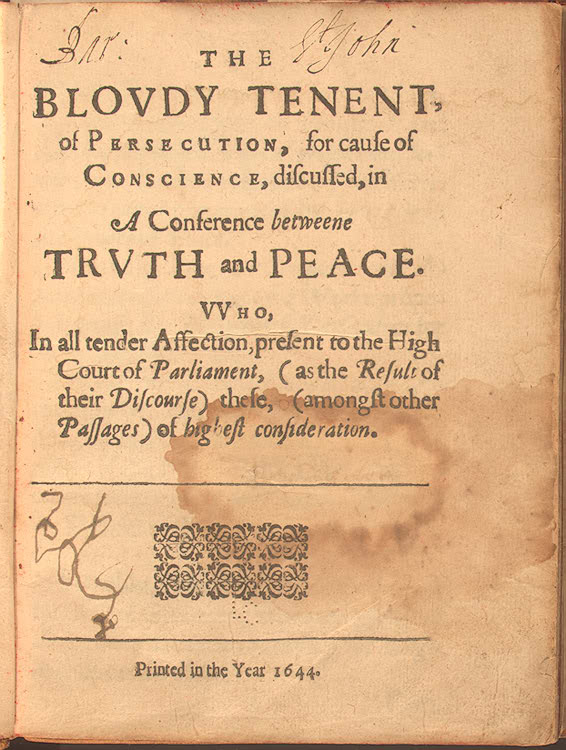
                       Roger Williams's banned book.

While in England, however, Williams could not refrain from stirring the pot.  In July of 1643 he published his most famous book, The Bloudy Tenent of Persecution for Cause of Conscience, a scathing indictment of religious intolerance and plea for separation of church and state.  The book caused an uproar and cost him the support of many former friends.  The Public Hangman was ordered to confiscate and burn copies.  Luckily Williams was on board ship home with his charter in his pocket or he might have been arrested and even executed.

Back home it took Williams until 1643 to bring the two towns of Rhode Island—by then prosperous seaports with larger populations than Providence—into a single government under his Charter.  Coddington, in fact, plotted to usurp Williams.  He sailed to England and in an astonishing bit of power politics returned in 1751with a document naming him governor for life over Rhode Island.  Providence and its allied town of Warwick sent Williams back to England to reverse the decision joined John Clarke representing Coddington’s numerous critics from Portsmouth and Newport.  Williams had to sell his trading post, the only source of income for his family, which now included six children, to pay for his crossing.  The two somehow succeeded in overturning Coddington’s patent.

Williams returned to America in 1654 and was immediately elected the President of the colony. He subsequently served in many offices in the town and colonial governments, and in his 70s he was elected captain of the militia in Providence during King Philip’s War in 1676.

Clark stayed in England and in 1664 obtained a new charter under the name Rhode Island that covered all of the towns on the mainland and on the island.  The colony remained a haven for all sorts of religious minorities—Baptists, Quakers, even Jews and Catholics.

Williams is usually described as a Baptist.  And indeed by 1638 had come to adopt the key Baptist tenant of believer’s baptism or credobaptism as opposed to the Puritan and Separatist practice of infant baptism.  He had been exposed to the writing of English General Baptists but arrived at the conclusion on his own.  He was baptized by Ezekiel Holliman in late 1638 and founded the First Baptist Church in America in Providence.  A few years later John Clarke formed a second church in Newport.  Following the traditions of their founders, Baptists in America became the leading advocates of church and state separation.

Yet the restless Williams did not himself remain a Baptist long, although he remained sympathetic to them.  He concluded that the corruption of the early church when it was co-opted by the Roman Empire under the Empower Constantine had broken the sacred covenant between God and the Church.  A new church, he now believed, could not be established without a special new divine commission.  He declared, “There is no regularly constituted church of Christ on earth, nor any person qualified to administer any church ordinances; nor can there be until new apostles are sent by the Great Head of the Church for whose coming I am seeking.”

Williams spent the rest of his days praying privately with friends awaiting that great day.  Despite his honors in the colony, he founded and his many achievements, Williams died in relative poverty and obscurity some time in early 1683.  He was buried in an unmarked grave on his property. 

Williams's WPA built grave site and monument.  You can be sure that this hater of idols and icons and the man who first advocated for "separation of Church and State" would not have approved.

Within 50 years his house had collapsed, and his grave was lost.  In 1860, Zachariah Allen sought to locate his remains but found only an apple tree root in the grave he believed to be that of Williams.  The root has been preserved as a relic by the Rhode Island Historical Society.  Dirt from the supposed grave was named “the Dust of Roger Williams” and preserved in an urn that was finally interred in a monument erected by the Works Project Administration (WPA) in Providence’s Prospect Terrace Park in 1937.  You can be sure that he would have protested. 

Wednesday, June 14, 2017

What Americans Drank Before Craft Beers, Clever Little Chardonnays, and Flavored Vodka


Here, have one on me....

Well, it’s Flag Day, official birthday of the Stars and Stripes.  As good enough reason as any to celebrate.  Pull up a chair.  Let me pour you one—Bourbon.  Neat of course, straight out of the bottle and into the glass.  Two or three fingers, what the hell.  A little water back.
You see by some accounts it’s also the birthday of Bourbon whiskey.  Legend has it that on June 14, 1789 the Rev. Elijah Craig, a Baptist preacher in what was then Fayette County, Virginia and is now Scott County in north central Kentucky, poured the raw corn whiskey from his still into charred oak barrels to age, which would ultimately become a brown colored elixir. 
Craig was born in Orange County, Virginia somewhere between 1738 and 1743.  He was a moderately successful tobacco planter in 1761 when he was born again and became a Baptist along with several of his brothers.  Within a few years he was preaching, first in his own barn, then on the circuit before becoming the pastor of Blue Run Church, halfway between Barboursville and Liberty Mills.  Later he was appointed apostle the wide area north of the James River.
Rev. Elijah Craig, maybe inventor of Bourbon
But the Baptists, threatening to sweep the back country and frontier of Virginia, soon came under attack by the established Anglican Church.  Several times Craig and his brothers, who had followed him as preachers, were arrested and jailed for failing to pay taxes to support the [Anglican] church and preaching without a license.
With the hold of the Anglicans weakened during the American Revolution Thomas Jefferson famously got the revolutionary Virginia government to adopt the principle of freedom of religion in the Declaration of Rights in 1776. Craig spoke to and converted ever larger crowds, often mixed Whites and Blacks, slave and free. 
But when the war ended elements of the Tidewater aristocracy pressed for the church, now re-established as the Episcopal Church to regain its privileges and tax support.  Craig was a leader of the western Baptists who fought for their religious freedom allied by James Madison and supported from afar by Jefferson.  He was a delegate to the Ratification Convention of 1788 and with Patrick Henry opposed the adoption of the Constitution without a Bill of Rights.  After securing religious liberty in the Virginia and Federal constitutions Craig was ever after a vigorous Jefferson Republican.
Meanwhile Craig’s brothers led the largest migration to the new lands beyond the mountains, the so called Traveling Church of more than 600 people who crossed into Kentucky County through the Cumberland Gap.  In 1782 Craig joined his brothers and bought a large tract of land near the settlement of Lebanon.  Within a few years not only had built up a church and a fine farm, but had established lumber and grist mills, a blacksmith shop and nail cutter, as well as general stores and taverns.  The distillery he established in 1789 was just the next logical step in the expansion of his holdings.  With a still Craig could convert the corn from his farms and mills to a product that could be hauled over the mountains and sold for cash back East. In the process Craig became a wealthy man.
But he shared his wealth.  He founded the first classical academy west of the mountains in Lebanon in 1787 and later donated the land and seed money for Georgetown College, the first Baptist college founded west of the Allegheny Mountains.  He also supported Baptist missionary efforts and the establishment of new churches. 
In fact, he gave so much of his fortune away that when he died in 1808 the Kentucky Gazette eulogized:
He possessed a mind extremely active and, as his whole property was expended in attempts to carry his plans to execution, he consequently died poor. If virtue consists in being useful to our fellow citizens, perhaps there were few more virtuous men than Mr. Craig.
But those killjoy historians point out that Craig was hardly the first man to make whiskey from corn rather than rye whiskey of the east.  And they are not even sure that he used charred oak casks, at least at first.
Indeed corn whiskey was being made all over the trans-Allegheny west, the source of hard money for pioneer farmers.  The stuff made famous by the Whiskey Rebellion in Pennsylvania from 1791-94 probably tasted more like lighter fluid than the aged whiskey we are used to.  It went directly into jugs from the still and was corked raw.   It was despicable stuff to drink, but thirsty Americans, evidently gluttons for punishment, did so any way.

This still at Mt. Vernon is probably very like the one Elijah Craig used west of the mountains.
Whiskey historians speculate that Scotch-Irish distillers, familiar with aging in a barrel, introduced the practice to the frontier before the turn of the 19th Century.  Craig may, or may not have been one of those to adopt the practice early.  At least he was wealthy enough to sit on his product for two to six years while the whiskey aged and mellowed in the barrels.  Smaller operators had to rush their product to market immediately.
Whatever the case, by the 1820’s many Kentucky distillers were producing aged whisky around Fayette, Scott, and Bourbon counties.  The stuff came to be called Bourbon.  Jacob Spears was the marketing genius who first slapped the Bourbon label on his bottles.
In the mid 1830’s the development of the sour mash process using material from an older batch of mash to start fermentation in the batch currently being made was introduced.  The process was said to “smooth and mellow” the flavor.  Dr. James C. Crow, a Scottish immigrant then employed as a master distiller for Glenn’s Creek Distillery in Woodford County Kentucky and/or his assistant Dr. Jason S. Amburgey is credited with invention of the process.  He later went work for two other producers using the technique.  Knowledgeable drinkers began calling his stuff Old Crow.  Eventually it was marketed under that name.  After disputes about authenticity, the brand finally came into the hands of the Jim Beam Company which sells it as a lower priced whiskey.
Virtually all Bourbons are now produced by the sour mash method.
Oh sure, they still drank rum by the gallon in the seaports, Eastern farmers and tradesmen drank Rye, and the rich imported wines and brandies.  Germans and other despised immigrants, gargled beer by the growler, But by the time of the Civil War real Americans with hair on their chests drank Bourbon neat, straight, or mixed with branch water.
Prohibition not only did damage to the Bourbon industry, it also changed American drinking habits, encouraging the spread of beer drinking and the use of gin and vodka in cocktails.  Scotch smuggled into the country by the  daring-do and Canadian blended rye which flooded the country supplanted Bourbon with many whiskey drinkers.
But well into the last decades of the 20th Century any saloon worth its name carried a long self of call-name Bourbons of distinguished legacy.  Now most of the joints I go into have replaced them with row after row of fancy Vodkas and designer Tequilas.  Most are hard pressed to keep one Kentucky Bourbon in stock plus the highly advertised Tennessee sipping whiskey Jack Daniels, once prized as a 90 proof but now watered to 80 proof and sold to be mixed with Coke. I’ve found saloons with no Bourbon at all.
And charming young bartenders are mystified by the simple order “Bourbon, neat, water back,” often serving it up on ice and/or mixed with water.  This is a sure sign that American civilization is doomed.
But there is dim hope.  Drinking fads change rapidly among highly prized urban hipsters eager to show off sophisticated tastes.  First, long neglected Scotch—the drink of Mad Men era dudes in shiny suites and skinny ties and of the Rat Pack began making a comeback with the snob appeal, expensive single malt brands.   Then the Japanese, who worship American culture and have a sharp eye for marketing opportunities, began distilling and exporting Bourbon style whiskey to the U.S. that critics in pricy men’s life style magazines praised.  Now craft distilleries are popping up in imitation of craft brewery pubs.  
Wondertucky, the local craft distillery product.  Nope, haven't tasted it yet.
Here in McHenry County local entrepreneurs in Woodstock are distilling and aging Wondertucky Whiskey—a tongue-in-cheek salute to nearby Wonder Lake, a village largely made up of converted summer cabins with poor and working class residents, many of them from Kentucky and Tennessee.  Believe me when I say that referring to the place as Wondertucky was never considered a compliment. 
Most tellingly Jim Beam, at best a mid-level quality Bourbon which is only 4 years old and which used to be most famous for their collector decanters is challenging the dominance of Jack Daniels among whiskey drinkers with a new series of TV ads featuring pretty, waif like Mila Kunis wandering among the aging barrels and branding “hers.”  A counter-intuitive choice for an industry that traditionally promoted whiskey as a man’s man’s drink.  But hey, she is easy on the eyes and may also bring women into the market.  In Chicago the ads are running heavily during Cubs gamesbig audience attractions where beer commercials once dominated unchallenged.  I suspect the ads will bring less sophisticated young drinkers into the fold and local salons may soon be thinning out all of those pricey vodkas to make room for some more Bourbon.
Mila Kunis, the unexpected but sexy face of Jim Beam.  She will probably sell whiskey.
Meanwhile finish that snort.  Let me pour you another.  We have some commiserating to do….


Friday, October 9, 2015

The Contrarian—The Banishment of Roger Williams


On October 9, 1635 the General Court of Massachusetts ordered Roger Williams, who they considered an obnoxious religious and political crank, into exile from the colony.  Specifically the 32 year old was convicted of both heresy and sedition for spreading, “diverse, new, and dangerous opinions.”
Williams was born in 1603 to a conventional Anglican family.  His father was a prosperous master tailor and merchant in Smithfield, London.  A bright, inquisitive, and pious boy, Williams had a personal religious conversion experience which began his long journey as a dissenter.  His father disapproved but allowed his wayward son to continue his education, including an apprenticeship with the great legal scholar and jurist Sir Edward Coke.  He attended Charterhouse, a prestigious public school before enrolling at Pembroke College, Cambridge from which he graduated in 1627.  He excelled at classicalHebrew, Greek, and Latin—and modernDutch and Frenchlanguages.
While at Cambridge Williams became a Puritan—an advocate of purifying the Church of England by stripping away the remaining trappings of Catholicism including the Mass, use of Latin in liturgy, and idolatry in the form of statues of saints and icons.  He took Holy Orders as an Anglican priest, but his chances at advancement were blocked by the firmly High Church hierarchy.  He took a position as a private chaplain to Sir William Macham, a leading Puritan lord.  As such he was privy to plans to seed a Puritan colony in the New World.  Newly married, he passed on his opportunity to go in the first ships sent to found what would become Massachusetts in 1630.  But he was soon so disgusted with church leadership that he determined to join the migration.  He also privately abandoned any hope of reforming the corrupt church and became a Separatist.
Williams and his wife Mary set sail for New England in December on the Lyden and arrived in Boston in February 1731.  He found himself not only welcome, but honored.  He was offered as a position as Teacher—sort of an associate pastor—of the Boston congregation.  He declined the position and openly declared himself as a Separatist.  He also insisted that civil magistrates should have no authority over religious maters and that individuals were free to develop and express their own religious convictions.  These positions shocked and appalled the Puritan worthies who demanded complete conformity to their beliefs in matters both civil and religious.
The church in Salem was then tending toward Separatism and invited Williams to become Teacher there.  Outraged leaders in Boston threatened the Salem church, which rescinded the invitation.  By August 1631 he had left Massachusetts for a friendly welcome among the Separatists of Plymouth.  Although not given an official position, he assisted the local minister and occasionally preached.  Governor William Bradshaw found his preaching, “entirely amicable” to the local church.
But Williams was never one to go long without examining his conscience and in holding the church to the very high standards he demanded.  He began to doubt that the Plymouth church was sufficiently separated from Anglicanism.  And his growing and admiring contact with native inhabitants led him to question the legitimacy of Royal Charters that granted land that the King did not own.  Instead he maintained that land need be purchased from its rightful owners, the native tribes.  In December 1632 Williams wrote a lengthy tract on these subjects which he circulated to churches in both Plymouth and Massachusetts colonies.
By this time Bradford noted that Williams had fallen “into some strange opinions which caused some controversy between the church and him.”  In 1633 he had worn out his welcome and was back in Salem, which now seemed more inclined to support him.  Upon learning of his return, the Massachusetts General Court summoned him to Boston.  Williams apparently agreed to make some concessions and all known copies of his critical tract were burned.  Allowed to return to Salem, he became acting pastor when his sponsor, Rev. Samuel Skelton died.
Soon Williams had returned to his criticisms of both civil authority over religious matters and of the legitimacy of colonial charters.  He was called before the General Court again in March of 1635 and in April he so vigorously opposed a new oath of allegiance to the colonial government that it became impossible for the magistrates to enforce it.
Unable to reign in Williams, the General Court turned on the Town of Salem.  It refused a routine petition to annex adjacent land on the Marblehead Neck and took other actions against Salem’s interest.  In July the Court formally demanded that Williams be removed from the pulpit of the Salem Church.  The Salem Church asserted that the order was a violation of congregational polity and independence and circulated a protest letter to other churches.  The General Court ordered that the letter not be read in the other churches and refused to seat delegates from the town of Salem until the Church was in compliance.
As pressure grew on the Church, Williams demanded that it formally separate itself from the Standing Order.  His support within the Church then collapsed. Williams withdrew as minister and began meeting privately with a few followers in his home.
Without the protection of the Salem church or Town, the General Court went ahead with its sedition and heresy trial in October.  When the conviction was handed down, Williams was confined to his bed by illness.  He was given a reprieve from banishment until spring on condition that he remain quiet.  Typically, Williams would not shut up.  The Sheriff was sent to seize him in January 1636 but found Williams gone.  
Roger Williams rests on his winter treck to freedom.
Rather than be taken into custody and dumped, most likely, in hostile Indian country, Williams fled on foot through the deep mid-winter snows.  He marched 105 miles from Salem to find refuge at the head of Narragansett Bay, where he was welcomed by his friend Massasoit, sachem of the Wampanoags.  That spring he was joined by his most loyal followers from Salem and began to settle on land he purchased from the Wampangoags.  Learning that his claim was within the boundaries of the Plymouth Colony, however, Williams and his people crossed Seekonk River to territory beyond any charter and purchased land from Canonicus and Miantonomi, chief sachems of the Narragansetts.  Williams named his new settlement Providence.
Williams declared his settlement a haven for those of distressed of conscience.  It was soon attracting dissidents and exiles from both Massachusetts and Plymouth colonies. The settlement was governed by a majority vote of the heads of households, and newcomers could be admitted to full citizenship by a majority vote.
In August of 1637 electors drew up a town agreement, which limited the government to civil matters.  In 1640 another agreement declared their determination “still to hold forth liberty of conscience.” Williams had founded the first place in modern history where citizenship and religion were separated, and where there was religious liberty and separation of church and state.  In fact Williams to advocate what he called a “wall of separation” between church and state—a term Thomas Jefferson would borrow over a 140 years latter in his famous Letter to the Danville Baptists.
A romanticized 19th Century rendition of Williams meeting with the Narragansett to purchase land for his haven.
 

Meanwhile, a second wave of exiles arrived on the Narragansett Bay.  In 1837 the Massachusetts Court moved against the followers of Anne Hutchins.  Williams invited them to settle near him and arranged for them to purchase land on Aquidneck Island.  They named their settlement Portsmouth and the island Rhode Island.  Their elected leader, William Coddington quickly turned out to be a civil and religious tyrant and was ousted.  He formed a second town, Newport.  Eventually these two settlements reunited with separate local administrations.
Meanwhile the Pequot War had broken out and much of Massachusetts was in flames.  Leaders there were forced to do what they loathed most—turn to Roger Williams for help.  And help he did.  Not only did his extensive contacts among all of the tribes—he was making his living by this time trading with the natives for furs—provide vital intelligence, he persuaded his friends the Narragansetts not to join the uprising and to become allies of the settlers.  The assistance of the Narragansetts became critical to the final victory in that ugly war.
Now, however Williams, his colony and his native allies became regional powers. In the next three decades Massachusetts, Connecticut, and Plymouth exerted pressure to destroy both Rhode Island and the Narragansetts.  In 1643 those colonies joined in an alliance excluding the towns around Narragansett Bay and hostile to them—the United Colonies.  To prevent the alliance from overwhelming them, Williams went to England to secure a Charter of his own.  He arrived just as his breakthrough dictionary of Native American words was published and creating a sensation among the English intellectual elite.  Through their influence he was able to get his charter for Providence Plantations over the vehement objection of Massachusetts agents.
Roger Williams's banned book.
While in England, however, Williams could not refrain from stirring the pot.  In July of 1643 he published his most famous book, The Bloudy Tenent of Persecution for Cause of Conscience, a scathing indictment of religious intolerance and plea for separation of church and state.  The book caused an uproar and cost him the support of many former friends.  The Public Hangman was ordered to confiscate and burn copies.  Luckily Williams was on board ship home with his charter in his pocket or he might have been arrested and even executed.
Back home it took Williams until 1643 to bring the two towns of Rhode Island—by then prosperous seaports with larger populations than Providence—into a single government under his Charter.  Coddington, in fact, plotted to usurp Williams.  He sailed to England and in an astonishing bit of power politics returned in 1751with a document naming him governor for life over Rhode Island.  Providence and its allied town of Warwick sent Williams back to England to reverse the decision joined John Clarke representing Coddington’s numerous critics from Portsmouth and Newport.  Williams had to sell his trading post, the only source of income for his family, which now included six children, to pay for his crossing.  The two somehow succeeded in overturning Coddington’s patent.
Williams returned to America in 1654 and was immediately elected the President of the colony. He subsequently served in many offices in the town and colonial governments, and in his 70s he was elected captain of the militia in Providence during King Philip’s War in 1676.
Clark stayed in England and in 1664 obtained a new charter under the name Rhode Island that covered all of the towns on the mainland and on the island.  The colony remained a haven for all sorts of religious minorities—Baptists, Quakers, even Jews and Catholics.
Williams is usually described as a Baptist.  And indeed by 1638 had come to adopt the key Baptist tenant of believer’s baptism or credobaptism as opposed to the Puritan and Separatist practice of infant baptism.  He had been exposed to the writing of English General Baptists but arrived at the conclusion on his own.  He was baptized by Ezekiel Holliman in late 1638 and founded the First Baptist Church in America in Providence.  A few years later John Clarke formed a second church in Newport.  Following the traditions of their founders, Baptists in America became the leading advocates of church and state separation.
Yet the restless Williams did not himself remain a Baptist long, although he remained sympathetic to them.  He concluded that the corruption of the early church when it was co-opted by the Roman Empire under the Empower Constantine had broken the sacred covenant between God and the Church.  A new church, he now believed, could not be established without a special new divine commission.  He declared, “There is no regularly constituted church of Christ on earth, nor any person qualified to administer any church ordinances; nor can there be until new apostles are sent by the Great Head of the Church for whose coming I am seeking.”
Williams's WPA built grave site and monument.
Williams spent the rest of his days praying privately with friends awaiting that great day.  Despite his honors in the colony he founded and his many achievements, Williams died in relative poverty and obscurity some time in early 1683.  He was buried in an unmarked grave on his property.  
Within 50 years his house had collapsed and his grave was lost.  In 1860, Zachariah Allen sought to locate his remains but found only an apple tree root in the grave he believed to be that of Williams.  The root has been preserved as a relic by the Rhode Island Historical Society.  Dirt from the supposed grave was named “the Dust of Roger Williams” and preserved in an urn that was finally interred in a monument erected by the Works Project Administration (WPA) in Providence’s Prospect Terrace Park in 1937.  You can be sire that he would have protested.