Showing posts with label Bolshevik Revolution. Show all posts

Saturday, February 21, 2015

The Communist Manifesto—Never Underestimate the Power of a Pamphlet


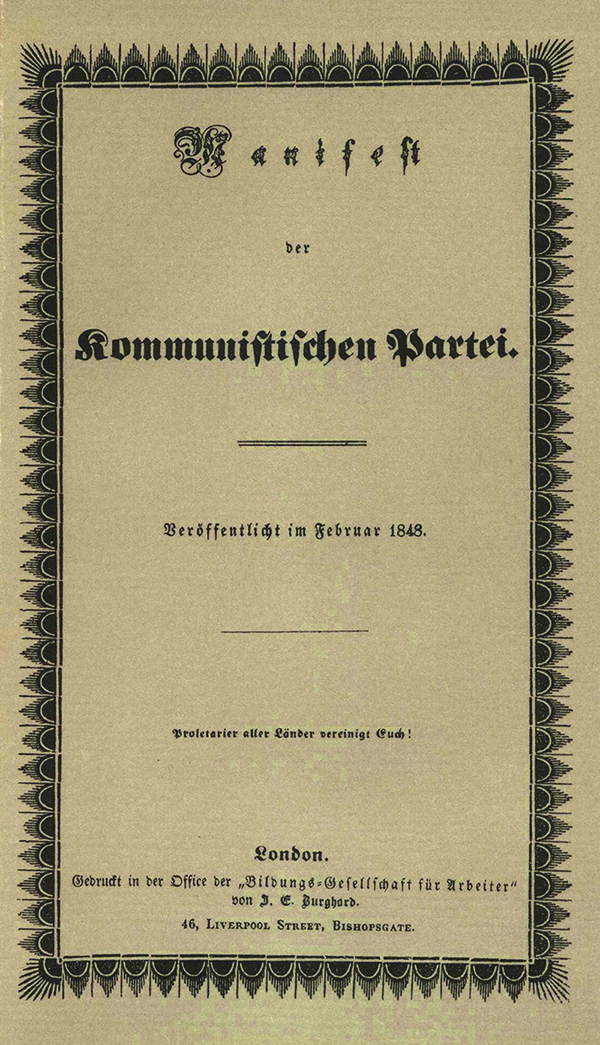
It couldn’t have been more timely.  The uprisings that would sweep from France across the German states and into much of the rest of Europe were gathering steam on February 21, 1848 when a tiny faction of radical socialists from across the continent met in London and published Manifest der kommunistischen Partei, literally the Manifesto of the Communist Party.  Now known more simply as the Communist Manifesto the 18,000 word paper bound pamphlet was authored by German Jewish journalist and intellectual Karl Marx and his close collaborator Friedrich Engels, a pioneering German born sociologist who had made his mark with the publication three years earlier of The Condition of the Working Class in England, one of the first systematic studies of working class life.
The publication was almost instantly notorious.  Editions appeared in French and English by 1850 and were followed by translations in most European languages.  By 1857 an American edition was published by the utopian and individualist anarchist Stephen Pearl Andrews.
Exactly how much each of the two credited authors contributed to the final product is hotly debated with those who want to raise Marx to the level of an infallible prophet and messianic figure pumping their hero up while reducing Engels to almost a mere clerk.  What is indisputable is that in the final draft it is Marx’s vigorous and muscular rhetoric that characterized the document beginning with its famous preamble:

A spectre is haunting Europe — the spectre of communism. All the powers of old Europe have entered into a holy alliance to exorcise this spectre: Pope and Tsar, Metternich and Guizot, French Radicals and German police-spies.

Where is the party in opposition that has not been decried as communistic by its opponents in power? Where is the opposition that has not hurled back the branding reproach of communism, against the more advanced opposition parties, as well as against its reactionary adversaries?

Two things result from this fact:

I. Communism is already acknowledged by all European powers to be itself a power.

II. It is high time that Communists should openly, in the face of the whole world, publish their views, their aims, their tendencies, and meet this nursery tale of the Spectre of Communism with a manifesto of the party itself.
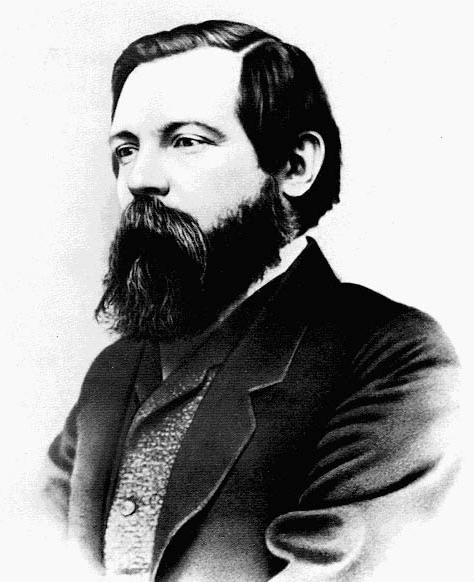
Engels in 1856

But we know that it was Engels who was commissioned by the Communist League, the first international party to adopt that name, in July of 1847 to draw up a catechism for the new movement.  His first effort became the Draft of a Communist Confession of Faith containing almost two dozen questions that helped express the ideas of both his own ideas and those of his comrade Marx at the time.  That was followed in October with a second draft renamed the less religious Principles of Communism.  Still, it was in the question and answer format of a catechism.  Engels was dissatisfied with that and suggested a new approach. 
He brought Marx into the project as the primary writer of the final draft, traveling to Brussels, Belgium where the exiled writer was publishing a radical newspaper.   Marx incorporated much of Engels’s work but heavily rephrased it and added his own insights. 
The controversy over who contributed what swirled over the life times of both men.  After Marx’s death Engels wrote of what had become known as Marxism:
I cannot deny that both before and during my forty years’ collaboration with Marx I had a certain independent share in laying the foundations of the theory, but the greater part of its leading basic principles belongs to Marx....Marx was a genius; we others were at best talented. Without him the theory would not be by far what it is today. It therefore rightly bears his name.
 
Behind the barricades in Berlin, March 1848.


Whoever was the primary author, the effects of the pamphlet were not long in being felt.  It began to “hit the streets” in Germany by spring.  It surely did not cause the wave of 1848 uprisings, those had been festering and boiling under the surface since the end of the Napoleonic Wars and the spread of the Industrial Revolution into previously agrarian and stable urban centers organized along traditional craft production.  The leaders of the rebellions, as far as they could be identified, came from various ideological shades, including different varieties of socialists, along with democratic rebels casting themselves in the anti-royalist traditions of the French Revolution.  Many were young idealists, including students and sympathetic intellectuals.  Others emerged from the ranks of the evolving working class itself.  Communists represented only a tiny sliver of active leadership—their organization was too new, too week to do much more than be swept up in an irresistible tide of history. 
Did the appearance of the Manifesto inspire the rebels?  To some extent.  But many were too engaged in making a revolution to spend much time reading about one.
But Marx’s somewhat bombastic claims in the introduction to the pamphlet led authorities to believe that there was indeed a “Spectre of Communism haunting Europe.”  The rebellions peaked and then faltered for lack of clear programs and ability to build sustained organizations while the forces of reaction rallied and counter attacked with overwhelming military power.  By mid-1849 most of the uprisings were crushed and a continent wide repression was under way.  The Manifesto was generally suppressed, although surreptitious copies continued to be circulated, often at great risk.  Identifiable Communists were arrested and sometimes executed—but so were leaders and activists of all ideological stripes.  Thousands were forced into exile.

Marx in 1860

Marx and his wife were among them.  They had to flee Brussels to join Engels in London, where he resumed work as a journalist, dedicated himself to study of the revolutionary movements and why they failed, and to assuming more formal leadership in the Communist movement.  In 1850 the Prussian master spy Wilhelm Stieber broke into Marx’s London home and made off with the Communist League’s membership records setting off a wave of arrests across Germany and France.  After the Cologne Communist Trial of 1852 the League was forced to dissolve.  There after Communism existed as a current in socialism and Marx worked to get national socialist and labor parties, as well as trade union, to adopt his analysis. 
The Manifesto was now a document for an organization that had evaporated.  The very stuff of ephemera, at best of interest to historians, antiquarians, and haunters of dusty archives.  But instead, it not only remained in print, it spread and continued to be issued in new languages.  It was passed hand-to-hand, often clandestinely, among the scattered survivors of the ’48 upheaval.  Marx and Engels issued editions with new introductions every few years that both explained themselves and sometimes modifying views expressed in the original text Some local Communist grouping were established, but a generation of radicals influenced by it became militants in the trade union movement, emerging Social Democratic Parties, and labor parties.  They were among the Communards who rose up in Paris after the Franco-Prussian War and were eventually crushed by the French National Guard.
The document shaped the thinking of many socialist and some anarchists who were not explicitly Communist.
Members of all of these organizations—except for avowed anarchists and anarcho-syndicalist unions—met in Paris in 1889 to form the Socialist International, better known as the Second International at which Marx and Marxism were dominant.  Of course, by this time Marx had moderated some of the insurrectionist views of the Manifesto and advocated parliamentary and electoral activity through the Social Democratic parties modeled on that of Germany.  Still, despite the modified doctrine, the Manifesto remained a revered document.
In the 20th Century Lenin would resurrect the Manifesto as a primary document to differentiate his Bolsheviks from reformist Russian Social Democrats and as a rallying point for his insurrectionist 1917 October Revolution.


Saturday, October 26, 2013

Igor Sikorsky and the Other Way to Fly

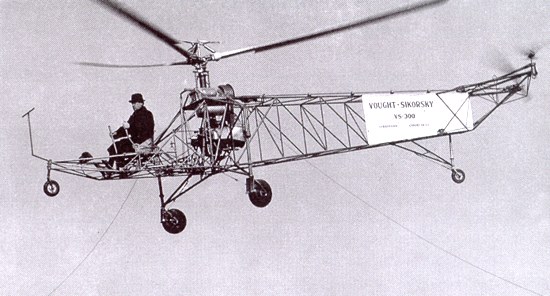
Sikorsky at the controls of his prototype  VS-300 helicopter for its maiden tethered flight in September 1939.


He was the son of privilege in a provincial capital of the Russian Empire.  His mother, the decedent of Polish nobles and a physician by training, home-schooled the lad.  In addition to the basics she taught him art and music and shared her particular enthusiasm for Leonardo da Vinci and the exciting tales of Jules Vern.  The latter two captured the boy’s imagination and by the age of twelve had constructed a model helicopter out of paper, glue, and rubber bands.  It was the beginning of a lifelong obsession.

Igor Sikorsky was born in Kiev, in the present-day Ukraine, 1889 the youngest of five children of Ivan Alexeevich Sikorsky, a Russian professor of psychology.  By the time he died in faraway Easton, Connecticut on October 26, 1972 at the age of 86 he had turned that childhood plaything into an aviation revolution and built a major company.

His father, an ardent Russian nationalist and monarchist, enrolled his youngest son in the service of the Tsar at then Russian Naval Academy when he was just 14.  Although he excelled at his studies young Igor resigned from the Academy in 1906 to study engineering in Paris.  The following year he returned home to enter the Mechanical College of the Kiev Polytechnic Institute.

In the summer of 1908, he accompanied his father on a trip to Germany.  That was the year Orville Wright was creating a sensation barnstorming Europe and Ferdinand Graf von Zeppelin was demonstrating his advanced LZ-4 dirigible.  Both ignited the young man’s imagination.  “Within twenty-four hours, I decided to change my life's work. I would study aviation,” he would later say.

By 1909 Sikorsky was back in Paris studying at the Ecole des Techniques Aéronautiques et de Construction Automobile.  The French were rapidly surpassing the American and France was becoming the center of the aviation world.  Sikorsky met and was influenced by the top men in the field including Louis Blériot. 
 
Back in Kiev, he turned to his childhood interest and began working on a helicopter.  His first problem was crating stability in the craft.  Although he made some breakthroughs on that issue, he disassembled his air craft before testing in when he realized it would not fly.  The technology needed for a workable model did not yet exist and Sikorsky felt he personally also had to learn more.

So he turned to fix wing aircraft.  He built two underpowered models, one of which briefly got off the ground, before he was successful.  In 1910 he had a breakthrough with a two seat aircraft, the S-5, his first entirely original design.  Flying it he earned his pilot’s license 1911.  He flew many demonstrations in his new plane and was attracting notice for his innovation when he was involved in a crash.  A simple mosquito had clogged the carbonator starving the engine.  The incident convinced him of the need to develop multi-engine air craft which could survive the loss of a single engine.  He enthusiastically threw himself into the development of such planes.

After winning a Russian Army aircraft exhibition in February of 1912 with his new three passenger S-6, Sikorsky joined the Russian Baltic Railroad Car Works in St. Petersburg as Chief Engineer of its new aircraft division.  This gave him financial backing and industrial capacity to make huge leaps in development.  Within a year he came up with his S-21 Russky Vityaz.  A first prototype was mounted with two engines.  Wings were extended and four engines in a push-pull arrangement were tried.  Finally he mounted four tractor engines on the large bi-plane which Sikorsky himself test piloted on May 12, 1913.  The accomplishment finally won him an honorary degree from the St. Petersburg Polytechnic Institute, the only degree he ever won.

Sikorsky turned to adapting his design into a commercial airliner, the S-22 Ilya Muromets.  It featured an insulated closed cabin with passenger saloon, comfortable wicker chairs, a bedroom, a lounge and even the first airborne toilet. It was heated by the passage of exhaust pipes from the engines through the cabin and had electric lighting powered by a wind turned generator. The cockpit had sufficient space allowing several persons to observe the pilot. Openings on both sides of the fuselage permitted mechanics to climb out onto the lower wings to service the engines during flight.  On February 11, the second factory prototype flew a successful demonstration carrying 16 passengers in addition to the pilot, shattering old capacity records.  Plans were made to introduce the plane to regular commercial service later in the year.

Those plans were shattered by the outbreak of World War I.  Sikorsky quickly adapted his air liner to the world’s first operational heavy bomber, the Military Ilia Mourometz, Type B. It was slightly smaller and lighter than the civilian Type A and fitted with internal racks carried up to 800 kg of bombs, and positions for up to nine machine guns for self-defense in various locations, including the extreme tail. The engines were protected with 5 mm-thick armor.

The bomber went into service in the Imperial Air Force in late 1915 and by 1916 enough had been produced to assemble the world’s first heavy bomber squadrons.  A total of 76 planes were produced during the war.  Their heavy armament made them practically invincible in the air.  Only one was ever shot down by enemy fighters, only after its gunners had knocked out three of the four attackers.  Four others were badly damaged but could continue to fly and return to base.  The Russians developed the first tactics for heavy bombers, including large scale and night time raids and attacks on industrial and transportation support behind the front lines.

At the beginning of the war, no other power had anything like it.  The Germans eventually built their own bomber using parts of a crashed Ilia Mourometz as a guide and licenses were granted to France and England to produce their own planes.  Thus virtually every heavy bomber in the Great War was based on Sikorsky’s design.

After the war four surviving bomber were retrofitted back to their original commercial use and between May and October 1921 were put into regular operations between Moscow and Kharkov.

By that time, Sikorsky had fled the country.  The 1917 Bolshevik Revolution and subsequent Civil War had made his life in the county untenable.  He remained, like his father, a monarchist and conservative as well as an ardent Orthodox Church member.  After fleeing the capital, he briefly served as an engineer with French interventionist forces in the Civil War, which cemented his condemnation by the Communist government.

Sikorsky divorced his wife Olga Fyodorovna Simkovitch, perhaps to protect her, and left her and their infant daughter, Tania, behind then fled to the United States.

On arrival he found a nation that was a relative aviation backwater.  Other nations had made most of the great technological leaps of the War years and the American forces flew mostly English or French made aircraft or American versions built under license.  The clamor to disarm cut the possibility of military contracts.  Only barnstorming pilots and airmail service using obsolete bi-planes kept any interest in aviation alive.  Sikorsky struggled to support himself as a teacher and sometime lecturing on aviation.

Finally with the support of exiled Russian Army officers and a major $5,000 investment by composer Sergei Rachmaninoff he was able to form the Sikorsky Manufacturing Company in Roosevelt, New York in 1923.  The same year he brought three of his sisters and his daughter Tania over from Russia.  In 1924 Sikorsky married 21 year old Elisabeth Semion.  They would have four children, including Igor, Jr. who would follow his father’s footsteps as an executive in his company.

His new company turned back to the design and production of commercial air liners.  The S-29-A was an all-metal, twin-engine biplane airliner, capable of carrying 16 passengers and a crew of three first flown in 1924.  The airline industry was in its early infancy and the plane never sold for its intended purpose.  The prototype was sold and used in promotions for Curlee Clothing and somehow as a “flying cigar store.”  Howard Hughes used it as a stand-in for a bomber in Hell’s Angels in 1929.  It crashed and was destroyed during the filming.

After becoming an American citizen in 1928 Sikorsky merged his company with United Aircraft and Transport (now United Technologies Corporation) becoming the Vought-Sikorsky Aircraft Division.  As was the case with his association with the Russian rail car manufacturer, the association with a larger company gave him more assets and the industrial capacity to produce planes in numbers.  A plant was established at Stratford, Connecticut.

Sikorski did not invent the Flying Boat, but he and his company produced the first really successful trans-oceanic airliners.  After developing a successful prototype the S-40 in 1931, Pan American Airlines (Pan Am) president Juan Trippe, asked Sikorski to submit a design.  At a luncheon meeting with Pan Am consultant Charles Lindbergh on a test flight of the S-40 the two men sketched out plans for a grand new aircraft on a napkin.  

The S-42, which went into production in 1934, became the mainstay of Pan Am’s global Clipper service flying on Latin American, Trans-Atlantic, and Trans-Pacific routes.  Only 10 were built but Pan Am kept them plenty busy.  The planes could carry 37 day passengers or 14 sleeper berths.  They had a range of 1,930 miles before needing to be refueled, and flew at 180 miles per hour, a speed that gobbled up miles on the long trips.

Sikorski had returned to tinkering with vertical lift ideas as early as 1929 when he filed a patent on a direct lift amphibious aircraft which used compressed air to power a direct lift propeller and two smaller propellers for thrust.  Another direct lift patent was granted the next year.  But neither of these were true helicopters.  They were somewhat similar to Spanish designer Juan de la Cierva’s fixed wing auto-gyros with enhanced ability to take off and land completely vertically and even to hover.

The Vought-Sikorsky VS-300, was not the first true helicopter—the Soviet Yuriev/Cheremukhin was flown in 1932—but it was the first built in the United States and the first with the combination of a single horizontal rotor for lift and small vertical rotor mounted on a tail for stability, both powered by a single engine.  This is the configuration that almost all modern helicopters incorporate.  Mounted with pontoons it became the first amphibious helicopter and was the first to have cargo capacity.  The VS-300 was tested on a tether on September 14, 1939 Sikorsky few the first untethered test flight on May 13, 1940.

Despite the breakthrough the demand for other type of aircraft production with the outbreak of World War II, interrupted further development and production.  In 1942 the company introduced the two-man R-4 which became the first helicopter in the world to go into mass production.  After testing prototypes which set records for endurance time aloft and distance, the Army ordered 44 aircraft, designated YR-4A, for use as a reconnaissance scout and passenger ferry.  The British ordered a handful for use on carriers. 

In 1944 a YR-4A performed the first helicopter rescue in history when it extracted the pilot of a crashed aircraft and three British passengers from rugged mountain country in Burma, bringing the men out in multiple flights.  That soon became a primary mission of the new aircraft.  They were also used to ferry aircraft parts to and from ships and to remote locations.  

The R-6 Hoverfly II was an improved, streamlined upgrade with increased speed and lift power that introduced by American and British forces in 1945 and saw limited use.  The British were the first to fit the landing booms with external stretcher bearing capacity for medical evacuation.  These machines continued in limited use through the early 1950’s.  Surplus YR-4A and R-6 were sold on the civilian market after the war igniting interest in commercial possibilities.

The post war years meant a growing demand for a variety of helicopters.  Among those produced were the H-19 Chickasaw, an eighteen passenger work horse that was ordered in large numbers by the Army, Navy (HOS-4) and Marines (HRS).  They were extensively used in the Korean War for cargo delivery, behind the lines troop transport, and medical evacuation.  The Navy and Coast Guard adapted theirs to air-see rescue.  Many were sold to foreign governments as well and the French were the first to use them in active combat as for paratroop insertion and as gun platforms in Algeria and to a lesser degree in Indo China.  It was French tactics that caused a re-evaluation of the use of helicopters by American forces.  The H-19 also had a long life in civilian service.

The Navy’s SH-3 Sea King dual turbo-prop anti-submarine helicopter was introduced in 1961 and the Army’s heavy lifting CH-54 Tarhe or Flying Crane which was capable of delivering a tank even retreating a downed aircraft, in 1962.   CH-3 Jolly Green Giant introduced in with fore and aft rotors and a rear ramp became a major cargo delivery and troop carrier ship. 

Sikorski lost the competition for an Army utility helicopter Bell’s UH-1 Iroquois (Huey), which became the work horse of the Vietnam War and the ship around which air mobile and air cavalry tactics were built.  But the company would come roaring back.

Sikorski himself remained active as Chief Engineer and had at least a hand in the development of everything that came out of his New Jersey plant, although his son and a new generation of designers took up more and more of the detailed work.  He also had time for other interests, including art and music.  His interest in religion never flagged and he wrote two volumes of essays on the subject, The Message of the Lord’s Prayer and The Invisible Encounter, both published during World War II.  He developed the Aeronautical Engineering program at Rhode Island University where he was a professor from 1932 to ’48 and subsequently lectured at the University of Bridgeport near his home.  And he was a long time member of the Board of the Tolstoy Foundation which helped Soviet displaced persons, dissidents and former Soviet citizens to settle in the West.

As noted, Sikorski died in 1972 and was buried in a Greek Orthodox cemetery near his home.  

But his work and company went on.  In 1974 the Army UH-60 Black Hawk, and Navy SH-60 Seahawk tactical armed transport helicopters with dual use as troop insertion and were introduced upgraded models are still in production.  They are still a backbone of operations and have been extensively used in conflicts including the First Gulf War, Iraq, and Afghanistan.  Their vulnerability to shoulder-fired anti-aircraft weapons and small arms—as the Russian discovered flying similar aircraft in Afghanistan, and as was demonstrated in the Black Hawk Down incident in Somalia has caused military planners to reassess the air-mobile tactic of Vietnam.

Despite this, the Navy is now operating its entire armed transport, reconnaissance, vertical insertion fleets with variants of the Seahawk.