 |
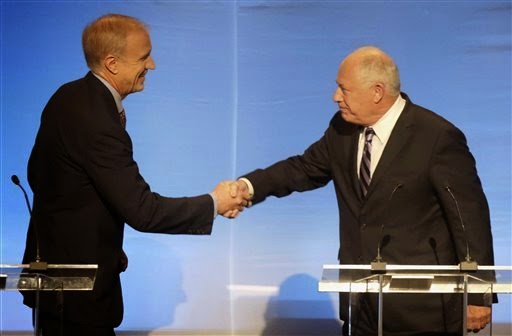
| Not so cordial handshake between Bruce Rauner and Pat Quinn at a debate. |
Note: It’s the first election year since I hung-up my clipboard and precinct map after nearly 30 year
as a McHenry County, Illinois Democratic precinct committee person. I
can’t say the blare of distant trumpets stirs this old war horse to kick down the stable gate. But
the airways are burning up with ads in one of the most expensive races for
governor in the country and early voting has already commenced. Hard not to take note of the shenanigans, or
what is at stake.
Nationally, if my e-mail inbox is any indication, Democrats are in a froth and panic over the
possibility of losing the Senate even
though poll after poll that even Red State voters are disgusted by the Republican agenda and fed up with obstructionism. It’s an accident of what seats are open and/or vulnerable this year and the Democrats have
more to lose and a harder path to victory.
Or, according to other messages, we are on the verge of an up-set victory
in key states, several governors’ races, and a handful of hot House races. Either way everyone wants my money right now and several times a day
as well as volunteer hours pounding the pavement again, manning phone banks, or joining in the begging brigades.
Here
in Illinois Senate Majority Whip and
leading liberal Senator Dick Durbin
will have little difficulty in turning back the challenge of self-financing dairy millionaire Jim
Oberweis, a perennial state-wide
candidate that the public has
grown bored with despite repeated efforts to re-invent himself.
There are only a
couple of hot House races in the
rigidly gerrymandered Illinois Congressional
Districts. The hottest and oddest
race is in the North Shore suburban 10th
District, a bastion of social
liberalism that has tended Democratic recently. In a topsy-turvy race, Republican PACs are running attack
ads on freshman Democratic Representative Brad Schneider for being
an uncaring millionaire and exporting jobs to China, while former Representative Bob Dold sometimes seems to be running as a Democrat emphasizing
his “independence” on abortion rights,
women’s health, gun background checks, and banning fracking under Lake Michigan.
But
if you are in Illinois the clash between incumbent Democratic Governor Pat Quinn and yet another
Republican deep-pocket rich dude, Bruce
Rauner, is painfully unavoidable.
The obscene amounts of money spent by both candidates, their national political parties, and nearly a dozen
major PACs to flood TV, radio, the Internet, and social media could probably cure Ebola and defeat ISIS.
Pat
Quinn, despite having the charisma of
a boiled turnip, the oratorical skills of the most boring teacher you have ever been stuck with,
the smug tinge of self-righteousness of
a goo-goo—short for good government for
those of you not versed in Illinois political
slang—has been one of the luckiest politicians alive. His career advancement to the Governor’s Mansion, in which, unlike
his notorious predecessor he sometimes sleeps, is fraught with timely accidents, the disappearance of
rivals, and the benefits of often not being taken seriously. Of course there was also relentless
self-promotion.
Quinn
was born on December 16, 1948 in comfortable, Middle class Hinsdale, a leafy suburb of Chicago. He was raised in a seriously Catholic family, was educated in local parochial schools, and got his B.A at prestigious Georgetown University in Washington
DC. Later he would get law degrees from Northwestern.
He
briefly practiced tax law but was
drawn to public service and politics.
Two years out of Georgetown, Quinn volunteered in the populist campaign of Dan Walker for governor and served
Walker as a low level aid. Walker was
always at odds with party regulars and
at war with the solid majorities the Democrats had in each house of the Legislature and was therefore unable to
achieve most of his legislative aims. A
belligerent attitude toward the legislature became ingrained in Quinn’s
political DNA
In
fact Quinn first rose to public notice leading reform crusades aimed at the General
Assembly. First he promoted the
so-called Illinois Initiative, a constitutional amendment to increase
the ease with which public referendums
could be placed on the ballot circumventing
the legislature and for recalls of public
officials. The petition drive was
successful, but the Illinois Supreme
Court ultimately ruled that it was an “unconstitutional constitutional
amendment,” and never was presented to voters.
Quinn
was more successful while still in law school when he created his own
organization, the Coalition for
Political Honesty and spearheaded the Cutback Amendment to the Illinois Constitution,
reducing the size of the Illinois House of Representatives from 177 to 118
members, allegedly as a money saving economy
move. It accomplished this by
eliminating the minority seat in
what had been three member districts.
Party’s could previously only nominate two candidates in each district,
meaning that the minority party—Republican
in Chicago, and Democrat in most
of the suburbs and downstate—was generally guaranteed a
seat. The unintended consequence was the
removal of large numbers of semi-independent swing voters in the legislature
who often could swing the body one way or another in a genuine legislative
process. Without the minority members,
the House was soon the political creature of the Majority and Minority
Leaders who dictated to their caucuses
and eliminated any genuine legislative give-and-take. Since then Governors have only negotiated
directly with Party leaders in each house ignoring the compliant rank-and-file in attempts to get their
agenda moving. The result has been
frequent stalemate and just about
everything wrong with state governance.
But
most of the public never became
aware of the consequences, only counting the few thousands of dollars “saved”
every year by the cutback. Quinn was a
populist hero.
On
the strength of that reputation, Quinn was elected to the obscure, low profile
office of a Commissioner of the Cook
County Board of Tax Appeals in 1982.
By doing things like calling press
conferences on Sunday afternoon when nothing was typically happening on the
government beat, he insured himself TV news time and regular inches for his
criticisms of property tax assessment and
his campaign to get more tax payers to file appeals.
As
a side line during the same years he
promoted the creation of a Citizens
Utility Board, a publicly funded consumer
watchdog group which over the decades has fought—often successfully—the electrical and gas utilities perpetual applications for rate hikes. The creation of
this Board was Quinn’s most successful, and popular, reform effort.
Declining
to run for re-election, Quinn set his sights on statewide office in 1986 running as an independent Democrat against regular Jerome Costintino for the nomination as State Treasurer. He was crushed. After a short stint as one of Chicago Mayor Harold Washington’s Revenue
Directors—the two classed over policy and Quinn’s habit of going around the
Mayor and announcing policy to the press—Quinn ran for and surprisingly won
election as State Treasurer in 1990. He
took on Republican Secretary of State
George Ryan accusing him of multiple abuses and running a clout heavy office. He made a big deal of the issuance of special
vanity license plates to political
donors and heavy hitters. It became a
well-publicized feud which led Quinn to challenge Ryan in 1984. He lost.
It was another in a string of election defeats that would have
discouraged any man less sure of his virtues.
In
’96 he ran for the U.S. Senate Seat vacated
by the Paul Simon and lost to
Simon’s protégée Dick Durbin. He
sought and lost the nomination for Lieutenant
Governor in 1998.
During
that campaign some people credit Quinn for being one of the first politicians to
invoke the Tea Party. He encouraged voters to flood popular
Republican Governor Jim Edgar with tea bags to protest a proposed increase
in the salaries of Legislators. He would
re-visit the tactic years later in 2007 asking consumers to enclose tea bags to
protest rate hikes by Commonwealth Edison. In the earliest days of the Tea Party Movement when it was still a
grass roots and somewhat bi-partisan presence,
Quinn attended and spoke to rallies, polishing his reputation as a “tax
fighter.” After the Tea Party became co-opted by national Astro-turf organizations, well-funded
by right wing billionaires, Quinn
quietly distanced himself from the movement.
In
2002 Quinn won the Democratic nomination for Lt. Governor. Under an unusual quirk of the Illinois Constitution,
the Governor and Lt. Governor candidates did not run together as a team, but
were elected independently. Youthful,
glib talking, hair-helmeted Rod Blagojevich
won the Governor’s chair. Not only were
the two men not close, they barely spoke to one another. Blagojevich gave no duties, as was customary,
to his Lt. whose official responsibilities beyond being available to step in
are negligible. Quinn kept himself busy—and
in the headlines—as a self appointed spokesperson for veterans and continued consumer
advocacy. Quinn made it a point to
personally attend all of the funerals of service
members killed in Iraq and Afghanistan which took him to every
part of the state and his picture on
TV.
Despite
Blagojvich’s battles with his own party’s Majority
Leader in the House, Michael
Madigan, both he and Quinn were re-elected in 2006. Quinn began to criticize the governor as
rumors of political corruption grew.
Blagojevich announced that Quinn would “not be considered a member of my
administration,” A gift for which Quinn
would later become grateful. According
to Quinn, and verified in office and phone records, the two men never talked
after August 2007.
After
Blagojevich was named in a multi-count Federal
corruption indictment, impeached, and removed from office on January 29,
2009, Quinn became governor. He appeared
in a rumpled, off the rack suit that didn’t fit well and lugged a foot thick
stack of manila file folders under his arm at his first press conference. He
promised a fresh start. The press and public assumed he would be
a place holder until the next
election and that at best his reputation as a squeaky clean reformer would help restore confidence in the
government.
Quinn
cleaned house of most high level Blagojvich appointments and announced a series
of administrative reforms. But he
quickly ran up against Mike Madigan in the House, who opposed his budget and revenue proposals and most of the governor’s other agenda
priorities. Quinn’s long time contempt
for the Legislature was barely contained and he had no tools to try and
negotiate.
In
the 2010 Primary Quinn unexpectedly defeated regular Democrat favorite Comptroller Daniel Hynes. In the same election neophyte gadfly Scott Lee Cohen even more unexpectedly
won a split field for the nomination as Lt. Governor. Within days it was revealed that he had
assaulted his girlfriend and was a steroid
abusing body builder. His continued
presence on the ticket would have doomed Quinn, but he was muscled aside and
Party chiefs, without input from Quinn, selected Sheila Simon the daughter of Paul Simon, to replace him.
With
the state still in the grips of the worst economic crisis since the Great Depression, -unemployment high, and the state teetering on bankruptcy, few observers thought that
Quinn stood a chance in November against Republican State Senator Bill Brady. But
Brady had emerged from his own bitter primary
and not all wounds within the GOP
had healed. Despite holding a consistent
lead in the polls Quinn squeaked to victory by only 9,400 votes out of
3,600,000 on the strength of African
American turnout in Cook County and
in the St. Louis suburbs and
defections among suburban Republican women. RealClearPolitics
called the race the No. 5 General Election upset in the country and Politico
said it was the 7th closest gubernatorial race in American history
Few
expected that Quinn would even try to run for a second full term, but would
retire gracefully with getting to the top job on his own the culminating feather in his career cap. From almost the beginning it was widely
assumed that Attorney General Lisa
Madigan, the daughter of the Speaker who had carved out her own reputation
as one of the country’s to AGs, could have the 2014 nomination and general
election pretty much for the asking. Her
father was said to regard it as his highest aspiration. Madigan, a young mother, refused to commit to
the run, or to rule it out.
Meanwhile
the battles between the Governor and the Speaker only heated up over the budget
crisis, taxes, and the state’s huge pension
fund debts. Gridlock was the order
of the day. Lisa Madigan quietly let it
be known that she would not run unless her Dad stepped down as Speaker. She believed the public would never trust the
two of them not to collude. With more
than 30 years in power, everyone expected the Speaker would step aside and let
his daughter become governor. But the
old war horse could not do it. He
announced he would run for reelection to the House and as Speaker in the new
session. Lisa announced that she would
run for re-election as Attorney General.
Suddenly the way was open to Quinn for another run.
The
Speaker and the Governor managed to cooperate, after some nail biting, on major
social issues—the abolition of the death
penalty and the passage of Marriage
Equality. They were about the only
solid achievements either could claim in their legislative standoff.
 |
| Diane Rauner--the candidate's wife lends desperately needed likability to her husband's cause. |
Meanwhile
the Republicans saw a grand
opportunity to retake the Governorship for the first time since George Ryan. But being Republicans, a fratricidal civil war had to come
first.
Narrow
loser Brady tossed his hat in the ring for a second crack at Quinn as did Senator Kirk Dillard as did State Treasurer Dan Rutherford. But early
out of the gate in June 2013 was a political unknown, the very rich businessman and entrepreneur Bruce Rauner of Winnetka and
several other addresses. Rauner declared
he was ready to spend $6 million dollars of his own money just in the
primary. And as a businessman with deep
connections to the highest levels of the Chicago
and Illinois corporate elite could expect to raise millions more, blowing
his competitors out of the water. Wasting
no time Rauner began running introductory campaign commercial nine months
before the primary, depicting him as a folksy, ordinary guy in a plaid shirt
and zippered jacket who just wants to save Illinois. No one had ever rolled out such an expensive
campaign so early.
Despite
his claims to be a self-made man who
“didn’t inherit a nickel,” Rauner was not exactly born in a log cabin.
Rauner was born on February 18, 1957 in Chicago but grew up in
comfortable Deerfield where his
mother was a nurse and his father
was a lawyer and a senior vice president at Motorola presumably pulling down a
handsome salary and benefiting from stock
options routinely offered to management. He claims his first job was as a paper boy, but that was for pocket money not because his family was
in need.
He
attended, with no visible strain on the family, Ivy League Dartmouth College where he graduated suma
cum laude in economics. He went on to get his MBA at Harvard Business School, de rigueur for the aspiring cutthroat
mogul of the 1980’s. Upon graduation
he went straight to work at the privet
equity firm GTCR in 1981. In thirty
years there he climbed the ladder with single minded success and became Chairman of the Board and largest shareholder.
Most
people don’t understand what a privet equity firm does. Essentially it buys companies, either
willingly offered, or often in hostile
takeovers. It then tries to “maximize share holder value” by
slashing costs—usually by mass lay-offs and outsourcing as many functions as possible off shore. Alternatively,
they strip companies of value by selling off assets and real estate
piecemeal before dumping the stock and
letting remaining shareholders hold the bag in bankruptcy. Vulture
companies like GTCR were the engines of American economic decline while making
their operators and investors very, very rich.
Just like Bruce Rauner.
Upon
retiring from GTCR, Rauner set up his own smaller venture firm, R8 Capital Partners to “invest in
Illinois companies.”
About
the same time Rauner started polishing his credentials as a philanthropist and do-gooder. He is the Chairman
of the Education Committee of the Civic Committee of the Commercial Club of
Chicago, Co-Chairman of the
Chicago-China Initiative, and Chairman
of ACT Charter School. In the later position he forced the founders of the school out in a manner
similar to a corporate takeover. He also served as Chairman of Choose Chicago, the not-for-profit that serves as the city’s convention and tourism bureau, resigning in May 2013, and as Chairman
of the Chicago Public Education Fund.
In
these capacities Rauner became very close to Chicago Mayor Rahm Emanuel and
has served him as a personal advisor as well as a campaign contributor. Rauner, Emanuel, and their wives have even vacationed
together. This leaves many to speculate
that the Mayor prefers Rauner over Quinn, who has steadfastly blocked one of
the Mayor’s top legislative priorities—a land
based casino for the city and has not enthusiastically backed his plans to
dismantle as much of the Chicago Public
School system as possible replacing it by corporate charter schools and break the power of the Chicago Teachers Union. Rauner enthusiastically backs all of
that. Emanuel has sunk in popularity but
has no current serious challengers for re-election. While he does not command the armies of precinct workers or necessarily command
the loyalty of Aldermen and Ward Committeeman, he does command a
new-style army of pinstripe patronage and
deep pocket elites in the city. The
question is, how much of that clout has he privately steered to Rauner despite
official, if tepid, support for Quinn.
Back to Rauner, he has backed a number of charitable
projects, especially where he can get maximum credit. Some of these double as outreach projects
into constituencies generally hostile to Republicans—Blacks and Latinos. Among them
are, the Red Cross regional headquarters in
Chicago, the YMCA in the Latino Little Village neighborhood, six new
charter high schools, an AUSL (Academy for Urban School Leadership which “manages”
under contract several Chicago Public Schools) turnaround campus,
scholarship programs for disadvantaged Illinois
public school students, and
achievement-based compensation systems for teachers and principals
in Chicago Public Schools.
As you can see, many of these “charities” feedback
on Rauner’s business interest in privatizing education.
At least one donation back-fired into a mini scandal. In 2008, Rauner’s daughter was admitted to Walter Payton Prep, a prestigious magnate
school despite the family’s mane residence in Winnetka through the “principal picks” process. The
family, which owns up to nine residences, claimed a downtown Chicago apartment to
qualify. Although she had top grades, she had missed several days of school due
to illness and therefore did not qualify through
the regular admissions process. Rauner called in a favor from his personal friend, Arne Duncan then the CEO of Chicago Public
Schools. The daughter was admitted and soon after Rauner donated $250,000 to
the school.
Critical articles charging quid pro quo in the admissions
process and an abuse of clout unavailable
to ordinary parents broke during the Republican primary and began to tarnish
the image Rauner was paying a lot of money to establish.
Rauner picked a Lt. Governor running mate, Wheaton City Councilwoman City Evelyn Sanguinetti, an
obscure figure with connections to the Right
to Life movement in a bid to shore up support on the right where his social
issues credentials were suspect.
He also hoped a female would help his support among suburban women. At the same time Sanguinetti was unlikely to
capture any of the shine Rauner thought he was due at the top of the ticket.
In the primary, Rauner’s money and rising name recognition began to swamp his
opponents. Attempts to rally behind one
of them in and anyone but Rauner movement
faltered when none of the major contenders would withdraw. Brady, making his third run, rapidly fell far
behind in fundraising and generated little enthusiasm from the rank and
file. Despite getting the endorsement of
the Chicago
Tribune when it was already apparent he was heading for a third place finish,
Brady was going nowhere.
Rutherford suddenly found himself in a sex scandal charged by a former male staffer of sexual harassment, coming on to him, and groping. Another
male staffer was identified as traveling with Rutherford, including on a trip
to Israel and sharing a room with him. Rutherford indignantly denied the accusations. He hinted at what everyone suspected that the
revelations were backed and funded via backchannels
by the Rauner campaign. If so it
worked. Rutherford was done for and his
political future probably destroyed.
That left Dillard around whom there was a last
minute to rally behind to stop Rauner.
Despite charges that Dillard was too friendly with state employee unions, some of which contributed
to his campaign—a huge taboo for a
Republican—polls show that he was closing the gap in the final days of the
primary campaign.
All during the primary campaign Rauner was running to
the right in an attempt to win the skeptical Tea Party vote. It was during these days that he was telling friendly
audiences that he supported a roll back
of the minimum wage in Illinois, wanted to
privatize Medicare, end
public worker pensions, fight
to repeal marriage equality, and
would be a pro life governor.
In the end Rauner won the nomination with 40.13% of
the vote, less than his own expectations and lower than polls had
predicted. Dillard was fairly close with
37. 22%, Brady got 15. % and Rutherford
lagged at 7.55%. Less than a ringing
endorsement. And Brady and Rutherford
refused to make-up and make-nice in a display of party unity.
Meanwhile the lucky Quinn had sailed through his
primary with only token opposition and had saved his
less-than-unlimited-but-substantial war chest for the General Election
confrontation with Rauner. He had a new
running mate—Sheila Simon elected to run against incumbent Republican Judy Barr Tropinka for State Comptroller, a constitutional office with
actual responsibilities. With single
minded tone deafness, Quinn selected former Chicago School CEO Paul Valis, an idol of the goo-goo crowd who
were already solidly behind him. In
doing so he may have snubbed the African American and women’s constituencies that
saved his as four years earlier. Rauner,
who could find no responsible Blacks for key positions in his private companies
and campaign, used this to charge that Quinn was snubbing the African
Americans.
 |
| Pat Quinn calls in desperately needed heavy artillery to whip up enthusiasm in Chicago. |
The campaign got off to a start with Quinn doing
positive image ads—cutting his own Chicago
postage stamp yard with a reel
mower, hanging out with Ford employees from a
new Chicago assembly plant and
driving off with them in an SUV pointedly
declaring, “I’m Driving.”
Rauner now
had to run back to the center were elections
are won in Illinois by virtually repudiating his whole primary campaign beyond vague
promises of deep cuts to taxes while simultaneously giving huge bumps to
education spending. He threw around
numbers that no one could make any sense of while refusing to provide
details. But to reclaim the center,
Rauner turned to the woman who has turned out to be his greatest asset, his
second wife, Diana, an
attractive but relatable middle aged woman who seems well spoken, and
thoughtful and tells us that she is a life-long
Democrat, but supporting her husband anyway.
Diana Rauner has made several more ads with and
without her husband at her side and has taken to the hustings for her husband
at women’s events assures
voters that Bruce will support Roe vs Wade without explaining that he
supports abortion restrictions short of abolition and that his education
initiatives make him “a perfect fit for women.”
Meanwhile Rauner has also made gestures to Black and Latino voters,
mostly through the endorsements of local leaders beholden to him for large
gifts to their organizations or causes.
He has also aired commercials featuring endorsements by union members
mad at Quinn for his attempts to deal with the state pension crisis, not
mentioning his own approach to state pensions would be much more draconian.
By late summer both campaigns were employing the
most dire negative advertising against the other, with hit pieces making the most dubious claims
paid for by national party groups and third party PACS that give a campaign
plausible deniability if one blows up in their face.
Both candidates have come under intense press
scrutiny. Quinn, who always relied on
his squeaky clean Boy Scout image, was tagged in some relatively minor
scandals, none involving personal corruption.
The most damaging was the funding of a heralded anti-violence campaign in neighborhoods beset
with gun violence and gang shootings.
Quinn’s administration funneled funding through friendly neighborhood and community organizations that were ill prepared to
handle it and spent the money without much, if any accounting. It was a botched program to which Quinn was
not attentive. The headlines were nasty
for a few days, and a Federal investigation undertaken, but so far no serious
damage has been done to the governor personally.
Meanwhile Rauner’s business dealings have been a
bottomless pit of ruthless behavior and questionable personal and business ethics. Nursing
homes under his company’s control slashed staffs and support spending to
maximize profits and investigators linked the cuts directly to several patient
deaths. Rauner's cold response was a
shrug of the shoulder that, “these things happen in nursing homes.” His company made something of a specialty of
outsourcing jobs, especially to China, costing lots of Illinois jobs. Another shoulder shrug and a statement that, “All
jobs don’t belong in Illinois.” One
company was looted of its assets, and when it failed Rauner’s company provided
generous large bonuses to the management that had wielded the axes and kissed
of thousands of employees with only a $20 gift card in lieu of separation pay. The list goes on.
The biggest damage came from allegations made in a
suit by a former female chief executive of a company Rauner set up to
facilitate outsourcing. She claimed he
never provided for promised support to establish the firm and get it up and
running. He claimed she was wasting
money. When he maneuvered the Board to
unceremoniously fire her, she filed suit alleging a pattern of discrimination and
abuse. Although the suit was thrown out
on technical grounds, the woman’s litany of threats made by Rauner against her
and her family was never refuted. Rauner
was caught several times threatening to make her “radioactive and unemployable and, most famously, quoted as saying, “She will
never get another job anywhere, ever. I will bankrupt her with legal fees. I
don’t know if she has a family or not, but if she does, she better think twice
about this.”
When reports first surfaced, Rauner doubled down on
acusations that the female executive was incompetent, further damaging her
reputation just as he promise. But the
story of such brutal arrogance began to spin out of control. Rauner tried to have reporting by Chicago
Sun-Times long time Springfield
bureau chief Dave McKinley squelched by upper management. Rauner was a former minority owner of the
newspaper and still close to top management.
After the story ran anyway and was broadcast on NBC Channel 5 by Carol Marin, Rauner attacked McKinley’s wife, a political
consultant, and charged that McKinley’s reporting represented a conflict of interest.
McKinley was taken off his beat two weeks before the election
and suspended “pending an investigation.
The report made a noisy resignation that ignited one of the biggest
journalistic brouhahas in
recent Chicago history.
The halo seems to be slipping from Rauner. Polls show a tightening race. Several now show what was considered
impossible in midsummer in the face of Rauner’s massive spending—a small lead
by Quinn statewide. Of course the trick
is something called Voter enthusiasm. Rauner voters are said to be more
enthusiastic about their candidate and Republicans are known to be willing to
crawl through glass to cast their vote.
Democrats often don’t show up in non-Presidential years, and almost no
one is passionate about Pat Quinn.
Both parties are hoping that referenda questions on
the ballot will stir voter turnout.
Democrats are counting on enthusiasm for an endorsement of a minimum wage boost and an advisory referendum on
requiring employers to
provide contraceptive coverage to women
as part of their health care coverage to bring
voters to the polls. Republicans hope a crime victim’s bill of rights provision
will motivate law and order voters.
As for me, I may just be mild about Quinn, but I
endorse him over Rauner and will cast my vote accordingly on Tuesday, the old
fashion way. I will not stand by and
watch a spoiled, vindictive rich guy try to turn Illinois into a clone of Scott Walker’s Wisconsin.
This is no time for Quinn’s unbelievable luck to run
out.


