 | ||||||
| The main dramatis personae of the 1801 Marbury v Madison case--Brand new Federalist Chief Justice and frormer Secretary to State for John Adams, John Marshall and his fellow Virginian and long-time political enemy Democratic Republican President Thomas Jefferson
On February 24, 1802 Chief
Justice John Marshall handed President Thomas Jefferson a narrow political victory by asserting a power that Jefferson was convinced the Court did not have in the
case of Marbury v. Madison.
The details of the case were as convoluted
and tiresome as Marshall’s hair-splitting
decision. Those of you who have not
been tortured in first year
Constitutional law will undoubtedly find
it confusing.
The case had its origins with John Adams’ famous
“Midnight appointments” of judges
aimed at packing the Federal bench
with avowed Federalists before Jefferson and the new Democratic-Republican
Congress could do anything about it. The new Circuit Court judges and Federal
justices of the peace appointed
needed receipt of an official commission
from the Secretary of State before taking
office.
John Marshall had been Adams’ Secretary of State before accepting
appointment as Chief Justice and was still acting
in that position in lieu of a new
appointment. He rushed as
many certificates as possible to the new
officers of the court, but he could
not finish the job. He left it to the incoming Secretary, James Madison to routinely process the rest of the documents. But Jefferson believed that the unfulfilled appointments had expired with the Adams administration
and directed that no action be taken on
them.
William Marbury, a prominent Maryland businessman and staunch Federalist did not receive his credentials
as Justice of the Peace for the District
of Columbia and, believing the job his legal
due, sued Secretary of State
Madison to compel him to issue his
commission. Meanwhile the new Congress overturned the Judiciary Act of 1801 under which Adams had acted and largely re-instated the previous Judiciary Act of 1789.
Marshall, now Chief Justice, did not recuse himself from hearing the
case despite his personal
involvement in the appointments. Instead the Federalist and sworn political enemy of Jefferson wrote the opinion in the case. It
was a doozy.
First, he held that Marbury had a right
to receive a legal appointment and suffered
an injury for which there must be a
judicial remedy. So far it looked like Marshall was going to affirm
the case and the old President’s authority to make the
appointments.
But then Marshall answered an unasked question: did
the Supreme Court have the authority to provide
Marbury the remedy he sought
through a writ of mandamus?
After examining the Article III of the Constitution which sets
forth the power of the Supreme Court and the Judiciary Act of 1789, Marshall concluded that the Court does not
have original jurisdiction over writs
of mandamus and therefore had no
power to issue an order. Score
one for Jefferson who did not want to seat the judges.
Then Marshall threw his best curve ball. He declared that Section 13 of the Judiciary Act, which seemed to allow the court to take
original jurisdiction, was at odds
with the Constitution and therefore “unconstitutional
and invalid.”
The results: Marbury didn’t
get his job, Jefferson wasn’t stuck
with judges he didn’t want, and the Court had boldly asserted co-equal
power with the Executive and Legislative branches of government
and indeed had the power to overturn
actions by either or both of the others when those actions were
unconstitutional.
The expansion of judicial power appalled and frightened Jefferson who believed that moneyed interests would always
control the Court and stymie
democracy.
Thus began the judicial activism which modern Conservatives
so abhor—except when that activism advances their own ideology.
Lawyers, law students,
and pettifoggers among my readers are invited to tear my summery of the case to pieces.
I’m sure they will be right.
|
Showing posts with label John Marshall. Show all posts
Showing posts with label John Marshall. Show all posts
Saturday, February 24, 2018
Sweet Irony—Conservative High Court Coup Enshrined Judicial Activism


Sunday, February 22, 2015
Giant Naked Stalk of Asparagus or Phallus—A Monument Rises to Washington

Today is not only George Washington’s Birthday, it is
also the anniversary of the dedication of that object in his honor that so
dominates the landscape of the nation’s
capitol. With elaborate ceremony the Washington
Monument was finally dedicated on February 22, 1885, 37 years after the corner stone was laid.
The story behind the Monument and
its construction, like almost everything else in Washington, D.C. is fraught with drama, political intrigue, the occasional whiff of scandal and posturing politicians out the wazoo.
The hero of the Revolution and First
President was hardly in his grave on the grounds of his Mount Vernon estate when calls to
memorialize him began to heat up. Despite
his exalted status, however, these plans were not unanimously applauded.
The Federalists, the party of “responsible” state power and authority,
which had sprung from Washington’s closest circle including Alexander Hamilton and President John Adams, were eager to use
Washington as a mantle of legitimacy.
They promoted the celebration of his birthday as a civic celebration, paraded in the streets with black cockades in their hats,
and staged elaborate banquets.
Thomas Jefferson,
father of the newly minted Democratic
Republicans, had always deeply admired Washington and craved his attention
and respect. Not only was he stung by
Washington’s evident preference for Hamilton, especially in his second term,
but he was deeply wounded when the old general rebuffed his efforts at
reconciliation back in Virginia
after the President’s retirement.
So perhaps it was understandable
that the Democratic Clubs originally
organized to support the French
Revolution and which eventually became the local building blocks of the new
Jeffersonian party, derided the
birthday celebrations as aristocratic or
even monarchical. With their tri-color cockades they sometimes tried
to interfere with Federalist celebrations.
They preferred to take to the streets behind a Liberty Pole and Cap on other occasions, particularly the Fourth of July, a date identified with
their own hero and founder.
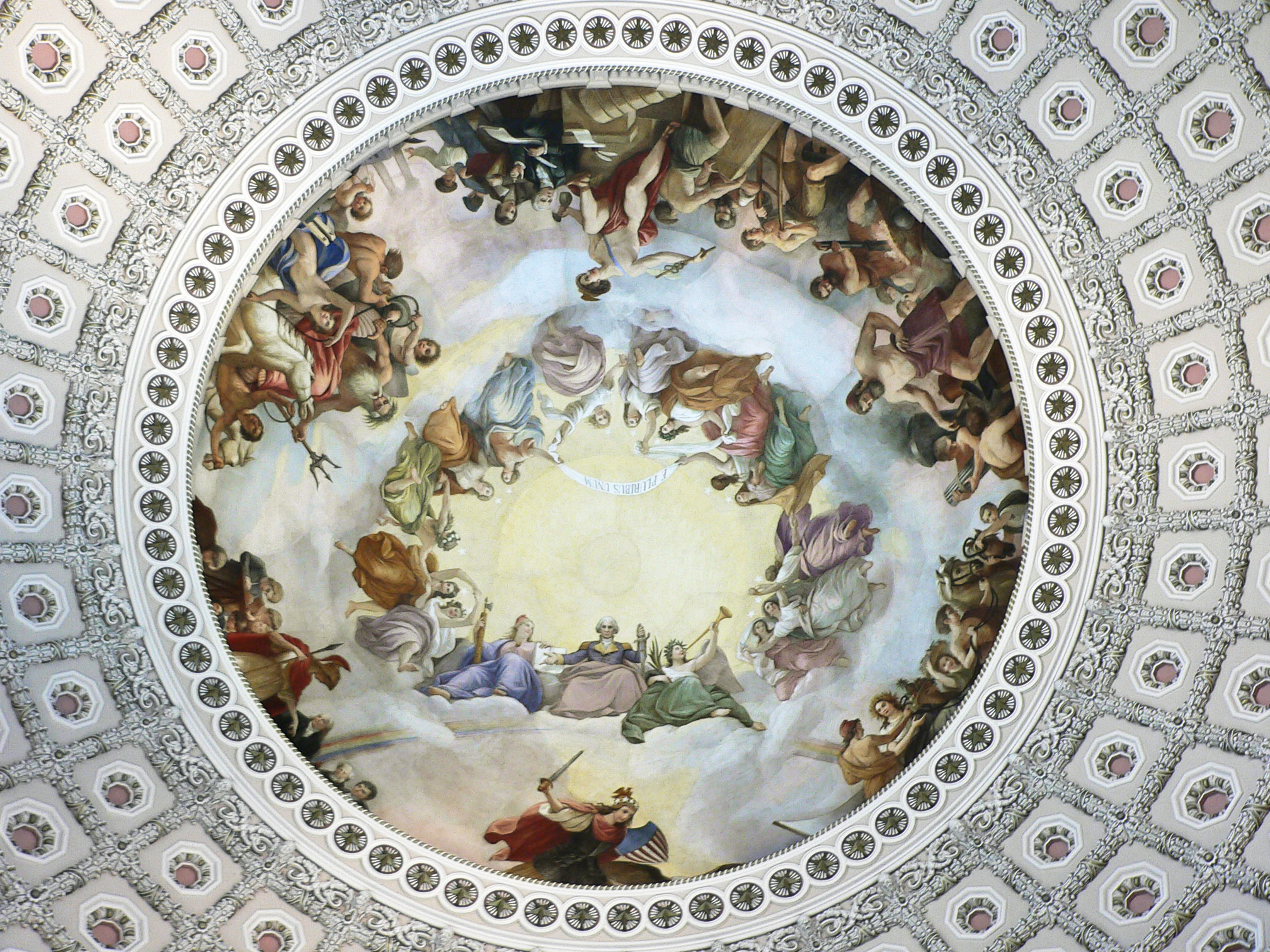 |
| The crypt under the Capitol Rotunda remains unfilled and no monumental statue ever erected, but Washington eventually was commemorated in the painting under the Dome known as the Apotheosis of Washington. |
Within days of his death, staunch Virginia Federalist John Marshall proposed creating a tomb for Washington under the Rotunda of the Capitol Building accompanied by a suitable statue of the great
man. Congress approved the proposal but
a shortage of funds and a reluctance of Washington’s heirs to move his body
amid political uncertainty delayed the project.
When the Jeffersonians came decisively to power after the Revolution of 1800, they promptly
killed the plan outright.
Other than the honor of having the
whole new Capitol city named for him, Washington was officially without a
memorial in the Federal District.
In the intervening years Washington’s
fans and the Federalists floated several proposals but their power and
influence were rapidly waning after the defeat of John Adams for a second term and the duel death
of the party’s Machiavellian leader
Hamilton.
Then the emergency of the War of 1812 interrupted any
progress. Worse for them, the secessionist plots by New England Federalists during the war,
finished the party as a national force.
By the so called Era of Good
Feelings ushered in with election of Democratic Republican James Monroe in 1816 the Federalists were just a feeble regional rump in New England and ever
there were only keeping the support of the educated commercial and religious
elite.
But old John Marshal, by now the Chief Justice of the Supreme Court,
never gave up his dream of a monument. A
revived interest in the Father of the
Country on the occasion of the 100th anniversary of his birth in 1832 gave
the old man the opportunity he was looking for.
He also benefited from the continuing popularity of Parson Weems’s 1800 spurious
biography of Washington—the one that invented such wild yarns as chopping down
the cherry tree, throwing a dollar across the Potomac, and the Vision at
Valley Forge. Peddlers sold cheaply
printed copies to the barely literate frontier farmers and urban poor who were
ordinarily Republicans helping to elevate the General to folk hero status even in the hearts of his enemies.
Marshal began circulating letters in
the hope of establishing a memorial association and obtaining support in
Congress for the erection of a monument.
Although he was able to get the support of old Federalists, the scheme
had no chance of getting crucial Congressional approval unless the Republicans
changed their spot.
Then in 1834 the ancient and infirm James Madison one of the heroes of the
Republican pantheon and Jefferson’s closest political associate, in a moment of
sentimental regard and genuine generosity, agreed to endorse his ancient foe
Marshal’s plans. The damn was broken and
other old Republicans, now known as Democrats,
followed suit. The Washington National Monument Society was formed and began to raise
money for the project.
By 1836 an impressive $28,000—about
$600,000 in modern currency—was raised and a design competition launch
specifying that the construction “…should blend stupendousness with elegance,
and be of such magnitude and beauty as to be an object of pride to the American
people, and of admiration to all who see it. Its material is intended to be
wholly American, and to be of marble and granite brought from each state, that
each state may participate in the glory of contributing material as well as in
funds to its construction.”
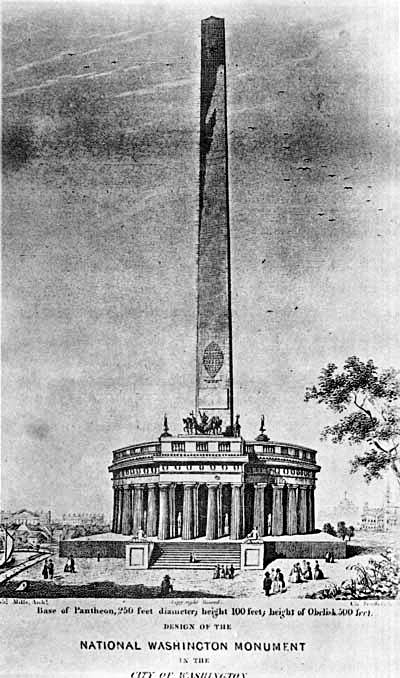 |
| The original design for the Monument. |
The winner of the competition, to no
one’s surprise was the recently appointed Architect
of the Capitol, Robert Mills who
had experience with monuments, including the design of an elegant one to
Washington in the city of Baltimore. Mills, by the way, was my mother’s maiden name so he might
possibly be some kind of ancestor to me.
Anyway, Mill’s plans were certainly
stupendous, elegant, and above all grand.
He proposed building an enormous nearly flat topped obelisk to be
surrounded circular colonnade with a statue of Washington as a charioteer over an elaborate entry
gate. Inside the ring would be 30
additional life size statues of Revolutionary heroes and notables.
It was apparent that far more than
the money they had at hand would be needed to bring this vision to life—over a
million dollars in fact. So the
Association returned to fund raising while starting construction of the obelisk
alone in the hopes that seeing it rise would bring further donations to finish
the whole project.
The original location was supposed
to be on a point originally
designated for an un-built equestrian statue of Washington authorized by the Continental Congress way back in 1783
in a line between the Executive Mansion
and the Capitol Building. But the marshy ground there proved to be far too
unstable to support the massive weight of the proposed structure. Eventually Congress designated a spot in what
is now called the National Mall for
the project.
After many delays, the Monument
Society finally began work on the foundation in the spring of 1844. And on July 4 of that year the corner stone was laid in Masonic ritual, of which Washington, the
Master Mason would no doubt have
approved.
Work went on steadily with the outer
walls sheathed in smooth light gray quarry stone and the interior with a
variety of marble, granite, limestone, and other blocks. For ten years it rose course by course until
the Society ran out of funds. Congress
agreed to contribute $200,000 toward the completion in 1854. But it also stipulated that cities, states,
and organizations be solicited to contribute memorial stones to be used in the
interior construction. The idea was both
to save money on building materials and to get the public engaged in the
completion of the monument.
At first the donation scheme seemed
to be working perfectly. Enormous
blocks, cut to rigid specifications, poured in from all directions in addition
to governmental bodies, organizations, including a Temperance society, churches, fraternal organizations and even
foreign governments sent stones. Then
disaster struck in the form of a stone sent as a gift from Pope Pious IX. This outraged
the ascendant Protestant
establishment and the American Party a/k/a
the rabidly anti-immigrant and anti-Catholic
Know Nothings, then at the height of
their brief moment in the sun of American history. Outraged, Know Nothing hooligans stole the
offending stone from the construction site and reportedly threw it into the
Potomac.
Worse, with the collusion of a
minority on the Society Board which called an illegal special election, the
Know Nothings wrestled control of the Society.
They hoped to use the prestige of Washington’s name to add patriotic
luster to their xenophobic and nativist program.
Disgusted by the turn of events,
Congress withdrew its support before a dime was ever spent.
The Know Nothings retained control
until 1858 by which time they had expired as a political force. During their tenure they did manage to add 13
courses, but the construction was so shoddy and sub-par—they would not use
highly skilled, mostly Catholic and immigrant stone masons—that those additions
had to be removed. When they finally
returned the Society’s books and papers to the legitimate board that year,
finances were in a shambles. Some of the
Know Nothings seem to have had very sticky fingers.
By that time sectional differences
were heating up to a frenzy leaving little room in the nation’s attentions to
raise funds for the completion of the project.
All the way through the Civil War
the Monument sat as stump less than a third of its intended height in a weedy
and over grown field, often surrounded by the encampments of soldiers.
It was not until well after the Civil
War that attention returned to the
monument with an eye on making it a symbol of national identity and
re-unification. After engineers
re-examined the ground and foundation to make sure that it could stand the
weight, Congress authorized a new $200,000 to resume construction in connection
the country’s Centennial observances
in 1876.
Mills, still Architect of the
Capitol, pressed for the completion of his original design. But skeptics believed it was far too
expensive and old fashion in design.
Many wanted to simply complete the obelisk. Others thought that it was to plain to honor
the First President. Mills complained
that the obelisk without the colonnade would look like a bare, “stalk of
asparagus.”
The society commissioned yet another
completion to complete a re-design.
Congress considered five designs in addition to retaining Mills’s
original. The winner was William Wetmore Story. He eliminated the colonnade and statue,
redesigned the base, and made the obelisk conform to classic Egyptian proportions crowned with a pyramidal rather than flat top. It emphasized the great height of the
structure, destined to be the tallest in the world, along with sleek, clean
lines, and almost Spartan simplicity.
Actual work on the project resumed
under the supervision of Lieutenant
Colonel Thomas Lincoln Casey of the U.S.
Army Corps of Engineers in 1879.
After first removing the shoddy work, he was unable to exactly match the
color of the original quarry stone. Above
the level abandoned in 1856, the stone blocks are slightly darker than the
originals. Casey, at the direction of
Congress, also found use in the interior for all of the dedication stones that
had littered the construction site for decades.
 |
| Setting the aluminum cap stone. |
Construction went quickly. In December 1884 a specially cast aluminum capstone was set on top
completing the pyramid top. Aluminum was
then rare and as expensive as silver.
Setting the cap with such a precious material captivated the interest of
the nation.
On that day in February a crowd
of 800 gathered for the formal
dedication and to listen to speeches by Ohio
Senator John Sherman, William Wilson
Corcoran Monument Society, Col. Casey, and President Chester Arthur. After the speeches Senator Sherman’s
brother, General William Tecumseh
Sherman led a procession of the dignitaries and the crowd, to the east main
entrance of the Capitol building, where the President reviewed passing
troops. The popular illustrated
national newspaper/magazines of the day captured the pomp in elegant
engravings.
The monument was a hit with the
public and an immediate tourist destination.
Even before it was officially opened to the public in 1888, thousand
flocked to laboriously climb the 897 steps and 50 landings to the top where they
could peer out of horizontal slit open windows and take in the Capitol and White House as well as all of the District of Columbia and far into
surrounding Virginia and Maryland. That number grew even further when a
freight elevator used during construction was converted for passenger use.
The setting of the Monument in the
National Mall was completed when the Lincoln
Memorial was constructed and dedicated on May 30, 1922 at the opposite end
of the long park from the Capitol Building and the completion of the Reflecting Pool a short time later.
In 1933 the Monuments and Mall came
under the direction of the National
Forest Service which manages, provides visitor services, and acts a police
force. Under its auspices, then first
restoration work on the monument was undertaken to seal material leaking from
between the heavy stones and clean the structure by sandblasting.
 |
| The Monument has often loomed over giant protests like this one against the Vietnam War. |
The iconic structure loomed over the
hundreds of thousands who gathered to hear Dr. Martin Luther King, Jr. gave his I
Have a Dream speech from the steps of the Lincoln Memorial in
1963. It also occasionally became the
focus of protests, most dramatically in 1983 when Norman Mayer took the monument hostage along with eight
tourists. He was protesting the nuclear
arms race and claimed he had large bomb in the van that he drove to the base of
the structure. During a stand-off
covered live on television, the tourists were allowed to evacuate unharmed
before Park Service police shot and killed Mayer. No bomb was found.
After a massive fundraising campaign
which included the soliciting of corporate sponsors including Target stores, a $5 million dollar
restoration was begun in 1996. A giant
scaffolding enclosed the exterior which was examined for cracks and damage, tuck pointing, and cleaning. The interior, which had suffered significant
damage from the humidity brought in by tens of thousands of visitors annually,
was also restored, although the historic stairway was closed to the public. Work last more than four years.
In 2004, after the 9/11 attacks, the Monument, considered
an attractive symbolic terrorist target, was closed again for another $15
million dollar upgrade, mostly to security systems, aircraft warning lights,
and new landscaping that would disguise barriers that would prevent the
approach of a bomb laden vehicle. The
monument itself reopened in April 2005 and the surrounding grounds were
reopened that August.
The monument received a one-two
punch in when the D.C. area was shaken by a rare earth quake followed a few days later with being slammed by the
high winds and driving rains of Hurricane
Irene. After the storm water was
discovered in the interior where it shouldn’t be and an exterior inspection
revealed significant cracks in the structure, especially to the pyramidal top. Large stones were also dislodged in the
interior. The monument was once again
closed to the public. After 32 months of repairs, the Park Service
and the Trust for the National Mall
reopened the Monument to visitors on May 12, 2014.
If
you go to Washington you can still see it rising magnificently against a clear
blue sky, if you are lucky, or illuminated and gleaming in the darkness. It’s is suitably awe inspiring. And yup, you’re gonna think of a phallus. You won’t be able to help yourself.
Subscribe to:
Posts (Atom)