Showing posts with label Revolution of 1800. Show all posts

Sunday, February 16, 2020

How Aaron Burr Almost Became President

They were supposed to be Democratic Republican running mates but ended up with a tie vote in the Electoral College throwing the race into the House of Representatives.
It was called the Revolution of 1800.  The Democratic-Republican ticket of Thomas Jefferson and Aaron Burr had crushed the re-election hopes of Federalist John Adams sweeping to a popular vote victory of 61.4% to 38.6 and carrying the Electoral College votes of 8 of the 15 states with a total of 73 to 65.  
Yet the election turned into a breathtaking cliff hanger that was finally decided February 17, 1801 when a tied vote in the House of Representatives was finally broken.  Here’s how it happened.  

Federalist incumbent President John Adams was clearly the looser in both the popular vote and the Electoral College but at least his party's electors remembered to withhold one vote to assure that Adams led the ticket.
The Constitution allowed each elector two votes, but only one for President.  It also did not clearly define who was at the top and who was second on the party tickets because it failed to predict the rise of political parties.   Both parties planned to have one elector either abstain from voting for the Vice President or cast a single ballot for an alternative candidate to make sure that the intended candidate would be elected President and the second as vice president.  And one Federalist elector did withhold his vote for Adam’s running mate Charles Pinckney of South Carolina.  
On the Republican side, something went amiss, however, with Jefferson and Burr both tied with 73 votes.  Historians still debate whether Burr had any role in arranging a tie or if he was the beneficiary of a happy—for him—accident.  
At any rate the election was thrown into the House, which was still in the hands of the Federalists.  Many Federalists, for whom Jefferson was a well-established boogey man, opted to cast their votes for Burr, who may—or may not—have encouraged them as he waited in New York.  
Although each Representative had a vote, the majority vote of each state’s delegation carried the state and each state had one vote.  An absolute majority of the states—9—were required for election.  From February 11 to February 17, the house held 35 votes. Each time the results were the same—8 states for Jefferson, 6 states for Burr, and two state delegations tied and unable to cast any vote.  
Maneuvering and secret negotiations on all sides was intense.  Finally Alexander Hamilton, the leader of the so-called Ultra Federalists who had sabotaged Adams’s chances with a scheme to replace him with Pinckney, chose to speak.  

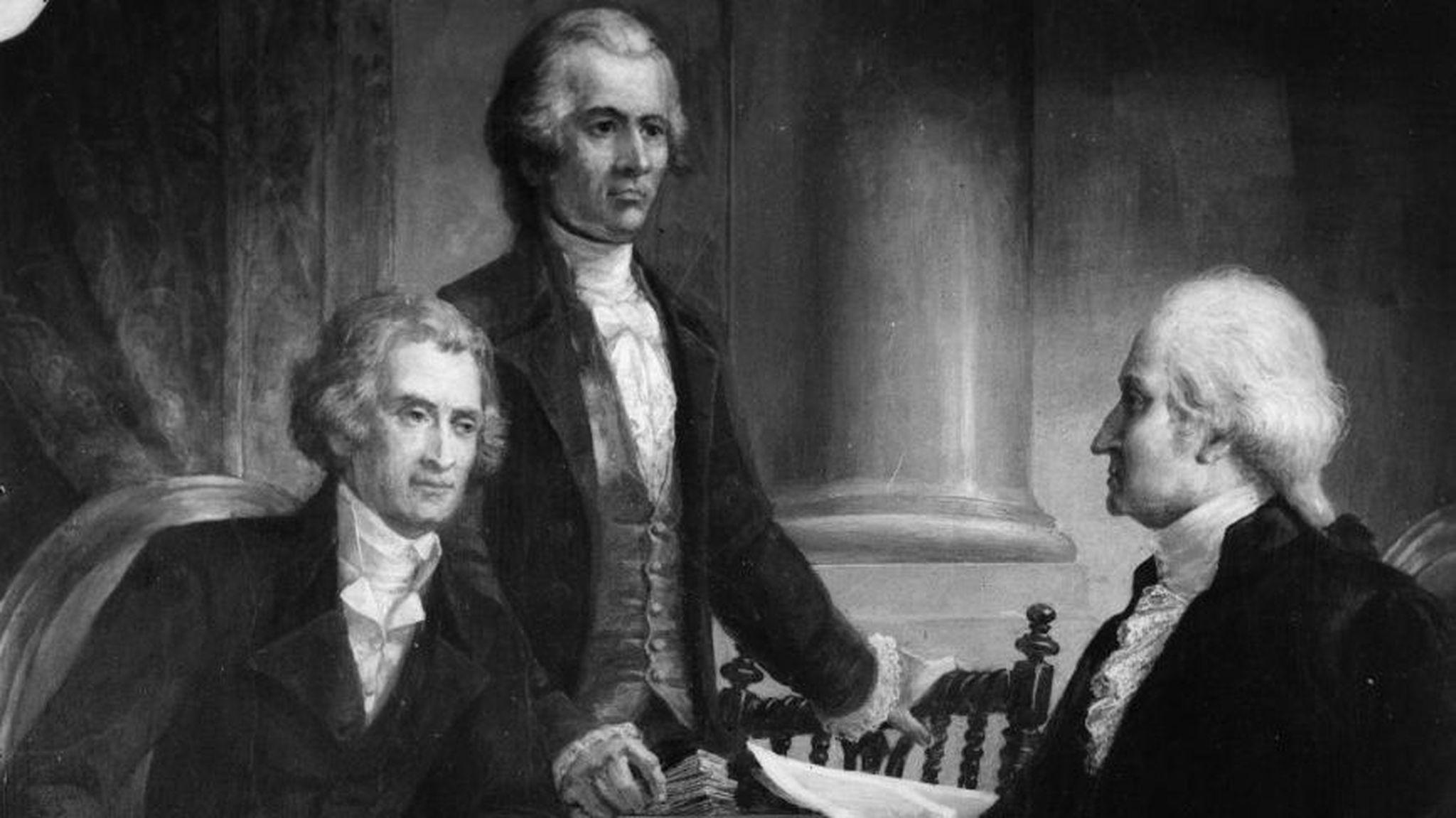
During the Washington administration rivals Secretary of State Thomas Jefferson and Secretary of the Treasury vied for the President's support and affection.  In the end, Hamilton won out and fathered the Federalist Party while Jefferson created the Democratic-Republicans.
Hamilton had been Jefferson’s implacable enemy when they were together in George Washington’s cabinet.  Hamilton was the father of the Federalists as Jefferson was the creator of the Republicans.  They had always been bitter rivals.  Yet Hamilton let it be known that he preferred Jefferson over Burr because “he is by far the less dangerous man,” than the Machiavellian Burr.  
Hamilton’s letters finally had an effect and on ballot number 36 Maryland and Vermont moved from the no result column to Jefferson while Delaware and South Carolina switched from Burr to no result.  Jefferson was finally elected President and Burr, Vice President.  
The Twelfth Amendment, which provided each elector must cast distinct votes for President and Vice President, was initiated and adopted to make sure that such a debacle would never happen again. 
Jefferson never trusted and came to detest Burr.  The Vice President, for his part tried to trade his tie-breaking vote in the Senate to the Federalists in exchange for certain favors and became involved in a bizarre plot to seize Texas from the Spanish and create an inland empire with break-away portions of the trans-Allegany west by also wresting control of New Orleans.  But that is yet another tantalizing tale.  
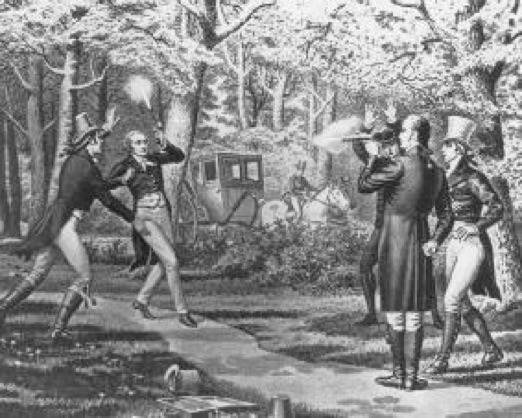
In the end, Burr would revenge himself on his nemesis Hamilton by killing him on the dueling field. 

Vice President Burr avenged himself on Hamilton by killing him in a duel.
After being acquitted of treason in the filibustering affair, the still disgraced Burr lived in Europe and Britain for some years always plotting either a political come-back or a new scheme to seize Texas.  Finally returning to New York, he often used the pseudonym Edwards to hide from his creditors.  After a stroke rendered him paralyzed, Burr died penniless on Staten Island in 1836.

More recently the American public became reacquainted with Burr thanks to being presented as the villain of the Broadway musical sensation Hamilton by Lin-Manuel Miranda.  He would probably have reveled in the attention.


Saturday, February 24, 2018

Sweet Irony—Conservative High Court Coup Enshrined Judicial Activism

The main dramatis personae of the 1801 Marbury v Madison case--Brand new Federalist Chief Justice and frormer Secretary to State for John Adams, John Marshall and his fellow Virginian and long-time political enemy Democratic Republican President Thomas Jefferson


On February 24, 1802 Chief Justice John Marshall handed President Thomas Jefferson a narrow political victory by asserting a power that Jefferson was convinced the Court did not have in the case of Marbury v. Madison.  
The details of the case were as convoluted and tiresome as Marshall’s hair-splitting decision.  Those of you who have not been tortured in first year Constitutional law will undoubtedly find it confusing
The case had its origins with John Adams’ famous “Midnight appointments” of judges aimed at packing the Federal bench with avowed Federalists before Jefferson and the new Democratic-Republican Congress could do anything about it.  The new Circuit Court judges and Federal justices of the peace appointed needed receipt of an official commission from the Secretary of State before taking office.  
Outgoing President John Adams precipitated the crisis by spending his last hour in office furiously making out  judicial appointments--the so-called Midnight Judges and the churlishly left town before his bitter enemy Jefferson's inauguration--the only sitting president ever to boycott the swearing in of his successo

John Marshall had been Adams’ Secretary of State before accepting appointment as Chief Justice and was still acting in that position in lieu of a new appointment.  He rushed as many certificates as possible to the new officers of the court, but he could not finish the job.  He left it to the incoming Secretary, James Madison to routinely process the rest of the documents.  But Jefferson believed that the unfulfilled appointments had expired with the Adams administration and directed that no action be taken on them.  
William Marbury, a prominent Maryland businessman and staunch Federalist did not receive his credentials as Justice of the Peace for the District of Columbia and, believing the job his legal due, sued Secretary of State Madison to compel him to issue his commission.  Meanwhile the new Congress overturned the Judiciary Act of 1801 under which Adams had acted and largely re-instated the previous Judiciary Act of 1789.  
The official litigants--Federalist judge wanna-be William Marbury and Jefferson's Secretary of State James Madison.

Marshall, now Chief Justice, did not recuse himself from hearing the case despite his personal involvement in the appointments. Instead the Federalist and sworn political enemy of Jefferson wrote the opinion in the case.  It was a doozy.  
First, he held that Marbury had a right to receive a legal appointment and suffered an injury for which there must be a judicial remedy.  So far it looked like Marshall was going to affirm the case and the old President’s authority to make the appointments.  
But then Marshall answered an unasked question:  did the Supreme Court have the authority to provide Marbury the remedy he sought through a writ of mandamus?  After examining the Article III of the Constitution which sets forth the power of the Supreme Court and the Judiciary Act of 1789, Marshall concluded that the Court does not have original jurisdiction over writs of mandamus and therefore had no power to issue an orderScore one for Jefferson who did not want to seat the judges.  
Then Marshall threw his best curve ball.  He declared that Section 13 of the Judiciary Act, which seemed to allow the court to take original jurisdiction, was at odds with the Constitution and therefore “unconstitutional and invalid.”  
A cartoon that sums up what Marshall did.
The results:  Marbury didn’t get his job, Jefferson wasn’t stuck with judges he didn’t want, and the Court had boldly asserted co-equal power with the Executive and Legislative branches of government and indeed had the power to overturn actions by either or both of the others when those actions were unconstitutional. 
The expansion of judicial power appalled and frightened Jefferson who believed that moneyed interests would always control the Court and stymie democracy.  
Thus began the judicial activism which modern Conservatives so abhor—except when that activism advances their own ideology.  
Lawyers, law students, and pettifoggers among my readers are invited to tear my summery of the case to pieces.  I’m sure they will be right.


Wednesday, February 17, 2016

Aaron Burr—President in Bizzaro World

1800 Democratic-Republican running mates Aaron Burr and party leader Thomas Jefferson ended up contesting a long series of tie votes in the House of Representatives after a Constitutional Quirk sent the decision there despite a landslide win over John Adams and the Federalists.


It was called The Revolution of 1800.  The Democratic-Republican ticket of Thomas Jefferson and Aaron Burr had crushed the re-election hopes of Federalist John Adams sweeping to a popular vote victory of 61.4% to 38.6 and carrying the Electoral College votes of 8 of the 15 states with a total of 73 to 65.  
Odd man out President John Adams.
Yet the election turned into a breathtaking cliff hanger that was finally decided February 17, 1801 when a tied vote in the House of Representatives was finally broken.  Here’s how it happened. 
The Constitution allowed each elector two votes, but only one for President.  It also did not clearly define who was at the top and who was second on the party tickets because it failed to predict the rise of political parties.   Both parties planned to have one elector either abstain from voting for the Vice President or cast a single ballot for an alternative candidate.  And one Federalist elector did cast his vote for South Carolina’s Charles Pinckney. 
On the Republican side, something went amiss, however, with Jefferson and Burr both tied with 73 votes.  Historians still debate whether Burr had any role in arranging a tie or if he was the beneficiary of a happy—for him—accident. 
At any rate the election was thrown into the House, which was still in the hands of the Federalists.  Many Federalists, for whom Jefferson was a well-established boogey man, opted to cast their votes for Burr, who may—or may not—have encouraged them as he waited in New York. 
Although each Representative had a vote, the majority vote of each state’s delegation carried the state and each state had one vote.  An absolute majority of the states—9—were required for election.  From February 11 to February 17, the house held 35 votes. Each time the results were the same—8 states for Jefferson, 6 states for Burr, and two state delegations tied and unable to cast any vote.  
Maneuvering and secret negotiations on all sides was intense.  Finally Alexander Hamilton, the leader of the so-called Ultra Federalists who had sabotaged Adams’s chances with a scheme to replace him with Pinckney, chose to speak.  

The founders of their respective political parties, Secretary of State Thomas Jefferson and Secretary of the Treasury Alexander Hamilton were bitter rivals in President George Washington's Cabinet.
Hamilton had been Jefferson’s implacable enemy when they were together in George Washington’s cabinet.  Hamilton was the father of the Federalists as Jefferson was the creator of the Republicans.  They had always been bitter rivals.  Yet Hamilton let it be known that he preferred Jefferson over Burr because “he is by far the less dangerous man,” than the Machiavellian Burr. 
Hamilton’s letters finally had an effect and on ballot number 36 Maryland and Vermont moved from the no result column to Jefferson while Delaware and South Carolina switched from Burr to no result.  Jefferson was finally elected President and Burr, Vice President. 
The Twelfth Amendment, which provided each elector must cast distinct votes for President and Vice President, was initiated and adopted to make sure that such a debacle would never happen again.
Jefferson never trusted and came to detest Burr.  The Vice President, for his part tried to trade his tie-breaking vote in the Senate to the Federalists in exchange for certain favors and became involved in a bizarre plot to seize Texas from the Spanish and create an inland empire with break-away portions of the trans-Allegheny west by also wresting control of New Orleans.  But that is yet another tantalizing tale.  

Sitting Vice President Burr plugged the meddling Hamilton on the dueling grounds at Weehawken, New Jersey. 
In the end, Burr would revenge himself on his nemesis Hamilton by killing him on the dueling field. 
After being acquitted of treason in the filibustering affair, the still disgraced Burr lived in Europe and Britain for some years always plotting either a political come-back or a new scheme to seize Texas.  Finally returning to New York, he often used the pseudonym Edwards to hide from his creditors.  After a stroke rendered him paralyzed, Burr died penniless on Staten Island in 1836.