 |
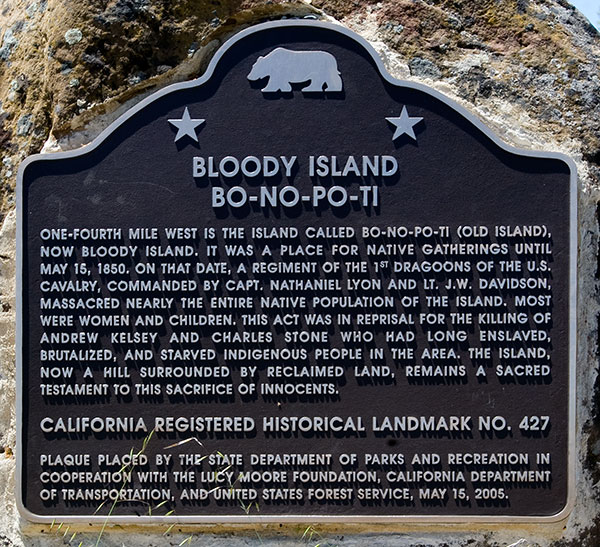
| It is a testament to the obscurity of the the Massacre at Bloody Island that not a single illustration of the battle could be found. It is almost as if it never happened. All that could be found was a grainy photograph of the island--now a mound on a dried lake bed surrounded by crops--and this photo of the marker finally put in place in 2002 to commemorate the aromaticity. And it still got Lt. Lyon's rank wrong and the fact he led only a portion of a company, not the entire Regiment in the action. |
May
15, 1850 was a very bad day for the Pomo,
a Native American people from
northern California that you have
probably never heard of. Because no one
wants to talk about them, or what happened that gruesome day when Lt. Nathaniel Lyon led troopers of the U.S. First Dragoons Regiment, against a
village on an island in Clear Lake. Sketchy and contradictory accounts claim that
between 100 and 400 mostly women, children, and old men were killed and another
50 or more were run down and slaughtered as they tried to escape along the Russian River.
Of
course massacres of Native villages were not even then something new. They were, you should pardon the expression,
as American as apple pie. And before the
first protest, let me acknowledge that there were also massacres of white settlers committed by various
tribes. What should probably be called
the 400 year long War of the Conquest of
North America was brutal and terrible—a conquering people on one side and a
desperate, doomed defense on the other, quarter not asked and seldom
given.
The
trouble is after all these years, even after school textbooks have taken a more
sympathetic view of the native resistance,
popular culture has kept the memories of hair-raising, bloody Red savages committing unspeakable
atrocities on nice settler women in gingham
and sunbonnets and their
innocent, adorable blond children alive and well. Burning villages and troopers tossing papooses on their saber tips, not so much.
And
it is also important to remember that the cycle of massacre and mayhem
generally started with the invader/settlers.
Way back in 1637 in the Pequot
War, English colonists and Mohegan
and Narragansett allies, launched a
night attack on a large Pequot village on the Mystic River in present-day Connecticut,
where they burned the inhabitants in their homes and killed all survivors, for
total fatalities of about 600–700. And
the village that was attacked had not even been involved in the minor
depredations in Massachusetts Bay
which started the war.
That
also started a pattern. White militia
and later regular troops could not tell “good Indians” from “Bad Indians.” They all looked alike to them, and frankly
they did not give a damn. Time after
time peaceful bands, even allies, were attacked and brutalized because they
were easy to find and at hand. Notable
instances include the massacre of the Praying
Indians—a village of Lenape (a/k/a
Delaware) who had been converted by pacifist Moravian missionaries—by Pennsylvania Militia in 1782 and the
infamous Sand Creek Massacre by the Colorado Volunteer Cavalry who attacked
an massacred Black Kettle’s peaceful
Cheyenne who were flying an American flag in 1864. The Bloody River Massacre, as we shall see,
fit into the same familiar pattern.
Since
native warriors were notoriously hard for militias or Army troops to engage “in the field”—they tended to break up into
small groups after raids and melt into whatever wilderness was
available—settler troops early on began seeking out villages which, even if
“hostile” were usually empty of warriors.
That became pretty much standard U.S. Army operational tactics in the Indian warfare after General William Henry Harrison and his
troops pushed deep into Shawnee territory
to attack Prophetstown, seat of Tecumseh’s and the Shawnee Prophet Tenskwatawa’s confederacy. The idea was to
disrupt the food supply of the tribes and to force them to come to the defense
of their homes. After destroying several
impotent villages, Harrison finally fell upon the main camp of hostiles
defending Prophetstown and decisively whooped them at the Battle of
Tippecanoe. After that searches and
attacks on villages became standard operating procedure. Again, the hapless Pomo fell victim to the
same strategy.
The Pomo had one of the most unfortunate of
histories. At the dawn of the 19th
Century it is estimated about 10,000 of the loosely related peoples now
lumped together as Pomo lived in a broad swath of northern California as hunter/gatherers
and fishers who also traded with neighboring tribes for items using
the magnesium rich red clay of the region which was used in
making beads, dyes, and face paint. Not
politically united, they lived in small bands or clans and spoke 7 related, but
mutually unintelligible.
They had largely escaped the slavery and misery of
the Mission Indian further south.
But as Europeans pressed more deeply into north, they came under
pressure. They were attacked by Russian
fur traders who wanted to force them to abandon their traditional hunting
and fishing to trap for trade goods.
Then the Dons of California began to arrive with pieces of paper
from a far off king giving them huge land grants.
Without central leadership and lacking a well-developed
warrior culture the Pomo around the Big Valley Region and Clear Lake,
were easily turned into semi-enslaved peons on Salvador Vallejo’s vast
1844 grant from Mexico, Rancho Lupyomi. The men were turned into vaqueros as
Vallejo and his brother introduced beef cattle to the range. Women were discouraged from traditional
fishing and foraging and some were turned into house servants. Life was hard, and punishments cruel, but it
was about to get worse. Much worse.
That same year American settlers aided by explorer
and U.S. Army Captain John C. Frémont acting on his own authority
established the Bear Flag Republic. Meanwhile
the United States and Mexico went to war.
Commodore David Stockton and the Pacific Squadron arrived
to claim California and General Stephen Kearny led 150 Dragoons overland
from Kansas via Santa Fe, New Mexico. After several battles with the Californios,
California was secured and later ceded by Mexico to the U.S. in the treaty
of Treaty of Guadalupe Hidalgo.
Under the circumstances American settlers Andrew
Kelsey and Charles Stone were able to force a purchased a large
number of Vallejo’s cattle and established a ranchero of their own in
1847. With a handful of hired men, they
raided Pomo villages, rounded up men women and children, and made them build a stockade
in which to imprison themselves. All
arms, down to simple knives and hatchets, as well as fishing gear were
confiscated. With their wives and
children held hostage, the men were once again used as vaqueros—and in back
breaking labor building the grand hacienda and outbuildings, digging
wells, erecting fencing, and other work.
Women and girls were called to the house as sex slaves for the masters
and beaten, sometimes to death if they resisted.
Rations for the enslaved Pomo were four cups of
crudely milled flour a day—no meat or protein. It was hardly enough to survive
on and soon many were dying of starvation and disease. Then, things got even worse.
In 1849 Kelsey took 50 of the Pomo men as laborers on
expedition to the new gold fields to try back breaking placer
mining. Kelsey got sick. His claim did not produce and in desperation
he sold all of his slave’s rations to other miners. Most of the Pomo starved to death and only
two made it back with Kelsey.
The remaining Pomo at the hacienda were becoming
desperate. Under the leadership of Chief
Augustine two of the men stole Stone’s horse in an attempt to kill a cow
and smuggle the meat back to the stockade.
But in a thunderstorm, Stone’s horse ran off. Knowing that the enraged Stone would wreck vengeance,
horrible vengeance, Augustine had his wife, a maid in the hacienda, pour water
on all of Kelsey and Stone’s gunpowder rendering it useless. At dawn the men armed only with a handful of
hastily made and crude bows, cudgels, farm tools, and stones attacked the house
in force. Kelsey quickly fell with an
arrow and died. Stone tried to escape by
a window and to run for cover. It is
said that Augustine personally found him and crushed his head with a rock.
The Pomo knew there would be trouble. They hastily gathered all of the provisions
they could carry, rounded up the families, and fled north hoping to join up
with other Pomo bands.
Word of the killing quickly reached a U.S. garrison
Lt. Lyons set out in pursuit. He got
word of a large Pomo fishing camp on an island known to the Indians as Badon-napo-ti
(Island Village), at the north end of Clear Lake. Lyons assumed the fugitive Pomo had headed
there. He was wrong, those Pomo steered
clear of the lake as they made a dash north towards Oregon Territory. The Pomo on the island did not even speak
the same language and were, as far as they knew, at peace with the United
States. Most were Habematolel Pomo of Upper Lake and from a band
from the Robinson Rancheria. Most
able bodied men were off hunting in the north leaving the fishing and drying of
the catch to their women and children.
When Lyon arrived on the scene he recognized that
the Island afforded the Indians some natural protection. He quickly sent to the Arsenal at Benicia
where he obtained two small brass field guns and two whale boats that
were hauled overland. Outfitting the
boats with the cannon in the prow, he launched them in secret from the southern
shore of the lake. Meanwhile highly
undisciplined mounted militia joined his Dragoons.
On the morning of the attack Lyon opened fire on the
village from the boats attacking the south end of the island. That naturally sent the inhabitants of the
camp stampeding in a panic to the north of the island where they were cut down
by musket fire from the wooded shore.
The cavalry then splashed across the shallow water and began cutting
down everyone they encountered with saber slashes. Babies and small children were bayonetted
by dismounted troops and their bodies thrown into the water.
The Army encountered virtually no resistance. Lyon reported three light injuries. Almost every living person on the island was
killed. Many of those who tried to
escape in the water were shot as they swam or drown. A few made it to shore and a desperate run
for safety.
One six year old girl, Ni’ka managed to
escape the slaughter by hiding under the water and breathing through tulle
reed. Later known as Lucy More
she became a folk hero to her people and her descendants continue to work to
memorialize the massacre.
Lyon ordered his men to pursue the escapees and as
noted over the next few days they hunted down and killed about 50
survivors. A general war against all
native people in the north continued for month with members of any and all
tribes ruthlessly killed whenever they were encountered. Large numbers of usually drunken Militia did
most of this dirty work, but the Dragoons also participated.
Lyon, already cited for bravery in the Mexican
War for capturing enemy cannon in the Battle for Mexico City, was
proclaimed a hero all over again and his advancement in the Army was
assured. He was soon sent to Bloody
Kansas where conflicts with Missouri Border Ruffians made him an
ardent anti-slavery man and loyal Republican. In 1861 as commander of the St. Louis
Armory, he kept the powder and weapons there out of the hands of the pro-Confederate
state government, secretly armed Republican Wide Awake militia, and
attacked Governor’s Jackson’s camp, marching his prisoners through St.
Louis. He also ordered his troops to
fire on rioting southern sympathizers killing 75.
For his ruthless efficiency, Lyon was promoted to Brigadier
General and made Commander of the Department of the West, relieving the incompetent
but politically well-connected John C. Frémont.
Lyon at the head of Federal regulars and four quickly mustered and armed
regiments of loyal Unionist Missouri Volunteers pursued Jackson and his
troops across the state. After forcing
the Rebels out of the capital of Jefferson City, he beat them at the Battle
of Booneville, forcing them to retreat to the southwest.
On August 10, 1861 he caught up to the force of the
Missouri Militia and Confederate troops under the command of Ben McCulloch
near Springfield at the Battle of Wilson’s Creek. Lyon was killed
during the battle while trying to rally his outnumbered soldiers. Although the battle
was a technical Confederate victory, it broke the power of the south to operate
conventional forces in the state and kept Missouri in the Union. That made Lyon
one of the first great martyr heroes of the Union.
Keeping the noble hero’s reputation untarnished only
partly explains how the Massacre at Bloody Island was quickly stripped from
California’s collective memory.
As for the scattered Pomo survivors of the nasty
little war, they lived on in small bands, many of them back in virtual slavery
to local rancheros. Later, despite pleas
for a unified reservation with enough land to hunt and fish, the local bands
were assigned small Rancherias on marginal land. They were among the poorest of California
Indians, and that is saying a lot. They
survived on the tiny plots through much of the 20th Century but current
policy aims to move them to urban areas.
As for the battle ground, Clear Lake was drained and
“reclaimed” for agriculture in the 1930’s.
The island is now a mound rising from the dusty lake bed. It is a California State Park. In 1942 an outfit called the Native Sons
of the Golden West erected a historical marker a third of a mile off
of U.S. Highway 20 noting that it was the site of a Battle between
Cavalry under “Captain” Lyon and Indians under Chief Augustine. It attracted few visitors as the entire
episode goes unmentioned in California history texts.
Just to set matters straight, however, a second
plaque was erected in 2005 by the Department of Parks and Recreation and
the Lucy Moore Foundation, telling the story in greater, and more
accurate detail.


