
Cubs haters, most of whom
are devotees of Chicago’s junior team, take unending
delight in pointing out that the National
League team has not won a World
Series since 1908, 107 years ago.
Not that Cub fans are not excruciatingly aware of the long dry spell. But we are a devoted and patient bunch
given equally to eternal optimism and
resignation. Hey, it’s not like we never got
close. Besides we agree with the late Jack Brickhouse that “any team can have
a bad century.” And most of us are too damned nice to remind Sox
fans that while we have not won in a while, at least our boys never
actually threw the World Series and
nearly destroyed baseball. And anyway teasing about the drought is easier to swallow than
hearing more crap about the ridiculous Curse of the Goat.
Ah,
but this year the sweet smell of
ultimate victory is once again in
the air. Manager Joe Maddon has taken a down-on-its-luck-team
with a smattering of promising young
players, and turned it into the well
rounded contender that finished the 2016 regular season with the third
best record in all Baseball—better than the leader of every other division
in both leagues. They have already dispatched one team ahead of them in the
super-competitive National League
Central, the Pittsburg Pirates and
now seem have done the same to perennial
NL power house the St. Louis
Cardinals who had a 100 win season. Now it is on to the NL Championship Series and quite likely another birth in the Fall Classic.
We
can now dare to dream anyway. And we can draw inspiration from those long-ago Cubs who last won it all on October
14, 1908.
That
1908 team also had its roots as a frisky young team, albeit one which had
matured into a dominating team that looked to become a dynasty. After sitting atop
the National League for most of the professional league’s early years as the Chicago White Stockings, the team had a
run of hard years and ran through a variety of informal monikers including the Colts
and the Orphans.
Back
in 1902 new owner James Hart had begun to assemble a talented young team around
their infielders and pitching. The Daily News took to calling the
Orphans the Cubs because of their youthfulness.
In 1905 the anchor of the
famous double-play combo Tinkers to Evans to Chance, Frank Chance, took over as player manager and threw the renaissance
into high gear with more
acquisitions, especially the dominating
pitcher Mordecai “Three Finger “Brown. In 1907 the team officially adopted the nickname Cubs and won the World
Series. The Cubs won four pennants and two World Series
titles over a five-year span.
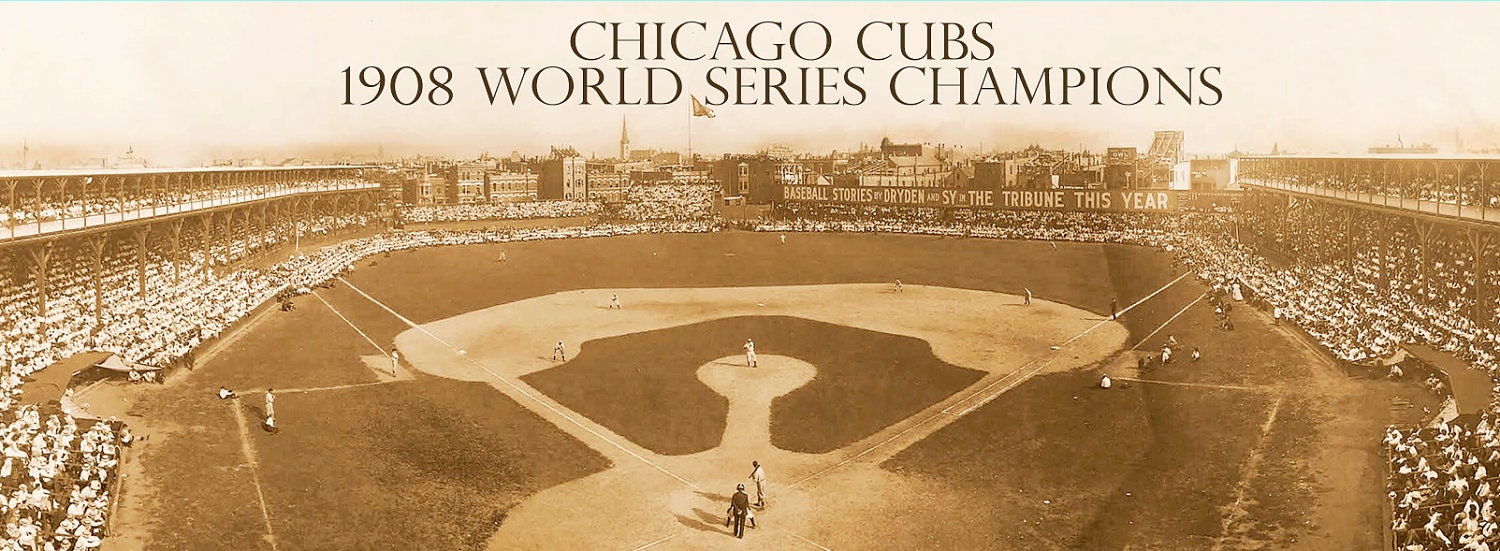 |
| Game 3 at the West Side Grounds did fill the stands, but was not the sell out ownership had hopped. Note the nearly empty spaces marked out for on-field seating marked out by lines along the left and right field stands and in foul territory between the bases. |
They
claimed their first championship that
year. In 1908 they were back and
confident. It turned out to be a legendary season. The Cubs took the National League lead on
June 30 when Mordechai Brown blanked the Pittsburg
Pirates. The Pirates were nipping at
the Cub’s heels the rest of the season.
On September 26, Ed Reulbach
became the only pitcher in Major League Baseball history to pitch two shutouts
on the same day completing both ends of a doubleheader
against the Brooklyn Dodgers and
walking away with 5–0 and 3–0 victories.
Just
like this year’s NL Central, by August three teams were dominating the National
League leaving the others far behind in their dust and running neck-an-neck in
piling up victories.
Late
in the season the Cubs and New York
Giants were tied for first place when they played each other on September
23, just three days before the Reulbach twin
bill, they met at the Polo Grounds. The game was a 1-1 tie in the bottom of
the 9th inning with two outs and one man on base when Fred Merkel, the youngest player in the League and in the starting line-up for the first time,
came to bat. He singled and the runner at first advanced to third. Shortstop
Al Bridewell was up next and connected with a presumed single that sent the
man on third racing to the plate.
Merkel, believing the game was won, began trotting off the field without
touching second base or tagging up on first.
Johnny Evers realized the
mistake and got an outfielder to toss the ball into second as delirious fans swarmed the field. Umpires
were unsure if the ball used was the actual ball—some thought it had been
tossed into the stands by a Giant’s player or one that had been tossed in from
the Cubs dugout. But unable to clear the field of fans and
with darkness closing in, they
decreed Merkel out and called the game over as a tie.
Merkel’s Boner would have
fateful consequences for the Giants. The
season ended with the two teams in a tie with identical 98-55 records and the
Pirates one game behind. They were
forced to meet for a one game playoff at the Polo Ground on October 8. The Cubs won 4-2 and advanced to meet the Detroit Tigers, American League Champions.
This was a rematch, the first in World Series
History. The teams had met in 1907 when
the Tigers, led by the vicious but supremely talented Ty Cobb, regarded by
many as the greatest all-around player in
MLB history despite his character flaws,
had under performed. After a first game
3-3 tie in 12 innings which was called because of darkness, the Cubs went on to
sweep the next four games.
In 1908 the Tigers, like the Cubs, were in a tight,
dramatic pennant race to the very end.
They finished the regular season just half a game in front of the Cleveland Naps—the teams had identical
win records but Detroit played and lost one game fewer.
Despite the obvious drama of a rematch between the
two best teams in baseball, the Championship Series was something of an anti-climax. The post season series between league
champions was still in its relative
infancy. The first games had been
held in 1903 and the following year the American League had boycotted the contest. Many fans still considered the Series a gimmick to enrich the owners, who were less popular then than they are now. Winning a League Pennant was more prestigious in the eyes of many.
Attendance for the games at the Cubs’ dilapidated West Side Grounds and Detroit’s Bennet Park was the lowest in the history of the Series. There was miserable weather in Detroit and a massive ticket scalping scandal in Chicago, which some suspected Cubs ownership was complicit in. Some newspapers had called for a fan boycott of the Chicago games. Evidently it worked because attendance to Series games was a miserable. The final game was played to a more than half-empty house in front of only 6,210 fans. Contrast that with the huge crowds in and around Wrigley Field last night when the team advanced to the NLCS.
 |
| Player/managers Frank Chance and Hugh Jennings meet with the two umpires assigned to a game at the West Side Grounds. |
Cobb and the Tigers were in better form this year, but the results were
not much different. Cubs pitching
dominated most games. And in the dead ball era when balls were hit out of stadiums less frequently
than a blue
moon, the Cubs excelled at small ball—slapping
singles, taking walks, forcing errors, and stealing
bases.
In the first game on October 10 at Bennett Park, the Cubs came from
behind in the 9th inning with six straight one-out singles scoring 5 runs for a final victory of 10-6.
The
second game at the West Side Grounds was a scoreless pitching duel into the 8th
when Joe Tinker’s rare two-run homer launched a six-run Cub outburst. The Tigers were able to spoil a shutout for pitcher Orval
Overall by pushing one run across. The Cubs pulled ahead two games on a 6-1
final score.
Back
on the West Side, the Tigers finally got back in the series on the strength of
an offensive outburst by Cobb—the best post-season game he would ever
have. He hit three singles and a double in five at bats and stole two
bases with his famous sharpened spikes slashing
high. He was finally thrown out trying to steal home in the 9th. The Cubs went down 8-3.
Back
at Bennett Park Mordechai Brown through a complete game shutout and the Cubs
took game four 3-0.e
Not
to be out done on Monday, October 14 Overall pitched his own shut out. It was the first game in Series history in
which neither team committed an
error. The Cubs won 2-0 and walked
away World Champions for the second consecutive year.

A little gloating was in order as in this souvenir post card from the previous year.

They
had completely dominated their AL rivals out-scoring
them a total of 24 to 15 runs and out hitting them 48-33. Besides dominating pitching from Brown and
Overall, the Cubs were nearly flawless in the field with only two error’s to
Detroit’s nine.
It
was not quite the end of the Cub’s dominance.
They would go on to play in the Series in 1910, 1918, 1929, 1932, 1935,
1938, and 1945 but come up short every time.
Their last appearance in 1945 when both clubs fielded wartime teams of cripples, the walking
wounded, 4-Fs, old-timers, and kids as yet unfamiliar with razors, was
also against the Tigers.
Loyal
Cub fans, among whom I am proud to include myself, now wait eagerly to return
to the Fall Classic and win it all.


