Showing posts with label U.S. Cavalry. Show all posts

Wednesday, March 15, 2023

Black Jack Pershing and the Futile Chase of the Last Cavalry Campaign


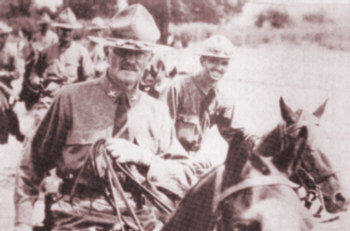
General John J. "Blackjack" Pershing leads his Punitive Expeditionary Force across the Rio Grande and into Mexico.

fools errand.  That’s what General John J. “Blackjack Pershing was sent on by President Woodrow Wilson.  On March 15, 1916 the General rode off at the head of about 12,000 troops of the Punitive Expeditionary Force on a mission to find and destroy Pancho Villa and his rebel army in Mexico

Doroteo Arango, alias Francisco PanchoVilla, was born in 1877 in San Juan del Rio, the State of Durango in Northern Mexico.  He was an outlaw by 16 and the head of his own gang of banditos shortly after.  Because he frequently clashed with the forces of the hated dictator Porforio Díaz, he began to be regarded as a folk hero by the dispossessed and landless peons of his home state. 

When the Mexican Revolution installed democratic hero Francisco Madero as President, Villa offered his services to battle a turncoat Revolutionary commander Pascual Orozco.  He led his División del Norte in the defense of the President he actually deeply admired.  He fought alongside another general, the ambitious Victoriano Huerta.  Huerta, however betrayed him and almost succeeded in having him executed.  

Pancho Villa and his Division del Norte from a 1914 Monarch newsreel.

Madero commuted Villa’s from his death sentence, but allowed him to be put in prison, from which he soon escaped.  Huerta went on to betray Madero as well, seizing power with the connivance of the nephew of Porforio Díaz and the U.S. Ambassador. Madero was executed

Villa in the North, Emiliano Zapata in the South and other generals rallied to Venustiano Carranzas plan to restore the revolution

The colorful Villa invited American film crews to cover his battles.  He invented new tactics, particularly the use of the armored train and specialized in lightening cavalry assaults. He secured the State of Chihuahua and was appointed Provisional Governor

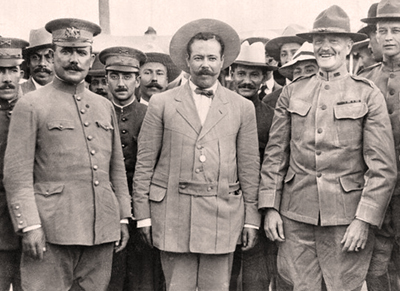
Better times--Revolutionary generals Obregon and Villa and their staffs with Pershing at Fort Bliss, Texas.  The tall young officer behind Pershing is Lt. George Patton in what may have been an early photo bomb.

His campaigns were admired by U.S. Army officers who studied them closely and he was even invited to visit Ft. Bliss to meet with Pershing and his staff

Villa turned his army south in a drive to the capital.  After victories against Federal forces at Gómez Palacio and Torreón, Carranza ordered Villa to divert his division from the drive on Mexico City to allow rival generals to enter the capital first.  Despite the snub Villa attacked the last major Federal stronghold in the north, Zacatecas finally forcing Huerta to leave for exile in July 1914. 

After Carranza defied Villa, Zapata and other revolutionary generals who had hoped for a democracy by assuming dictatorial power, Villa went back into rebellion. 

At first he believed that the United States would back him.  Instead, the Wilson administration threw its support behind Carranza.  Outraged, Villa began plotting ways to force the Americans to enter the war on the side of Carranza, which he believed would lead to an even wider popular uprising

He attacked and killed 16 American mining engineers hired by the Carranza government to reopen the vast silver mines of the north.  When that failed to get Wilson to act, he launched an audacious attack on a small cavalry garrison at Columbus, New Mexico.  He also burned and looted the town killing several civilians then rode east attacking isolated targets in Texas before re-crossing the Río Grande. 

That left Wilson no choice but to order Pershing’s intervention at the reluctant invitation” of the Carranza regime.  By the time Pershing crossed the border Villa was several days ahead and melted his forces into the rugged mountains.  Pershing’s forces were primarily cavalry.  In fact, this would be the last great campaign of the U.S. Cavalry, but it also included motorized units and a Signal Corps air arm, both for the first time in American military history

The fragile Jenny biplanes actually dropped some bombs by hand on Villista stragglers, but harsh conditions and inexperienced pilots put the air arm out of commission within weeks. 

Despite dividing into two columns, Pershing could never make contact with Villa’s main force.  They simply melted away.  There were several small skirmishes, including a little engagement that made a popular hero out of young Lt. George SPatton.  

The charge of the 11th Cavalry at Ojos Azules.

When Villa tricked Pershing’s troops into an attack on Carranza forces, the President was compelled by popular outrage to demand the withdrawal of American troops.  There was even talk about full war between the countries and the Georgia National Guard had to be mobilized to take up defensive positions along the Río Grande in Texas. 

Wilson had enough and he needed his Army back for the looming war in Europe.  He ordered Pershing’s recall in January 1917.  Despite never capturing or engaging Villa, Pershing declared victory

The Mexican people, delighted to see the Yankees gone, proclaimed Villa the victor and hero.  But his military power was broken.  After a few years of fruitless campaigning, he finally negotiated his retirement and was rewarded with a hacienda in Chihuahua.  But the government feared he might return to his old ways.  

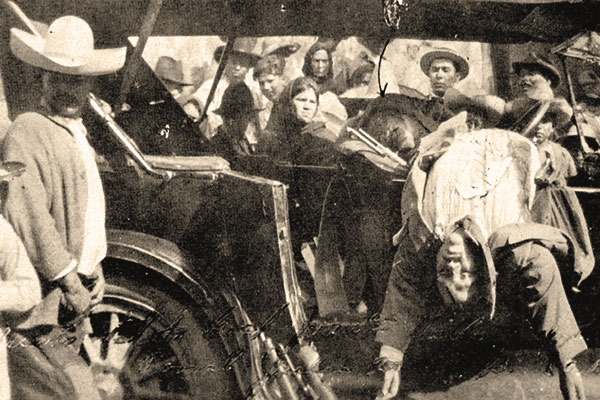
The body of Pancho Villa in his bullet ridden Dodge touring car.  As he was dying his last words were "Tell them I said something important."

On July 20, 1923 Villa was cut down with his bodyguards in a fusillade of rifle fire while riding in his Dodge touring car.  His Mexican enemies finally accomplished by Black Jack Pershing could not.


Thursday, March 1, 2018

Yellowstone Park Birthday Party Dimmed byThreats

The Old Faithful geyser is the enduring and iconic image associated with Yellowstone National Park in images like this classic Art Deco style National Park Service poster.


Today is a milestone in conservation/preservation history, one with deep personal connections for me.  On March 1, 1872 President Ulysses S. Grant signed into law the act creating Yellowstone National Park.  It was the first National Park not only in the U.S. but in the world. It became a model for conservation and habitat protection as well as an example of the huge economic impact on local economies such parks could provide.
The future of the Park, and other public lands especially in the West are in jeopardy as a radical movement to return Federal land to the states or be put up for sale for grazing, lumbering, and mineral exploitation gains steam.  That once fringe idea promoted by Randist Libertarians and Western militia groups was endorsed by the Republican Party in its 2016 platform and has substantial support in the GOP-led House of Representatives and the Trump administration which has repudiated the long Republican tradition of conservationism and ecological concern that stretched from Theodore Roosevelt to Richard Nixon.

Trump's Interior Secretary Ryan Zinke on a winter photo-op visit to Yellowstone Park.  The Secretary claims a third of his employees are disloyal and has gutted senior conservation management and science staff, including the once politically off limits Park Service.
Trump’s Secretary of the Interior, Ryan Zinke, is a former Montana Congressman who once opposed the movement to cede or sell Federal lands.  But he was always an advocate for opening up those lands to private exploitation.  Once in office he gutted senior levels of conservation management and environmental scientists, resulting in chaos and mass resignations especially after he told a Petroleum industry convention that, “I got 30 percent of the crew that’s not loyal to the flag.”  Others fled after gag orders were issued on discussing scientific findings.  Among Zinke’s notable accomplishments were massive reductions to National Monuments expanded or created by the Obama administration including Bears Ears, Grand Staircase-Escalante, and Cascade–Siskiyou.
Although Zinke is not ready to challenge the boundary integrity of wildly popular iconic National Parks like, Yellowstone, Yosemite, and the Grand Canyon, he has signaled support for mining and timbering right up to Park boundaries, as well as expanded grazing and selective culling logging within the parks, expanded roads, and development of new private resorts and accommodations.  An avid big game trophy hunter, he has also suggested opening sports hunting, rather than cull killings, in some parks. 
Movement environmentalists and more traditional conservationists consider Zinke, the Trump administration, and the rape-the-land-before-the-apocalypse crowd that backs them as significant threats to the long-term health of the Parks.
The Yellowstone Park occupies the northwest corner of Wyoming and strips of Montana and Idaho.  It contains the most active area of geothermal ventshot springs, geysers, mud pots—in North America. 
The region was a center of trade from Clovis Culture era for fine arrowheads made from local obsidian which have been found at archeological sites along Mississippi River in Missouri and Illinois.  Much later it was a hunting ground for Native American tribes, notably the Nez Perce, Shoshone, Crow and Blackfoot. 

A painting of trapper/explorer John Coulter being captured by the Blackfoot in what is now the Park.  The tribe gave him a sporting chance of sorts--they stripped him naked and gave him a head start running barefoot then pursued him with their own best runners.  By grit and ruse Coulter eluded them over hundreds of miles of mountains and prairie finally stumbling into St. Louis with raving tales of what would become known as Coulter's Hell. 
In the winter of 1807-08 John Coulter, a young trapper who left the Lewis and Clark Expedition in search of furs, encountered some of the geothermal sites.  After he was injured in a fight with the Blackfoot and made an epic naked run over hundreds of miles to escape, he stumbled into Saint Louis.  His tales of boiling mud and water shooting out of the ground were widely dismissed as the ravings of a mad man and derided as Coulter’s Hell.
The legendary Jim Bridger himself confirmed the reports after an 1856 expedition causing the government to decide on an official survey.  In 1860 Bridger guided a small party led by Captain William F. Reynolds and including geologist Ferdinand Vandeveer Hayden which tried to enter the area from the Wind River Range but was turned back by heavy snow. 
The Civil War prevented further exploration until the privately funded Cook, Folsom, and Peterson party followed the Yellowstone River to Lake Yellowstone.  Their notes guided another expedition by Montana Surveyor General Henry Washburn, Army Lt. Gustavus Doan, and Nathaniel P. Langford.  Reports from that trip generated support in Montana for somehow protecting the unusual area.  

The Heyden Expedition in camp.  Photo by William Henry Jackson, 1842.
In 1871, eleven years after his first failed attempt, F. V. Hayden was finally able to get into the area as the head of the Hayden Geological Survey.  His party included pioneering landscape photographer William Henry Jackson and landscape painter Thomas Moran.  Hayden’s official report and the striking images of Jackson and Morn convinced Congress to withdraw the area from sale as public land and to create the new National Park.  

The Grand Canyon of the Yellowstone by Hayden expedition painter Thomas Moran.
Langford was appointed the first Superintendent of the Park but Congress did not vote him any funding or staff.  In fact they didn’t even pay his salary.  Langford was helpless as poachers roamed the Park threatening the large herds of elk, mule deer, antelope, and bison. Langford was reduced to pleading for funds and trying to arouse public support. 
In 1875 an Army expedition under Colonel William Ludlow reported the wide-spread decimation of wild life by hide hunters.  His report caused the removal of the hapless Langford.  His replacement, Philetus Norris was granted a salary and a small budget with which he built crude roads into the Park and some permanent facilities.  Despite the addition of Harry Yount, sometimes called the first Park Ranger, as official game keeper in 1880, there was still not enough staff to prevent poaching.  

The second Superintendent of the Park Philetus Norris looking every inch the daring Mountain Man.
Native Americans, including a small band of Shoshone who lived within the park boundaries and others who used it as traditional hunting ground were excluded from the Park.  Chief Joseph’s band of Nez Perce was pursued across the Park in their attempt to reach Canada. 
In 1886, with the Indian Wars largely behind them, the U.S. Army was charged with policing the Park and preventing poaching.  They built their first post at Mammoth Hot Springs and later established Fort Yellowstone.  They slowly made progress against poachers while creating policies enabling other visitors.  

Company D, 6th Cavalry at Liberty Cap, Mammoth Hot Springs, Yellowstone National Park, 1893.

Tourism to the Park grew, especially after the Northern Pacific created access on a spur from Livingston, Montana in the 1880s and the Union Pacific connected via West Yellowstone, Montana 1908.  Visitors traveled the park by stage coach or horseback and could stay at crude campgrounds and rustic lodges or beginning in 1908, the historic Old Faithful Inn.  By 1915 1000 automobiles a year were making the trip. 

Rustic Old Faithful Inn with stage coaches or Talley Hos which carried tourists on tours of the Park in an early hand tinted post card.
The newly created National Park Service assumed control of the Park from the Army in 1918. 
During the Depression the Civilian Conservation Corps (CCC) built the current road system, visitor centers, and improved campgrounds. 

Touring the Park by motor car in 1925 was promoted in the brochure.
In August of 1959 the Park was the epicenter of an earthquake measured between 7.3 and 7.8 on the Richter scale. The quake caused a huge landslide resulting in over 28 fatalities, blocked the flow of the Madison River resulting in the creation of Quake Lake, and left $11 million in damage.   German scientists studying the quake have recently concluded that the event was one that was likely caused by human activity.
The Hebgen Lake area in the northwest corner of the Park has also experienced earthquakes again in 1964, 1974, 1977 and 1985. The Park remains a seismic hot spot.  A swarm of moderate quakes hit the park in October 2012. 
The whole area essentially sits on top of an enormous super volcano whose pressure dome is growing.  When it eventually bursts, the eruption could be one of the greatest and most devastating of all time.
Today the Park boasts of having saved the bison from extinction—the largest surviving herd found refuge and protection within the park and has been used to repopulate the species elsewhere.  In a controversial move, wolves were re-introduced and have successfully rebounded. 
Local ranchers have pushed back on both preservation efforts, shooting bison and wolves that wander out of the Park.  The state of Wyoming has even asked the Park Service to allow hunting of wolves in the park and bounties on ears.
The Park draws over three million visitors a year.  Despite this more than a decade of deep cuts to the National Park Service has left facilities in deteriorating conditions.  Damage to the ecosystem by the exhaust of nearly a million vehicles a year has caused the Park Service to limit the total number admitted each year and implemented steep visitor fees. But with the formerly excellent rail and motor coach services to the Park gone, that limits its accessibility to many families
On a personal note, my father W.M. Murfin was licensed as a hunter to thin the elk herds—their natural predators having all been eradicated—and ran a guide service to the Park out of his West Yellowstone sporting goods store 1946-48.  We traveled frequently in the Park with him in the 1950’s when he was Secretary of the Wyoming Travel Commission.  Somewhere there are black and white snap shots of Old Faithful erupting that I captured on my Kodak Brownie.

Tuesday, March 15, 2016

Black Jack Pershing’s Futile Chase —The Last Cavalry Campaign


General John J. "Blackjack" Pershing leads his Punitive Expeditionary Force into Mexico


A fool’s errand.  That’s what General John J. “Blackjack” Pershing was sent on by President Woodrow Wilson.  On March 15, 1916 the General rode off at the head of about 12,000 troops of the Punitive Expeditionary Force on a mission to find and destroy Pancho Villa and his rebel army in Mexico. 
Doroteo Arango, alias Francisco “Pancho” Villa, was born in 1877 in San Juan del Rio, the State of Durango in Northern Mexico.  He was an outlaw by 16 and the head of his own gang of banditos shortly after.  Because he frequently clashed with the forces of the hated dictator Porforio Díaz, he began to be regarded as a folk hero by the dispossessed and landless peons of his home state. 
When the Mexican Revolution installed democratic hero Francisco Madero as President, Villa offered his services to battle a turncoat Revolutionary commander Pascual Orozco.  He led his División del Norte in the defense of the President he actually deeply admired.  He fought along side another general, the ambitious Victoriano Huerta.  Huerta, however betrayed him and almost succeeded in having him executed.  

Pancho Villa and his Division del Norte from a 1914 Monarch newsreel.
Madero commuted Villa’s from his death sentence, but allowed him to be put in prison, from which he soon escaped.  Huerta went on to betray Madero as well, seizing power with the connivance of the nephew of Porforio Díaz and the U.S. Ambassador. Madero was executed. 
Villa in the North, Emiliano Zapata in the South and other generals rallied to Venustiano Carranza’s plan to restore the revolution. 
The colorful Villa invited American film crews to cover his battles.  He invented new tactics, particularly the use of the armored train and specialized in lightening cavalry assaults. He secured the State of Chihuahua and was appointed Provisional Governor. 
 
Better times--Revolutionary generals Obregon and Villa and their staffs with Pershing at Fort Bliss, Texas.  The tall young officer behind Pershing is Lt. George Patton in what may have been an early photo bomb.

His campaigns were admired by U.S. Army officers who studied them closely and he was even invited to visit Ft. Bliss to meet with Pershing and his staff. 
Villa turned his army south in a drive to the capital.  After victories against Federal forces at Gómez Palacio and Torreón, Carranza ordered Villa to divert his division from the drive on Mexico City to allow rival generals to enter the capital first.  Despite the snub Villa attacked the last major Federal stronghold in the north, Zacatecas finally forcing Huerta to leave for exile in July 1914. 
After Carranza defied Villa, Zapata and other revolutionary generals who had hoped for a democracy by assuming dictatorial power, Villa went back into rebellion. 
At first he believed that the United States would back him.  Instead the Wilson administration threw its support behind Carranza.  Outraged, Villa began plotting ways to force the Americans to enter the war on the side of Carranza, which he believed would lead to an even wider popular uprising. 
He attacked and killed 16 American mining engineers hired by the Carranza government to reopen the vast silver mines of the north.  When that failed to get Wilson to act, he launched an audacious attack on a small cavalry garrison at Columbus, New Mexico.  He also burned and looted the town killing several civilians then rode east attacking isolated targets in Texas before re-crossing the Río Grande. 
That left Wilson no choice but to order Pershing’s intervention at the reluctant “invitation” of the Carranza regime.  By the time Pershing crossed the border Villa was several days ahead and melted his forces into the rugged mountains.  Pershing’s forces were primarily cavalry.  In fact this would be the last great campaign of the U.S. Cavalry, but it also included motorized units and a Signal Corps air arm, both for the first time in American military history. 
The fragile Jenny bi-planes actually dropped some bombs by hand on Villista stragglers, but harsh conditions and inexperienced pilots put the air arm out of commission within weeks. 
Despite dividing into two columns, Pershing could never make contact with Villa’s main force.  They simply melted away.  There were several small skirmishes, including a little engagement that made a popular hero out of young Lt. George S. Patton.  

The charge of the 11th Cavalry at Ojos Azules.

When Villa tricked Pershing’s troops into an attack on Carranza forces, the President was compelled by popular outrage to demand the withdrawal of American troops.  There was even talk about full war between the countries and the Georgia National Guard had to be mobilized to take up defensive positions along the Río Grande in Texas. 
Wilson had enough and he needed his Army back for the looming war in Europe.  He ordered Pershing’s recall in January 1917.  Despite never capturing or engaging Villa, Pershing declared victory. 
The Mexican people, delighted to see the Yankees gone, proclaimed Villa the victor and hero.  But his military power was broken.  After a few years of fruitless campaigning, he finally negotiated his retirement and was rewarded with a hacienda in Chihuahua.  But the government feared he might return to his old ways.  

The body of Pancho Villa in his bullet ridden Dodge touring car.  As he was dying his last words were "Tell them I said something important."

On July 20, 1923 Villa was cut down with his bodyguards in a fusillade of rifle fire while riding in his Dodge touring car.  His Mexican enemies finally accomplished by Black Jack Pershing could not.