Showing posts with label record album. Show all posts

Thursday, June 21, 2012

Your Mellow and Groove Made Possible by Columbia’s LP

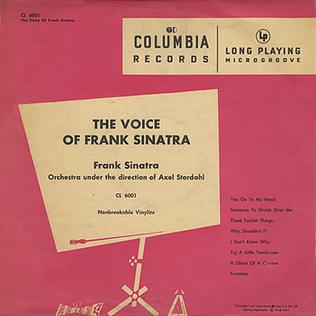
Columbia's first pop 10" LP album

Columbia Records introduced their revolutionary new Long Playing Record format on this date in 1948.  Played at 33⅓ rpm, less than half the speed of the industry standard 78 rpm, the new disks were pressed in soft vinyl instead of hard shellac with a narrow groove.  They could hold up to 20 minutes of music per side and when played with an improved stylus reproduced music clearly and with less distortion from surface noise.

There were antecedents to the long playing format, notably the discs used in the Vitaphone motion picture sound system in the 1920’s and the 16” electronic transcription discs for radio broadcasting beginning in 1930.  Originally recorded on shellac, Columbia introduced vinyl pressing in 1930 and other companies experimented with other plastics.

Columbia released one hundred titles simultaneously in two formats in 1948.  Twelve inch discs were intended for long form classical music, opera, and Broadway scores.  Popular music was released on 10” disks usually with three songs to a side.  By catalog number the first pop album was a re-release of a previous 78 album set, The Voice of Frank Sinatra.

Despite the need of many to upgrade their phonographs to play the new disks, they were phenomenal success and were soon the industry standard.  Columbia’s success allowed to eclipse long time dominant RCA Victor.

Victor responded in 1949 by introducing its own new format, 45 rpm also on vinyl.  The small disks could only hold one song no longer than about 3½ minutes of music on each side.  The company expected to package albums of 45s like they had with 78.  The multi-disc album idea was a bust, but the new format quickly replaced the 78 as the standard for singles.

Together the two formats, after Columbia dropped the 10” LP, would rule the recording industry for 40 years with upgrades including longer content per side on LP that would allow whole Broadway shows to be recorded, and, of course, the introduction of stereophonic sound and multi-track recording technology.

Even the introduction of cheap tape alternatives like eight track cartridge and cassette tapes in the ‘70s mainly captured the market for play in cars, never an option for discs of any kind, and on popular portable devices like boom boxes.  In fact, sales of the cheap tapes often spurred the sales of disk recording to be played on high quality home audio equipment.

The death knell for the LP was the one-two punch of technology.  First the new, light weight and easily portable Compact Disc (CD) that also reproduced sound at high quality—although without the “warmth” of vinyl in the eyes of some audiophiles.  Then the I-pod and downloadable music was a hand grenade that nearly destroyed the whole recording industry.  By the early years of this century, few albums were being issued in vinyl LP format.

A niche market remained for club DJs who could better cue songs from LPs and for Hip Hop DJs who relied on manipulation—hand spinning disks back and forth—for some of the signature sounds of rap.
But vinyl LPs have had a loyal cult following and some artists are now releasing their music again in the format for a discriminating audience.

But the days so many of us remember of lining up at record stores for the release of a hotly anticipated LP by The Beatles or other hot act are now as quaint a memory as the listening booths in stores of an earlier era where Bobby Soxers picked out the latest tunes on 78 from their Big Band idols.

Tuesday, January 31, 2012

Covering Sgt. Pepper’s Lonely Hearts Club Band


I was looking up something else last night when I stumbled across it—the cover of The Beatles Sgt. Pepper’s Lonely Hearts Club Band.  Not only is the record—old timers will remember those—usually at the top of lists of the greatest albums of all time with its psychedelic orchestrations, segues, and themes, but he cover itself is iconic.

Maybe the most breathlessly anticipated release ever, record stores—remember those—were jammed on the June 1, 1967 release date.  I hopped on the Skokie Swift and headed to the City where I obtained a copy at Rose Records on Wabash Avenue, then the Mecca for music loving teens. 

I was 18 years old and had just graduated from high school.  I was spending my summer washing dishes at Howard Johnson’s, trying to struggle through Shakespeare’s Coriolanus, a summer reading assignment before I started Shimer College that fall, and listening to that record in my basement room.  I studied the lyrics printed on the back.  I listened intently.  I was in awe.

But the full power of the record did not hit me until I arrived on campus in Mt. Carroll.  I quickly discovered it was on every turntable in every dorm room I visited.  The same rooms also seemed to offer unlimited supplies of marijuana, hash pipes, and an assortment of the latest and most powerful hallucinogens.  Within a couple of weeks I went from being a clean cut, if semi-radical kid in a cowboy hat to a dope fiend and hippy.  I couldn’t have been more pleased.
 
A good deal of that first semester was spent listening to St. Pepper’s experimentally to different grades, combinations, and concoctions of illicit drugs and cheep beer.   It also meant hours of staring intently at that cover trying to unravel its many deep mysteries.  I studied it by candle light, flickering strobe, black light, dorm fluorescents, and even in the bright sunshine of the Quad when someone would turn their giant speakers to their room window and blast the album at full volume for the communal experience of the masses.

Try as I could, I could only identify some of the faces on that cover, although I knew they all must have cosmic significance.  Others had the same quest.  We swapped our knowledge or our guesses and passed around clippings from underground newspapers but still fell far short.  

Eventually shiny new toys came out to divert our attention.  The great old album would get pulled out sometimes for a play, but we would only glance again at the cover.

So when I saw the cover again I thought that after all of these years, experience, and a life as a history and pop culture geek, I should do far better at picking out those pictures than way back then.  So I gave it a try.
This is what I could come up with.

In front surrounding the Beatles flower planting--Hindu Goddess front, unidentified Japanese figure, Disney Snow White figurine, bust of T. E. Lawrence, unidentified doll, Shirley Temple Doll dressed in “Welcome Rolling Stones” sweater.  

Front row—Sonny Liston, the Fab Four from Madame Tussaud’s Wax Museum, the Lads as Sgt. Pepper’s Band, Marlene Dietrich, the real Shirley Temple, obscured Turk, Dianna Doors.

Second row—Pin-up girl, Eddie Foy, Lucile Ball, Marlon Brando, Tom Mix, Oscar Wilde, unidentified, unidentified, Johnny Weissmuller as Tarzan, six unidentified heads, Lewis Carroll.

Third Row—Former Beatle Stuart Sutcliff, an American GI,  Dylan Thomas, seven unidentified heads, and the real T. E. Lawrence as Lawrence of Arabia

Fourth Row—Four unidentified heads, Tony Curtis, two unidentified heads, Marilyn Monroe, Boris Pasternak, unidentified head, Stan Laurel, unidentified head, Oliver Hardy, Karl Marx. H. G. Welles, Paramahansa Yogananda, unidentified man, unidentified woman.

Top Row—Two unidentified men, Mae West, Lenny Bruce, unidentified man, W.C. Fields, unidentified man, Edgar Allen Poe, unidentified man, Fred Astaire, unidentified man, unidentified woman, two unidentified men, and  Bob Dylan.

So how did I do?  Clearly better than those long ago daze.  But still a lot of missing pieces.  So I checked a list on Wikipedia—not entirely easy to do, because their rows and mine do not exactly correspond.  I learned that I made some mistakes.  The two female figures in the second row left that I identified as a pin up and Lucile Ball both turned out to be illustrations “Petty Girls” by magazine artist George Petty.  In between the man in the Derby hat who I identified as American vaudevillian Eddie Foy was in fact British Music Hall star Max Miller.  On the other end of the row the partially obscured figure I thought to be a Turk was an American Legionnaire.

In the third row in the string of unidentified faces, I can’t believe I missed George Bernard Shaw directly above George Harrison’s hat.  In my defense I never saw a color picture of him and most of his long beard was obscured.

In the fourth row to the right of Marilyn, the man I thought was Russian Boris Pasternak was really the American junkie/poet/playwright William Burroughs.

Wikipedia also identifies the bust down in front only as “a statue brought over from John Lennon’s house.”  But I stand on my identification of it as Lawrence.  Compare with the photo in at the end of row three.

Can you do better?  

To check by Wikipedia’s list, click here.