Showing posts with label reform. Show all posts

Friday, December 27, 2013

An Ax to Grind


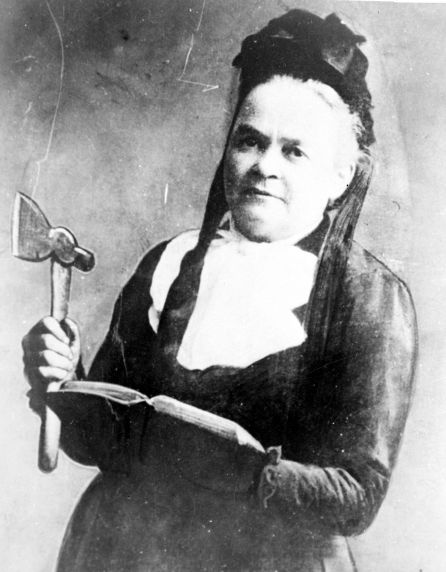
It was on this day in 1900 that Carrie Nation, a/k/a Carry A. Nation, all 6 foot, 180 pounds of her, stormed into a Kansas saloon shouting for the Lord and wielding a hatchet to break up the bar and smash the bottles.  Terrified customers fell over themselves trying to flee the carnage and the obviously deranged giantess.

The militant teetotaler had vandalized saloons before, hurling rocks through windows.  But her husband made an offhand comment that what she really needed was a hatchet.  She thought it was a brilliant idea.  And it was.  Within days news of her rampage spread across the country and she was suddenly famous.

Encouraged, she went on to smash more taverns.

She recognized the symbolic importance of the hatchet as a trade mark and later sold souvenir reproductions and post cards of herself with the “tool of God.”  She even toured on the American vaudeville stage and in English music halls with the trusty blade.  She had to give that up, however when outraged Brits pelted her onstage with eggs.

She was born Carrie Amelia Moore in 1841 to a slave holding family with a small plantation in Gerrard County, Kentucky.  Thus her background was very different from most of the women who later became Temperance leaders, who tended to come from comfortable Northern families with connections to abolitionism and other social reform movements, especially women rights.

Her family was beset by health woes, including several cases of mental illness.  Her mother suffered from periodic delusions that she was Queen Victoria.  Carrie herself, despite her robust frame, was often sickly.  With the continuing illness the family fell into poverty and want, although they retained at least some of their slaves.

By the time of the Civil War, the family was in Cass County, Missouri and were Southern partisans in a state racked by its own bloody civil strife.  Union troops forced them to vacate their farm.  Evacuated first to Kansas City, young Carrie volunteered as a nurse following a Union raid on Independence.

In 1865 despite her Rebel sympathies, Carrie met and fell in love with a Yankee Army doctor, Charles Gloyd.  The couple wed in 1867.  But Gloyd was a heavy drinker.  The marriage was not a happy one.  Before the birth of their daughter Charlien the next year, they had separated.  Gloyd died a few months later.  This tragic episode was the experience that eventually thrust her into the Temperance movement.

A widow with a small child, Carrie attended Normal School to get a teaching certificate that would make her able to hold one of the few jobs open to women.  After graduation she taught for four years in Holden, Missouri.  But she was fired for reasons not entirely clear, but which may have been related to erratic behavior.

In 1874 Carrie met and married David A. Nation, a preacher, lawyer and occasional newspaper editor.  Nation was 19 years older than his 28 year old wife and had the care of several children from a previous marriage.

The couple bought a cotton plantation in Texas, but was soon brought to ruin by their total ignorance of agriculture and the expense of field hands in the post-war south.  They kicked around Texas, David practicing law, Carrie managing hotels, a job at which she turned out to be successful.  In 1889 after David’s involvement in a Reconstruction era battle for control of local government known as the Jaybird/Woodpecker War, the couple fled to Medicine Lodge, Kansas.  David became preacher of the local Christian Church and Carrie managed the local hotel.

She also took up serious temperance work for the first time, founding the local chapter of the Women’s Christian Temperance Union (WCTU).  She launched a personal campaign of persuasion and shaming against local saloon keepers, bar tenders, and public drunks.  She greeted them on the street and at the doors of their establishments with sarcastic comments like,  “Good Morning, Destroyer of Men’s Souls!”  She also became a leader in a campaign to turn the state dry.

A word about the Temperance movement is in order.  America was undeniably a hard drinking country.  It always had been.  Partly this was due to the fact that most water was not potable.  Beer and cider were the table drinks of even the most respectable families and served even to children since colonial times.  The wealthy always enjoyed the fine wines that they could have imported from Europe


Cheap rum flooded the eastern seaboard as a side effect of the infamous triangle trade—slaves from Africa to the Caribbean, sugar to New England distillers, rum back to Africa.  What didn’t get shipped, got drunk on and near the waterfronts where frequently “every other house was a tavern or rum shop.”

Whiskey, because it was an inexpensive way to get grain crops to distant markets in the pre-canal and railroad era, was a major national product, relatively cheap and soon the beverage of choice over wide swaths of the country, especially in the South and on the old frontier.

But drinking to excess was always a problem.  The famous stocks of colonial New England were most frequently filled by public drunks.  The problem of families being abandoned by drunken men was a common story.  The Temperance movement began to take shape at the turn of the 19th Century as a reform movement spearheaded by Protestant clergy.  At first it was about temperance—moderation.  It preached voluntary moderation in drinking.  It did not necessarily demand that all liquor consumption stop. 
 
The movement took off with the waves of German and Irish immigrants swamping the slums of the big cities.  These people were rowdy, public drinkers—and Catholic.  In fact Protestant ministers became evermore zealous and absolutist in direct proportion to the swelling of Catholics in their midst.
By the 1840’s a well established web of social reform movements spread out from New England and New York across much of the country.  The same folks who advocated the abolition of slavery, prison reform, public education, and women’s rights were also frequently involved in the temperance movement.  After the Civil War, many former Abolitionists shifted their attention to alcohol.  In their minds the saloon was the den of vice that impoverished families.

By the time that the WCTU was formed in 1872, the movement was being spearheaded by reformist Evangelical women, who were evolving a program of governmental Prohibition coupled with the uplifting moral reform of Protestantism.  As even greater waves of dirty, drunken Papists and Jews washed up upon American shores, they became ever more determined.

Although her southern background and her husband’s Democratic politics were different than most leaders on the lecture platform, Carrie was ready to bring zealous, crusading Protestantism to even greater heights.

Then on June 5, 1899 she got her marching orders directly from God.  She later described the experience:

 The next morning I was awakened by a voice which seemed to me speaking in my heart, these words, "GO TO KIOWA," and my hands were lifted and thrown down and the words, "I'LL STAND BY YOU." The words, "Go to Kiowa," were spoken in a murmuring, musical tone, low and soft, but "I'll stand by you," was very clear, positive and emphatic. I was impressed with a great inspiration, the interpretation was very plain. It was this: "Take something in your hands, and throw at these places in Kiowa and smash them.
Two days later she was heaving rocks through the window of Dobson's Saloon in the town of Kiowa.  She went on to damage two more that first day.  After the Almighty showed his approval by having a tornado touched down nearby, she took the show on the road across Kansas.  She was frequently arrested, but undeterred.

It was after a particularly wild raid in Wichita, her husband made the offhand remark that for maximum damage she should use a hatchet.  “That is the most sensible thing you have said since I married you.”  She went out and bought the hatchet.  The rest is history.

It is perhaps understandable that a year later he filed for divorce. 

Carrie continued chopping up saloons and taking to platforms to talk about it.  She was a strong advocate for total prohibition.  She was a celebrity and perhaps the most famous woman in America.

She collapsed in 1911 giving a temperance address at a park near the home she built in Eureka Springs, Arkansas.  Transported by to Kansas for treatment, she died in a Leavenworth hospital and was laid in an unmarked grave in nearby Benton.  Some years later the WCTU paid for a monument.

Sunday, June 23, 2013

Hardy Icelanders Convene “World’s Oldest Parliament”

This painting depicts an early meeting of Iceland’s Althing with the Lögsögumaður (Lawgiver) calling the body to order at the Lögberg (Law Rock.)


On June 23, 930 the Alþingi (Althing in English) of Iceland met for the first time in an open field.  It is considered the oldest parliament in the world.  This was less than 60 years after Ingólfur Arnarson and other Norsemen (Norwegians) established permanent settlements on the North Atlantic island. 
The Althing—literally All Thing meaning an assembly of all—met out doors about 27 miles west of the principle settlement and future capital, Reykjavík.  The first assembly marked the beginning of the self-governing Icelandic Commonwealth. 
Sessions were held in the spring and could be attended by any free man.  The event drew large crowds and was surrounded by a festive atmosphere.  The Althing had both legislative and judicial functions.  The gathering centered on the where the sessions were called to order and dissolved by the Lögsögumaður (Lawgiver) who presided over the sessions and was responsible for orally repeating laws, actions, and decisions.  The legislative session of the Althing was called the Lögrétta and was made up of 39 Goðar, or regional leaders, nine additional members and the Lawgiver. 
After 965 the country was divided into four judicial districts and each of them had a court of 36 judges which met at the Althing.  In the early 11th Century a sort of supreme court, the Fimmtardómur, comprised of 48 judges appointed by the Lögrétta also met. 
In 1262 Iceland submitted to the authority of the King of Norway under the Old Covenant (Gamli sáttmáli) and rule by the Goðar was replaced with the executive authority of the King and his representatives on the ground, Royal Commissioners and District Commissioners.  The Lögrétta was made up of 39 members and the Lawgiver was replaced by two Lögmenn or legal administrators. 
The King and the Lögrétta shared mutual responsibility for governance and laws—each had to ratify the action of the other.  In 1388 the Norwegian throne was inherited when boy king Olav V died by his mother Queen Margrethe I of Denmark. The Danish Crown evolved into an absolute monarchy and the power of the Lögrétta was lost.  The Althing, however, continued to meet annually at its outdoor location until 1799 functioning mainly as a court.
In 1800 the Danish Crown abolished the Althing and replaced it with a High Court of three judges that met in Reykjavík.  As a wave of liberalization swept Europe the Danes restored the Althing as an elected constituent assembly in 1843 with the first session meeting two years later. 
There were 20 legislative districts represented by a single member and the King appointed six Royally Nominated Members.  Suffrage was extended to all males with substantial property over the age of 25—about 5% of the population.  The Althing was officially only a consultive body to the king and its actions, called petitions, had to be approved by him. 
The Danish Constitution of 1874 further restored the authority of the Althing, giving it joint legislative authority with the Crown over exclusively Icelandic matters.  However the King retained the right to veto Althing acts, and frequently did so.  His interests were also protected by the creation of a second, upper chamber consisting of six elected members and six Royally Nominated Members which had to concur with the lower house.  In practice the Crown controlled the upper house.  The same Constitution gave the Treasury the right to collect taxes and disburse funds in Iceland for the first time. 
The Althing was to meet biannually but after 1886 was frequently called into special off year sessions.  Beginning in 1881 sessions were held in a new Parliament House in Reykjavík built of hand hewn Icelandic stone. 
In 1903 a Constitutional amendment granted Iceland home rule with a parliamentary system and an Icelandic Minister as head of government.  Elections, previously held at various times in local districts, were consolidated to a single day nationwide and the old system of publicly proclaiming votes was replaced by the secret paper ballot.  The Althing was expanded to 40 members.
In 1915 another amendment replaced the six Royally Nominated Members with six members elected at large by the entire nation divided among parties by a system of proportional representation. 
In December 1918 the Act of Union placed Iceland in personal union with the Danish Crown.  The Althing was granted unrestricted legislative power and the king became a constitutional monarch figurehead. The Act was set to expire at the end of 25 years at which time either party could dissolve the union. 
By the Constitutional Act of 1934 the membership of the Althing was increased.  The system of system of National representation was replaced with 11 seats meant to equalize representation among parties to correct discrepancies between total national vote and regular seats held.  The total membership was thus increased to 49. The voting age was also reduced to 21. 
When Nazi Germany occupied Denmark on April 9, 1940 ties between Iceland and the mother country were effectively severed.  The next day the Althing assumed control and gave the powers of Head of State to the Cabinet.  It declared itself in charge of foreign policy and assumed responsibility for defense. The following year a Regent was named to represent the Crown. 
On June 17, 1944 Iceland declared itself a Republic formally severing all ties with Denmark.  Since then representation in the Althing has been tinkered with repeatedly.  Voting age was reduced first to 20 and then to 18.  The upper house was abolished in 1991 making the Althing once again a unicameral body.  It is currently made up of 63 members—52 elected from four constituencies and the 11proportional representation members. 
After elections held in April 2009 following the collapse of Iceland’s banking system in the world-wide financial crisis the Social Democratic Alliance held a plurality of seats and its leader, Jóhanna Sigurðardóttir was Speaker.  Other parties represented, in descending order of number of seats are the center-right Independence Party, the Left-Green Movement, Progressive Party, and the Citizen’s Movement.
The new government pursued a recover strategy dramatically different than the bank bailout followed by austerity model in the United States and Europe.  Banks were allowed to fail and bankers charged with crimes.  The interests of ordinary citizens were protected.  As a result Iceland led the world in a remarkable economic turn-around that strangely was not copied anywhere.
Despite the success, however, the election in April of this year was won by the two center-right opposition parties, Independence Party and Progressive Party which formed a coalition government.  Some of the reforms of the previous administration are threatened and independent power may be restored to the banking industry.  But voters evidently endorsed the conservatives stance against talks aimed at eventually brining Iceland into the European Union.
Those Icelanders—they will have their Democracy and their Althing.

Friday, November 25, 2011

The Greenbacks Rebelled Against the Power of Banks—Sound Familiar?


On November 25, 1874 a new political party was born at a convention held in Indianapolis, Indiana.  They called themselves the Independent Party.  In some states they would first appear on the ballot as the National Party.  But within months the new party was widely known as the Greenbacks as they grew at an astonishing rate challenging the entrenched Republican and Democratic Parties.

The Party was formed out of frustration with both major parties as major eastern banking interests demanded that the Federal Government stop issuing paper money and return the issuance of currency to the banks.  Federal paper money, popularly known as greenbacks, had been first issued under Secretary of the Treasury Salmon P. Chase to help finance the Civil War.  Inflation had been an inevitable result.

The banks and conservative hard money politicians in both parties, wanted not only to stop the government printing presses, they wanted to require that bills be redeemed in specie--gold.  This would create instant deflation.  But farmers and others who took out loans in inflated dollars would be required to repay the full face value of the loan plus interest in the much more expensive new currency or gold.  This alone would wipe out many farmers and small businesses.  It was also a blow at western mining interests by demonetizing silver coinage.  Silver coins would continue to circulate, but notes—printed currency—would have to be paid in gold.

The banks got their way with the passage of the Coinage Act of 1873.  Facing ruin, borrowers and their soft money supporters in both parties, organized to challenge the banking oligarch of the Gilded Age.

Within months the new party was established and running under different names in most states.  Although its greatest strength was in the Mid-West and West, it also found support among small farmers in the South, and Northeast.  In fact, with Democrats and Republicans fracturing mainly along the lines of the Civil War, it looked for a time like the Greenbacks were the only truly national party.

The Species Payment Restoration Act of 1875 completed what the Coinage Act had begun.  It limited remaining Greenbacks in circulation to $300 million and The Secretary of the Treasury was directed to ‘redeem, in coin” legal-tender notes presented for redemption 1 January 1, 1879.

In 1876 the new party nominated the distinguished, but eccentric 85 year old Peter Cooper as its candidate for President.  Cooper was an industrialist who had built the first practical railroad in the U.S.: a philanthropist who had founded Cooper Union, a college open to students of all economic, religious, racial, and ethnic backgrounds, and a leading liberal voice in New York City politics.  The party knew it had no chance to win the presidency, but the prestige of Cooper led to success in getting on the ballot in most states and helping elect local office holders.

The party crested in the off-presidential year of 1876 when it elected 13 members of Congress. Thomas Ewing, Jr. of Ohio a pre war Kansas Free Soil leader and post war soft money Democrat, was the leading spokesman for the party in Congress and the most widely known and influential public figure.

In 1880 the party broadened its base and attracted new support from industrial workers in the Northeast, especially the politically savvy Irish, by adopting a staunchly pro-labor platform advocating a progressive income tax and the eight hour day.  It also made a bid for the support of middle class reformers, previously primarily Republican, by endorsing women’s suffrage.  The rise of the Grange Movement mirrored Greenback popularity among its original farmer base.

The 1880 Presidential Candidate was Iowa’s James B. Weaver. He received 305,997 popular votes, 3.3% of the total and the high water mark of the Greenbacks in Presidential elections.

Despite the continued popularity of their core demand—the return to a system of government issued currency detached from gold—in some areas, the party began a decline.  Those middle class reformers never did abandon the Republicans in any significant degree.  Southern Democrats gained in popularity as Reconstruction ended and they seized state government from Black Republicans and fusion or pro-union whites leading to the Jim Crow Era.

Meanwhile the Knights of Labor largely collapsed following the Great Railroad Strike of 1877 and the rising craft union movement was both conservative and actually hostile to mass industrial workers greatly weakening their political power and influence.  The Irish returned to the traditional Democratic loyalties in most big cities.

Back in Indianapolis the 1884 Party convention nominated Benjamin F. Butler for President.  Butler had also received the nomination of an even smaller Anti-Monopoly Party.  The sitting Governor of Massachusetts, Butler was a polarizing figure in American politics.  A pre-war Democrat, Butler was a political general famous for his occupation command of New Orleans and the order to treat “disrespectful” ladies as “women of the streets plying their trade.”  He had a later command of the Department of Virginia where he refused to return runaway slaves that reached his lines to their owners, declaring the “contraband of war.”  He was also widely suspected of corruption.  Elected to Congress after the war he became a leading Radical Republican and one of the managers of the President Andrew Johnson’s unsuccessful impeachment trial before the Senate.  Back in his home state of Massachusetts he ran three times for Governor, finally winning in 1882 on a Democrat-Greenback fusion ticket. 

Butler’s presence on the ticket, despite a Mississippi running mate, virtually killed the Greenbacks in the South.  As head of the ticket he won only 177,096 popular votes, just 1.7% of the total.  The party was also reduced to just two seats in Congress, one of them taken by former Presidential candidate Weaver.

By 1888 local party apparatus around the country had collapsed.  Only 8 delegates showed up for a nominating convention.  They gave up and went home.  The party was essentially dead.  But not its ideas.

In the 1890’s the new Populist Party took up most of its core platform.  The Populists’ first Presidential Candidate in 1892 was the last Greenback in Congress—James B. Weaver.  In 1896 fiery Nebraska orator William Jennings Bryan got the nomination of both the Populists and Democrats, campaigning on the old Greenback demand of the free coinage of silver and end to the de-facto gold standard.