Showing posts with label Bill Clinton. Show all posts

Wednesday, October 2, 2019

The Smell of Impeachment in the Morning

There has been a steadily rising clamor to impeach Donald Trump over a number of issues.  A solid majority of Americans now support it.
What’s that I smell?  It may be the mildew of a soggy Fall in these parts or the dog’s grass pad gone too long uncleaned.  But no, I smell impeachment in the morning.  And this time it is serious.  Some folks have been muttering and calling for the impeachment of Donald Trump almost from the beginning—and he piled up many possible offencesviolating the emolument clause of the Constitution, payoffs and bribes to Stormy Daniels and others, possible tax fraud, obstruction of justice in several instances most notably in trying to interfere with or squash the Mueller Report to name a few.  
Wanting to impeach a President political opponents don’t like is nothing new—some Republicans were pushing to do it to Barack Obama from practically the first moment after he completed the Oath of Office despite a complete lack of evidence that he committed any impeachable offences.  Of course in those days leaders of the Congressional lynch mob were fond of telling Fox News that “An impeachable offence is anything we say it is.”  We will note a little later in this blog post a litany of Presidents who faced similar aborted partisan attacks.  
The Cheeto-in-Charge successfully evaded any serious threat first because the Republican controlled House of Representatives would never bring a Bill of Impeachment and then after the Blue Wave election in 2018 brought Democrats into control of the House because Mitch McConnell and the Republican Senate would never vote to convict.
Although over the spring and summer of this year impeachment resolutions were filed by Congresspersons Brad Sherman of California, Rashida Tlaib of Massachusetts, Sheila Jackson Lee of Texas, and Al Green also of Texas.  But those went directly into Speaker Nancy Pelosi’s circular file.  Despite a rising chorus demanding impeachment proceedings from the activist left of the Democratic Party and restless Congresspersons responding to pressure from their home Districts, Pelosi and most of the House leadership urged caution saying matters would best be left to the next election because impeachment would suck all of the air out of Congress for anything else.  Frankly, she feared that impeachment was a trap that would rouse the Trump base to a frenzy.
All those escapes emboldened the already narcissistic and megalomaniacal to be ever more reckless confident that his supporters would stand by him even as he once claimed “I could stand in the middle of 5th Avenue and shoot somebody and I wouldn’t lose voters.”  Certainly Evangelicals who had once been prissy prudes about all sexual matters threw away all of those scruples to declare him a saint and a holy man.  White voters uncomfortable and angry about becoming a minority in “their country” cheered every veiled or open attack on immigrants, minorities of all sorts, and their tribal enemies to supposedly sneering liberal elite.  Oligarchs who might cringe at his crudeness and bluster sang hallelujah and emptied their pockets to a President delivering their libertarian utopia by abandoning any and all business, environmental, labor, voting rights, or civil rights regulations.  
The Resident now shook off any of a small army of staffers and appointees who tried to restrain or temper his ever wilder excesses.  No one could stop Trump from being Trump.
That is until an as yet unknown whistleblower alarmed at possibly treasonous attempt to extort a foreign leader into digging up dirt on his leading Democratic presidential opponent, former Vice President Joe Biden and his son.  The whistleblower went through proper channels and the Inspector General of the Intelligence Community (ICIG) found the allegations credible only to have an investigation personally quashed when the acting Director of National Intelligence (DNI) refused to forward the report to Congressional intelligence committees.  After that all hell broke loose.  

Thanks to Trump’s own recklessness and the blabbering mouth of the world’s worst lawyer the essential details of the whistleblower’s alarm were soon made public.  Now armed with a simple and easily substantiated case so damnable that it might even stand a snowballs chance in Hell in the Senate, Pelosi dramatically declared that impeachment proceedings would commence under the leadership of House Intelligence Committee chairman Adam Schiff who moved with lightning speed for Congress with a flurry of subpoenas for documents as well as key individuals, including the whistleblower him/herself who is currently under protection from possible threats to his/her life.
Developments in the case emerge daily, fast than this blogger can hope to keep up with.  Consult your reliable news media daily rapidly breaking developments.  Suffice it to say that at least cabinet membersSecretary of State Mike Pompeo and Attorney General Bill Barr, Vice President Mike Pence, and the ever babbling personal lawyer Rudy Giuliani are also caught up in the scandal one way or another leading to the possibility that not only an incumbent President might be brought down, but his whole administration.
Most observers are now sure that impeachment by the House is a sure thing and that a Bill will be sent to the Senate before the first of next year.

Trump has finally realized the danger he is in and is in full panic mode.
Trump has finally realized that he has been trapped and has responded with increasingly bizarre Twitter rants including demanding to know the identity of the whistleblower and all of his/her informants hinting that they should be charged with treason.  He has also made similar charges of treason against Rep. Schiff claiming that he should be hung.  He has more than hinted at a possible civil war if he is impeached and called the whole procedure an attempted coupe d’etat.  The ravings only dig the whole deeper for himself and some of them might result in additional charges of obstruction of justice.
Impeachment of a sitting President is not only difficult, but rare.  Only two Presidents have been impeached in the House and neither was convicted in a Senate trial.

Representing the House of Representatives as prosecutor, Thaddeus Stevens reads the bill of Impeachment to the Senate.
After the assassination of Abraham Lincoln his Tennessee border state Vice President Andrew Johnson pursued a policy of reconciliation with secessionist states and their rapid rehabilitation within the Union.  This was in line with Lincoln’s own hopes for restoring the Union.  But it was at odds with the Radical Republican majority in the house which demanded harsh treatment of former Rebels and an expansive reconstruction that would empower freed slaves politically and economically while protecting them retribution by Southern Democrats.  Thaddeus Stevens of Pennsylvania saw a possibility for removing Johnson for violating the Tenure of Office Act to restrict the power of the President to remove cabinet members and certain other senior office-holders without the approval of the Senate.  Johnson was impeached by the House by an overwhelming margin but a dramatic Senate trial ended with a 35–19 vote in favor of conviction, one vote short of two-thirds majority needed for conviction.  A politically crippled Johnson served out his term.

 More recently in 1998 Bill Clinton’s cheap and tawdry affair with a starry eyed and naïve White House intern led to impeachment by the House of a still popular President.  Most Americans were disgusted but then believed that private sexual misconduct should not be the cause to “overturn the results of an election.”  The popular MoveOn movement began on that premise.  Today in the Me Too Era many powerful men have seen their careers destroyed on far less evidence than Monica Lewinski’s stained blue dress—witness a risqué photo that brought down Senator Al Franklin.  But back then the Senate voted 45–55 against obstruction of justice and split 50–50 on perjury, a tie that Vice President Al Gore had to recuse himself from braking.  
More celebrated than the Clinton case was the almost impeachment of Richard Nixon for numerous offences lumped together as the Watergate Scandal.  Months of investigative journalism and televised hearings by both House and Senate special committees had built an overwhelming case against the President.  Nixon was tempted to tough it out hopping that a groundswell of support by his beloved Silent Majority would prevent conviction in the Senate.  Then a delegation of Republicans including Minority Leader Hugh Scott, conservative icon Senator Barry Goldwater, and House Minority Leader John J. Rhodes came to the White House to deliver the news that the game was over—the Senate would vote for impeachment if the House delivered a Bill.

Richard Nixon resigned before he could be impeached and flew off to political exile and disgrace.
After wavering a bitter and disappointed Nixon finally decided to spare the nation a show trial and a constitutional crisis.  He delivered a one sentence letter of resignation to the Secretary of State and then boarded a military helicopter on the White House lawn to fly into exile and disgrace.  Gerald Ford went on television to announce “Our long national nightmare has ended.”
Nobody much expects the Mitch McConnell and Senate Republicans will rise above their slavish partisan devotion the President to act responsibly on clear evidence this time.  But some believe that the cornered rat might lash out so viciously and commit more open violations of the Constitution and the nation’s laws in plain sight that even they—or some of them—might finally abandon him.
There has been a long history of failed Presidential impeachment attempts.
 Whigs wanted to go after Andrew Jackson for beating the Second Bank of the United States to death and settled on a literal tempest-in-a-teapot bringing back up the Eaton Affair back in 1831 when Jackson demanded the resignations of most of his cabinet members because their wives insulted the wife of his friend and Secretary of War John Eaton.  It was a flimsy excuse and brought forward years after the fact.  It got nowhere because Democrats firmly controlled Congress and everybody was scared to death of the volcanic Presidential temper.  And everyone remembered what happened when a Federal Court issued a ruling against his imposition of Marshall Law in Louisiana in 1815.  After jailing at state legislator, a prosecutor, and a Federal Judge he dismissed a writ of Habeas Corpus defiantly asserting “The Judge made his ruling.  Now let him try to enforce it.”   No wonder politicians were terrified of Jackson.  Trump terrifies no one except Senate Republicans who fear that their MAGA cap wearing base will rise up against them.
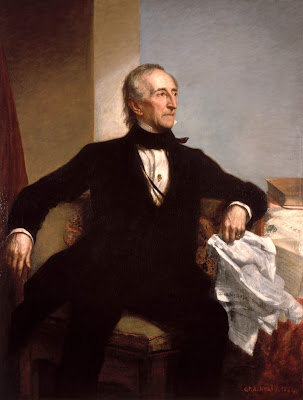
  • John Tyler was the first President to face a formal impeachment inquiry

In 1842 Congressman and former President John Quincy Adams led an attempt to impeach John Tyler—an accidental President after the death of Whig William Henry Harrison and a man without a party in Congress—for the use of the veto to reject Whig-backed tariffs.  Vetoes had been seldom used previously and there was some contention over just what a President could or could not achieve by a veto.  The attempt went nowhere but it did end up confirming the right of the President to freely use the veto.

In 1860 Whigs again targeted a Democratic President, the hugely unpopular James Buchanan, a “Northern man of Southern principles,” who had dilly-dallied through the impending secession crisis.  At issue was suspected wide-spread corruption in Buchanan’s home state of Pennsylvania.  A special investigation committee did uncover some staggering corruption and even possible treason.  But it issued a report and Congress did not act on impeachment.  The election of 1860 would quickly dispose of Buchanan and render him an embarrassing footnote in American history.

Republicans thought that Harry Truman's firing of General Douglas MacArthur might be impeachable.

In 1951 Republican Congressmen George H. Bender of Ohio and Paul W. Shafer of Michigan each introduced impeachment bills against Harry S. Truman for firing General Douglas MacArthur for insubordination.  The resolutions were referred to the House Judiciary Committee which, being run by Democrats, sat on them. However, the Senate held extensive hearings on the matter.  MacArthur benefited from a Senate investigation and was promoted at a possible Presidential candidate himself.  But he faded away and a more tactful general and war hero, Dwight D. Eisenhower, got the nod instead.

·     There were several attempts to launch impeachment investigations against George W. Bush. The most serious was filed by Congressmen Denis Kucinich of Ohio, and Robert Wexler of Florida in 2008 with several articles covering launching the War with Iraq, lying about its justification, outing the identity of covert American intelligence agent Valerie Palme, mistreatment of detainees, covert attempts to over throw the government of Iran, National Security Agency warrantless surveillance of American citizens, malfeasance in responding to the victims of Hurricane Katrina, as well as other complaints.  It was a long and unfocused laundry list however justified any of the charges might have been.  The House voted to send the resolution to the Judiciary Committee which let if quietly die before the 2008 election.

Attempts to impeach Barack Obama hardly got beyond the stage of racist memes.


Perhaps in retribution to the Kucinich-Wexler articles, Republicans moved, or talked loudly about moving, against Barack Obama from the beginning.  Among the focus of allegations were the bogus claim that Obama was not born in the United States, allowed people to use bathrooms based on their gender identity,  allegedly covered-up after the 2012 Benghazi attack, and failure to enforce immigration laws.  Despite chest pounding and blather no list of articles of impeachment was ever drawn up or proposed to the Judiciary Committee.
Nobody expects the current impeachment crisis will go away so easily.

Friday, September 18, 2015

Snubbing a Monument

To the Stuggle Against World Terrism a/k/a the Tear Drop Memorial.


Last week on the anniversary of the 9/11 attacks the internet and particularly Facebook was flooded with postssober reflections, hyper-patriotic star spangled memes, touching memorials, and the de rigueur rants of conspiracy theorists.  Mostly scrolling through them, one momentarily caught my eye—a photo of a large impressive looking monument with a caption that it was a memorial gift from then Russian people somewhere in New Jersey across the Hudson River from the site of the Twin Towers.  I paused briefly.  Funny, I had never heard of it or seen it.  But I rushed by in the press of things too busy for further investigation.
Then the other day my friend Marylin Ludwig posted another picture of the same monument to my Time Line with the comment, “Man I’d like to hear what you might write about this. I never knew about it—nor did anyone I know.”  Well, Marylin, you don’t have to beat me with a stick. Besides, curiosity got the better of me too.
It turns out the monument carries with it the clumsy official moniker of To the Struggle Against World Terrorism which certainly betrays its origin.  The name reeks of Soviet Era Socialist Realism even if the work does not.  Of course, that era is when Georgian born architect, sculptor, and painter Zurab Tsereteli got his start.  Could that off-putting name have contributed to the obscurity of the monument?  Perhaps.  But Americans who knew about it quickly gave it an apt and descriptive nickname by which it is now better known—the Tear Drop Memorial.
Tsereteli was born in Tbilisi, Georgian SSR in the old Soviet Union and graduated from the Tbilisi State Academy of Arts.  With dreams of doing monumental work he soon relocated to Moscow where, with the right political credentials, important commissions could be secured from the state.  Tsereteli dutifully acquired those credentials by membership in the Communist Party and working his way up in Soviet arts organizations. 
After striking up a friendship with Eunice Kennedy through their mutual interests in the Special Olympics, Tsereteli got his first international commission designing and installing Happiness to the Children of the World on the campus of SUNY Brockport to commemorate the 1979 Special Olympic Game and the UNESCO Year of the Child.

The artist--Zurab Tsereteli.


One his earliest important Soviet commissions came in 1986—designing a youth camp at Sochi, the Black Sea Resort which later housed the 2014 Winter Olympic Games. 
Despite his ties to the Party, Tsereteli managed to survive, even thrive in the wake of the collapse of the Soviet Union due in part to his connections.  Post-Soviet Moscow Mayor Yury Luzhkov, who had an ambitious building and redevelopment program, became his special patron, securing for him a number of important—and in the wild cowboy days of the city’s conversion to capitalism—lucrative commissions including the reconstruction of the Cathedral of Christ the Savior, the Manege Square ensemble of fountains and statues of Russian fairy-tale characters, and the War Memorial Complex on Poklonnaya Gora which featured an obelisk with a statue of the victory goddess Nike and a monument of St. George slaying the dragon. 
In gratitude for his work Luzhkov allowed Tsereteli and his wife, a Georgian princess who claimed descent from a Byzantine Emperor, to live in lavish old downtown mansion which the artist has transformed into the Zurab Tsereteli Gallery to display his work.  Notably on display there is a life-sized statue of his next useful patron, Vladimir Putin.
The experience with the War Memorial whetted his appetite for monumental work and set him on a quest for international recognition.  He began pitching proposals for monuments around the world with mixed success.  The United Nations, through which Tsereteli had excellent connections through his work for UNESCO accepted a variation of his St. George and the Dragon called straightforwardly Good Defeats Evil, on the grounds of its New York City Headquarters.  The 39 foot high, 40 ton monumental bronze statue represents St. George slaying the dragon of nuclear war employing sections of scrapped US Pershing II and Soviet SS-20 nuclear missiles.  It would not be the last time, as we shall see, that the artist employed salvaged Soviet era military material. 
Other international projects had rockier experiences.  Tsereteli was convinced that the 500th anniversary of the Christopher Columbus’s voyage to the New World cried out for his commemoration.  He designed a massive piece which he shopped to several U.S. cities, including the Big Apple and Columbus, Ohio.  He ran up against steady rejection on both artistic grounds and because of Columbus’s soured reputation—he was now seen as the instigator of genocide of native populations and a stubborn blowhard who never acknowledged that he hadn’t reached Asia.  Finally the municipal government of Cataño, Puerto Rico agreed to accept the statue in hopes of stimulating tourism.  The massive memorial was shipped there in pieces but has never been assembled because the city could not raise the funds for it.  At this writing reports are that it is finally being assembled for unveiling later this year in the municipality of Arecibo.  A clone of the American statue was erected in Seville, Spain under the title of The Birth of the New Man.  
Tsereteli’s next and most controversial project was oddly linked to by rumor and folklore to the failed and/or stalled instillation of the Columbus monument in Puerto Rico.  Mayor Luzhkov came up with another lucrative and epic scale project for his favorite artist—the creation of a monument to Peter the Great and the 300th anniversary of his founding the Russian Navy. 
From the beginning Moscow was an odd choice for such a monument.  Not only is it deeply landlocked but Peter hated the old Czarist which he believed was ignorant and backwards holding Russia in near medieval conditions due to the powerful influence of the Boyarsnobility.  He moved his capital to the new city he built on the sea—St. Petersburg.  But veneration of Peter and other “patriotic Czars” was very much part of the program of Trsereteli’s other mentor, Vladimir Putin to re-establish Russian pride and re-assemble as much as possible of the old Russian/Soviet empire.

The highly controversial Moscow Peter the Great Memorial voted one of the ugliest structures in the world.


But controversy over the appropriateness of the location paled beside the storm of criticism for the statue itself when it was erected and dedicated in 1997.  At 325.5 foot it is the eighth tallest free standing statue in the world and weighs a total of 1000 tons including 800 tons of stainless steel, bronze, and copper.  A mammoth Peter holding a rolled chart in one hand is depicted as a mariner and stands upon a jumbled column of 18th Century warships. 
Muscovites, by in large, hated it on sight.  Because of its nautical theme the rumor spread that the statue was really the Columbus monument, snuck back into the country with the Italian’s head replaced by Peter’s.  The monument has twice been placed on lists of the ugliest structures in the world.
After Tsereteli’s patron Luzhkov was ousted as Mayor for alleged corruption in 2010, new civic authorities tried to give the state to St. Petersburg, which wanted no part of it.  Its future remains in doubt.  The cities of Arkhangelsk—Archangel—and Petrozavodsk, the capital of the Russian Republic of Karelia have each reportedly offered to take the statue off of Moscow’s hands.
Despite this controversy and the loss of Luzhkov, Tsereteli continued to prosper under the encouragement of the even more powerful Putin, the former KGB officer who rose to power with promises to return Russia to past glory and who has ruled, directly or indirectly with an increasingly iron hand.  He continued to pile up medals and honors as a Hero of Russian and Georgian Art and has long served as President of the prestigious Russian Academy of Arts.
By his own accounts the then 67 year old Tsereteli was driving to work at the Academy when he passed lines of Muscovites surrounding the American Embassy  to sign condolence books for the 9/11 attacks.  Moved by the outpouring of human sympathy and connecting it in his mind to Russian losses to Chechnian terrorist attacks.  He immediately began sketching ideas for a monument intended as a gift to the American people.
He personally traveled to Ground Zero in New York in the weeks after the attack while the rubble was still smoking and efforts to find and retrieve bodies and body parts.  He claimed never to have considered offering his monument for erection on the former World Trade Center Site.  But it was already clear that a bitter controversy was brewing about whether to defiantly rebuild towers or to make the site an eternal shrine.  That would go on for a period of years and even a memorial shrine on the site was not likely to include his project, which had already been reported.  New York City officials also were cool to any other location for his project.
Tsereteli said that he became intrigued by the stories of the Dunkirk-like rescue of stranded refugees of the attack by a volunteer mixed flotilla of ferries, harbor tugs, sight-seeing excursion boats, and private pleasure craft of all sizes to the Jersey side.  He also noted heavy loss of life from residents of and suburbs.  He decided to pitch his monument on that side of the river.
Back in Moscow, Tsereteli, as he had in the case of the Columbus project, wasted no time getting underway before a site for his project had been approved and secured.  While the Jersey City contemplated accepting his gift, the artist finalized his plans.  Fortunately he abandoned the massive figurative work that had made his St. George, Columbus, and Peter the Great projects seem at once clunky and old fashion.  After seeing photographs of how the Trade Center towers dominated the New York skyline from the Jersey side, but from some angle looked like a single structure or two barely separated ones, he decided to recreate the vertical rectangular thrust.
The rough bronze tower, 100 feet tall, was riven by a fissure that widened near the middle in which a 40 foot long polished nickel tear drop was suspended.  The tower stood on a base of highly polished black granite onto which were engraved the names of all known victims of the 9/11 attacks, and also those who died in a 1993 bombing at the Trade Center. 
Tsereteli said that he personally bought and paid for the materials used in the monument, at an estimated cost of $12 million.  If so, it is a reflection of the enormous wealth he was able to amass as a favored state artist in the both the Soviet and post-Soviet eras.  More than likely, some or much of that cost was secretly subsidized either by the government or from donations obtained from Russian magnates whose quasi-legal empires required the continuing good graces of the regime.  This is how Putin would later characterize the monument as a “gift of the Russian People.”  Russia after years of Communism has literally no tradition of either charity or support of the arts through public subscription.  This was not like the school children of France giving their coins to send the Statue of Liberty to America. 
The depth of Putin’s personal support of the project was revealed in giving Tsereteli access to metal for the project from a military aircraft manufacturing plant in the secret city of Dzerzhinsk.
As work on the project continued in Moscow, word came that Jersey City had turned down Tsereteli gift.  That set off a scramble to find a new site.  Finally Bayonne, further south, agreed to take it.  The location was to be the tip of the pencil-thin man-made peninsula jutting out into Upper New York Bay just south of Port Jersey.  Originally designed as a port terminal, the site became a Naval Base in World War II and was transferred to the Army in 1967 and known as the Military Ocean Terminal at Bayonne.  The base was closed in 1999 and the City of Bayonne was planning to convert it to mixed use housing and light industrial with a park at the tip.  That park would be the site for the monument.  From it there is a clear few of the former Twin Towers site and the Statue of Liberty in the harbor.
A groundbreaking ceremony was held on September 16, 2005 with Tsereteli, local dignitaries, and Vladimir Putin himself in attendance as the principal speaker, He told the audience,
...Four years ago, the terrorists intended to plunge America and the civilized world into chaos, but they have failed. On the contrary, mankind united. We have made an efficient international anti terrorist coalition. I fully agree with Mr. Mayor [of Bayonne]. We defeated Nazism and together we will win a victory over terrorism. This monument, in memory of victims of the September 11th attacks, will serve as a symbol of Russian American unity against world terrorism.

Bill Clinton and Tsereteli shake hands as other dignitaries look on during the 2006 dedication of the monument.
Less than a year later on the sixth anniversary of the attacks and long before any permanent memorial had been raised on the site of the Twin Towers, the completed monument was dedicated in a solemn ceremony.  Former President Bill Clinton was the principal speaker.  Also speaking and in attendance was Sergei Mironov, Chairman of the Council of Federation of the Russian Federal Assembly, New Jersey Governor John Corzine, Democratic Senator Bob Mendez, Bayonne Mayor Joseph Doria, representatives of 9/11 victim families, and, of course Tsereteli.
Perhaps more notable were those who were absent.  Neither President George W. Bush nor Vice President Dick Cheney although they frequently used 9/11 as a bloody shirt to wave in support of their increasingly unpopular War in Iraq.  The administration was represented by the low wattage Secretary of Homeland Security Michael Chertoff who was under fire for bungling the response to Hurricane Katrina in the Gulf Coast a year earlier. 
Also missing was New York City Mayor Rudy Giuliani who usually wasted no opportunity to paint himself as a hero of 9/11 and was using that to fuel his unannounced run for the Republican Presidential nomination in 2008 for which he was still at that early point considered the favorite.  The city was represented by a truly obscure figure, Comptroller Bill Nelson. Giuliani and the city wanted to downplay any memorial except the one that would eventually accompany the redeveloped Trade Center site as well as avoid contamination by contact with the Russians.
In his speech Clinton said:
…9/11 gave us a moment of national and global unity all together too rare in these contentious times. It was a moment when we all knew that our common humanity is far, far more important than any differences we have. My prayer is that today we might recover some sense of that unity to finish the tasks that lay before us in the ashes of the World Trade Center, in the gaping wound of the Pentagon, and in that lonely field in Pennsylvania, by supporting the families of those killed and the injured, by improving our defenses, and by holding the terrorists accountable in the global world with more partners and fewer terrorists.
Outside of the New York metropolitan area the monument and dedication received scant press attention.  National network news broadcasts gave it maybe a minute with a 30 second sound bite from Clinton buried deep in their evening broadcasts.  It made few front pages anywhere.
In subsequent years the monument was not heavily promoted by New Jersey and its annual 9/11 observances were seldom mentioned alongside observance in New York City and Washington.
Then, in 2010 a desperate and cash strapped Bayonne, hit hard by the economic crash of 2008 sold the whole former military base, including the site of the monument, at a fire sale price to the politically powerful Port Authority of New York and New Jersey.  The authority announced plans for a new deep water container facility on the peninsula which would require that the monument be relocated.  There was some public protest and, of course, Tsereteli and the Russian government both expressed their dismay. 
No candidate for an alternative site has emerged.  But five years after the sale, the monument still stands and there are reports that the Port Authority may allow it to remain, at least for the foreseeable future.  Access to the site, however, may be limited by the new container facility.  It may only be accessible by boat after the facility is complete.