Thursday, July 3, 2014

The Stone of Scone Makes it Home—Maybe and Sort Of

A Replica of the Coronation Stone of Scotland at its traditional site, the Abby of Scone.


Back in 1996 the Conservative Government  of the United Kingdom led by John Major—Maggie Thatcher lite in trousers—was getting a little nervous about how long Her Majesty’s Kingdom might be united.  Suffering through the tail end of a steep recession and continuing Tory attacks on the “power” of the Trade Union movement, and on social services and the dole had helped to revive long simmering resentment in Scotland.  Specifically Major was edgy about growing cries for increased Scottish autonomy, a small but growing nationalist movement, and the intimidating glower of Sean Connery.
Major, a master of the empty gesture, decided to placate the Scots by announcing on July 3, 1996 that the legendary Stone of Scone would be returned to Scotland for safe keeping—at least until it was needed for the coronation of the next monarch.  The Stone’s origins traced back to mythic prehistory.  On it the Kings of Scotland had been enthroned for hundreds of years until Edward I of England made off with the heavy object as a spoil of war in 1296.  Edward hauled it to London and Westminster Abbey, where he had it fitted into a wooden chair, known as King Edward’s Chair, on which most subsequent English sovereigns have been crowned.  It was a humiliating thumb of the nose to the Scots and a symbolic claim to be Lord Paramount of Scotland and the superior to any Scottish monarch.
The 336 pound Stone, about the size and shape of a suitcase, was removed from Edward’s Chair with great care and ceremony and was transported with honor to the Scottish border a transfer ceremony between representatives of the Home Office and of the Scottish Office on November 15, 1996.  It was taken from there to Edinburgh Castle, arriving on St. Andrew’s Day November 30.  At a ceremony in which Queen Elizabeth II was represented by Prince Andrew it was formally turned over to Scottish custody—with the proviso that the next time it was needed would the Scotts kindly send it back to London  for the next coronation.  The fact that the next likely person to require the Stone’s use—Prince Charles—was not on hand may be a clue that the English were not entirely sure they would ever get it back.  At any rate the Stone of Scone remains at the castle and is on display to the public along with the long unused Crown Jewels of Scotland.
Some, however, believe the Stone was not the Stone at all—that the Monks of Monastery of Scone, a few miles north of Perth—had secreted the real stone, possibly at King Macbeth’s old castle at Dunsinane, and let Edward make off with a counterfeit.  To untangle the tale, it is best to start at the beginning—if we can find it.
Legend has it that the Stone a/k/a the Stone of Destiny, The Coronation Stone, Jacob’s Pillow Stone, the Tanist Stone, and in Scottish Gaelic clach-na-cinneamhain—it has more aliases than ten fugitives from justice—originated in Ireland. One tale credits the Dál Riata Gaels who established a kingdom spanning parts of what is now Ulster and Argyle carved out of the Pict Kingdom around the 4th or 5th Century.  This is dismissed by most scholars. 
More enduring is the story that the first King of the Scots, Fergus Son of Erc, brought the stone from Ireland and was crowned on it having defeated and overwhelmed the Picts before the year 500.  The stone was said to have been part of the Lia Fáil, the coronation stone of the high kings of Tara.  The Picts were another group of related Celtic tribes who held sway over the eastern and northern parts of what is now Scotland, You may remember that were called the Caledonii by the Romans in Britain and gave them such fits that Hadrian built his great wall to keep them out. 
This is the foundation myth of Scotland.  But the Picts were never really conquered by the waves of Irish known as the Scotts.  Over a period of two or three hundred years the kingdoms of the Dál Riata and the Picts danced around various relationships before merging into the Kingdom of Alba—Scotland—before 900.  If the Dál Riata or Scottish kings were crowned the Stone, it was probably not until King Donald II, that the Stone would have been used for the coronation of a somewhat united nation.  Donald was the first to be styled rí AlbanKing of Alba.
The Stone was said to be an important symbol in the struggle to bring the various Celtic peoples into full conformity with the Catholic Church.  The Church propagated an entirely new myth, that it was the stone used as a pillow by the Israelite patriarch Jacob at Bet-El when he was visited by a vision from God and was brought to Ireland by the prophet Jeremiah and from there to Scotland.
Originally said to be held in lost city of Evonium in Ayershire, the Stone was kept at the Monastery of Scone and thus in the hands of the Church from around 1,000.  Claimants to the throne had to journey to the Abby for coronation thus placing themselves under the blessing and protection of the Church.
There the stone sat and was sat on through the sometimes tempestuous succession of Scottish kings through the time of the Norman Conquest of Britain.  At first the Scotts were quasi-allies of the Normans, raiding the English coast with impunity as William the Conqueror ravaged the kingdom of the Angles and Saxons.  The Royal houses intermarried somewhat and the Scottish Court began to ape French styles and customs.  But a clash was inevitable.
When Alexander II died in an unfortunate fall from his horse in 1286 he left no direct heirs essentially ending the Dunkeld Dynasty that had ruled since Malcolm III in 1068.  He named his granddaughter Margaret, Maid of Norway as his heir, but she was quickly deposed.  In fact, she never sat on the Stone and was never crowned or even set foot in Scotland. 
Several claimants, none very closely connected to the royal house were put forward.  But in 1291 John  Balliol, who traced a relation to David I King of the Scots from 1124–1153 through his mother won the crown after a judgment of a panel of arbiters while England’s Edward I held the realm in supposed stewardship over his main rival Robert Bruce whose claim was slightly more distant yet.  Both Balliol and Bruce, however, were essentially Anglo-Norman noblemen.  Balliol was dutifully enthroned at Scone but did not hold power long. 
 Edward compelled Balliol to appear before the English Parliament on essentially trumped up charges and held for ransom in exchange for the Scotts levying taxes and raising arms for his wars in France.  Balloil was forced to admit fealty to the English king He was stripped of the authority to govern by the Council  Sterling .  The Council concluded an alliance with the French,  in retaliation and Edward invaded.  Despite all of this as Balliol took to the field as the Scottish king took but was forced to abdicate after the Scotts were defeated at Dunbar Castle on April 27 on 1296.
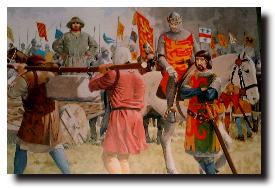
Edward I makes off with the Stone of Scone as booty of war.

To assert his primacy over Scotland and any future Scottish kings, Edward took the Stone of Scone from the Abby and took it with him to London where he incorporated it into the chair for the coronation of English kings.
That meant that the unfortunate John Balliol was the last King of Scotland crowned upon the historic stone.
After an interim without a monarch and rebellions against the English led by William Wallace, Robert the Bruce, grandson of John Balliol’s old rival, was able to claim the Crown after murdering his chief rival. After enthronement on the Stone for legitimacy, Robert led a succession of wars against the English and against his rivals in Scotland and with a firm ally in the French was finally able to have Scotland recognized as a completely independent Kingdom and in no wayu a vassal state of the English king.  This makes The Bruce the great national hero of the Scotts.
But alas, neither the heroic Bruce nor any of his successors including the Stewart and Stuart dynasties that originated with the Bruce’s grandson Robert II 1371 enjoyed the symbolic legitimacy of having been crowned on the Stone.
Under the Treaty of Northampton 1328 between the Kingdom of Scotland and the Kingdom of England, England agreed to return the captured Stone to Scotland. However, riotous crowds prevented it from being removed from Westminster Abbey.  Those rioters may, or may not have been encouraged by the Crown to circumvent the treaty it had just signed. 
When James VI of Scotland, son of Mary Queen of Scotts came to the English throne as James I of England, first to the Stuart Dynasty he did so on the Coronation Chair containing the Stone.  This united the two crowns while each nation remained, theoretically anyway, independent.  From that time onward—interrupted by the Cromwell’s Commonwealth--until the  the reign of Queen Anne united England and Scotland as a single sovereign state, the Kingdom of Great Britain 1707, monarchs of Scotland were again crowned on the Stone, but only because the simultaneously were enthroned as English Kings or Queens.
Since the ascent of the German House of Hanover with George I in 1714 British monarchs have been elevated on the Stone.  That includes the most recent and current occupant, Elizabeth II of the re-named House of Windsor in 1953.
In later years geologists examined the Stone that Edward captured and discovered that it was made of a variety of red sandstone quarried not far from Scone.  That meant one of two things—that the whole legend of Irish origin which gave it legitimacy was a fraud or that Edward had been fooled and a counterfeit stone was pawned off on him while the real stone was hidden by the Monks of Scone somewhere for safekeeping.
A firm belief by many Scotts in the second alternative has, over the centuries played out in very interesting ways.  A new legend arose in which when the Stone was found again, a new and legitimate king would be enthroned who would inaugurate not just the restoration of Scotland, but a grand pan-Gaelic empire uniting Ireland, Scotland, and Celtic regions on the English Border but perhaps Wales and even Britany in France.  It was sort of a Scottish version of the English return-of-the-king prophesies arising from the Arthurian legend.
Rumors of the Stone’s hiding place set off many a fruitless quest.  Many of those rumors centered on Macbeth’s castle at Dunsinane. 
For instance in 1818 The Chronicle in London printed this curious account:
On the 19th of November, as the servants belonging to the West Mains of Dunsinane-house, were employed in carrying away stones from the excavation made among the ruins that point out the site of Macbeth’s castle here, part of the ground they stood on suddenly gave way, and sank down about six feet, discovering a regularly built vault, about six feet long and four wide. None of the men being injured, curiosity induced them to clear out the subterranean recess, when they discovered among the ruins a large stone, weighing about 500 lb. which is pronounced to be of the meteoric or semi-metallic kind. This stone must have lain here during the long series of ages since Macbeth’s reign. Besides it were also found two round tablets, of a composition resembling bronze. On one of these two lines are engraved, which a gentleman has thus deciphered.— “The sconce (or shadow) of kingdom come, until Sylphs in air carry me again to Bethel.” These plates exhibit the figures of targets for the arms. From time immemorial it has been believed among us here, that unseen hands brought Jacob’s pillow from Bethel and dropped it on the site where the palace of Scoon now stands. A strong belief is also entertained by many in this part of the country that it was only a representation of this Jacob’s pillow that Edward sent to Westminster, the sacred stone not having been found by him. The curious here, aware of such traditions, and who have viewed these venerable remains of antiquity, agree that Macbeth may, or rather must, have deposited the stone in question at the bottom of his Castle, on the hill of Dunsinane (from the trouble of the times), where it has been found by the workmen.
This curious stone has been shipped for London for the inspection of the scientific amateur, in order to discover its real quality.
If such a stone was shipped to London, it has never been found.  But, trust me, someone is at this moment rummaging through basements and sewers searching for it.  Perhaps, even, it is the next quest of that eminent symbologist Robert Langdon. 
The Stone in Edward's Chair.
As a symbol of the Crown, the Coronation Chair and Stone has also been the target of political violence.  On  June 11, 1914, a lady’s handbag, containing a bomb, was hung on the back of the Chair in Westminster Abby. Exploding shortly after public viewing hours closed  at around 5:50 p.m. it blew off part of the carved work at the back of the chair. Although no individual was charged with carrying out the attack, Suffragettes were blamed because they were angry over the passage of the recent Cat and Mouse Act. That Act of Parliament officially known as the Prisoners (Temporary Discharge for Ill Health) Act 1913 which ordered Suffragettes in prison and staging hunger strikes to be released upon falling ill, but subject to re-arrest and imprisonment as soon as they recovered.  Police reports indicated that the damage to the Chair was minor, but made no mention of damage to the Stone.  

In 1950 the Stone became the center of a plot by romantic young Scottish nationalists which would make a hell of a good caper movie, perhaps with comic overtones.  On Christmas Day four students, Ian Hamilton, Gavin Vernon, Kay Matheson, and Alan Stuart somehow took the Stone from Westminster Abbey for return to Scotland and in the process managed to drop the heavy object breaking it into two pieces.  The largest piece was, I kid you not, buried at a Gypsy  camp site in Kent.  The exact hiding place of the second half has not been determined.  The four plotters returned to Scotland where at the University of Glasgow they recruited the assistance of a sympathetic English student, John Josselyn, ironically a lineal decedent of Edward I, to smuggle it across the border. 
A few days later the smaller piece was retrieved, but at a stop at Leeds, the young folk could not resist a little celebration—and libation taking the Stone to nearby Ilkley Moor, a wild and beautiful place fraught legendary significance where they serenaded it with the traditional Yorkshire folk song On Ilkla Moor Baht ‘at (On Ilkley Moor without your hat.)  This lighthearted bit of business disposed of, the small fragment was reunited with the other. The fragments were passed to a senior Glasgow politician who arranged for it to be professionally repaired by stonemason Robert Graytaken.
Despite a frantic hunt and the amateur status of the plotters, the British authorities were not able to find the Stone, although they must have known it was in Scotland somewhere.  On April 11, 1951 the stone was placed on the altar in the ruins of Arbroath Abbey where they believed the Church of Scotland would take protective care of it and not allow its return.  Of course as soon as authorities got wind of it, they swooped in and seized the stone, returning it to London in plenty of time for Queen Elizabeth’s investiture two years later.
Of course some claim the students only left a replica, fooling the English once again, and that the stone from Edward’s chair, which if you remember itself may have been a phony, lays securely in hiding.  
The whole thing resembles a giant historical shell game—stone, stone, who’s got the stone.
As for the students, their identity was veiled but when reveled were not prosecuted.  Some went on to distinguished careers.  Ian Hamilton became a lawyer and a leader of the Scottish Nationalist Party.  He authored an account of the caper in a bestselling book, The Taking of the Stone of Destiny on which a 2008 movie Stone of Destiny was indeed made and in which Hamilton appeared in a cameo.
Meanwhile Scottish restlessness has continued, even risen, even after the establishment of a Scottish National Parliament in 1998.  This year on September 18, 2014 Scotts will vote in a referendum on independence.  The question will be simply put—“Should Scotland be an independent country?”  Polling indicates it will be a close election that could go either way.  Even if the referendum passes,  long negotiations would lie ahead over the myriad of details required by the separation. 
Most Scottish nationalists are fervent republicans although there are some monarchists who still support a Stuart restoration.  The current Stuart Pretender is Franz, Duke of Bavaria, a lineal descendent of Charles I and styled Francis II by unreconstructed Jacobites.  It is hard to imagine a scenario where he would be crowned King of the Scotts on Stone of Scone.
But it is an open question if Prince Charles may ever sit over it and assume either a united crown, or an English one.


Wednesday, July 2, 2014

The Return of High Summer


I arrived yesterday morning at my day job in Woodstock, Illinois to find my basement office in a 114 year-old house flooded with two inches of water from the heavy thunderstorms that moved through the area last night.  Those came a day after another round of violent storms, which included a funnel cloud which dipped from the sky around 2 am Monday morning directly over my head as I worked by week-end overnight shift at a gas station/convenience store at the corner of Route 176 and Route 14 in Crystal Lake.
But despite the mess which will take a couple of days to get moderately dried out and which will leave me fighting mold and mildew in the sodden carpets with fans and a dehumidifier running overtime, my mood could not be soured.
You see, I got off my Pace Bus on a pristinely beautiful sun drench morning right in front of the display of day lilies and other flowers on the corner lot of a stately old Victorian home with an inviting wrap-around porch.  The house and yard are right across the street from the old Congregational Unitarian Church building—my religious home for more than 20 years.  That fine old building is now the Blue Lotus Buddhist Temple and a large, golden Buddha now squats atop the old monument sign at the corner, his beneficent gaze seeming to take in the beauty across the street.  In fact the day lilies nearly match his robes.
The spectacular garden has been lifting my mid-summer spirits ever since I began my commute to this day job just two short blocks away back in 2006.  Of course I had noticed them for years before, but the daily, up-close splendor as I stepped from my bus has become a welcome annual spiritual experience—and one which can, in good weather, last a month or so even when the weather turns blistering hot and oppressive.
Back in 2008 those day lilies inspired this short poem which first appeared in the relatively early days of this Blog when it was on LiveJournal and read by as many people as could be crowded into Volkswagen Bug.  Chances are you didn’t see it then, or even when I reposted it in 2010.
Please share my joy today.

 High Summer

The day lilies—
you know the ones,
crowding corner patch            
across from the Church,
leaning into the morning sun,
yearning nestlings,
orange maws wide,
insisting on that next fat worm.


 --Patrick Murfin

Tuesday, July 1, 2014

On-to-Ottawa Trek—Relief Camp Strikers Never Made it to the Capital

f
After a protest rally was ambushed by the RCMP in Regina, relief camp strikers and supporters fought a rolling street battle with authorities in 1935.


It was 1935, the midst of the Great Depression.  Times were hard in Canada, maybe even harder than in the big neighbor to the south.  Down in the States Franklin D. Roosevelt was rolling out the New Deal and practical programs to help the huge army of the unemployed, not the least of which was the hugely popular and successful Civilian Conservation Corps (CCC).  But the Dominion was firmly in the hands of the Conservative Party led by Prime Minister R. B. Bennett, ideological devotees of  Laissez-faire capitalism, allies of the big banks, and openly hostile to the unemployed who were considered shiftless and lazy.  In their view assistance to out of work Canadians would be a “disincentive” for them to take work at any level of pay or conditions.  In other words, Canada was run by the beau ideals of the modern American Tea Party.
The results of this policy were predictable, not only unemployment, but wide spread desperation.  Under severe pressure some relief, miserly as it was, was extended by the Federal government to “responsible families.”  But huge numbers of single men—the Depression caused marriage rates to plummet across the country—were considered leaches if they took any assistance and a potential danger to civilized society.  Bennett hit on a solution.  If unemployed single men wanted to eat, they had damn well best work for their keep.  He required—virtually drafted them—to go to work in remote labor camps in the far west to do hard physical on infrastructure construction projects—for 20 cents a day, board and bed.  The camps were organized by the Department of National Defence and run by Army officers and non-coms, many of the martinets
On the surface this program might seem like a Canadian version of the CCC.  But there were huge differences between the programs all stemming from two quite different premises—the Canadian camps were meant to be punitive and an incentive to get off the dole.  Therefore not only was the miniscule, food was limited, strictly rationed, and often of appalling quality.  Accommodations were in tents and huts.  Little attention was paid to sanitation and no provision made for the men’s “idle hours.”  For Bennett a bonus was that his 20 cents a day virtual slave laborers replaced “greedy” construction workers, many of them unionized.
By contrast, although the CCC was partially considered a safety valve to get potentially volatile young men out of the cities and the way of possible crime and mischief, it was also conceived as a way of building them up.  The camps were clean and well-constructed, food not only ample but generous and wholesome, mild military style discipline maintained order in the camps, clean high quality work clothing and uniforms were provided, and hours of labor were limited to eight a day.  Pay was adequate enough, considering that all living expenses were paid by the CCC, that workers sent home 50% of their earnings to help their families, or if they had no families half the pay was held for them until their end of service giving them a nice nest-egg.  Recreational programs were available for the off hours.  Although many conservation construction projects were undertaken around the country, CCC workers were not to be used instead of regular labor on other construction projects.
As a result, moral in the CCC camps was high.  Young men—and eventually some young women—emerged from the experience generally healthier than when they went in, often having developed useful skills and leadership experience, as well as confidence.  Former CCC workers were so highly thought of that they had far less trouble than others finding work even as the Depression dragged on.
By contrast moral in the Canadian camps was abysmal.  Anger and resentment grew with each day of mistreatment and forced separation from families and loved ones.  Protests, even minor riots, broke out in some of the camps.   Not surprisingly conditions gave rise to the Relief Camp Workers’ Union. 
The Bennett government would later blame Communist outside agitators for the creation and leadership of the union.  And there were Communists involved, openly and unapologetically.  But many activists were veterans of the One Big Union (OBU), a Canadian version of the Industrial Workers of the World (IWW) which had been active on big western construction projects and in the timber industry.  Most of the leadership of the union, however came from rank and file members with no previous political or radical connections.
The fledgling  union declared a strike in the camps  on April 4, 1935.  Demands included the provision of adequate first aid equipment in the camps, the extension of the Workmen’s Compensation Act to include incurred camp workers, and that workers in camps be granted the right to vote in federal elections.  They also demanded the repeal of the infamous Section 98 of the Criminal Code of Canada which had been enacted after the Winnipeg General Strike of 1919 to suppress the Communist Party, which had played a role in the post-World War I action and the OBU which was not involved in that strike but which was mushrooming in membership across western Canada at the expense of union affiliated with the American Federation of Labor (AFL) and the Canadian Trade Unions Conference (TUC).  In 1931 the act was used against several leaders of the Communist Party who were subsequently convicted under the law for  and sentenced for up to five year prison terms.  The law defined the offence thusly:
Any association...whose professed purpose...is to bring about any governmental, industrial or economic change within Canada by use of force, violence or physical injury to person or property, or by threats of such injury, or which teaches, advocates, advises or defends the use of force, violence, terrorism, or physical injury to person or property...in order to accomplish such change, or for any other such purpose..., or which shall by any means prosecute or pursue such purpose...or shall so teach, advocate, advise or defend, shall be an unlawful association.
Since those arrests social liberals, the union movement, and the otherwise widely fractured Canadian left had united in a campaign to repeal the law as fundamentally undemocratic.  The campaign gained the support of the opposition Liberal Party and a majority of Canadian citizens as measured by public opinion polls.  But the government would charge that inclusion of repeal among the strikers’ demands was evidence that the Relief Camp Workers’ Union was a Communist creation with insurrectionary intent.
Knowing that they could not gain critical public support in strike actions at remote and scattered camps, more than 1,500 camp works descended on the British Columbia capital of Vancouver, the principle city on the west coast to press their demands.  The workers set up camps in the city and began a round of daily protests, marches, and public rallies.  They did draw the support of many of the city’s workers and of much of the middle class including small business owners who felt squeezed by the Depressions, the Federal Government’s hands off policy, and the growing power of the Banks and major corporations.  Citizens provided food and supplies to the encampment, mingled freely with the strikers and often joined their demonstrations.
Despite the support in Vancouver, only the Federal Government could respond to the strikers’ demands and the Bennett Government steadfastly refused to have any communication with the strikers or their representatives.  After two months in Vancouver, strikers voted to take their demands to the Canadian capital in an On-to-Ottawa Trek.  In the mode of Kelly’s Army, a western contingent of Coxey’s Army that set out for Washington, D.C. from Oakland in 1893 onboard railway boxcars on commandeered trains, hundreds of men boarded freight cars headed east on June 3.  Once again, on their way they were greeted as heroes and provided food by locals in the towns through which they passed.
On June 14 the strikers arrived at Regina, Saskatchewan  where they made their first contact with the now alarmed Federal Government.  At a meeting between strike leaders including  Arthur “Slim” Evans and Minister of Railways and Canals R. B. Bennett and Minister of Agriculture Robert Weir an agreement was hammered out that a delegation of strikers could proceed to Ottawa to meet with Bennett while the Trekers were put up at the Regina Exhibition Grounds.
Slim Evans was a veteran Toronto born unionist who had joined the IWW in Minneapolis in 1911.  Two years later he arrived in Colorado to support the epic Coal Strike of 1913 and was shot during  the Ludlow Massacre just two days after arriving.  He walked with a limp from his wounds the rest of his life.  Returning to Canada, he organized coal miners and rose to leadership in the OBU as the leader of the local of coal miners in Drumheller, Alberta, where he was sentenced to a three-year prison term for leading a strike. He joined the Communist Party after 1921.  In ’33 he was arrested again for leading a coal strike and sentenced to 18 more months in prison under Section 98.
The meeting with Prime Minister Bennett did not go well, to say the least.  As soon as the union delegation was ushered into his presence and without any preliminaries, Bennett launched in to a shouting rant accusing them of being radicals, Communists and Evans an extortionist.  Evans bellowed back that the Prime Minister was a liar, probably interlaced with other more colorful descriptions of his character. Within minutes the meeting was over and the delegation was hustled out of Bennett’s offices and unceremoniously pushed out into the street where their humiliation was captured by the press.  Bennett himself soon strutted before the press bragging about his tough, no-nonsense approach and vowing never to concede a single point to the strikers.
The furious leaders returned to Regina where at a meeting on June 26 the Trekers vowed to resume their journey. 
Regina was the home of one of western Canada’s largest barracks of the Royal Canadian Mounted Police (RCMP) and Bennett ordered more troopers from around the Prairie Provinces to join them.  Along with local police they effectively blockaded the rail yards preventing the Trekers from resuming their journey by box car.  Attempt to depart the city in convoys of automobiles and trucks was met by armed blockades.
As anger and frustration grew on the Exhibition grounds, so did it in the city of Regina itself where support for the strikers only seemed to grow with government intransigence on one hand and a growing resentment, stoked by the newspapers, of the burden of supporting the “shiftless radicals” among the wealthier citizens and Conservative Party diehards.
While most of the Trekers stayed in their camp, on July 1, 1932 about three hundred of their number came into the city center for a public rally of support.  They were joined by hundreds more local residents including local unionists, socialists, Liberal Party members and even whole families.  The meeting gathered at Market Square in Germantown and about 1,500 people were in attendance listening to speeches delivered from the back of a truck.
As the crowd gathered a large force of the RCMP infiltrated the area surrounding the square carefully shielding their movements.  Regina police were hidden in a near-by garage.  At 8:17 pm as Slim Evans and George Black were on the platform, a whistle blew and police charged the crowd from all sides.  Evans and Black where whisked from the platform by plain clothes detectives stationed nearby. 
The unexpected baton charge left many of the crowd injured but quickly cleared the square.  But anger soon overcame fear as strikers and supporters regrouped and began to fight back.  Melees continued all around the city center for hours along with bloody street fighting involving clubs, bricks, and sometimes knives.  Police used their revolvers freely and lobbed tear gas grenades.  The now enraged mob dodged police, fought them when they had to, and began rampaging, overturning cars and shattering the windows of shops and storefronts.  There were some cases of arson.
When word reached the Exhibition Grounds, the remaining strikers tried to march to the relief of their comrades, but they found themselves surrounded by heavily armed RCMP troopers and unable to move.  By the next morning up barbed wire stockade around the grounds was erected turning it into an instant prison.  All of the men inside were eventually charged under Section 98.
As fighting in the city slowly died down, scores of the injured arrived at local hospitals where strikers and suspected demonstrators—even ordinary citizens who had just been caught up in the confusion—were all arrested and charged.  Hospital records were later confiscated and destroyed so that no evidence of the number of the wounded remained.  Or that of the dead whose bodies were taken and secretly disposed of.
The night of June 2 a Treker somehow managed to get to a telephone and place a call to Liberal Party Saskatchewan Primer James “Jimmy” Gardner begging for his intersession on behalf of the besieged Trekkers.  He agreed to meet a delegation the next morning.  The outraged RCMP arrested the appointed delegates as they tried to leave the grounds and held them for hours under rough interrogation before they were finally released to their meetings.
In response to the conversation Gardner sent a much publicized wire to Bennett accusing to police of “precipitating the riot” while he had actively been negotiating with the Trekers.  He outlined a plan to feed the men at Provincial expense while plans were made to send the Trekers back to either the camps or their home towns also at Provincial expense.  The broad outline of this proposal was eventually put into effect and most of the rank and file members dispersed within a few weeks, their union shattered.
Wire services spread reports of the violence quickly across the country.  Despite generally supportive of the police, accounts made it clear that the riot had been precipitated by an unprovoked police report. 
The official RCMP report of the “riot” reported that they had been fired upon first from the crowd at the rally and city police had returned fire.  It reported only two confirmed deaths, Charles Millar, a plainclothes policeman and Treker Nick Shaack who died of his wounds several days later in the hospital.  They listed a ridiculously low 30 injuries on all sides and 130 arrests on the streets.  
The trials of Evans and other alleged “ring leaders” dragged on.  But no evidence was ever shown supporting government claims that they had been fired upon or even that any striker or demonstrator had ever used a fire arm in the riots that followed.  The men were eventually released as the new government declined to continue prosecutions.
Bennett declared to the press that the On-to-Ottawa Trek was “not a mere uprising against law and order but a definite revolutionary effort on the part of a group of men to usurp authority and destroy government.”  He called the crushing of that uprising his finest hour of public service.
The disgusted voters did not think so.  In the October Federal elections later that year the Conservative Party lost its huge majority in Parliament falling from 134 seats to just 39.  The Tories would be frozen out of power until 1957.  Bennett was replaced as Prime Minister by Liberal William Mackenzie King who pointedly brought on Gardner as his Minister of Agriculture. 
Mackenzie followed a policy of moderate social reform, far short of the American New Deal, but a vast improvement of Bennett.  His government sponsored the repeal of Section 98.  The Federal Work camps were abolished and replaced by a system of Provincial camps where wages were at least moderately better and conditions vastly improved.
As for Bennett, he was so humiliated and outraged at his rejection, that he abandoned Canada altogether.  He moved to Britain in 1938 and was created a Vice Count and member of the House of Lords in 1941.  He died in 1947 and was buried in St. Michael’s Churchyard in Mickleham, Surrey.  He remains the only former Canadian Prime Minister not interred in Canada.
For his part Slim Evans continued a career as a union militant.  He organized a local of a Canadian section of the International Union of Mine Mill and Smelt Workers (CIO), formerly the old radical Western Federation of Miners.  He led fundraising for relief for the surviving Spanish Civil War veterans  of the Mackenzie-Papineau Battalion.  He died after being struck by a car in 1944 while serving as a shop steward on his job at the Vancouver Shipyards at the age of 53.
The prestige reputation of the RCMP was severely damaged and did not recover until the mid-50’s when a campaign in support of Canadian identity and nationhood picked the red-coated police as a national symbol.  The Communist Party, on the other hand, saw a surge of popularity although with or without Section 98 it long remained a targets of police action, spying, and disruptive dirty tricks. 
In the end those work camp strikers and  On-to-Ottawa Trekers may have lost a battle but won a war.