Friday, December 30, 2016

Only Putin Sings Happy Birthday to the USSR

The Soviet Union in 1924 after the foundational dust settled.


Nobody is nostalgic for the Soviet Union, except Vladimir Putin.  Make that especially Vladimir Putin who began his career as a KGB agent.  He seems hell bent on reasserting Russian dominance or outright control over the Republics and regions that broke away after dissolution of the USSR in 1991.  He also seems to be eager to ramp up the Cold War and nuclear arms race that everyone else in the world was glad was over.  He licks his chops at the stooge/idiot he helped get elected to the U.S. Presidency confident that he can run circles around the clueless dope.
Today is the birthday of the late, almost universally unlamented Union of Soviet Socialist Republics.  On December 30, 1922 a conference of plenipotentiary delegations from the Russian Socialist Federative Soviet Republic (SFSR), the Transcaucasian SFSR, the Ukrainian Soviet Socialist Republic (SSR) and the Byelorussian SSR approved a Treaty of Creation of the USSR and the Declaration of the Creation of the USSR.

The seal of the Soviet Union.
The long running Russian Civil War which had erupted in 1917 following the successful Bolshevik Revolution was reduced to mopping up operations in central Asia and virtually over.  The White Armies of Wrangle and others were smashed by the Red Army under Leon Trotsky.  Trotsky then turned his attention on former allies in the Ukraine—the Anarchist Black Army under Nestor Makhno.  After defeating the anarchists in the field, Trotsky secured his hold on the Ukraine with a campaign of mass extermination of its peasant supporters.

Peasants everywhere were protesting the War Communism that expropriated their crops.  When the Sailors of Kronstadt, once hailed as the heroes of the Revolution in 1917, rebelled in support of the peasants in March of 1921, Trotsky sent the Red Army over the ice of the Gulf of Finland to ruthlessly smash the mutineers.  Since then the Red Army had been very efficient in repressing localized peasant uprisings in Tambov, and Siberia.
Under Leon Trotsky (center in light uniform) the Red Army had finally secured  control after years of civil war and peasant uprisings make the establishment of the USSR possible.  Seen hear at a military victory parade in Moscow with senior Red Army soldiers and Bolshevik leaders.  Soon the ambitious man at the far right of the picture, Joseph Stalin, would succeed Lenin and Trotsky would be in exile with a price on his head.  Almost everyone else in the picture would be executed after Stalinist purge trials of the Old Bolsheviks
A war with Poland ended after the Poles defeated the Red Army in the Battle of Warsaw in August of 1920 and the Poles threatened to overwhelm the main units of the southern Red Army, the Soviets sued for peace and both exhausted nations agreed on a boundary splitting the disputed territory in the 1921 Treaty of Riga.
The Western Powers including the United States and Britain had largely withdrawn their intervening forces in the Russian Far East by the end of 1919.  Only the Japanese, who had territorial ambitions, remained after the fall of Vladivostok in October 1922.
So in late 1922 Soviet Russia and its allied states were militarily secure at last.  But they were in deep economic crisis.  Years of war had everywhere destroyed the economy.  Industrial production was only a fifth of what it had been before the October Revolution.  Where actual combat and the mass murder of peasants had not disrupted agricultural production, wide-spread refusal to plant as long as crops were subject to confiscation and two years of drought in much of the most fertile agricultural lands had reduced the countries to near famine.

Lenin in 1922.  When not ruthlessly consolidating power, the Bolshevik leader liked to play with his cats.
Vladimir Ilytch Lenin, Chairman of the Council of People’s Commissars of the Russian SFSR and leader of the Bolshevik Party moved to consolidate the military successes and essentially re-create much of the Russian Empire as a new federation of Soviet states.  Initially the non-Russian partners in the new USSR gained guarantees to be able to keep ethnic and national identities without forced Russification and the component states had a measure of governmental autonomy within the strictures of an avowedly Marxist state. 
The creation of a new country, and a new government with himself at its head as supreme authority gave Lenin the chance to placate peasant opposition with his New Economic Policy (NEP).  This plan had the Soviet State concentrate on the socialization and direction of heavy and basic industry.  Peasants would be allowed to sell their surplus on the open market.  Small business, craftsmen, and some non-essential industrial production would also be market driven. 
This plan did help turn around the shattered economy of the new Soviet Union.  But it also meant an ideological break with Trotsky, an advocate of continuing war communism, and the man whose military success made possible the creation of the new country.  The break was not total or immediate, but after Lenin died in 1924, Joseph Stalin, not Trotsky, succeeded as Party head and state leader.  Trotsky was soon in exile in Mexico with a price on his head.
Stalin, an ethnic Georgian, ironically, took greater central control of the various Socialist Republics and returned to the Czarist practice of Russification.  By the mid 1930’s he had purged all of the Old Bolsheviks and transformed what Lenin had envisioned as a quasi-democratic socialist state (via functioning Soviets, not political parties) into a one man dictatorship. 
You probably know the rest of the story.


Thursday, December 29, 2016

Kwanzaa Lights—Cultural Pride and the Controversy

A home altar shown on the official Kwanzaa web site.


This year represents the 50th anniversary of the foundational call for the celebration of Kwanzaa.  It was created in 1966 during the blossoming of a period of Black Nationalism by Maulana Karenga, a Black studies scholar and a leading Los Angeles militant. 
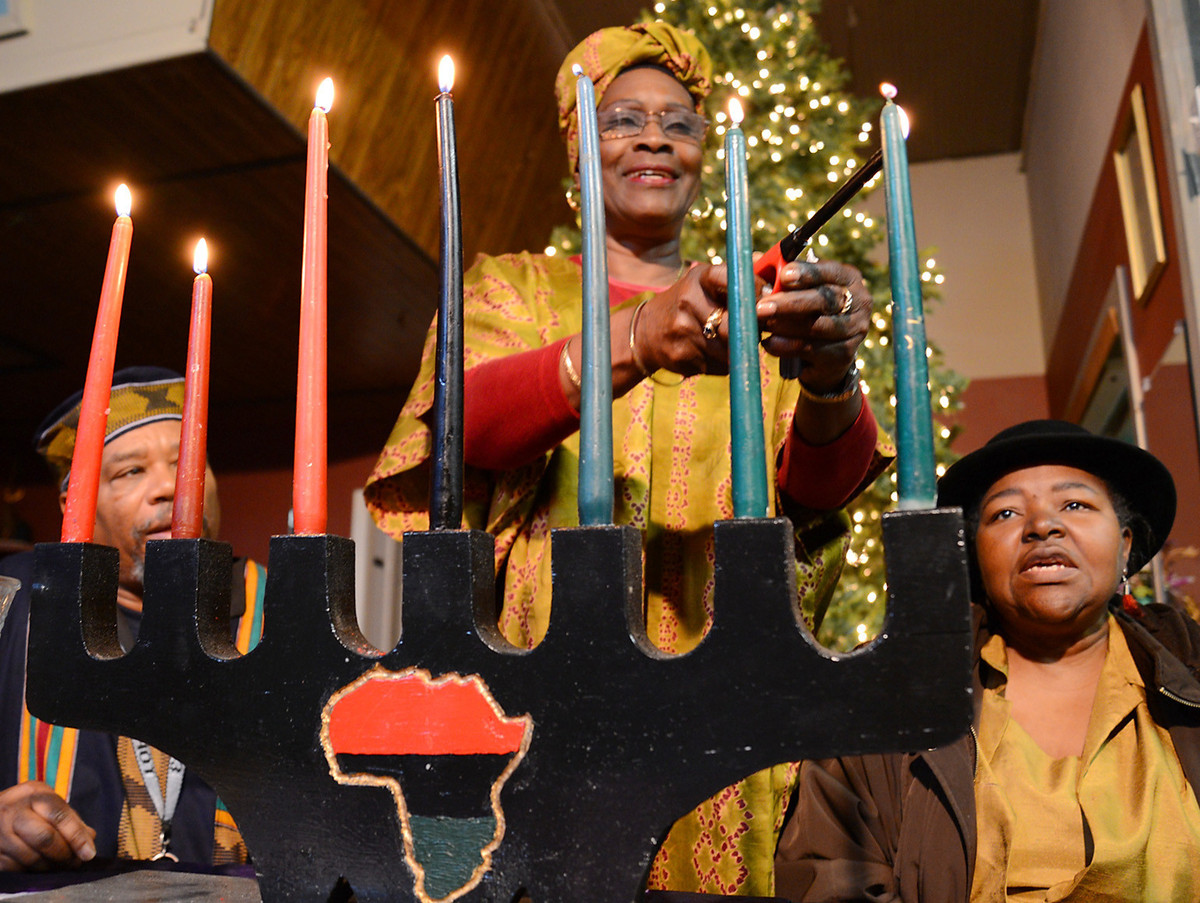
Today we are about half way through the African-American cultural celebration.  Beginning on December 26 and running through January 1, candles are lit representing values.  Each of the values is given a Swahili name.  Today, day 4 is Nia or Purpose “to make our collective vocation the building and developing of our community in order to restore our people to their traditional greatness.”
Karenga was born Ron Everett  in Parsonsburg, Maryland on July 14,1941 into the very large family—14 children of a sharecropper and Baptist preacher, he came to Los Angeles in 1959 where he studied at Los Angeles City College (LACC) and the University of Southern California (UCLA).  As an undergraduate he was active in the Congress of Racial Equality (CORE) and the Student Non-violent Coordinating Committee (SNICC) and was the first Black President of the Student Body.
It was during this period he took the title Maulana, Swahili-Arabic for master teacher and the name Karenga, Swahili for keeper of tradition.
After the Watts Riots of 1965 the young graduate student was influenced by Malcom X in developing African-American Unity, cultural pride, and a separatist militancy.  He was involved in many activities and organizations and was regarded as a rising intellectual leader.

Maulana Karenga speaking to a Malcolm X birthday rally in Los Angeles in 1966, the year of the Kwanzaa proclamation


Kwanzaa was designed in instill those values in a community he feared was still too dominated by “alien” and white ideology and religion.  It was to “give Blacks an alternative to the existing holiday and give Blacks an opportunity to celebrate themselves and their history, rather than simply imitate the practice of the dominant society.” The name is derived from the Swahili for first fruit celebration, matunda ya kwanza.
Karenga used Swahili as the ritual language of its operations because it is a pan-African language, the most widely spoken of Sub-Saharan African tongues.  But it is an East African language as are the customs on which the celebration was based.  The vast majority of African-Americans trace their lineage to the trans-Atlantic slave trade and West Africa, very culturally and linguistically distinct from the east.  Critics in the Black community charged that he could have taken inspiration from instead from the West African empires and kingdoms.  But Karenga was a student of Swahili and the east, and not of the slave trade or origins of his own people.
The celebration, centered around lighting candles in the home over seven days, obviously is borrowed from Jewish Chanukah traditions, but Karenga has barely acknowledged that obvious parallel.
Karenga at first frankly hoped that his new celebration would supplant Christmas and New Years, both in his opinion instruments of White oppression.  But the deep connection of the Black community to the Church and to its celebrations stood in the way of the spread of his new observance.  Also, his allies in nationalism among Muslims, both followers of Malcom X’s traditional Islam and the Nation of Islamthe Black Muslims—also objected to Karenga’s non-theism and hostility to religion.
After 1970 Karenga changed his tune and now emphasizes that it is a secular observation that does not conflict with or contradict religious celebrations.  “Kwanzaa was not created to give people an alternative to their own religion or religious holiday,” he wrote in 1994.
With that adaptation, Kwanzaa began to spread rapidly.  It was easy for families to adopt for private observation.  Most of those families also have a Christmas tree in the corner.  Public observations came to include many at major Black Churches.

Kwanzaa is now celebrated in many Black churches.

Candles are lit every night for the seven values.  Materials are available for study and reflection.  Songs and poems have been written.  The values are:
·         Umoja (Unity): To strive for and to maintain unity in the family, community, nation, and race.
·         Kujichagulia (Self-Determination): To define ourselves, name ourselves, create for ourselves, and speak for ourselves.
·         Ujima (Collective Work and Responsibility): To build and maintain our community together and make our brothers’ and sisters’ problems our problems, and to solve them together.
·         Ujamaa (Cooperative Economics): To build and maintain our own stores, shops, and other businesses and to profit from them together.
·         Nia (Purpose): To make our collective vocation the building and developing of our community in order to restore our people to their traditional greatness.
·         Kuumba (Creativity): To do always as much as we can, in the way we can, in order to leave our community more beautiful and beneficial than we inherited it.
·         Imani (Faith): To believe with all our hearts in our people, our parents, our teachers, our leaders, and the righteousness and victory of our struggle.
The final night concludes with a feast and gift giving.
The spread of the observance was aided, ironically, in no small part to the attention given it in the mainstream, white dominated media, especially local television news coverage in major urban centers.  The attention always made the celebration seem much more pervasive than it ever was.
Despite claims to tens of millions of participants across the globe made every year by Karenga on his official Kwanzaa web site, at its heights in the mid-70’s it was actively observed by a small fraction of the Black community.  Exact figures are hard to come by and wildly exaggerated claims are made not only Karenga, but by sympathetic scholars.  With the decline of Black Nationalism as a movement and the founder’s many troubles—more on that in a bit—participation has declined and leveled off.  Estimates range from 12 to as low as 2 million participants in the first decade of the 21st Century.  Market research by the National Retail Foundation in 2004 found that 1.6% of those surveyed planned to celebrate Kwanzaa. Generalized to the US population as a whole, that would mean that around 4.7 million people planned to celebrate Kwanzaa in that year.

The predominately White Unitarian Universalist Church of Norwich in Connecticut celebrated a Kwanzaa service last year opening with a Kujichagulia kick-off drum circle.  Celebrations by Whites is controversial and often meets charges of cultural appropriation.
And some of them would be White.  Introduction of Kwanzaa into school curricula as part of the general holiday observances has brought it to many White children.  In my own, overwhelmingly White faith tradition, Unitarian Universalism, which embraces diversity and often poaches traditions, Kwanzaa is often integrated with other winter holiday celebrations.
A lot of other White folk, however, turn purple in the face every time they hear about Kwanzaa.  For them it is an affront, and more than that a direct threat.  Black Nationalism and cultural pride evokes for them all of the old nightmares of slave rebellions and rampaging Mau Maus.  It is also confabulated with the alleged war on Christmas by a shadowy Commie/liberal/Black conspiracy.  Every year the Right Wing talking heads froth at the mouth over the observation.  Which probably delights Karenga who remains a separatist at heart.
As he promoted the holiday, Karenga also got involved in one of the nastiest and most violent of feuds within the Black militant community.  The group that he founded in 1965 and led—US \ Organization—became a rival of the emerging Black Panther Party for leadership of the nationalist movement on the West Coast.  Egged on by an FBI COINTELPRO dis-information program, members of the two groups engaged in a gun fight on the UCLA campus in 1969 resulting in the death of two Panthers and the wounding of on US member.  Retaliatory shootings occurred across the country from months resulting in two more deaths and the delight of J. Edgar Hoover.

Maulana Karenga awaiting sentencing on kidnapping charges.


The Panther Party had better press and more adherents.  Its members and supporters naturally withdrew from any Kwanzaa celebrations.
But the worst was yet to come.  In 1971 Karenga was convicted of kidnapping and sexually torturing Deborah Jones and Gail Davis.  Karenga’s estranged wife, Brenda Lorraine Karenga, testified that she had participated in the abuse.  Karenga claimed that the women were plotting against him and were part of the COINTELPRO harassment.  He denied claims of abuse.
He was sentenced to ten years in prison and held at the California Men’s Colony until he was released with the support of high profile Black state politicians and office holders.  While he was in prison US fell apart and the reputation of Kwanzaa was damaged.  Karenga seldom speaks about the conviction, except to note that he was once a political prisoner.  The episode is left out of his auto-biography and on the Kwanzaa web page.

Dr. Karenga greets admirers at an event celebrating the First Day of Issuance ceremony for the U.S. Postal Service's first-ever Kwanzaa stamp in 1997.
Upon being released, Karenga tried unsuccessfully to resurrect US, and then devoted himself to an organization promoting Kwanzaa.  He finished one PhD. at United States International University (now Alliant International University) and a second at UCLA.  He is now the Chair of the Africana Studies Department at California State University, Long Beach, the Director of the Kawaida Institute for Pan African Studies, and the author of several books.
Despite its ups and downs, Kwanzaa remains meaningful and is an inspiration for many in the Black Community.  And there is nothing wrong with that.